
[Courtesy of KT]
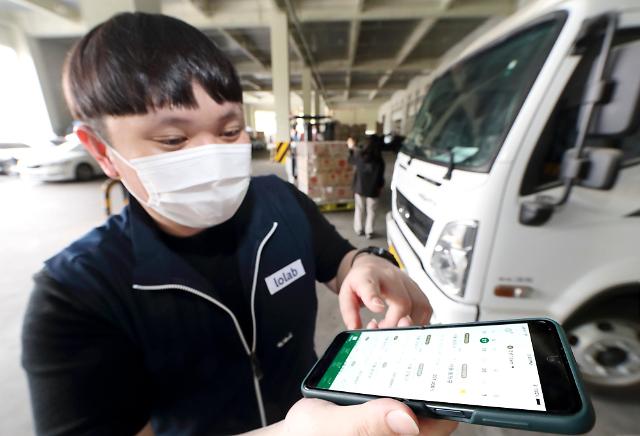
lolab said that the company released a freight brokering service platform called "Brokarry" to help customers find matching logistics services for a low fee. The platform matches drivers when users register their cargo information. It calculates logistics costs based on travel distances, vehicle models, and destination areas. The service will consistently match cargo owners and drivers to minimize the time truck owners spend driving empty vehicles. Drivers will be paid a day after the service.
"Although the logistics market is growing rapidly, most logistics workers suffer from high cost and low efficiency due to analog methods. Such a situation led us to think that digital transformation was urgent," lolab CEO Choi Kang-rim said in a statement on May 9.
"Yongdal" is one of the most well-known freight brokering services in South Korea. When users post their photos of cargo on Yongdal websites, service managers find the best-matching vehicle. Users are required to pay logistics costs of more than 50,000 won and additional costs depending on the size and weight of the cargo. The service is also frequently used by business operators moving to a new office or young people moving from a single-room apartment to another.
Copyright ⓒ Aju Press All rights reserved.
Related News
-
 Samsung Electronics Accelerates Digital Transformation in Vietnamese Manufacturing
Samsung Electronics is showing improvements in production efficiency through its smart factory support program aimed at local manufacturing companies in Vietnam. Companies receiving technical and operational consulting from Samsung have been accelerating their digital transformation by shortening production times and integrating process data, thereby expanding their participation in the global supply chain. According to local media outlet Tien Phong on November 19, Samsung Vietnam has supported improvements in the production management systems of local companies through the '2026 Smart Factory Development Support Project' in collaboration with the Ministry of Industry and Trade of Vietnam. This year, a total of 14 companies completed the program, with Viet Uc Plastic Mechanical, located in Dong Nai Province, highlighted as a key success story. Production Time Reduced from 5 Days to 3 Days... Smart Factory Level Increased from 1.0 to 2.5 Viet Uc Plastic Mechanical improved its production processes and data management systems with Samsung's support. Previously, employees had to call multiple departments to check the production status for each order, but after integrating the system, the sales department and management can now remotely monitor production status. Nguyen Duc Hoang Jui, chairman of Viet Uc Plastic Mechanical, explained that after consulting with Samsung experts, the production time was reduced from the previous 4-5 days to 3 days. The time spent on paperwork and data retrieval has decreased, streamlining the order processing. Chairman Jui noted that before pursuing digital transformation, it was challenging to determine the scale of investment and the order of implementation. However, with Samsung experts conducting on-site diagnostics to analyze the company's strengths and areas for improvement, they were able to clarify the business direction and develop a phased implementation plan for the software to be introduced. During the smart factory construction process, employees' technical capabilities have also improved. Samsung experts provided training that went beyond simply automating production equipment, teaching how to connect equipment and processes to a central system and quickly collect and manage data. As a result, internal personnel have gained the ability to perform tasks such as data analysis, process standardization, and risk management. Tran Thi Chang, head of the integrated systems management department at Viet Uc Plastic Mechanical, stated, "What we are most proud of is not just the system we built, but that Viet Uc employees have gained the confidence to develop technology and operate it themselves." In fact, evaluations from Samsung experts indicated that the smart factory level of Viet Uc Plastic Mechanical increased from the previous 1.0 to 2.5. Samsung applied a five-level evaluation system, and the company plans to enhance its smart factory operational capabilities to level 3.0 and eventually to level 4.0. Chairman Jui remarked, "After completing the project, Viet Uc clearly understands the direction it needs to take to establish a smart factory," adding that the support from Samsung experts has instilled confidence in employees to continue tackling the remaining challenges. Support for 96 Vietnamese Companies... Expanding the Foundation for Global Supply Chain Entry Samsung's smart factory support program is expanding across the Vietnamese manufacturing sector. Since 2022, Samsung has been operating a smart factory development project in collaboration with the Ministry of Industry and Trade to enhance the production capabilities and management levels of local industrial companies. To date, Samsung has completed smart factory construction consulting for 96 Vietnamese companies and trained over 240 experts in related fields. This year, 14 companies, including Viet Uc Plastic Mechanical, completed the program. Samsung emphasizes not only the introduction of equipment or software in this initiative but also training local employees to manage and improve the systems themselves. This approach helps build internal technical operational capabilities so that productivity and quality can continue to improve even after external expert support ends. Cha Ji-ho, head of Samsung Vietnam's purchasing center, stated, "The key goal of the smart factory model is to support local personnel in operating the systems directly and identifying and resolving issues more quickly," emphasizing the importance of developing into an organization that can continuously pursue self-improvement. Samsung believes that activities to enhance the technological and quality management capabilities of local companies will also help expand opportunities for participation in the global supply chain for Vietnamese manufacturing. In particular, the plan is to strengthen Vietnam's industrial ecosystem through the sharing of technology and management know-how between foreign direct investment (FDI) companies and local manufacturers. Head Cha emphasized, "Samsung Vietnam believes that a strong supporting industrial ecosystem is formed based on trust, cooperation, and mutual development," adding that as Vietnamese companies improve their management capabilities, technology, and quality, they will enhance their competitiveness and secure deeper opportunities for participation in the global supply chain.* This article has been translated by AI.
-
Hyundai Engineering Enhances AI-Based Quality Management System to Accelerate Digital Transformation
Hyundai Engineering is accelerating the digital transformation of construction sites by enhancing its smart quality management system utilizing artificial intelligence (AI) and big data. The company plans to integrate the entire quality management process—from concrete pouring to curing and crack management—into a single system to improve construction quality and operational efficiency.On November 5, Hyundai Engineering announced that it will expand the capabilities of its self-developed smart integrated inspection system, Q-Pocket, to cover all areas of quality management. The system will enhance collaboration features, allowing stakeholders such as clients, supervisors, contractors, and partners to share relevant information in real time.Q-Pocket, a mobile and web-based quality management system developed by Hyundai Engineering in 2021, enables digital handling of on-site quality management tasks, including inspection and testing planning, material inspection, and concrete crack management.Notably, if defects are discovered during construction, reports can be generated immediately on-site, linking verification and corrective actions with partners. Hyundai Engineering has patented this technology, establishing a non-contact, paperless quality management system.The core of this system enhancement is the introduction of the concrete quality management system, QCON v3.Since developing QCON v1 in 2018, which allowed mobile input of concrete inspection results, Hyundai Engineering has added features to monitor the real-time status of ready-mixed concrete truck shipments and evaluate quality by supplier.QCON v2 incorporated big data technology for predicting concrete strength.The newly launched QCON v3 integrates weather forecast data from the Korea Meteorological Administration to establish concrete pouring plans based on temperature and rainfall. It improves accuracy in curing management under low-temperature conditions and integrates defect and crack management functions into the mobile system.This allows for the entire process—from concrete pouring planning to ready-mixed concrete production and shipment control, curing management, defect verification, compressive strength testing, and crack management—to be handled within a single system.Q-Pocket also includes a defect management feature that links concrete material separation and rebar exposure status, as well as a menu for managing products produced using off-site construction (OSC) methods.Additionally, AI-based intelligent character recognition (ICR) technology has been applied, enabling quality managers to photograph handwritten notes for automatic data registration.Hyundai Engineering is also working to disseminate its technology externally. In August, it signed a usage agreement with Soft Zion for three QCON-related patents, allowing the construction industry to utilize the technology.Q-Pocket has been registered in the 'Smart Construction Technology Yard,' a technical data sharing system under the Ministry of Land, Infrastructure and Transport, and has advanced to the finals in the smart technology category of the '2026 Smart Construction Challenge' for complexes and housing.Hyundai Engineering plans to continuously improve AI-based analytical functions and on-site data utilization systems, expanding the smart quality management system to all construction sites.Transitioning from individually managed quality control data at each construction site to an integrated data management system is expected to help systematically manage defect occurrence histories and corrective actions.A Hyundai Engineering official stated, "Since developing the industry's first smart integrated quality management system, Q-Pocket, and applying it to on-site operations, we have systematized the entire quality management process through continuous upgrades and technology development. We will continue to enhance AI-based analytical functions and on-site data utilization systems to broaden the application of smart quality management technology and strive for 100% on-site implementation."* This article has been translated by AI.
-
LG CNS Partners with Japan's KDDI to Expand AI and Digital Transformation in Asia-Pacific
LG CNS is teaming up with Japan's telecommunications company KDDI to expand artificial intelligence (AX) and digital transformation (DX) initiatives in the Asia-Pacific region. The partnership will initially focus on Vietnam, Thailand, the Philippines, Indonesia, and China, with plans to develop collaborative projects in AI, smart cities, telecommunications, and systems integration management. On October 14, LG CNS announced that it will combine its AI and smart city capabilities with KDDI's communication infrastructure and global network, which spans 19 locations across 15 countries in the Asia-Pacific region, to jointly identify new business opportunities. KDDI is one of Japan's three major telecommunications companies, providing mobile and internet services, as well as B2B IT solutions in AI and cloud computing. The company operates in 15 countries across the Asia-Pacific region. Through this collaboration, LG CNS aims to leverage its AX and DX capabilities alongside KDDI's communication infrastructure and global network to explore new business opportunities in AI, smart cities, telecommunications, and systems integration management services. The two companies will utilize LG CNS's Agentic AI platform, 'AgenticWorks,' for AI projects, seeking to develop customized Agentic AI services tailored for local businesses in the Asia-Pacific region. They are also considering collaboration in physical AI-based automation. Discussions are underway to provide integrated robotics management services to clients in manufacturing, logistics, and distribution using LG CNS's robotics platform (RX), 'PhysicalWorks.' The partnership will also explore synergies in smart city projects in Southeast Asia, a region actively pursuing urban modernization initiatives. LG CNS plans to combine its urban integrated control systems and intelligent transportation systems with KDDI's communication infrastructure technology to develop local business models. Additionally, the two companies will examine opportunities for collaboration by sharing their respective technologies and expertise in telecommunications and systems integration management, KDDI's core business areas. To facilitate this, they are establishing a working committee to focus on new business opportunities in Vietnam, Thailand, the Philippines, Indonesia, and China. Kentarou Matsuura, Deputy General Manager of KDDI's Business Growth Division, stated, "The collaboration between KDDI and LG CNS aims to create a new industrial foundation that integrates AI, telecommunications, and data. We aspire to build a digital ecosystem that supports businesses and social infrastructure in the Asia-Pacific region through partnerships with various stakeholders." Park Sang-kyun, Senior Vice President of LG CNS's Telecommunications, Distribution, and Services Division, expressed optimism about the agreement, saying, "We expect that by combining our capabilities, we can create new business opportunities in the Asia-Pacific market. We will work with KDDI to achieve tangible results in the global AX business." Meanwhile, LG CNS has been pursuing local business expansion through collaborations with Japanese companies. In July 2024, it signed a memorandum of understanding with Japanese education company Aeon to collaborate on the development of an AI English conversation learning app and the enhancement of an online learning platform in the edtech sector. In its first-half performance report this year, LG CNS also announced plans to expand its financial DX business, focusing on the Asia-Pacific and Japan (APJ) regions.* This article has been translated by AI.