
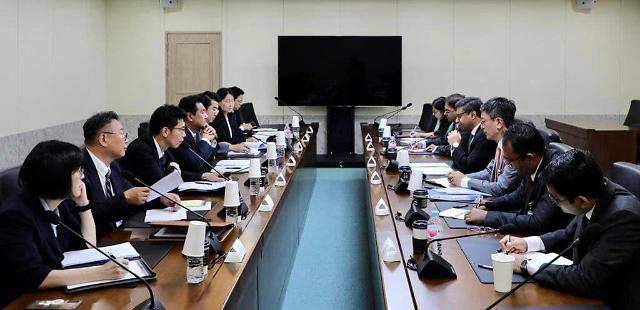
SEOUL -- Without disclosing details, the Indian Embassy in South Korea said India's national security advisor visited Seoul for strategic cooperation in various areas, including defense, technology, and economic security. This was the first dialogue between the two nations after South Korean President Yoon Suk-yeol took office in 2022.
The strategic dialogue was regularly held after the two countries' summit in 2014. The fourth event took place on August 23 about two years since the third dialogue in India in December 2021.
Government data showed that South Korea's exports to India reached $18.8 billion in 2022, up 21 from a year ago. South Korea's imports also rose 10.5 percent year-on-year to $8.9 billion. South Korea's export products include semiconductors and steel plates, while the main import items are petroleum products and aluminum.
India has also shown interest in cooperation in the defense sector. In 2017, the Indian government signed a contract with South Korea's Hanwha to import 155mm K-9 tracked self-propelled howitzers.
The Embassy of India said Deputy National Security Adviser Vikram Misri visited South Korea and met Kim Tae-hyo, South Korea's Deputy Director of National Security. The embassy said: "They highlighted the importance of closer cooperation on critical and emerging technologies and agreed to step up engagements in these areas. Views on regional and global security environment were also exchanged."
The dialogue was also joined by Eom Dong-hwan, the Minister of the Defense Acquisition Program Administration (DAPA). The embassy has not replied yet regarding detailed information shared during the meeting.

Copyright ⓒ Aju Press All rights reserved.
Related News
-
 Lotte Wellfood Reports 29.7% Increase in Q3 Operating Profit Driven by Growth in India and Kazakhstan
Lotte Wellfood reported a nearly 30% increase in operating profit for the third quarter, driven by growth in overseas markets such as India and Kazakhstan, along with improved domestic profitability. Despite a decline in domestic sales, the expansion of overseas subsidiaries offset this downturn, leading to overall performance improvement.On November 11, Lotte Wellfood announced that its consolidated operating profit for the third quarter reached 89.9 billion won, a 29.7% increase compared to the same period last year. During the same period, sales rose to 1.1739 trillion won, up 1.5%. The operating profit margin stood at 7.7%.For the first three quarters of this year, cumulative operating profit totaled 190.4 billion won, marking a 58.7% increase from the previous year. Cumulative sales reached 3.3569 trillion won, up 5%, with a cumulative operating profit margin of 5.7%.The primary driver of this performance improvement was the overseas business. In the third quarter, operating profit from overseas subsidiaries soared to 23.1 billion won, a 137.8% increase year-on-year. Sales from these subsidiaries grew by 16.1% to 271 billion won. For the year to date, cumulative operating profit from overseas subsidiaries reached 64.7 billion won, up 105.4%, while sales increased by 20.5% to 852.7 billion won.In India, the expansion of the Choco Pie production line has begun to yield results. The stabilization of operations at the fourth Choco Pie line and the expansion of sales regions contributed to revenue growth. In Kazakhstan, increased domestic sales and exports also supported overseas performance.Conversely, domestic operations experienced a decline in sales as part of a management efficiency process focused on profitability. Despite challenges such as weather impacts on the ice cream market and rising costs for packaging materials and crude oil, the company improved profitability by streamlining low-efficiency products and distribution channels while enhancing productivity.Lotte Wellfood plans to continue focusing on expanding its overseas markets and improving domestic operations in the fourth quarter. In India, the company aims to stabilize operations of the Choco Pie production line and expand quick commerce sales, while in Kazakhstan and Russia, it plans to broaden the distribution of Lotte brand products.Domestically, the company will strengthen marketing efforts for Pepero Day and expand product offerings tailored to new growth sales channels such as warehouse discount stores and household goods stores. Efforts to enhance profitability will also continue.A Lotte Wellfood official stated, "The continuous enhancement of our business structure and the strong performance of our overseas subsidiaries in India and Kazakhstan drove our third-quarter results. We will continue to pursue qualitative growth through strategies aimed at strengthening domestic profitability and expanding our global market presence."* This article has been translated by AI.
-
Why Japanese Steel Companies Are Investing in India
Steel mills cannot relocate like a shop that closes due to poor business. Once a company invests heavily in a location, it must produce and sell steel there for a long time. Therefore, examining where steel companies invest can provide insights into which countries they expect to profit from in the future.Recently, Japanese steel companies have been expanding their production facilities in India, with JFE Steel and Nippon Steel leading the way. These two companies are distinct entities, partnering with different firms in India. JFE is collaborating with Indian steelmaker JSW Steel, while Nippon Steel is working with Dutch steel giant ArcelorMittal.On October 23, JFE Steel announced plans to double the annual crude steel production capacity at the Sambalpur steel mill in Odisha, India, from 4.5 million tons to 9.5 million tons. Crude steel is the intermediate product before processing into steel products. The company plans to implement new blast furnaces and rolling equipment by 2030.The rationale behind this investment lies in demand forecasts. The World Steel Association recently projected a steel demand growth rate of 0.9% for Japan and 7.9% for India this year. For next year, the forecasts are 1.7% for Japan and 8.0% for India. While Japan is expected to recover, the pace is markedly different from that of India. For steel-selling companies, it makes sense to invest more resources in a rapidly growing market.India's growth rate is not the only noteworthy aspect. The projected steel demand in India for this year is 172.4 million tons, expected to rise to 186.2 million tons next year, indicating an annual increase of 13.8 million tons. Although these figures are projections rather than actual results, they illustrate the backdrop for steel companies expanding their operations in India.Building homes requires rebar, and laying railroads necessitates rails. Steel plates are also used in automobiles and refrigerators. The World Steel Association cites infrastructure construction, private real estate, and manufacturing growth as key drivers of demand in India. This indicates that steel is sought after in both construction sites and factories, differing from investments focused solely on one booming sector.While increasing local production facilities entails significant burdens, shipping steel from Japan is another option. Establishing a factory is just the beginning; securing raw materials, power, labor, and transportation networks is essential for stable operations. Increasing local production despite these challenges can be seen as a strategy to respond closely to Indian customers' orders and establish a long-term market presence.The name JFE has given to its Indian operations reflects this intention. The company positions the Sambalpur steel mill as its 'third integrated steel mill' following its facilities in eastern and western Japan. This signifies a commitment to making it a major production hub rather than merely securing another overseas investment.An integrated steel mill encompasses the entire process from extracting molten iron from iron ore to reducing impurities and producing steel, followed by rolling it into sheets. This type of mill has a broader production scope than facilities that merely cut or surface-process steel products. JFE announced its joint venture plans last December, proposing an investment of 157.5 billion rupees (approximately 270 billion yen). The joint venture, in which JFE and JSW each hold a 50% stake, was finalized in March of this year.Competitor Nippon Steel has also been investing in India through its partnership with ArcelorMittal, operating AM/NS India. This venture aims to increase the annual crude steel production capacity at the Hazira steel mill from approximately 9 million tons to 15 million tons. Nippon Steel's investment plan for related production facilities, announced in 2022, was around 410 billion rupees (approximately 730 billion yen).AM/NS India is also pursuing the acquisition of port and power-related facilities alongside its expansion. Steel mills require ports for importing raw materials and exporting products. If electricity supply is unstable, production can be disrupted. Establishing infrastructure outside the factory is as crucial as investing in blast furnaces and rolling equipment. Directly producing steel overseas entails numerous responsibilities.POSCO is also expanding its production base in India. The company already operates a cold-rolled and galvanized plant in Maharashtra with an annual capacity of 1.8 million tons, processing steel products for use in automobiles and other applications. It also has steel processing plants in Delhi and Chennai.In April of this year, POSCO signed a joint investment agreement with JSW Steel in India, each holding a 50% stake. This venture aims to construct an integrated steel mill in Odisha with an annual crude steel production capacity of 6 million tons. While the existing cold-rolled and galvanized plant processes steel products, the new steel mill will include the entire process from extracting molten iron from iron ore. The existing plant is operational, while the new integrated steel mill is still in the construction phase.Both POSCO and JFE Steel have partnered with JSW Steel in India, while Nippon Steel's partner is ArcelorMittal. As South Korean and Japanese companies secure production bases in India, Indian firms are also leveraging their technology and capital to expand their operations. It remains to be seen how the investments of South Korean and Japanese steel companies will impact the competitiveness of Indian firms.However, merely projecting increased demand does not guarantee investment success. JFE's new facility is targeted to commence operations by 2030. After completing construction and stabilizing production, the company must sell the increased output. As multiple companies expand production capacity, competition for securing customers may intensify. There is often a significant time gap between projected demand growth rates and the actual profits companies realize.Steel mills cannot be built hastily after orders come in. Securing land and establishing facilities takes considerable time. If companies wait to confirm rising demand before acting, other firms may have already captured customers. This context explains why Japanese steel companies are investing in India now, as they prepare to establish production bases for future steel sales.Of course, not all companies investing in the growing Indian market will profit. Local steelmakers are also increasing their production capacities. Market conditions may change during the construction of new plants, and if supply outpaces demand, price competition could become fierce. Japanese companies must secure not only factory sites but also a steady customer base for the steel produced there.POSCO faces similar competitive challenges. Steel companies that have competed in South Korea and Japan are now expanding their production bases in India in partnership with local firms. Simply entering the Indian market does not guarantee an advantage. They must meet the quality demands of automotive companies, deliver products on time, and generate profits in the process. Establishing a factory overseas and growing a business there are two distinct endeavors.The trend of Japanese steel companies moving to India is also relevant for South Korea. As Japanese firms increase their customer base locally, it will impact the volume available for South Korean companies. This is why the South Korean steel industry must closely monitor the scale of Japanese investments and their joint venture partners. The plants Japanese steel companies are building in India will serve as a foundation for steel sales for decades to come. POSCO must not only welcome the growth of the Indian market but also proactively respond to the movements of Japanese steel companies to remain competitive.* This article has been translated by AI.
-
Opportunities in India's Booming Financial Sector
India stands out among major global economies for its rapid growth. The World Bank projects India's economic growth rate for the 2026-2027 fiscal year at 7.1%. A particularly fast-growing sector in India is fintech, which is expected to grow at an average annual rate of 16.4% from 2027 to 2032. As the economy accelerates, the financial sector is racing ahead even faster. Appinit is also experiencing growth in this environment, with first-half revenues reaching 112.3 billion won, a 45.8% increase from the previous year, marking a record for the period. This difference in growth rates highlights where new demand is emerging.Why is the financial sector thriving in India? The expansion of income and consumption is meeting digital infrastructure. Last year, India saw smartphone shipments reach 152 million units. By March of this year, the number of credit cards in circulation rose to 118.63 million, an increase of 8.75 million in just one year. However, the sale of a single smartphone does not necessarily translate to a new customer. The key point is that within these devices, payment, credit, and insurance are interconnected, broadening the options for economic activities. Small business owners can secure funding when needed, and consumers can plan their spending and choose new products. Expanding financial accessibility is not just about increasing transaction numbers; it is about enhancing the possibilities for daily life and business.If changes in finance lead to consumer opportunities, financial companies must also explore the next market. This is why Appinit supported market research in India for entrepreneurs in the fragrance and cosmetics sectors through its 'Free Unicorn India' program last October. Participants in the fragrance, skincare, aesthetics, and lip product sectors met with ten local companies and institutions over six days and interviewed consumers. Appinit employees also participated in surveys and interviews to gauge local workers' reactions. On the final day, they presented their products and business directions to over 100 local university students and gathered feedback. This was a chance to identify pricing, preferences, and purchasing pathways that cannot be gleaned from reports showing growth rates alone. Finding reasons for consumers to spend money is more important than simply hearing positive feedback. This program aimed to transform the vast Indian market into a space where each participant has their first customer.Opportunities in India should not be viewed solely through the lens of large corporations or massive investments. In the first half of last year, South Korea's exports of cosmetics to India increased by 44.7% compared to the previous year. This signals that even small brands that can read consumer preferences have opportunities. Of course, the 1.4 billion population does not immediately translate to a customer base. Lifestyles vary by region, income, and language, and the pricing and sales methods that worked in Korea must be re-evaluated. Therefore, what is needed is not vague optimism but quick on-the-ground verification. Rather than targeting all of India from the outset, it is more realistic to solve a specific inconvenience for a particular city or customer. It is essential to ask local customers about the standards of 'good products' that are familiar in Korea. Appinit, which started as a small startup 12 years ago, also began its business by understanding customers in the vastly different Indian market.Entrepreneurs seeking growth opportunities in larger markets should keep an eye on India. The data accumulated from interactions with small business owners and consumers in the fintech sector can provide insights into unmet demand. Questions such as 'As economic activity and consumer intent grow, are there sufficient products and services to support them?' and 'What do customers want that is not yet available or is difficult to access?' should guide entry into the Indian market. For entrepreneurs looking to create new markets by identifying unmet demand, India presents an attractive stage. If market size indicates the scale of opportunity, the daily lives of customers reveal where to seize those opportunities. What is needed is not mere expectations about the population but more specific hypotheses about the customers. It is hoped that South Korean startups seeking the next growth opportunity will directly verify this potential in the field.* This article has been translated by AI.