
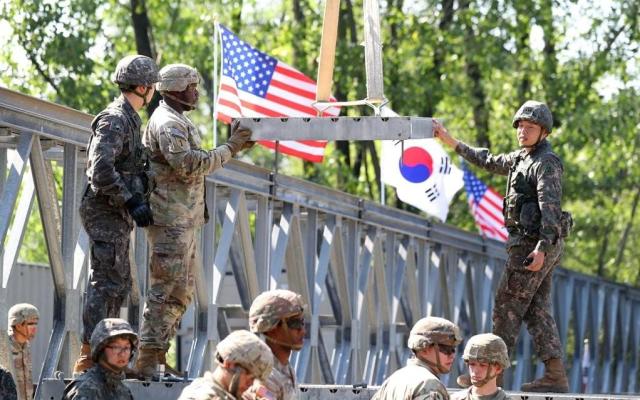
Based on an all-out war scenario, the 11-day exercise includes computer-simulated war games, field training and civil defense drills.
The scale of the exercise, involving 19,000 troops, is similar to the previous year but features more field maneuvers and live-fire drills.
The Joint Chiefs of Staff said that the exercise will enhance the readiness amid North Korea's provocations and nuclear and missile threats.
At a Cabinet meeting, President Yoon Suk Yeol stressed the importance of bolstering readiness against North Korea's provocations such as GPS jamming and the launch of trash-filled balloons. He also warned that "war can break out any time," as seen in Ukraine and the Middle East.
"The exercise will be focused on mastering integrated procedures to respond to various crisis scenarios to deter North Korean provocations including psychological warfare and cyberattacks," Yoon added.
Copyright ⓒ Aju Press All rights reserved.
Related News
-
 President Lee Discusses Shipbuilding Cooperation with Australia, Proposes Nuclear Project in Vietnam
President Lee Jae-myung discussed cooperation in the shipbuilding sector with Australian Prime Minister Anthony Albanese during his visit to the ASEAN-APEC summit. He also proposed concrete achievements in infrastructure projects, including nuclear power, to Vietnamese Secretary General Nguyen Phu Trong.A senior official from the presidential office spoke with reporters on November 18 (local time) at a press center in Shenzhen, China, sharing insights from conversations held with leaders during the trip, stating, "There were discussions regarding shipbuilding issues on several occasions."According to this official, President Lee and Prime Minister Albanese exchanged views on shipbuilding cooperation in the context of discussions about AUKUS nuclear-powered submarines between the U.S. and Australia.The official noted, "There were also discussions aimed at advancing Korea-U.S. shipbuilding cooperation, and there were consultations with several individuals regarding shipbuilding matters."With Vietnam, discussions focused on practical cooperation in the nuclear and infrastructure sectors. Prior to a welcome dinner, President Lee and his wife met with Secretary General Trong and his wife in the leaders' lounge, continuing their conversation at the dinner table.Earlier, National Security Office Director Wi Sung-lak briefed on the outcomes of the trip, mentioning that President Lee exchanged greetings with U.S. President Donald Trump at a dinner hosted by Philippine President Ferdinand Marcos Jr. on November 17, and engaged in in-depth discussions with Prime Minister Albanese and Japanese Prime Minister Sanae Takaichi on bilateral relations and mutual interests.During the APEC welcome dinner hosted by Chinese President Xi Jinping, President Lee also conversed with President Trump about future diplomatic schedules and Korea-U.S. cooperation agendas, according to Director Wi.In particular, a senior official from the presidential office explained that discussions with President Trump included the schedule for the upcoming G20 summit and the topics to be addressed, although specific details were not disclosed.Both sides agreed that the outcomes derived from active exchanges between the leaders are leading to tangible benefits for the citizens and businesses of both countries. They also committed to cooperating for the successful hosting of the APEC summit in Vietnam next year.Regarding the "difficult issues that could hinder the development of bilateral relations" mentioned by President Lee during the Korea-Japan summit, it was noted that progress on historical issues should also be made in this context.The senior official stated, "The meeting with Prime Minister Takaichi began with a review of experiences from shuttle diplomacy, such as the visit to Andong in May. President Lee's remarks imply that historical and past issues should also progress alongside future exchanges."He added, "The government's direction for shuttle diplomacy is to discover and accumulate examples of current and future cooperation, and to derive a mutually flexible stance on historical issues through the positive cycle generated from this."* This article has been translated by AI.
-
Attention on Meeting Between President Lee and Putin Amid North Korea-Russia Ties
President Lee Jae-myung arrived in Shenzhen, China, on November 18 to attend the Asia-Pacific Economic Cooperation (APEC) summit, where interest is growing regarding a potential first meeting with Russian President Vladimir Putin. The Russian side has expressed a positive stance on the meeting between the two leaders, but there are concerns that establishing relations with Russia, which is strengthening military and diplomatic ties with North Korea, could pose diplomatic burdens for the South Korean government. In particular, if the South Korea-Russia summit takes place while the conflict with Ukraine remains unresolved, significant diplomatic repercussions are expected.According to diplomatic sources, the Russian side is optimistic about a meeting between President Putin and President Lee. Although the schedule for the South Korea-Russia summit has not been set, there is a possibility that the two leaders could meet if necessary during the APEC summit. However, the South Korean government has not made a clear statement regarding the summit. With a trilateral meeting involving the U.S., China, and Russia scheduled for November 19, the potential meeting between the two leaders could serve as an opportunity for South Korea to convey its position to Russia, which is closely aligned with North Korea.Some diplomatic analysts suggest that if Russia plays an active role, it could positively influence not only North Korea-U.S. dialogue but also the resumption of inter-Korean talks. Earlier, National Security Office Director Wi Seok-ryeol stated during a briefing on November 12 that he would seek continued support and constructive contributions from regional countries for the South Korean government's efforts to resume inter-Korean and North Korea-U.S. dialogue and to establish peace on the Korean Peninsula.However, Foreign Ministry spokesperson Park Du-sun expressed a cautious stance during a regular briefing the day before, stating, "We have been continuously communicating with relevant countries, including Russia, regarding the peace and stability of the Korean Peninsula and our position." While the nature of multilateral meetings means that the possibility of contact between the two leaders cannot be ruled out, the South Korean government has not disclosed any plans for a separate summit, making the actual likelihood of a meeting uncertain.Political commentator Lee Jong-hoon, an advisor at Daeryun Law Firm, noted in a conversation with Aju Economy that, "If South Korea does not manage its relations with China and Russia well, it could negatively impact the South Korea-U.S. relationship."He added, "The public will be keenly interested in what President Lee discusses with President Xi Jinping and President Putin, making message management crucial for President Lee. It seems likely that President Putin will request improvements in relations and support from President Lee, so his response will be significant."Meanwhile, the South Korean government is embroiled in a conflict with Ukraine over the alleged breach of a non-disclosure agreement regarding the repatriation of North Korean military prisoners. The South Korean government has demanded an official explanation and apology from Ukraine, but the differences in positions between the two countries remain unresolved. In this context, if President Lee conducts an official meeting with President Putin, it could also impact relations with Ukraine, adding to the diplomatic burdens faced by the government.* This article has been translated by AI.
-
Blue House: Lee Did Not Discuss Sanctions with Putin, North Korea-U.S. Dialogue Remains Uncertain
The Blue House stated that during a brief meeting on November 18 local time between President Lee Jae-myung and Russian President Vladimir Putin, the issue of international sanctions was not specifically discussed. However, it explained that it was possible to gauge Russia's thoughts on sanctions within the broader context of its position.A senior official from the Blue House responded to reporters at the press center in Shenzhen, China, when asked whether the Russian side mentioned the sanctions issue.According to this official, President Lee and President Putin naturally met and talked for about ten minutes during the exit process after the welcome dinner of the Asia-Pacific Economic Cooperation (APEC) summit hosted by Chinese President Xi Jinping. This was the first face-to-face contact between the leaders of South Korea and Russia since the G20 summit in Osaka, Japan, in June 2019.The official noted that the meeting was brief and not a pre-arranged agenda, so not all issues were systematically addressed.Both sides generally agreed that while the South Korea-Russia relationship is challenging due to various conditions, there is room for cooperation in areas without issues, and they should manage their relationship accordingly.They also shared the need to prevent the deterioration of the situation on the Korean Peninsula and to ease tensions. The official mentioned that the North Korean issue was discussed in the context of the Korean Peninsula during the conversation with President Putin, although it was not a lengthy discussion.The official explained that during this trip, President Lee communicated South Korea's position on the Korean Peninsula issue to the leaders of the U.S., China, and Russia. However, it remains uncertain how the Korean Peninsula issue will be addressed in the U.S.-China-Russia summit, and it does not appear to be a major agenda item.Regarding concerns that the U.S.-China-Russia meeting could become a 'second Yalta Conference,' the official stated, "There are many observations that it may not necessarily turn out that way."The official argued that the great powers that participated in the original Yalta Conference had common goals and tasks in fighting against Germany, but currently, there is not that level of commonality among the U.S., China, and Russia.He also pointed out that China considers itself a victim of the Yalta Conference decisions, indicating that the positions of the three countries are not entirely aligned.Earlier, National Security Office Director Wi Seong-lak stated in a briefing on the results of the trip that President Lee emphasized that peace on the Korean Peninsula is a vital interest for South Korea and explained efforts for peaceful coexistence during his meeting with President Xi. President Xi evaluated the efforts to improve inter-Korean relations and ease tensions, responding that China would also play a constructive role.A senior official from the Blue House commented on the prospects for North Korea-U.S. dialogue, stating, "The future of North Korea-U.S. dialogue remains an unknown area," adding, "Nothing is certain at this point."He noted that while the possibility of North Korea-U.S. dialogue was mentioned during the South Korea-China summit, it was more of a reference to statements made by President Trump or discussions emerging from the U.S. rather than a discussion based on concrete information. He also stated that there have been no special developments regarding North Korean leader Kim Jong-un's visit to China.* This article has been translated by AI.