
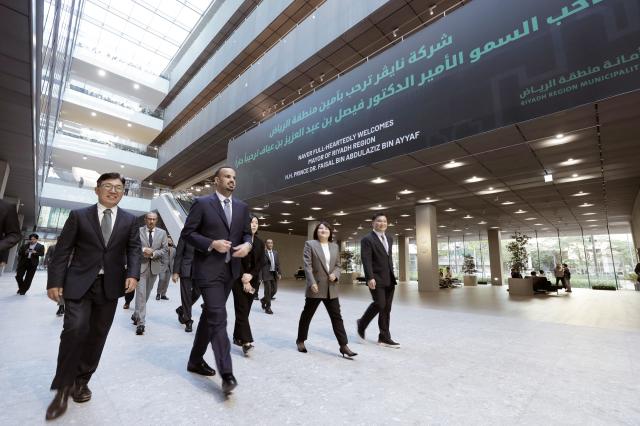
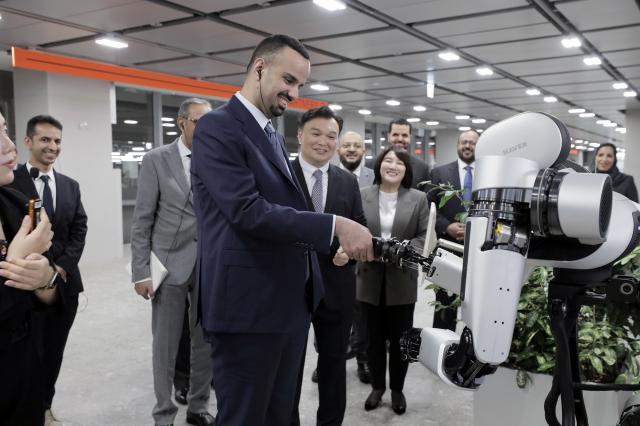
The Saudi prince, serving as the mayor of Riyadh Region, explored innovative technologies, including digital twin solutions and a dual-arm robot.
Naver plans to establish its digital twin platform for five Saudi cities, laying the foundation for developing essential services, such as urban planning and flood simulations.
The Saudi delegation included CEOs from the National Housing Company (NHC), Balady, New Murabba, and Riyadh Holding Company (RHC). They are scheduled to attend Smart Life Week, a three-day event designed to showcase Korean firms with advanced technologies, starting on Thursday.

Copyright ⓒ Aju Press All rights reserved.
Related News
-
 Naver and Kakao Mobility Confirm Continued Collaboration with Nvidia Following Jensen Huang's Resignation
Jensen Huang, CEO of Nvidia, resigned amid an affair controversy involving a woman accused of being a Chinese spy, raising concerns about the ongoing projects of domestic companies collaborating with Nvidia in the artificial intelligence (AI) sector. In South Korea's IT industry, attention is focused on Naver, which has attracted significant investment from Nvidia, and Kakao Mobility, which recently signed an autonomous driving technology agreement. Both companies assert that they will continue their existing projects as planned despite the leadership change at Nvidia. On November 13, Nvidia's board announced Huang's resignation and appointed Colette Kress, the CFO, as interim CEO. Huang stepped down from the board on the same day. Nvidia stated that it will proceed with its major business operations, including existing customer contracts, GPU supply, and next-generation product development, as planned despite the management changes. Huang co-founded Nvidia in 1993 and led the company for 33 years, transforming it from a GPU manufacturer into the world's largest AI semiconductor company. He played a crucial role in developing AI semiconductor technology and spearheading large-scale investments and strategic collaborations with global firms. Given that key decision-making authority was concentrated in Huang, the industry is closely monitoring potential changes in Nvidia's global business strategy and its partnerships with domestic companies. Naver and Kakao Mobility, which have been expanding their collaboration with Nvidia in the AI sector, are particularly noteworthy. Naver has established a capital and technology partnership with Nvidia, securing a significant equity investment and jointly pursuing a global AI factory project. In June, Naver collaborated with Nvidia and global asset management firm Brookfield to build a gigawatt-scale AI factory. Last month, it signed a contract with Brookfield for computing infrastructure worth up to $9 billion and completed a capital increase investment of approximately 1.34 trillion won from Nvidia on November 6. Nvidia has become a major shareholder, acquiring 4.13% of Naver's shares. Naver plans to operate the AI factory based on Brookfield's infrastructure investment and Nvidia's GPU supply. A special purpose vehicle (SPV) funded by Brookfield will secure infrastructure such as GPUs and data centers, while Naver Cloud will provide AI computing services to external clients. The AI factory is set to begin operations in the first half of next year with a capacity of 55 megawatts (MW), expanding to 200 MW by 2028. Naver is also negotiating to secure Nvidia's next-generation GPU, 'Hopper,' and place large server orders. The industry is keen to see how additional collaborations with Nvidia will unfold to support the expansion of the AI factory project. However, Naver believes that the recent management changes will not have a direct impact on its established investment and business structure. A Naver representative stated, "We have already finalized major investment procedures and business structures, and Jensen Huang's resignation is a personal matter that will not affect our ongoing collaborative projects." Kakao Mobility recently signed a memorandum of understanding (MOU) with Nvidia to enhance Level 4 autonomous driving technology. On November 9, Kakao Mobility and Nvidia agreed to combine Kakao Mobility's self-developed autonomous driving AI technology with Nvidia's automotive computing platform and safety technologies to develop an autonomous driving system. Initially, Madison Huang, a senior director at Nvidia and Jensen Huang's daughter, was scheduled to visit South Korea to attend the signing ceremony, but her trip was canceled due to the controversy surrounding her father. Despite this, the MOU between the two companies was signed as planned. They aim to apply Nvidia's automotive AI computing platform, 'Drive AGX Orin,' along with sensor and computing technologies, to Kia's purpose-built vehicles (PBVs) to commercialize Level 4 autonomous driving services. Kakao Mobility maintains that there will be no disruptions to its technological collaboration and business initiatives. A Kakao Mobility representative stated, "Technical cooperation will proceed normally regardless of the management changes."* This article has been translated by AI.
-
Naver Reports Record Q3 Revenue of 3.5 Trillion Won, Focuses on AI and Logistics Growth
Naver has achieved its highest quarterly revenue ever in Q3, focusing on artificial intelligence (AI) and logistics as its two main growth pillars.The company reported consolidated revenue of 3.47 trillion won for Q3, a 10.7% increase compared to the same period last year, according to a disclosure on November 12. Operating profit, however, fell by 20.9% to 451.3 billion won due to increased marketing expenses in infrastructure investment, commerce, and offline payment businesses.Revenue by business segment included 1.95 trillion won from the Naver platform, 487.7 billion won from the financial platform, and 1.03 trillion won from global challenges, marking increases of 7.3%, 14.1%, and 15.9%, respectively, year-on-year.Naver announced plans to strengthen its growth momentum through an expansion of its AI business and significant investments in logistics. The AI factory aims to secure new revenue streams from global companies while enhancing the competitiveness of its commerce business through increased logistics investment.The AI factory has already signed supply contracts with its first client, projecting revenue generation from the start of operations next year. Naver CEO Choi Soo-yeon stated, "We have signed a computing service supply contract worth approximately 2 trillion won with an AI inference company in the U.S., including next-generation graphics processing units (GPUs), and have secured customers for initial volumes by 2027."Currently, Naver is negotiating additional supply contracts with over ten global AI companies. Choi added, "We plan to pursue long-term contracts with large clients while expanding our customer base to include high-potential global AI firms, thereby reducing dependence on specific clients and ensuring stability and high profitability."Naver is also enhancing AI services for users. The company plans to launch a personalized AI agent app by the end of the year, integrating its services such as search, shopping, places, reservations, maps, and Naver Pay.To strengthen delivery competitiveness, Naver will establish a logistics subsidiary and invest approximately 1 trillion won by 2030 to expand its delivery infrastructure centered around leased logistics centers.Naver will manage logistics center operations and delivery through existing partners while focusing on designing systems and data infrastructure. The strategy emphasizes improving logistics efficiency using AI-based demand forecasting and inventory placement technology rather than direct operation of the delivery network.Choi emphasized, "We will predict demand based on shopping search data and position inventory closer to users to achieve faster and more efficient delivery with the same infrastructure." Existing partners will handle logistics center operations and actual deliveries, while Naver will oversee system and data infrastructure design.In Q3, Naver's 'N Delivery' transaction volume increased by 38% year-on-year. The number of early morning delivery centers grew from three to nine in the first half of the year, with early morning delivery transaction volume increasing more than fourfold compared to the previous quarter.Naver is also enhancing its shopping services, focusing on the Naver Plus Store app and AI-based personalized recommendation features. In Q3, transaction volume from smart stores rose by 6.4% year-on-year, while transaction volume driven by AI recommendations increased by over 50% compared to the previous year.The use of the shopping AI agent is also expanding. The number of users from March to September increased nearly fivefold, with transaction volume rising about fourfold. Naver plans to pilot a feature in the shopping AI agent that allows users to complete transactions from product exploration to payment in the fourth quarter.AI utilization is also expanding in the advertising business. According to Naver, the application of AI predictive models in Q3 improved the click-through rate of Powerlink ads by 12% and conversions by 9%. Next year, the company plans to revamp its advertising system and pilot a model that charges advertising fees based on actual transaction performance in sectors such as finance, insurance, and automotive.* This article has been translated by AI.
-
Meritz Securities Lowers NAVER Target Price to 270,000 Won Amid Profit Concerns
Meritz Securities has lowered its target price for NAVER from 330,000 won to 270,000 won, citing concerns that declining profitability in existing businesses will outpace the performance of new ventures. The firm anticipates ongoing cost burdens due to investments in infrastructure, marketing, and logistics expansion.Lee Hyo-jin, a researcher at Meritz Securities, noted, "In the third quarter, NAVER's consolidated revenue and operating profit were 3.4724 trillion won and 451.3 billion won, respectively, marking a 10.7% increase in revenue but a 20.9% decrease in operating profit compared to the same period last year, falling short of market expectations." He explained that investments in infrastructure and marketing for core businesses, primarily advertising and commerce, exceeded anticipated levels.Lee further stated, "While we initially expected investment costs for devices to peak in 2026, additional investments related to the expansion of offline integrated device operations and the establishment of logistics subsidiaries are anticipated to continue, leading to sustained cost pressures. We believe managing costs will remain challenging into 2027, prompting a significant downward revision of our earnings outlook."He projected that the separate business margin would decline from 28% in 2025 to 19% in 2026, without rebounding thereafter. Lee pointed out, "The investment costs necessary to maintain existing operations are resulting in profit declines without corresponding revenue growth." While he acknowledged that the Neo Cloud new business could transform the company's future core profits, he cautioned that the negative impact on existing business profits due to increased investments is more certain than the confirmation of new business performance.Lee concluded, "The adjustment of the target price is due to the downward revision of earnings and the change in the target period to 2027. We expect market sentiment to shift when we communicate reasons for buying and managing reasons against buying in market language." * This article has been translated by AI.