
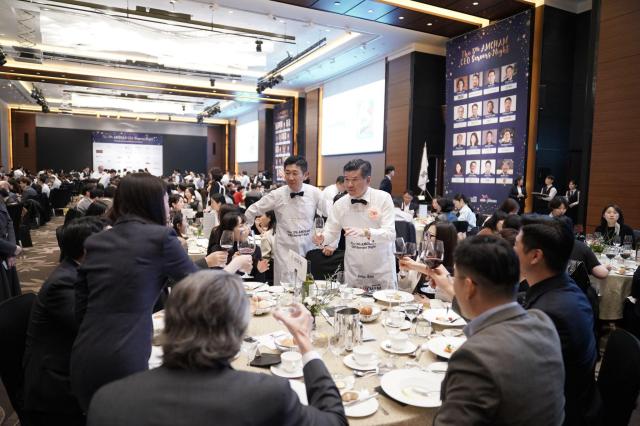
Thirty-five CEOs and executives served dinner and wine to 430 attendees at the 17th AMCHAM CEO Service Night organized the previous day by the Partners for the Future Foundation under AMCHAM Korea.
"Together, we are building a brighter future, and I'm proud to be part of such a remarkable community," AMCHAM Korea Chairman and CEO James Kim shared on LinkedIn.
Copyright ⓒ Aju Press All rights reserved.
Related News
-
 Prosecution Requests Police to Supplement Investigation of Former Coupang CEO Park Dae-jun
The prosecution has requested the police to conduct a supplementary investigation into Park Dae-jun, the former CEO of Coupang, who is accused of perjury during a National Assembly hearing regarding the Coupang incident.According to Yonhap News on the 20th, the Seoul Southern District Prosecutors' Office recently sent the case involving Park, who is facing perjury charges under the National Assembly Witness Protection Act, back to the Seoul Metropolitan Police Agency's Anti-Corruption Investigation Unit for further investigation.Previously, the National Assembly's Science, Technology, Information and Communications Committee filed a complaint against Park, Harold Rogers, the interim CEO of Coupang, and Kim Beom-seok, the chairman of Coupang, on charges including perjury.Park is accused of providing false testimony related to allegations of concealing industrial accidents involving the late worker Jang Deok-jun during the Coupang incident hearing held at the National Assembly on December 30-31 of last year.The Seoul Metropolitan Police Agency's Anti-Corruption Investigation Unit transferred Park and Vice President Cho Yong-woo to the Seoul Southern District Prosecutors' Office without detention on August 31. They determined that there was no evidence against Rogers, who was also reported, and decided not to pursue charges against him.* This article has been translated by AI.
-
Kolon Group Announces 2027 Executive Reshuffle, Appoints Han Yong-bin as CEO
Kolon Group has conducted a regular executive reshuffle, appointing a total of 25 new executives, including new CEOs for the holding company and major affiliates.On November 20, Kolon Group announced its 2027 regular executive appointments, naming Han Yong-bin as the CEO of Kolon Corporation and bringing in Jeong Hang-ki as the CEO of Kolon Global.Han Yong-bin is set to enhance the competitiveness of the affiliate businesses and elevate the value of the holding company as its CEO.Jeong Hang-ki, appointed as CEO of Kolon Global, will be responsible for improving the financial structure and restructuring management processes. Kolon Group plans to leverage Jeong's financial and management experience to enhance Kolon Global's financial soundness and focus on improving its profitability-driven business structure.An Byeong-deok, currently serving as the CEO of Kolon Corporation, will transition to the role of vice chairman of the group. He will oversee major management issues and external affairs at the group level.Jo Je-hyung has been appointed as the CEO of Green Narae. He will be promoted to executive director and will manage the operational system of the group's golf business and collaboration among affiliate businesses.A total of nine new executives have been appointed in this reshuffle. Among them, five are in their 40s, continuing the trend from last year of maintaining over half of new appointments for prepared talent in their 40s. Three women are also included among the promoted executives.At Kolon Corporation, Han Woo-jun and Choi Yoo-jung have been promoted. In the manufacturing division of Kolon Industries, executive director Moon Hee-soon, along with six executive directors and four associate executive directors, are on the promotion list. In the FnC division, executive director Park Seong-cheol has been promoted.At Kolon Global, Kim Gi-hwan, Park Chang-min, and Lee Gi-wook have been newly appointed as associate executive directors. At Kolon Benit, Choi Sang-moon and Kim Sang-eok have been promoted, while Yoo Byeong-seok has been promoted at Kolon Life Science. Kim Jun-mok of Kolon Spaceworks and Moon Soo-kyung of Kolon Investment are also included in the list of those promoted.A Kolon Group official stated, "In the rapidly changing internal and external environment, we need talent capable of making bold decisions and driving the group's competitiveness. Therefore, we have conducted appointments to provide opportunities to those who have proven their potential for innovation through performance."* This article has been translated by AI.
-
Xi Jinping Promises Expanded Access to Chinese Market at APEC CEO Summit
Xi Jinping, the President of China, promised global companies an expansion of access to the Chinese market and improvements to the investment environment. He outlined plans to gradually expand access in the service sector following manufacturing, as well as to promote institutional improvements such as tariff reductions and easing market entry regulations. In his keynote speech at the opening ceremony of the 2026 Asia-Pacific Economic Cooperation (APEC) CEO Summit held in Shenzhen on November 18, Xi stated, "China's 15th Five-Year Plan (2026-2030) is not only a blueprint for China's own development but also a list of opportunities for economic growth in the Asia-Pacific and the world." He presented three opportunities that China offers to global companies: a massive open market, vast development space, and a mutually cooperative investment environment. Xi emphasized that China has the world's largest middle class and significant potential for investment and consumption. He explained that new business opportunities are opening up for global companies in various new industries, from new energy vehicles and smart homes to the silver economy and winter sports tourism. Xi also highlighted that China is expanding imports of high-quality products and services and building an open mega-market. This aims to create diverse consumer demand and broaden opportunities for foreign companies to enter the Chinese market. From an industrial perspective, he presented innovation-driven and green transition as key directions. He stated that China will accelerate the establishment of a modern industrial system and promote the integration of scientific and technological innovation with industrial innovation to support global companies in technology development and business expansion. Xi expressed his commitment to improving the investment environment for foreign companies. He stated that China will practice true multilateralism and uphold the multilateral trading system centered on the World Trade Organization (WTO) in the face of the shocks of unilateralism and protectionism. He emphasized the need for deep institutional reforms in areas such as tariff reductions, market access expansion, and rules and standards. In the manufacturing sector, he promised to fully implement systems that guarantee not only market entry for foreign companies but also actual operations and management, while also steadily expanding access in the service sector. In his speech, Xi also called for strengthening economic cooperation in the Asia-Pacific region. He noted that the most important bay economic zones in the world are concentrated in the Asia-Pacific region and emphasized the openness, cooperation, and spillover effects of bay economies. He announced China's support for the establishment of a global bay economic cooperation alliance, suggesting that exchanges and cooperation between major bay economic zones, including the Guangdong-Hong Kong-Macao Greater Bay Area where Shenzhen is located, should be strengthened to seek new pathways for Asia-Pacific economic cooperation. As directions for Asia-Pacific economic cooperation, he proposed four key areas: maintaining peace and stability, expanding open cooperation, securing innovative growth momentum, and mutual benefits and common prosperity. Xi stated, "Stability is necessary for peace, and peace is essential for development," emphasizing the need to uphold the post-war international order and resolve differences between countries through dialogue and negotiation. He also stated that it is important to maintain a multilateral trading system centered on the WTO and support free and open trade and investment. In the technology sector, he urged for expanded cooperation in the digital economy and artificial intelligence (AI) and called for promoting green and low-carbon transitions. He proposed that the advancement of the Asia-Pacific Free Trade Area (FTAAP) should be carried out steadily and that a comprehensive connectivity network for regional economic integration should be established. He expressed hope that global companies would find new opportunities in China's development process, stating, "China's 15th Five-Year Plan is an invitation for cooperation to global entrepreneurs."* This article has been translated by AI.