

This move, aimed at countering slowing exports and uncertainties arising from the new Trump administration, underscores the central bank's commitment to reviving economic momentum.
In a surprising decision, the BOK's monetary policy committee reduced the key rate by 25 basis points to 3 percent. This marked the first back-to-back rate reduction since the 2008 global financial crisis and the first since May 2020.
While many analysts had anticipated a rate hold due to the weakening Korean won and concerns over high household debt, the BOK prioritized economic growth.
BOK Governor Rhee Chang-yong explained that four out of six board members supported the rate cut, recognizing the significant impact of the U.S. elections and the slowdown in exports. The BOK's statement highlighted the intensified downward pressure on economic growth and the need to stimulate the sagging economy, even in the face of foreign exchange market volatility.
The central bank lowered its economic growth outlook for 2025 to 1.9 percent and for 2024 to 2.2 percent, reflecting concerns over global economic uncertainties and the potential impact of U.S. policies.
The rate cut is expected to provide a modest boost to economic growth, but Governor Rhee acknowledged the possibility of further adjustments to the growth outlook.
Copyright ⓒ Aju Press All rights reserved.
Related News
-
 Muan County Council Member Yang Young-bok Calls for Improvement in Local Financial Burden of National Subsidy Projects
The Muan County Council in Jeonnam Gwangju Integrated Metropolitan City has urged the government and metropolitan governments to alleviate the excessive local financial burden concentrated on basic local governments during the implementation of national subsidy projects, and to raise the national subsidy rates reflecting regional financial conditions.On November 17, during the first session of the second regular meeting of the 312th council, a proposal titled 'Request for an Increase in National Subsidy Rates Reflecting Financial Conditions and Alleviation of Local Financial Burden' was adopted, which was introduced by council member Yang Young-bok.This proposal points out the increasing financial burden on basic local governments as national subsidy projects expand and aims to establish a reasonable resource-sharing system between the central government and metropolitan and basic local governments.According to the Muan County Council, there are a total of 389 matching projects for national and local funds included in the 2026 budget and the first supplementary budget, with a total project cost of approximately 265.5 billion won (KRW).Among these, Muan County bears about 50.4 billion won (KRW), which is 1.9 times the burden of approximately 26.4 billion won (KRW) borne by the Jeonnam Gwangju Integrated Metropolitan City. Notably, there are 105 projects where the local financial burden accounts for more than half of the total, indicating significant financial pressure on basic local governments.The issue is that Muan County has been disadvantaged in additional financial support, such as the local extinction response fund, as it was excluded from the designation of a population decline area due to population growth from the development of the Namak and Oryong new towns.Conversely, the administrative demand to respond to the increased infrastructure needs due to the population growth in the new towns and the aging and population outflow in existing rural areas is simultaneously increasing, placing a double burden on the county's finances, according to the council's explanation.In particular, it was also pointed out that the current differentiated subsidy rate system for national subsidy projects does not adequately consider local governments with poor financial conditions, which should be improved.The council noted that the application of the differentiated subsidy rate system based on financial conditions does not reach even 10% of all national subsidy projects, and the criteria for judgment, such as financial independence, do not sufficiently reflect the actual administrative demands of each region.In response, the Muan County Council has requested the government to expand the application of the legal standard subsidy rate and the differentiated subsidy rate, while urging the Jeonnam Gwangju Integrated Metropolitan City to increase the resource-sharing rate of metropolitan governments to reduce the financial burden on basic local governments.Additionally, it emphasized the need to establish a basis for financial support for the operation and maintenance costs of public facilities and essential living infrastructure, and to create separate support measures for local governments that struggle to secure the local funds necessary for implementing national subsidy projects.Council member Yang Young-bok, who introduced the proposal, stated, "This is not about reducing national subsidy projects, but about correcting the resource-sharing structure so that necessary projects for residents can be stably promoted," and expressed hope that the government and the Jeonnam Gwangju Integrated Metropolitan City would actively pursue institutional improvements reflecting the realities of basic local governments.Meanwhile, the Muan County Council made it clear that the criteria for resource-sharing in national subsidy projects should not be limited to simple administrative districts or uniform financial indicators. Attention is focused on whether institutional improvements reflecting the uniqueness of regions where new towns and rural areas coexist and actual financial demands can be achieved.* This article has been translated by AI.
-
 More workers use AI, but productivity remains low: BOK study
Edited and compiled by AJP. Graphics AI assisted. SEOUL, November 17 (AJP) — About two in three South Korean workers now use generative artificial intelligence (AI) at work, but the time saved has yet to translate consistently into higher output, a recent study reveals on Tuesday. Workplace AI adoption rose to 66.5 percent this year from 51.8 percent in 2025, the highest rate among countries compared in a Bank of Korea (BOK) study conducted by researchers Seo Dong-hyun, Oh Sam-il and Yoon Jong-won. The figure was nearly double the 33.7 percent average for the U.S. and six European countries. The average share of working time saved through AI more than doubled to 9.2 percent from 3.8 percent a year earlier. That translates into about 3.7 hours saved in a 40-hour workweek, compared with 1.5 hours last year. Yet the correlation between time saved and increased work output stood at just 0.08, up from zero in 2025, suggesting that individual efficiency gains have not consistently translated into greater productivity. The researchers cautioned that the weak correlation did not mean AI had failed to increase output. Rather, workers who saved more time were not necessarily completing proportionately more tasks. Some 33.8 percent of respondents said they primarily used the time saved to concentrate on core duties, while 29.3 percent reported taking on additional work. Another 13.2 percent cited learning and professional development. The researchers noted that faster task completion may not increase output if the amount of work assigned or demand for additional services remains unchanged. They pointed to the need for changes in workflows, task allocation and workplace organization to translate individual efficiency gains into higher overall output. AI adoption also remained uneven across occupations. Usage reached 86.0 percent among professionals and 81.3 percent among office workers, compared with 39.6 percent among elementary workers. Even in occupations with high adoption rates, actual AI use in core duties fell substantially short of what researchers assessed as technically possible. Paid access was associated with stronger efficiency gains. Workers who personally paid for AI services reported average time savings of 11.4 percent, compared with 8.3 percent among those who did not pay out of pocket. Employees receiving company support reported savings of 11.6 percent. The researchers cautioned that the differences could not be attributed solely to paid access, as workers with greater demand for AI tools may be more likely to subscribe. The study also found limited evidence that longer experience with AI or formal training had significantly improved time savings over the past year, suggesting that advances in AI technology itself may have played a substantial role. Workers who actively experimented with AI tools, checked results and integrated them into their routines, however, showed stronger improvements. The researchers estimated that AI could potentially increase aggregate output by 2.6 percent if all time saved were redirected to productive activities, up from an estimated 1.0 percent last year. That figure represents a hypothetical gain under the study's assumptions, not an increase in actual gross domestic product. The relationship between time savings and improvements in work quality was also weak, with a correlation coefficient of 0.09. However, workers whose duties involved a larger share of core tasks reported relatively stronger quality gains. The findings suggest that some AI benefits may emerge through better results rather than faster task completion or greater work volumes. The study was based on a survey of 16,342 employed people aged 18 to 64 conducted between August and September, alongside panel data tracking 2,024 respondents from the previous year's survey. The researchers concluded that wider adoption alone would be insufficient to realize AI's full economic potential, highlighting the importance of improving workers' skills and adapting how companies organize and assign work.
-
 Global markets diverge amid AI concerns Q3: BOK
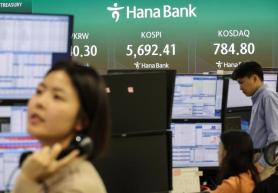
Employees work at a Hana Bank dealing room in Seoul on October 15, 2026. AJP Yoo Na-hyun. SEOUL, November 12 (AJP) — Global stocks and currencies have diverged while foreign investors continued to unloand Korean equities in the third quarter as doubts over artificial intelligence investment fueled risk aversion, according tko the Korean central bank Thursday. The Bank of Korea (BOK) in assessment on global finance said global risk aversion persisted amid concerns about the sustainability of AI investment even as uncertainty surrounding the Middle East eased. Major stock markets showed divergent performances, reflecting differences in their exposure to the AI investment cycle. The U.S. S&P 500 fell 1.7 percent from the end of September through November 10, while Japan's Nikkei 225 lost 9.4 percent and South Korea's KOSPI tumbled 23.4 percent. Britain's FTSE 100 gained 1.4 percent over the same period. The BOK attributed weakness in U.S. stocks partly to concerns over tighter regulations on data center construction following the midterm elections, while Japanese technology shares came under pressure from fears of slowing AI investment. Government bond yields generally declined as investors sought safer assets. The U.S. 10-year Treasury yield fell to 4.99 percent on November 10 from 5.28 percent at the end of September, while German and British yields also eased. The U.S. dollar strengthened, supported by better-than-expected employment data and expectations of tighter AI-related regulations. The dollar index rose 0.8 percent over the period, while the Japanese yen and euro weakened. In South Korea, foreign securities investment recorded a ninth consecutive month of net outflows, although the pace slowed as bond investment returned to positive territory. Net foreign portfolio outflows narrowed to $13.70 billion in October from $19.97 billion in September, according to the BOK. Equity outflows widened to $19.31 billion from $14.16 billion a month earlier as concerns over global AI investment profitability weighed on investor sentiment. Bond investment, however, swung to a $5.61 billion net inflow from a $5.81 billion outflow in September, supported by funds tracking the World Government Bond Index (WGBI) and improving short-term arbitrage incentives. The three-month arbitrage incentive turned positive at 2 basis points on average in October, compared with minus 31 basis points in September. Cumulative foreign securities outflows reached $160.75 billion in the first 10 months of 2026, driven overwhelmingly by equity withdrawals. The won nevertheless strengthened against the dollar, supported by increased dollar selling by exporters. The currency stood at 1,337.5 per dollar on November 10, compared with 1,352.8 at the end of September. It had strengthened to 1,334.3 at the end of October before giving back some gains. Currency volatility eased in October, with the won's average daily movement narrowing to 4.6 won from 7.0 won in September. Despite the continued portfolio outflows, the BOK assessed overseas borrowing conditions for Korean banks as broadly favorable. Short-term external borrowing spreads narrowed to 18 basis points in October from 27 basis points in September, although medium- to long-term spreads widened to 58 basis points from 40 basis points.