
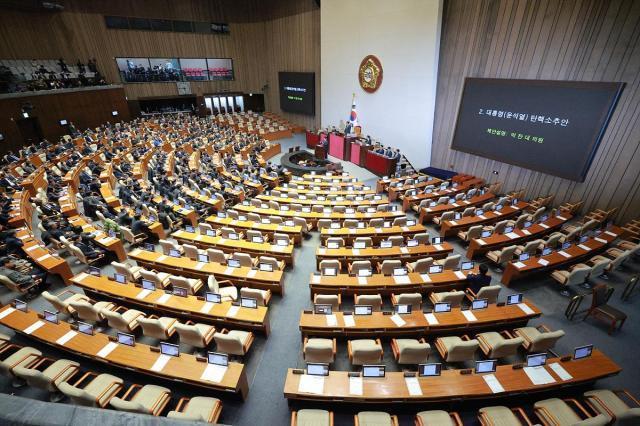
The proposal, led by the main opposition Democratic Party, passed the Legislation and Judiciary Committee and is expected to be put to a vote during a plenary session on Tuesday.
Unlike a regular special counsel bill, an investigation by a permanent independent prosecutor does not require the president's approval.
Also included among those for investigation were Prime Minister Han Duck-soo, Choo Kyung-ho, the floor leader of the ruling People Power Party (PPP), and Yeo In-hyeong, the head of the army's Defense Counterintelligence Command who was allegedly implicated in orchestrating Yoon's martial law order.
The DP argued that the scope of the investigation should be expanded to include them in the probe, as they are suspected of having either collaborated on or plotted last Tuesday's botched plan.
It also submitted another motion to investigate first lady Kim Keon Hee over a dozen allegations including a stock manipulation scheme, alleged involvement in the PPP's candidate nomination process ahead of the general elections last April, the acceptance of a luxury handbag, and several other accusations.
The motion, which is expected to be put to a vote on Thursday, comes as the fourth attempt of its kind, after it was dropped last Saturday for falling short of the required two-thirds majority by just two votes.

Copyright ⓒ Aju Press All rights reserved.
Related News
-
 Yoon Ho-jung Inspects Fall Forest Fire Prevention Measures
The Ministry of the Interior and Safety announced that Minister Yoon Ho-jung visited the Yeongdeok Fire Station and Juwangsan National Park on November 13 to assess preparedness for fall forest fires and to conduct a public participation campaign for fire prevention.At the Yeongdeok Fire Station, Minister Yoon reviewed a location-based mountain rescue system and an AI-supported forest fire response system. He demonstrated a privately developed location tracking system that sends a URL to the reporter to pinpoint precise locations. He also examined a field command support system based on AI and Geographic Information Systems (GIS), developed by three active firefighters, which integrates terrain, weather, and satellite information to predict fire spread.Minister Yoon emphasized the critical role of advanced technology in making efficient evacuation decisions and ensuring the safety of personnel on the ground, encouraging the firefighters involved in the development.He then visited Juwangsan National Park in Cheongsong County to check the preparedness for the fall forest fire prevention period, which runs from November 1 to December 15. After receiving reports on fall forest fire prevention measures from the National Park Service and Gyeongsangbuk-do, he urged for prompt initial suppression and proactive evacuation of residents, while also encouraging fire suppression personnel and volunteer firefighters.Minister Yoon participated in the 'Forest Fire Prevention Public Participation Challenge,' where he completed a green forest using leaf stickers, encouraging hikers to engage in preventive actions. He also led a campaign at the trailhead to inform visitors about the prohibition of carrying flammable materials, smoking, cooking, and the importance of reporting any forest fires immediately.“Forest fire prevention starts with the small actions of each citizen,” Minister Yoon stated, expressing hope that the campaign would raise awareness and encourage preventive practices in daily life. He added, “The government will concentrate all its efforts to respond thoroughly from prevention to initial suppression and evacuation, doing its utmost to protect the lives and safety of the public.”* This article has been translated by AI.
-
Yoon Suk Yeol Denies Charges in First Court Hearing, Cites Diplomatic Crisis Management
Yoon Suk Yeol, the former president of South Korea, and Shin Won-sik, the former head of the National Security Office, were indicted by the second special prosecutor's team led by Kwon Chang-young for allegedly justifying the declaration of martial law to key allied nations shortly after it was announced on December 3. During their first court hearing on November 13 at the Seoul Central District Court, they both denied all charges and asserted their innocence. The court, presided over by judges Jang Seong-jin, Jeong Soo-young, and Choi Yeong-gak, heard the case regarding abuse of power and obstruction of the exercise of rights. Yoon's legal team argued, "The essence of this case is diplomatic crisis management," and rejected all allegations. Yoon's defense emphasized that immediately after the martial law declaration, foreign governments and the diplomatic corps in South Korea sought to understand the situation and the government's position accurately. They stated, "Maintaining trust with allies, such as the U.S.-South Korea alliance, and confirming the continuity of foreign policy and security is an essential duty of the president representing the nation under Article 66 of the Constitution." They further contended, "Regardless of the evaluation of martial law, communicating with allied nations for national interests cannot be a crime," and described the explanation of positions through diplomatic channels as a normal operation of the command structure. Regarding specific directives, the defense acknowledged that Yoon instructed Kim Tae-hyo, the former first deputy director of the National Security Office, to explain the purpose of a statement to the U.S. ambassador but claimed that no specific expressions were designated and that there was no directive to convey messages to four countries, including the UK, Japan, and Australia. They added that the content of the messages was merely a summary of the statement and contained no falsehoods, asserting that conveying the president's position is a fundamental duty of diplomats, thus negating the basis for abuse of power. Yoon also directly questioned the special prosecutor's assertion that the end of insurrection was marked by the National Assembly's approval of the impeachment motion on December 14, 2024. He stated, "Immediately after the National Assembly's resolution to lift martial law at 1:01 a.m., the Minister of National Defense ordered commanders to withdraw troops, and even before the Cabinet meeting, he instructed to end the martial law situation and send home standby personnel. It is difficult to understand how insurrection could persist after martial law was completely lifted." Shin's defense team also denied all charges related to important duties during insurrection and abuse of power. Shin's lawyer explained, "The first thing the defendant said to the president after the Cabinet meeting on the day of the martial law declaration was, 'What kind of martial law are you talking about? Cancel it immediately.' He opposed martial law in front of the president and instructed that employees summoned for emergency meetings should be sent home." In response to the special prosecutor's claim that they attempted to defend the state of insurrection through U.S. support, Shin's defense countered, "That night, I rejected multiple requests for calls from Jake Sullivan, the White House National Security Advisor, saying, 'I cannot understand or accept martial law, so what could I possibly say to the U.S.?' Shin's team also addressed the special prosecutor's previous statement that he directed the explanation to four countries, including Australia, after receiving a call from Yoon the day after the martial law declaration, stating, "There is no record of a call with the president at that time, and we are correcting the misunderstanding based on the statements of subordinate employees." Conversely, the special prosecutor argued that their actions constituted abuse of power and insurrection to justify an unconstitutional and illegal martial law. They stated, "By having the president and the head of the National Security Office convey distorted messages to foreign officials, they compelled them to perform duties they were not obligated to do," and particularly noted that Shin was aware of the unconstitutionality of the martial law declaration but conspired with Yoon and Kim to secure the legitimacy of the insurrection. The court requested the special prosecutor to supplement the indictment, stating, "It is necessary to clearly specify at what point Shin recognized the specific purpose of violating the Constitution." The judges also remarked, "The content of the first message appears to consist of simple sentences without any distortion of facts. There seems to be an unavoidable aspect to explaining the purpose to allied nations during martial law, so please specify where it exceeds normal diplomatic duties." Meanwhile, during witness testimony, Lee Chung-myeon, the former diplomatic secretary of the National Security Office, testified about the circumstances surrounding the directives. He stated, "There was a prevailing atmosphere that presidential directives should naturally be implemented within the presidential office," and when he questioned whether such directives should be conveyed to countries like Australia and New Zealand, Shin responded in the sense of 'implement it.'* This article has been translated by AI.
-
President Yoon Pledges to Revitalize Capital Markets Amid Recent Declines
President Yoon Suk Yeol stated on November 13 that he will make greater efforts to normalize the capital markets, emphasizing that necessary measures will be taken, whether through legislative or administrative actions, or by revising exchange operating rules. During a policy meeting on capital markets titled "Building a Trusted Capital Market: Seeking Answers from the Field" held at the Korea Exchange in Yeouido, Seoul, President Yoon reiterated his commitment to firmly pursue capital market normalization and swiftly complete institutional reforms to restore market confidence. In his closing remarks, he noted that the causes of the domestic stock market's undervaluation, attributed to industrial and economic policies as well as geopolitical risks, have significantly improved. However, he diagnosed that issues related to market transparency and corporate governance remain unresolved. He called for an expansion of the financial supervisory authorities' powers and personnel, and for swift legislative action to ensure respect for shareholders and enhance management transparency and rationality. "We will expose all issues and rationally devise and implement solutions to address them," President Yoon stated, adding, "I will personally oversee the swift completion of these efforts." About 80 participants attended the meeting, including government officials, lawmakers, representatives from the Blue House, the financial investment industry, corporations, institutional investors, and experts. In his opening remarks, President Yoon assessed that the recent significant adjustments in the stock market have once again put the government's commitment and policies for capital market reform to the test. He emphasized that capital market normalization is a firm policy direction and commitment of his administration, stating, "There is no doubt about this." He described the reality of undervalued stocks simply because they belong to South Korean companies or are listed on the domestic stock market as "an extremely unreasonable abnormality." He asserted that normalizing these abnormalities is a core task for his administration, stating that the normalization of asset and financial markets is something the government must and can achieve. Regarding unfair practices such as stock manipulation, he mentioned that he has already instructed the Serious Crimes Investigation Agency to strictly crack down on unfair activities in the financial and capital markets. During the meeting, discussions focused on topics such as expanding shareholder-centric management and enhancing corporate value, redesigning the venture investment ecosystem and the KOSDAQ market, and increasing long-term and institutional demand in the stock market. Discussions included the buyout ratio and allocation method of the mandatory public offering system, activating hostile mergers and acquisitions (M&A), delisting companies with excessively high major shareholder ownership, and strengthening investor relations (IR) while utilizing long-term investment tax benefits and the securities market stabilization fund. On the mandatory public offering system, opinions diverged between a 100% buyout plan for shareholders wishing to sell and a plan to buy only 50% plus one share of the total issued shares. President Yoon conducted a show of hands among attendees and checked the reactions of live-stream viewers on YouTube. He stated, "Even if I face criticism, I believe that expanding the pie and activating M&A to normalize the entire market will benefit all shareholders," while also calling for additional feedback. He instructed a review of exit strategies for listed companies that operate like personal companies due to excessive major shareholder ownership. Regarding the KOSDAQ market, he ordered the swift application of delisting criteria for underperforming and weak companies, ensuring that firms with technological capabilities and growth potential are not adversely affected, and called for a comprehensive review of the entry, exit, and evaluation systems. He also directed that conditions and methods for the immediate operation of the securities market stabilization fund be examined. During the discussions, President Yoon also instructed the formation of a high-level body dedicated to capital market reform. He suggested creating a separate task force for capital market advancement and reform, emphasizing the need for a horizontal organization that engages in vigorous discussions on equal footing rather than a conventional discussion structure. He directed that contentious issues be organized and reported directly to him.* This article has been translated by AI.