
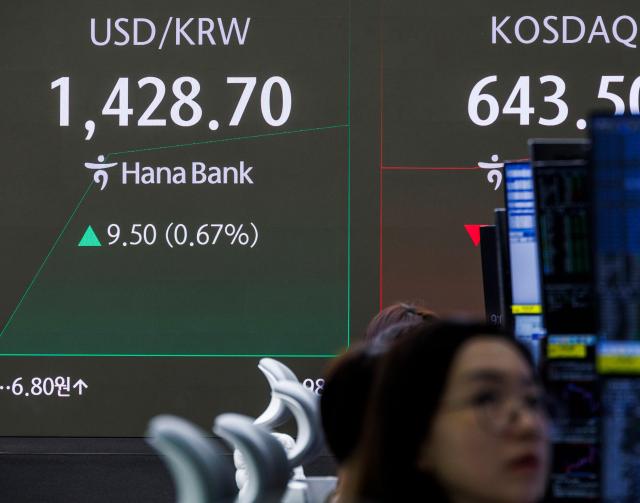
SEOUL, December 09 (AJP) - South Korea’s currency plummeted to a two-year low last week as a political crisis, marked by President Yoon Suk Yeol’s declaration of martial law and the subsequent impeachment attempt, roiled the nation. The won’s decline reflects growing investor anxiety over the country’s future stability.
The South Korean won weakened 24.5 won against the dollar last week, its sharpest weekly drop since January. The currency has been under pressure for months, but the recent political turmoil accelerated its fall.
The crisis began on Dec. 3 when President Yoon declared a martial law and deployed troops to the National Assembly.
The move, which was widely criticized as the de facto coup, sent shockwaves through financial markets. Investors, fearing further political instability, rushed to sell the won and buy dollars.
The won’s decline has raised concerns about its impact on the South Korean economy. A weaker currency can lead to higher import costs, which can fuel inflation. It can also make it more difficult for South Korean companies to compete in global markets.
Analysts say that the long-term outlook for the won remains uncertain as the political crisis in South Korea is far from over.
The impeachment proceedings against President Yoon are still ongoing, and if the crisis deepens, the won could continue to weaken.

Copyright ⓒ Aju Press All rights reserved.
Related News
-
 Citizens Lose Lawsuit Against People Power Party Over Emergency Martial Law Vote Interference
A South Korean court has ruled against citizens who filed a damages lawsuit against the People Power Party, claiming that Daegu Mayor Choo Kyung-ho obstructed the National Assembly's resolution to lift emergency martial law during the December 3 incident. On November 9, legal sources reported that the Seoul Southern District Court, presided over by Judge Choi Jong-du, ruled against the 46 plaintiffs in their lawsuit against the People Power Party on October 30. The court determined that the actions taken by Mayor Choo, in his capacity as the party's floor leader, to summon party members did not sufficiently demonstrate an intent to obstruct or delay the National Assembly's resolution to lift the emergency martial law. Furthermore, the court stated that these actions were merely part of individual politicians' political judgments or legislative activities, making it difficult to attribute legal responsibility to the party itself. The plaintiffs had claimed that after former President Yoon Suk Yeol declared a state of emergency in December 2024, politicians affiliated with the People Power Party, including Mayor Choo, caused them harm by obstructing the National Assembly's resolution to lift the emergency martial law. They sought 100,000 won in damages. They alleged that Mayor Choo changed the venue for party meetings multiple times, disrupting lawmakers' participation in the vote on the resolution to lift the emergency martial law. At that time, the National Assembly passed the resolution with unanimous support from all 190 present lawmakers. Only 18 of the 108 People Power Party members participated in the vote, while 90 were absent. Separately, the special prosecutor's team investigating insurrection, led by Special Prosecutor Cho Eun-seok, has sought a 20-year prison sentence for Mayor Choo, who was indicted for allegedly obstructing the vote to lift the emergency martial law. The first-instance ruling on Mayor Choo's charges of engaging in insurrection is scheduled for November 18 at 2 p.m. If he receives a sentence of imprisonment or higher, he will lose his position as mayor under local government laws. Mayor Choo's side has denied all charges, arguing that merely having the authority to convene party meetings as the floor leader does not equate to controlling lawmakers' participation in the vote to lift the emergency martial law.* This article has been translated by AI.
-
Joint Investigation Unit Formed to Address Remaining Martial Law Allegations
The Serious Crimes Investigation Agency and police are moving to establish a joint special investigation unit to address remaining allegations related to the December 3 martial law, despite two previous special prosecutor investigations led by Special Prosecutors Cho Eun-seok and Kwon Chang-young. This initiative aims to clarify unresolved facts and accountability regarding cases that were not concluded by the special prosecutors.According to legal sources on November 5, the Serious Crimes Investigation Agency and police are discussing the staffing and operational location for the establishment of a 'Martial Law Special Investigation Unit.' They are considering sending one representative from each agency to jointly lead the unit. However, the specifics of the joint operation and command structure have yet to be finalized.The proposed unit is intended to investigate not only the remaining cases related to the martial law but also all incidents associated with the emergency martial law. Although investigations have been conducted by both the martial law special prosecutor and the comprehensive special prosecutor, there are still cases requiring further verification.The need for this joint unit arises from concerns that the limited duration of the special prosecutor investigations may not allow for a thorough examination of all related allegations. In August, Special Prosecutor Kwon Chang-young suggested the establishment of a permanent special investigation unit involving multiple investigative agencies, emphasizing the necessity for a systematic and long-term investigation beyond the individual special prosecutor's time constraints.Thus, the current discussions focus on how to investigate the remaining cases after the conclusion of the special prosecutor's work. Just because these matters have been previously investigated does not mean that all lingering allegations have been resolved, nor does it imply that the necessity for further investigation has been negated. If follow-up investigations occur, it will be essential to substantiate the remaining allegations with concrete evidence.For the investigative personnel, candidates include a director-level official from the Serious Crimes Investigation Agency and Police Commissioner Kang Il-gu. The Serious Crimes Investigation Agency is considering dispatching an official of that rank, while discussions are ongoing regarding sending Commissioner Kang as the unit's leader.Commissioner Kang has led a dedicated investigation team for remaining cases after the dissolution of the police special investigation unit that handled the three major special prosecutor cases, including the martial law and the Kim Geon-hee case. While the possibility of a joint leadership structure involving both the Serious Crimes Investigation Agency and Commissioner Kang is being explored, the final selection of leadership and operational format has not yet been determined.The location for the unit's establishment is also under discussion. Given that the internal facilities of the Serious Crimes Investigation Agency, which was launched last month, are not yet completed, there is speculation that the unit may be set up in police facilities or a separate location. Both agencies are coordinating personnel and location details to finalize the structure of the special investigation unit.* This article has been translated by AI.
-
Special Prosecutor Struggles to Connect Evidence in Martial Law Case
The second comprehensive special prosecutor team, led by Kwon Chang-young, has added charges against soldiers for their alleged involvement in insurrection. However, the prosecution is struggling to clarify who knew what and acted accordingly. Previously, eight military commanders indicted by the military prosecution and currently under the insurrection special prosecutor, led by Jo Eun-seok, were all acquitted in the first trial. The court determined there was insufficient evidence linking the declaration of martial law to individual responsibility for insurrection.Evidence Lacking Between Meetings and Troop DeploymentsAccording to legal sources, the Seoul Central District Court's Criminal Division 38-2, presided over by Judge Jeong Soo-young, acquitted eight former military personnel, including former Army 2nd Armored Brigade Commander Koo Sam-hwe and former Defense Innovation Planning Officer Bang Jeong-hwan, on charges related to significant insurrection duties on October 30. The insurrection special prosecutor had sought prison sentences of seven years for the two and five to seven years for the other defendants.The court acknowledged that Koo and Bang attended the so-called 'Lotte Ria meeting' with former Intelligence Command Chief Noh Sang-won. They were also slated to lead the second investigation team. However, the court found it unclear what plans they received, how well they understood them, and what actions they took in preparation and execution.The judges concluded that the two did not receive any mission-related documents and were not involved in or directed troop mobilization and preparation. The summoned troops were unaware of their presence. The special prosecutor's evidence, which included their positions and the meeting, was insufficient to conclude that they shared and participated in the insurrection plan.Responsibility for sending troops to the National Assembly varied among commanders. Considerations included that former Capital Defense Command Military Police Chief Kim Chang-hak did not receive or share orders to remove lawmakers. Former Special Operations Air Command Chief Kim Se-woon was also judged unlikely to have understood the connection between his planned surprise deployment training and the martial law.In contrast, former 707th Special Mission Battalion Commander Kim Hyun-tae, who led the entry and blockade of the National Assembly, was sentenced to 12 years in prison in August for his orders to block the main assembly hall and entrances, actions that supported the goal of paralyzing the assembly's functions.The court noted that while the troops heading to the National Assembly were the same, the perceptions of those transporting them and those commanding the blockade on-site could differ. Orders from higher-ranking commanders, who understood the overall plan, might have been conveyed to subordinates as directives for facility security or deployment preparation. Investigations must clarify what was shared and omitted in that communication process.In the case of former Counterintelligence Command Chief Jeong Seong-woo, the court considered his request for legal review after receiving orders and his objections to superiors. His instructions to subordinates to stay away and return were also reflected in the acquittal. The distinction between whether his actions after receiving orders constituted active involvement or limited execution was crucial.The insurrection special prosecutor expressed dissatisfaction, stating, "The ruling did not adequately consider the positions and responsibilities of high-ranking commanders." They argued that the court should have taken into account the circumstances from the time orders were received until the mission's conclusion, but the judges made a narrow assessment. They are currently reviewing whether to appeal, and the acquittal has not been finalized.Additional Charges by Special Prosecutor Raise QuestionsThe comprehensive special prosecutor has brought additional charges against figures not previously indicted by the insurrection special prosecutor, including former Defense Security Command 1st Guard Brigade Commander Cho Sung-hyun and former Army Headquarters Legal Affairs Chief Kim Sang-hwan, among others. Issues raised include the issuance of orders to remove personnel from the National Assembly, actions following the passage of a motion to lift martial law, and directives for establishing internal situation rooms.To support these additional charges, there must be grounds for reassessing facts overlooked in previous investigations or existing evidence. However, there are concerns that the comprehensive special prosecutor's insurrection-related trials are being urged to clarify the connection between defendants' actions and the alleged crimes.During a pre-trial hearing on October 30 for former National Intelligence Service Director Jo Tae-yong and former NIS Deputy Director Hong Jang-won, the court requested clarification on whether Hong ignored or acted upon a list of individuals to be arrested after receiving it. In the case of former National Security Office Chief Shin Won-sik, the court demanded further explanation regarding the basis for the alleged intent to disrupt the constitution.There are actions to verify, such as preparation directives, personnel assignments, and information dissemination, between the acknowledgment of receiving a list and the determination to execute arrests. If this process is omitted, the indictment may retain names, positions, and contact details, but the specific roles each individual played in the insurrection become unclear.It cannot be assumed that all participants were aware of the full scope of the martial law after the fact. Information received by commanders may have varied, and initial orders may have differed from additional directives received on-site. Narrowing these differences through time-stamped communications, orders, and troop movement records is essential for reconstructing individual actions in court.Importance of Command Orders Over Troop MovementsDuring the investigation period, reports obtained by Aju Economy regarding the military command and control system provided clues to reconstructing the actual command structure of the martial law troops. Kim Hyun-seok, who participated in the development of military communication systems for an extended period, claimed that some troop movements and command post records did not match, and he heard from unit personnel that they did not use satellite positioning reporting equipment (PRE) as directed by superiors.However, the mere non-use of equipment cannot definitively conclude intentional concealment or involvement in insurrection. It is necessary to compare equipment access logs, flight records, and situation reports from Special Forces and the Joint Chiefs of Staff to determine whether operational issues or separate directives were responsible. Matching the communication records from that time can help distinguish the roles of those who issued orders, those who conveyed them, and those who executed them without understanding the intent.Yoon Suk Yeol's order to deploy troops does not explain the entire command process beneath him. It is crucial to clarify where the regular command structure was excluded, who shared the overall plan, and what orders were conveyed on-site to reconstruct the execution from design to implementation.However, this information was offered to the special prosecutor's office early in its establishment but was only formally received and assigned about four months later. Kim was questioned for about four hours on video on August 22, just before the investigation concluded, but military investigator Kim Jeong-min stated, "I was not informed of that." Investigators Kim Sang-hoon and Jang Jong-cheol later transferred the materials to another agency for follow-up investigations, but it remains unclear how thoroughly the special prosecutor verified and incorporated this information into their findings.Despite the comprehensive special prosecutor's investigation, doubts surrounding the command structure of the martial law troops persist, and the court continues to demand clarification of individual roles. The verdicts on the additional charges have yet to be determined, and there remains potential for further evidence to be presented. However, if gaps are not filled, the structure of the martial law's execution may remain incomplete even after the trial concludes.Kwon Chang-young, the special prosecutor, stated upon concluding the investigation, "The initial evaluation of the special prosecutor will be made by the court, and ultimately, the people and history will judge it."* This article has been translated by AI.