

The decision, announced by the KTC under the Ministry of Trade, Industry and Energy on Thursday, comes in response to a formal complaint filed in June 2024 by South Korean steelmaker DKC. The company accused Chinese manufacturers of flooding the market with underpriced steel.
The proposed tariffs target stainless steel plates over 4.75mm thick and wider than 600mm - materials essential for industries like shipbuilding and industrial equipment manufacturing.
Chinese steel imports surged to 8.77 million tons in 2024, marking their highest level since 2017, according to the Korea Iron & Steel Association.
The KTC's recommendation has been forwarded to the Ministry of Finance for review and potential implementation.
Kim Dong-young
Kim Dong-young is a bilingual journalist at AJU Press (AJP), covering Korean tech, energy, and bio/pharma.
He reports from the field at events like CES and APEC, runs AJP's YouTube channels,
and is pursuing a master's at Sogang's MOT program.
Copyright ⓒ Aju Press All rights reserved.
Related News
-
 Korean firms ramp up US investments amid policy uncertainty
LG Twin Tower/ Yonhap SEOUL, January 13 (AJP) - Major South Korean companies are committing to substantial investments in the United States, signaling strategic moves to align with shifting trade and economic policies under a second Trump administration. On Nov. 13, CJ Group broke ground on a $540 million Asian food manufacturing plant in South Dakota, a day after Governor Kristi Noem was tapped as the nominee for homeland security secretary by President-elect Donald Trump. SPC Group followed suit on Jan. 2, unveiling plans for its first U.S. bakery facility in Texas with an investment of $160 million. The company, which operates the Paris Baguette chain, aims to expand its North American presence from 200 stores to 1,000 by 2030. SPC Chairman Hur Young-in is among Korean business leaders who are expected to attend Trump’s inauguration. Hyundai Steel is also eyeing the U.S. market, considering Louisiana as the site for its first steel mill. Meanwhile, LS Cable & System is set to break ground this April on the nation’s largest submarine cable factory in Virginia, with an investment of approximately $770 million. In Tennessee, LG Electronics is evaluating plans to expand its washing machine plant to include the production of refrigerators and televisions. The move comes in response to trade measures, including safeguard tariffs of up to 50 percent, imposed during Trump’s first term. LG CEO Jo Joo-wan emphasized last week that the company is preparing for a range of scenarios to navigate potential policy shifts. The wave of investments highlights a calculated response to the anticipated economic policies of a Trump second term, including universal import tariffs of 10 to 20 percent and the possible rollback of subsidies under the Inflation Reduction Act and the CHIPS Act. “South Korean firms are positioning themselves to mitigate risks while capitalizing on growth opportunities in the U.S. market,” said an industry analyst.
-
 Hyundai Motor Group considers constructing steel plant in US
Hyundai Motor vehicles at the Hyundai Motorstudio in Goyang, Gyeonggi Province/ Courtesy of Hyundai Motor Group SEOUL, January 8 (AJP) - Hyundai Motor Group is considering building its first overseas steel mill in the United States, as the company seeks to navigate potential trade barriers under the incoming Donald Trump administration, according to industry sources on Wednesday. The South Korean conglomerate is examining several locations, including Georgia, where it currently operates automotive manufacturing facilities, for the construction of a steel plant through its subsidiary, Hyundai Steel Co. The investment could amount to about 10 trillion won (US$6.88 billion), with an estimated annual production capacity of several million tons, industry analysts said. Hyundai Steel CEO Seo Gang-hyun said at a shareholders' meeting in March 2024 the firm is reviewing potential overseas production bases to address global protectionism. The move comes as President-elect Trump emphasizes that foreign companies seeking to sell products in the U.S. market should manufacture them domestically, while signaling intentions to impose universal tariffs and strengthen trade restrictions. Currently, South Korean steel exports to the United States are limited by the Trade Expansion Act, which restricts duty-free exports to 2.63 million tons annually. The proposed steel mill would support the group's expanding U.S. production capacity, which is expected to reach 1.2 million vehicles annually with the full operation of its Georgia-based Hyundai Motor Group Metaplant America. The investment could serve as a strategic gesture toward the incoming administration, which has emphasized domestic manufacturing investment as a key priority for international companies operating in the U.S. market.
-
 Hyundai Motor charts path toward sustainability amid mounting challenges
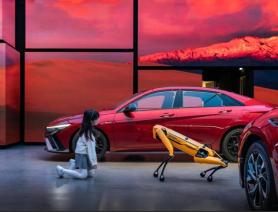
Hyundai Motor vehicles on display at the Hyundai Motorstudio in Goyang, Gyeonggi Province/ Courtesy of Hyundai Motor Group Editor's Note: This article is the first installment in our series on Asia's top 100 companies, exploring the strategies, challenges, and innovations driving the region's most influential corporations. SEOUL, January 2 (AJP) - South Korea’s automotive giant Hyundai Motor Group, which includes Hyundai Motor Co. and Kia Corp., is gearing up for a pivotal 2025 as it navigates mounting global competition and an industry-wide shift toward sustainable vehicles. Hyundai Motor Co. is making a strategic pivot, focusing on mid-to-large-sized electric vehicles (EVs) and next-generation hybrid models, moving away from its recent emphasis on smaller, affordable EVs. This shift highlights the firm's ambition to establish a stronger foothold in the burgeoning EV market, particularly in premium segments. Hyundai Motor plans to launch the Ioniq 9, its first large electric SUV, in the first half of 2025. The vehicle, unveiled in November at the Los Angeles Auto Show, is set to debut in South Korea and the United States before expanding into Europe and other markets. Kia will focus on expanding its purpose-built vehicle (PBV) lineup and affordable EV offerings. PBVs cater to niche markets with small-batch production designed for specific uses. The group's Chairman Chung Eui-sun has reaffirmed commitment to hydrogen energy as part of its long-term vision. Speaking at CES 2024 in Las Vegas, Chung emphasized the importance of hydrogen as a sustainable energy source, stating, “This transition is not for our generation but something we must prepare for future generations.” Hyundai Motor Group Chairman Chung Eui-sun greets visitors of Hyundai N x TOYOTA GAZOO Racing Festival held in Everland Resort in Yongin, south of Seoul, on Oct. 27, 2024. Yonhap Hyundai Motor named Jose Muñoz its first non-Korean CEO in November - a move widely viewed as a response to potential shifts in U.S. policy, particularly under a possible second Trump presidency. Trump has vowed to cut subsidies for electric vehicles, a significant concern for automakers like Hyundai and Kia. In another significant development, Chairman Chung recently met with Toyota Chairman Akio Toyoda at the World Rally Championship in Japan to discuss potential collaboration on hydrogen technology. Previously an automobile repair business, Hyundai Motor was officially founded in 1967 by Chung Ju-yung, Chung's grandfather, and released its first car Cortina In collaboration with Ford Motor Company in 1968. Hyundai Motor Group subsidiary Boston Dynamics' robot 'Spot' faces a young visitor at Hyundai Motorstudio in Hanam, Seoul/ Yonhap Hyundai Motor Group consists of about 70 affiliates, including Hyundai Mobis Co., Hyundai Steel Co., and Hyundai Engineering & Construction Co. In 2023, the group ranked third in global sales with 7.3 million units, trailing only Toyota (11.2 million units) and Volkswagen (9.2 million units). The group’s financial performance is equally robust. For the first three quarters of 2024, its auto units reported record-breaking cumulative sales of 208.9 trillion won (US$141 billion) and an operating profit of 21.3 trillion won. If only considering operating profit, Hyundai Motor Group surpasses Volkswagen as second place, 11.1 trillion won off from Toyota in first place. Hyundai Motor workers demonstrate the usage of exoskeleton robotics for assembling cars. Courtesy of Hyundai Motor Group Individually, Hyundai Motor Co. reported revenue of 42.93 trillion won and an operating profit of 3.58 trillion won for the third quarter of 2024. Compared to the same period of 2023, revenue increased by 4.7 percent, while operating profit decreased by 6.5 percent. Net profit declined by 3 percent to 3.21 trillion won. Kia reported all-time high revenue and profits for the third quarter. Revenue rose by 3.8 percent year-over-year to 26.52 trillion won, while operating profit rose 0.6 percent to 2.88 trillion won. Net profit increased 2.1 percent to 2.27 trillion won. Compared with the second quarter, sales and operating profit fell 3.8 percent and 20.9 percent, respectively. However, the group faces increasing challenges as global automakers strengthen their positions. Japan’s Honda and Nissan has announced plans to merge, aiming to finalize negotiations by mid-2025 and establish a holding company by 2026. Combined, the two companies’ sales would surpass those of the group's automaking units. In addition, the Korean automaker has experienced falling sales in key markets like the U.S. and China amid increased competition and changing consumer preferences. Global supply chain issues, such as the semiconductor shortage, have also impacted Hyundai's production and sales. Despite these challenges, Hyundai Motor Group has taken diverse measures to address them, such as investing in electric and autonomous vehicle technologies, expanding its product lineup, and strengthening its brand image. The company has vowed to overcome these troubles by improving its supply chain resilience and adapting to changing consumer preferences.