

Chey, who also serves as the chairman of the Korea Chamber of Commerce and Industry, met with Lam in Hanoi on Friday, according to a report by Viet Nam’s state-run news agency VNA.
“SK Group possesses world-class capabilities in the energy sector, and we seek to contribute to Viet Nam’s sustainable economic growth through enhanced collaboration,” Chey said.
In response, Lam expressed appreciation for SK Group’s achievements and Chey’s commitment to Viet Nam. “We highly value SK Group’s contributions and deeply appreciate Chairman Chey’s dedication,” he said.
Lam further noted that relations between the two countries are progressing well across all sectors and acknowledged the key role Korean companies, including SK Group, play in Viet Nam’s development through investments and business activities.
SK Group has been engaged in the Southeast Asian country’s renewable energy and resource circulation sectors. Since 2020, SK Innovation & E&S has been operating a 131MW solar power facility in the southern Ninh Thuan region and has also completed and is operating an offshore wind power plant.
SK Earthon, a subsidiary of SK Innovation, is helping search for oil and gas in a specific area off the coast of Viet Nam called Block 15-2/17, with the potential to extract natural resources from the ocean.
The meeting, held at the Central Committee headquarters in Hanoi, was also joined by Choo Hyeong-wook, CEO of SK Innovation & E&S, Park Won-cheol, CEO of SKC, Kim Jong-hwa, CEO of SK Energy, and Myeong Seong, CEO of SK Earthon.
Copyright ⓒ Aju Press All rights reserved.
Related News
-
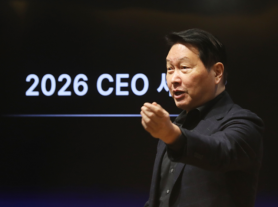 SK chief pushes AI flywheel strategy
SK Group Chairman Chey Tae-won speaks at the 2026 CEO Seminar in Icheon, Gyeonggi Province, on Nov. 14, 2026. Courtesy of SK Group SEOUL, November 15 (AJP) - SK Group Chairman Chey Tae-won has called on the conglomerate to redefine itself as an AI company, expanding beyond semiconductors into infrastructure, energy and AI services, according to SK Group on Sunday. Speaking at the group's annual CEO seminar held in Icheon from Thursday to Saturday, Chey urged executives to build an "AI flywheel" in which growth across interconnected businesses reinforces further expansion. "We must break away from existing business frameworks and redefine ourselves as an AI company," Chey said, calling for closer integration of AI chips, data centers, energy and services. Under the strategy, advances in AI semiconductors would drive the expansion of AI factories, generating greater demand for power infrastructure and AI services. That growth, in turn, would fuel further investment in advanced chips and computing infrastructure, creating a self-reinforcing cycle across SK hynix, SK Telecom and SK Innovation. The group also agreed to pursue "Portfolio Rebalancing 2.0," a restructuring initiative aimed at strengthening core businesses, improving financial efficiency and directing resources toward future AI investments. The initiative follows an earlier restructuring drive focused on divesting noncore assets. Executives also agreed to expand practical AI adoption across the group to improve productivity and profitability, building on initiatives such as SK hynix's AI-powered smart factories and SK Innovation's use of industrial data to optimize operations. "Nobody can do everything alone in the AI era," Chey said, emphasizing the need for open collaboration with global partners to accelerate growth.
-
 Smilegate divorce sets Korean tycoon record as SK chief partly yields
Smilegate founder Kwon Hyuk-bin speaks in an image posted by Yonhap News on November 12, 2025. Captured from Yonhap News' official Instagram account. SEOUL, September 09 (AJP) – South Korea saw its two biggest tycoon divorce battles move in opposite directions Wednesday, as Smilegate founder Kwon Hyuk-bin was hit with a record 2.55 trillion won ($1.8 billion) property-division ruling while SK Group Chairman Chey Tae-won moved to end most of his own dispute. The Seoul Family Court ordered Kwon to transfer about 2.55 trillion won in assets to his estranged wife, including a 35 percent stake in the privately held gaming company, setting a new record for a court-ordered divorce property division in South Korea. Hours later, Chey said he would no longer contest 700 billion won of the 944 billion won he was ordered to pay his former wife, Roh Soh-yeong, leaving only 244 billion won at issue before the Supreme Court. For a few months, Chey's case had defined the upper limit of how costly a South Korean divorce could become. Kwon's ruling has now pushed that figure well past 2 trillion won, just as Chey is seeking to draw most of his years-long legal battle to a close. The contrast extends beyond the size of the awards. Chey's obligation was structured as a cash payment, allowing him to retain the SK Inc. shares through which he exercises influence over the conglomerate. Kwon, by contrast, was ordered to hand over Smilegate shares themselves, potentially turning a marital property dispute into a direct question of corporate ownership. "The marriage has broken down to a point beyond repair," the Seoul Family Court said in granting the divorce. The court valued Kwon's Smilegate shares at about 7.1 trillion won and ordered him to transfer 35 percent of them to his wife, surnamed Lee. The shares are worth about 2.49 trillion won, while Kwon was also ordered to pay another 65 billion won in cash. The total property division amounts to roughly 2.55 trillion won. The award is more than two and a half times the 944 billion won ordered in July in the divorce of Chey and Roh, which had been South Korea's largest publicly known divorce property award. Unlike Chey, who was allowed to keep his SK Inc. shares and compensate Roh in cash, Kwon was ordered to divide the shares directly. The court said requiring the full amount in cash would be difficult because most of Kwon's wealth is tied up in company shares. If the ruling stands, Lee would become a direct shareholder in Smilegate. The court granted Lee's divorce petition but dismissed her claim for consolation money, finding that both spouses shared responsibility for the breakdown of the marriage. Lee filed for divorce in November 2022, about two years after the couple began living apart. She had sought half of Kwon's holdings, arguing that she held a 30 percent stake in Smilegate during its early years and served as a representative director and board member. She also said she contributed to the family's wealth through household duties and child care over more than two decades. Kwon argued that Lee had neither invested in nor worked for the company and therefore should not be considered a co-founder. The court nevertheless found the Smilegate shares subject to division, taking into account Lee's early involvement in the company as well as her contribution to the household and raising their children. The ruling is a first-instance judgment and can still be appealed. Key Developments in the Chey-Roh divorce case. Graphics generated by ChatGPT Chey scales back Supreme Court fight As Kwon's case set a new record, Chey moved in the opposite direction by sharply narrowing what had previously been South Korea's biggest divorce fight. Chey's lawyers filed a request with the court on Aug. 31 reducing the scope of his Supreme Court appeal, according to legal sources. Of the 944 billion won he was ordered to pay Roh in cash, Chey will no longer contest 700 billion won and will challenge only the remaining 244 billion won. Chey's side said the move was intended to narrow the years-long dispute and bring it to a quicker end while continuing to challenge any amount above 700 billion won. The decision sharply reduces the stakes in a legal battle dating back to 2017. Chey and Roh married at the presidential Blue House in 1988, during the presidency of Roh's father, former President Roh Tae-woo. Image generated by ChatGPT Their marriage publicly unraveled in 2015, when Chey disclosed that he had fathered a daughter with another woman. He sought divorce mediation in 2017, and Roh later filed a countersuit seeking damages and a share of his corporate wealth. The Seoul Family Court initially ordered Chey in 2022 to pay 66.5 billion won in property division, finding his SK shares were largely separate property. The Seoul High Court later raised the award to about 1.38 trillion won. The Supreme Court subsequently overturned the property-division portion of the ruling over its treatment of 30 billion won linked to former President Roh. On remand in July, the Seoul High Court excluded the disputed 30 billion won but still found that Roh had contributed to building and maintaining the couple's marital assets. It awarded Roh one-third of the couple's property, resulting in the 944 billion won cash payment. Chey appealed again last month. The Supreme Court fight will now center on the remaining 244 billion won. Among the outstanding questions is whether Roh's contribution should have been set at 33.3 percent even after the disputed 30 billion won was removed from consideration. The previous appellate court had assessed her contribution at 35 percent. Chey is also challenging the court's use of SK Inc.'s rising share price in calculating the divisible assets and argues that his stake in SK Siltron should not be included. The latter stake was acquired in 2017, after the marriage had effectively broken down, raising the question of whether it should be treated as property accumulated through the couple's joint contribution. The distinction underscores how differently the two divorce rulings reach into the corporate fortunes involved. Chey's 944 billion won obligation leaves his core SK ownership intact. Kwon's ruling, if upheld, would require him to surrender part of the company itself. On the same day that South Korea's costliest divorce became substantially more expensive, the man who previously held that distinction moved closer to bowing out of his own battle. AJP Takeaways - On September 9, 2026, the Seoul Family Court ordered Smilegate founder Kwon Hyuk-bin to transfer about 2.55 trillion won ($1.8 billion) in assets to his wife, including a 35 percent stake in Smilegate. - The Kwon Hyuk-bin ruling surpassed the 944 billion won property division ordered in the divorce of SK Group Chairman Chey Tae-won and Roh Soh-yeong, making it South Korea's largest publicly known divorce property award. - Kwon Hyuk-bin was ordered to transfer company shares directly, while Chey Tae-won's 944 billion won obligation is structured as a cash payment that allows him to retain his SK Inc. shares. - Chey Tae-won has accepted 700 billion won of the 944 billion won he was ordered to pay Roh Soh-yeong and will contest only the remaining 244 billion won before the Supreme Court.
-
 SK chief's lengthy divorce case nears end as appeal deadline looms
AJP Song Ji-yoon SEOUL, August 9 (AJP) - Attention is turning to whether the long-running property division dispute between SK Group Chairman Chey Tae-won and his wife Roh So-yeong will finally come to an end after nearly a decade. According to legal sources Sunday, the deadline for the estranged couple to file a final appeal against the Seoul High Court's ruling delivered late last month in the case, which was sent back to the appellate court for retrial, is approaching. In its ruling on July 24, the court ordered Chey to pay his ex-wife 944 billion won in property division. Chey and Roh have 15 days from receiving formal notice of the ruling to file a final appeal, with the deadline falling on Aug. 15. If neither side appeals, the ruling will become final. The deadline can be extended to the next business day if it falls on a Saturday or public holiday. In this case, the deadline would be Aug. 18, as Aug. 15, Liberation Day, falls on a Saturday and Aug. 17 is a substitute holiday. Their marital dispute began in 2017, after Chey revealed in December 2015 that he had a child out of wedlock and later filed for divorce when the couple failed to reach an agreement on the terms of their separation. In the first trial in December 2022, the court ordered Chey to pay Roh 100 million won in alimony and 66.5 billion won in property division. But in May 2024, the Seoul High Court sharply raised those amounts, ordering Chey to pay 2 billion won in alimony and 1.38 trillion won in property division, citing a 30 billion won slush fund that Roh’s father, the late former President Roh Tae-woo, had funneled into SK Group. But the Supreme Court ruled in October last year that the slush fund was illegal money and could not be counted as Roh's contribution to the couple's wealth. It upheld the 2 billion won in damages but sent the property division case back to the Seoul High Court for retrial. At the retrial on July 24, the appellate court ordered Chey to pay Roh 944 billion won in property division, again ruling that his SK shares were subject to division, but recalculating the amount as orderd by the top court, making it the largest divorce settlement in the country's history. If either side appeals, the case will once again be heard by the top court. Chey, the chief of the country's second-largest conglomerate after Samsung, married Roh in September 1988 and have three children between them. Now it remains to be seen whether the lengthy legal battle over the largest divorce settlement in the country's history will finally come to a close. AJP Takeaways: - The deadline for SK Group Chairman Chey Tae-won and his estranged wife Roh So-yeong to file a final appeal against the Seoul High Court's July 24, 2026, retrial ruling in their property division case falls on Aug. 18, 2026. - In its July 24, 2026, ruling, the Seoul High Court ordered Chey Tae-won to pay Roh So-yeong 944 billion won in property division, making it the largest divorce settlement in South Korean history. - The Supreme Court of South Korea ruled in October 2025 that a 30 billion won slush fund linked to Roh So-yeong's father, the late former South Korean President Roh Tae-woo, was illegal money and could not be counted as Roh So-yeong's contribution to the couple's wealth; the court sent the property division case back to the Seoul High Court for retrial while upholding a separate 2 billion won alimony award. - The property division dispute between Chey Tae-won and Roh So-yeong began in 2017, after Chey Tae-won disclosed in December 2015 that he had a child outside the marriage and later filed for divorce when the couple could not agree on separation terms. - If either Chey Tae-won or Roh So-yeong appeals the July 24, 2026, ruling by the August 18, 2026, deadline, the case will be heard again by the Supreme Court of South Korea; if neither appeals, the ruling becomes final.