

The tariffs, enacted through executive order last month, apply a uniform 25 percent duty on all imported steel and aluminum products, encompassing 253 derivative items.
The policy eliminates South Korea’s previous exemption quota, which had allowed the country to export 2.63 million tons of steel annually without tariffs. The measure marks a significant escalation from Trump’s first term, with aluminum duties rising to 25 percent from the previous 10 percent.
While 166 derivative products, including bolts, nuts, and springs, are now subject to immediate tariffs, duties on 87 items — such as automotive components, appliance parts, and aircraft components — have been temporarily postponed pending further guidance from the U.S. Department of Commerce.
Industry analysts suggest that while the removal of quota limits could offer South Korean steelmakers an opportunity to expand their U.S. market share, the 25 percent tariff remains a substantial barrier to competitiveness.
According to the International Trade Administration of the U.S. Department of Commerce, South Korea was the fourth-largest steel exporter to the United States last year, accounting for approximately $2.9 billion, or 9 percent, of U.S. steel imports — trailing only Canada, Mexico, and Brazil. Steel exports to the U.S. make up about 13 percent of South Korea’s total steel shipments, according to the Korea International Trade Association.
The steel and aluminum tariffs come ahead of Trump’s planned implementation of reciprocal tariffs on April 2, a policy that would adjust duties based on other countries' tariff rates and non-tariff barriers against U.S. goods.

Kim Dong-young
Kim Dong-young is a bilingual journalist at AJU Press (AJP), covering Korean tech, energy, and bio/pharma.
He reports from the field at events like CES and APEC, runs AJP's YouTube channels,
and is pursuing a master's at Sogang's MOT program.
Copyright ⓒ Aju Press All rights reserved.
Related News
-
 HD Hyundai rides shipbuilding super cycle with strategic moves
HD Hyundai Heavy Industries' large liquid hydrogen carrier/ Courtesy of HD Hyundai Heavy Industries Editor's Note: This article is the ninth installment in our series on Asia's top 100 companies, exploring the strategies, challenges, and innovations driving the region's most influential corporations. SEOUL, March 06 (AJP) - HD Hyundai Heavy Industries, a dominant force in global shipbuilding, recently secured a $314 million contract with Malaysia’s MISC for two Very Large Ethane Carriers (VLECs), reinforcing its leadership in high-value vessel construction. The deal underscores the South Korean shipbuilder’s continued strength in specialized ship manufacturing. Founded in 1972, HD Hyundai has evolved into an industrial giant, employing 15,000 workers across its 6.8 million-square-meter facility in Ulsan. The company ranks second worldwide in order backlog as of early 2025, strategically prioritizing high-value ships such as liquefied natural gas (LNG) carriers, petroleum product tankers, and eco-friendly vessels. Within South Korea, HD Hyundai commands an overwhelming 80.3 percent market share by vessel weight, far outpacing rivals Samsung Heavy Industries (11.9 percent) and Hanwha Ocean (formerly Daewoo Shipbuilding & Marine Engineering) at 5.4 percent. The competitive landscape is evolving, however, as HD Hyundai and Hanwha Ocean have set aside years of fierce rivalry to form a strategic partnership in naval vessel exports. Under this collaboration, HD Hyundai will lead surface vessel sales while Hanwha Ocean will focus on submarines, following a joint setback in 2024 when both firms lost a major Australian frigate contract to Japanese and German competitors. A submarine (HDS-2300) independently developed by HD Hyundai Heavy Industries/ Courtesy of HD Hyundai Heavy Industries As the shipbuilding industry rides a cyclical upswing, HD Hyundai has focused on securing contracts for high-value ships while maintaining financial stability, investing in technological innovation, and diversifying into defense projects. The company remains at the forefront of green shipping technology, delivering the world’s first methanol-powered container ship, "Laura Maersk," in September 2024, and securing orders for the world’s first ammonia-powered vessels a month later. Additionally, HD Hyundai has pioneered high-pressure direct injection ammonia dual-fuel engines and is spearheading technology verification for hydrogen carriers, slated for 2026. Autonomous navigation is another frontier where HD Hyundai is advancing rapidly. In 2024, its subsidiary, HD Hyundai Samho Heavy Industries, delivered the world’s first vessel equipped with an artificial intelligence-based engineer system for real-time monitoring of critical equipment. Meanwhile, its navigation technology subsidiary, Avikus, successfully developed an autonomous navigation assistance system for large commercial vessels and achieved a historic autonomous ocean crossing in June 2024. HD Hyundai's 2024 financial performance has been robust, with orders for 36 vessels securing a stable three-year production pipeline. The company’s emphasis on LNG carriers has been particularly lucrative, driving a fourfold increase in operating profit to 705.2 billion won ($525 million). Affiliate companies HD Hyundai Samho and HD Hyundai Mipo have also bolstered their order books, securing contracts for 43 and 97 vessels, respectively. Despite its success, HD Hyundai faces challenges, including rising raw material costs and supply chain vulnerabilities. The price of steel plates, a critical shipbuilding component, doubled in 2022 and remains volatile, pressuring profitability. Additionally, supply chain dependencies on Chinese materials create potential risks amid shifting international trade dynamics. Any downturn at major shipbuilders like HD Hyundai could have cascading effects on smaller suppliers and subcontractors. HD Hyundai's tanker/ Courtesy of HD Hyundai Heavy Industries Looking ahead, HD Hyundai is expanding its global partnerships, working with Shell on liquid hydrogen carrier development with an eye toward commercialization by 2030. Its parent company, HD Korea Shipbuilding & Offshore Engineering, is leading research into large liquid hydrogen tanks and cargo management systems, while HD Hyundai focuses on hydrogen engine development and vessel design. Digital transformation remains a key pillar of HD Hyundai’s strategy. HD Hyundai Global Service has partnered with Singapore’s Eastern Pacific Shipping to enhance maritime digitalization through AI-driven operational efficiency systems designed to reduce carbon emissions. The company is also collaborating with Woodside Energy, Hyundai Glovis, and Japan’s MOL on developing liquid hydrogen transportation infrastructure. HD Hyundai's booth at CES/ Courtesy of HD Hyundai HD Hyundai Heavy Industries' newly built VLEC at its Ulsan yard/ Courtesy of HD Hyundai
-
 Seeking to counter China, US looks to South Korea for naval shipbuilding
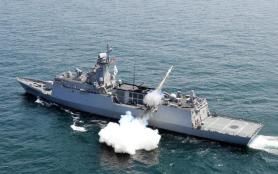
Guided missile destroyer USS Arleigh Burke (DDG 51)/ Courtesy of the U.S. Navy Editor's Note: This is the first in a series of stories examining how the Trump administration’s economic policies affect South Korea's key industries. From trade restrictions to shifting global supply chains, we explore the challenges businesses faced, how they adapted, and the lasting effects on the country’s economy. SEOUL, March 4 (AJP) - As the Trump administration presses ahead with its "Make America Great Again" agenda, the White House is looking to bolster the United States’ waning maritime supremacy — with an eye on South Korea. The U.S. shipbuilding industry has been in decline for decades, a trend set in motion by the Merchant Marine Act of 1920, known as the Jones Act, which fostered monopolies among domestic shipbuilders and eroded global competitiveness. Further restrictions, including the Byrnes-Tollefson Amendment of the 1960s, mandated that military ships and critical components be constructed domestically, exacerbating the sector’s stagnation. Meanwhile, China has tightened its grip on global shipbuilding, accounting for about 60 percent of worldwide orders in 2023. Analysts say that by the end of last year, China had surpassed the United States in total fleet size, fielding 234 vessels to the U.S. Navy’s 219. With domestic ship production amounting to just 0.4 percent of China’s annual output, Washington is turning to allies with robust shipbuilding capabilities. The administration has also announced plans to levy hefty fees on Chinese vessels entering U.S. ports, citing supply chain risks. A Navy frigate (FFX-I)/ Courtesy of HD Hyundai Heavy Industries South Korea, which led the global shipbuilding market in January 2025 with 62 percent of total compensated gross tons (CGTs) for 13 shipbuilding orders, has emerged as a key partner in the U.S. maritime revival. In a call on Nov. 7, Trump asked President Yoon Suk Yeol to strengthen cooperation not only in ship exports but also in maintenance, repair, and operations. One company at the center of these efforts is Hanwha Ocean, which recently acquired Philadelphia Shipyard through its subsidiary Hanwha Systems. Hanwha has secured two maintenance, repair, and operations (MRO) contracts with the U.S. Navy, including work on the 40,000-ton dry-cargo ship Wally Schirra and the U.S. 7th Fleet’s Yukon — developments that have heightened interest in the firm’s role. HD Hyundai Heavy Industries is also reportedly exploring investment opportunities in the United States. The company, which entered the MRO sector in 2022 through work with the Philippine Navy, is now considering investment in U.S. shipyards to expand its foothold. Both Hanwha and Hyundai secured Master Ship Repair Agreements (MSRAs) with the U.S. Naval Supply Systems Command this year, though these contracts remain limited to MRO. A new bill introduced by Republican senators on Feb. 5 could change that, potentially allowing the Pentagon to contract naval shipbuilding to allies with mutual defense treaties or NATO member states — an opening that could position South Korea as a builder of U.S. military vessels. The U.S. aims to construct 364 new warships by 2054, an effort estimated to cost $1.075 trillion, in a bid to counter China’s growing maritime power. Beyond naval projects, South Korean shipbuilders specializing in liquefied natural gas (LNG) carriers are also anticipating a market boom as the U.S. tightens restrictions on Chinese shipyards. Industry leaders, including HD Korea Shipbuilding & Offshore Engineering, Samsung Heavy Industries, and Hanwha Ocean, posted collective operating profits in 2024. With environmental regulations tightening and tariffs looming over Chinese-made vessels, analysts predict further gains for South Korean firms. Signs of this shift are already evident: German shipping giant Hapag-Lloyd is reportedly in the final stages of a $1.2 billion deal with Hanwha Ocean for six LNG dual-fuel container ships, choosing the South Korean firm over Chinese competitors, according to the shipping trade journal TradeWinds. Diplomatic engagements further underscore the sector’s importance. South Korea’s Minister of Trade, Industry, and Energy, Ahn Duk-geun, recently met with senior Trump administration officials to discuss shipbuilding cooperation, and U.S. Secretary of Defense Pete Hegseth is expected to visit Seoul in late March to advance talks. Even as Trump's 25 percent tariffs on steel and aluminum imports remain in place, South Korea and the United States have agreed to establish a consultative group to explore tariff measures and deepen cooperation in shipbuilding. LNG carrier Maran Gas Amphipolis delivered by Hanwha Ocean/ Courtesy of Hanwha Ocean
-
 Korea seeks trilateral partnership with US, Japan for Alaska gas project
South Korean Minister of Trade, Industry and Energy Ahn Duk-geun, right, meets with Doug Burgum, chair of the U.S. National Energy Council and Secretary of the Interior, in Washington, D.C. Feb. 28. Yonhap SEOUL, March 04 (AJP) - South Korea has expressed interest in joining Alaska’s natural gas development project, seeking a trilateral partnership with the United States and Japan, according to government sources familiar with the discussions, Tuesday. Industry Minister Ahn Duk-geun conveyed South Korea’s interest during meetings with U.S. Commerce Secretary Howard Lutnick and Doug Burgum, chairman of the White House National Energy Council, in Washington, D.C., from Jan. 26 to 28, officials said. The Alaska LNG project aims to transport natural gas from the Prudhoe Bay gas field on Alaska’s North Slope to Nikiski, near Anchorage, via a 1,300-kilometer pipeline, where the gas would be liquefied for export. The initiative carries an estimated price tag of at least $45 billion. U.S. President Donald Trump has made the development of Alaska’s natural gas resources a priority in his second term, signing an executive order to lift restrictions on energy development in the state. The move is part of a broader effort to bolster U.S. energy production. Japan has already signaled strong interest in the project. During a visit to Washington last month, Japan's Prime Minister Shigeru Ishiba discussed the initiative with Trump, who later highlighted it in a joint press conference. “The United States needs Korea’s participation because Japan alone cannot provide sufficient demand,” a senior South Korean government official said. “Korea has key technological advantages, from ice-breaking vessel construction capabilities to steel production, which are crucial for pipeline construction." South Korea and Japan rank as the world’s second- and third-largest importers of liquefied natural gas, following China. The U.S. share of South Korea’s LNG imports rose from 0.1 percent in 2016 to 18.5 percent in 2021, though it declined to 12.2 percent last year. The South Korean government is expected to assess the project’s viability carefully, weighing potential risks against opportunities for the country’s steel, shipbuilding, and construction industries. “The Alaska gas project is a key initiative for the U.S. government, as evidenced by the executive order,” the South Korean official said. “If we move forward in partnership with Japan, the project could become more viable. We plan to establish a working-level consultation channel with the United States to explore this further.”