
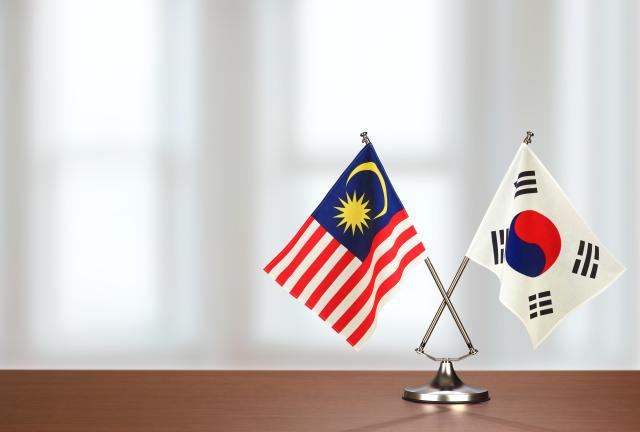
Roughly 70 officials from both nations are expected to participate in the eighth formal round of talks, which will run from Tuesday through Friday.
The South Korean delegation will be led by Kwon Hye-jin, the country’s chief trade negotiator, while Sumathi Balakrishnan, senior director at Malaysia’s Ministry of Investment, Trade and Industry, will head the Malaysian side.
They will seek to bridge remaining gaps across 10 priority areas, including trade in goods, services, and broader economic cooperation.
The push for a bilateral deal comes as both nations seek to insulate themselves from growing volatility in global trade. The ripple effects of the Trump administration’s tariff policies have led South Korea and Malaysia to pursue greater diversification of their export markets, South Korean officials said.
South Korea and Malaysia currently face steep levies of 25 percent and 24 percent, respectively, on certain exports.
For South Korea, the importance of Southeast Asian markets is becoming increasingly evident.
Exports to the Association of Southeast Asian Nations (ASEAN) nations outpaced those to China for two consecutive months this year. In February and March, South Korea exported $9.58 billion and $10.32 billion in goods to ASEAN, compared to $9.51 billion and $10.09 billion in exports to China during the same period.
“We will engage proactively in negotiations aimed at swiftly concluding a bilateral FTA with Malaysia to improve market access conditions for our businesses and help alleviate uncertainty,” said Kwon in a statement.

Kim Dong-young
Kim Dong-young is a bilingual journalist at AJU Press (AJP), covering Korean tech, energy, and bio/pharma.
He reports from the field at events like CES and APEC, runs AJP's YouTube channels,
and is pursuing a master's at Sogang's MOT program.
Copyright ⓒ Aju Press All rights reserved.
Related News
-
 Korea-China FTA Expands Economic Cooperation After 10 Years
The economic cooperation structure between South Korea and China has reached a turning point. While the Korea-China Free Trade Agreement (FTA), which took effect in 2015, laid the groundwork for expanding goods trade, the recent conclusion of follow-up negotiations on services and investment is expected to broaden the scope of economic cooperation between the two countries.According to the Ministry of Trade, Industry and Energy, the two countries declared a substantial agreement on the FTA services and investment follow-up negotiations during a summit held on November 18 at the Asia-Pacific Economic Cooperation (APEC) summit. This comes 8 years and 8 months after negotiations began in March 2018.Since the FTA took effect in 2015, the trade volume between the two countries, which was 227.4 billion dollars, is projected to increase by about 20% to 272.9 billion dollars by 2024. Last year, the trade volume also reached 272.7 billion dollars, indicating an expansion in economic cooperation.However, the trade environment surrounding the two countries has changed significantly over the past decade. In the past, South Korea exported intermediate goods, which China used to produce finished products, creating a division of labor. However, as China rapidly advances in technological independence and industrial sophistication, competition between the two countries' industries is intensifying. According to the Korea Chamber of Commerce and Industry, the share of South Korean products in the Chinese import market fell from 9.6% in 2018 to 6.3% in 2023.This is why there is keen interest in the conclusion of the follow-up negotiations. While the previous agreement focused on reducing tariffs on goods, this time the emphasis is on opening service markets and strengthening investment regulations in areas such as content, tourism, law, distribution, and finance. Lee Sang-hoon, head of the China team at the Korea Institute for International Economic Policy (KIEP), stated, "While it may be difficult to change the overall framework of Korea-China economic cooperation immediately, it could serve as an opportunity to expand cooperation from goods to services and investment in the long term."As of 2024, the scale of services trade between South Korea and China is only 38.8 billion dollars, which is just one-seventh of goods trade. While China accounts for 20.7% of South Korea's total goods trade, it only represents 12.4% of services trade. This indicates that there is still room to expand trade between the two countries in the service sector.In this negotiation, China promised to grant most-favored-nation treatment in the film and gaming sectors and to adhere to the principle of non-discrimination in content pre-review. In the tourism sector, domestic travel agencies established in 23 regions in China will be allowed to directly sell overseas travel packages to Chinese customers.In the distribution sector, domestic companies will now be able to operate more than 30 stores independently in China without needing to form joint ventures with local companies. In the construction sector, the removal of restrictions on projects that domestic companies can participate in has increased access to China's construction market, which is worth approximately 4 trillion dollars annually.China's push for a consumption and service-oriented growth structure through its 15th five-year plan (2026-2030) could also present new opportunities for domestic companies. If the consumption of Korean Wave content leads to tourism and exports of consumer goods such as K-beauty, food, and fashion, the opening of the service market could positively impact the expansion of goods trade.Another significant achievement is the shift from a positive list approach to a negative list approach for market opening. This means that all sectors will be opened in principle, with exceptions explicitly stated. A principle to prevent the re-tightening of regulations once they are relaxed has also been introduced.In the investment sector, the obligation to prohibit forced technology transfer has been codified. The scope of protection under the investor-state dispute settlement (ISDS) system has also been expanded to include stages prior to investment establishment.The government aims to have the follow-up agreement take effect next year. The two countries plan to formalize the agreement in the form of a revised protocol to the existing FTA. They plan to finalize the English agreement text by February next year after reflecting the final agreement details and adjusting the specifics.After that, it is expected to take at least five months to draft the Korean and Chinese agreement texts and go through the Ministry of Foreign Affairs treaty signing process and the Legislation Office review. The Ministry of Industry expects that formal signing could be possible in the second half of next year. After formal signing, the agreement will take effect following domestic procedures, including National Assembly ratification.However, even if the level of market opening in the agreement increases, it does not necessarily mean an immediate expansion of business opportunities for domestic companies. There is uncertainty about whether non-tariff barriers, such as China's licensing and review practices, will be effectively eased, and competition with local companies must also be considered.Lee noted, "As the technological competitiveness of Chinese manufacturing increases, there are movements to replace imported goods with domestic products within China, and the number of items competing between Korea and China in the global market is increasing. Given that China has indicated a direction to transition to a consumption and service-oriented growth structure, this agreement could help Korean companies enter the Chinese consumer and service market."* This article has been translated by AI.
-
Korean Cosmetics Surge for Second Day Amid Hopes for China-Korea FTA Agreement
Korean cosmetics are continuing to surge for the second consecutive day following news of the conclusion of service and investment follow-up negotiations for the China-Korea Free Trade Agreement (FTA). The increase in Chinese tourists and expectations for expanded exports of cosmetics to China are believed to have stimulated investor sentiment.According to the Korea Exchange, as of 9:24 a.m. on the 20th, Korean cosmetics were trading at 7,200 won (KRW), up 11.46% from the previous trading day. The day before, the stock closed at 6,460 won (KRW), marking a 29.98% increase and achieving the highest price limit in the securities market. Compared to the closing price on the 18th, this represents a 47.08% increase.The rise in stock prices appears to reflect expectations of benefits from the substantial conclusion of the follow-up negotiations for the China-Korea FTA. South Korea and China declared the substantial conclusion of the FTA service and investment follow-up negotiations during a summit held on the sidelines of the Asia-Pacific Economic Cooperation (APEC) summit on the 18th.This agreement allows Korean travel agencies operating in 23 regions in China to directly recruit Chinese group tourists and sell individual travel products. It also includes provisions that allow domestic companies to operate independently if they manage more than 30 stores in China.Korean cosmetics sell skincare and color cosmetics and operate a brand shop business through its subsidiary, The Saem International. The anticipated increase in domestic cosmetics consumption due to expanded tourism exchanges and the potential for expanding distribution networks in China are viewed positively.* This article has been translated by AI.
-
Korea-China FTA Agreement Sparks Cautious Optimism in Duty-Free and Beauty Industries
Expectations are rising in the domestic retail industry following the conclusion of subsequent negotiations on the Korea-China Free Trade Agreement (FTA). While the duty-free, fashion, and beauty sectors are keenly observing the potential easing of the Hallyu (Korean Wave) restrictions and the possibility of increased group tourists from China, there is also a cautious sentiment given that previous thawing moods regarding the restrictions have not led to substantial progress.According to industry sources on the 19th, Korea and China declared a substantive agreement on the follow-up negotiations for the Korea-China FTA service and investment during a summit the previous day. This marks the first significant agreement since negotiations began in March 2018, taking 8 years and 8 months. The agreement allows Korean travel agencies in 23 regions in China to directly recruit Chinese tourists and sell overseas travel packages.The duty-free industry is focusing on the potential for increased sales recovery due to the rise in Chinese group tourists. China is a major customer market for domestic duty-free shops, and an influx of group tourists could lead to increased purchasing demand at city duty-free shops. Before the THAAD incident in 2016, the number of Chinese tourists, including both individuals and groups, reached 8 million, but last year, the number of Chinese tourists visiting Korea was around 5.48 million.However, it remains uncertain whether the increase in foreign tourists will directly translate into improved sales for duty-free shops. According to the Korea Duty-Free Shops Association, the number of foreign buyers in September was over 1.266 million, a 25% increase compared to the same month last year, but foreign sales amounted to 751.4 billion won (KRW), a 3.8% decrease. The average spending per person also dropped by about 23%, from approximately 770,000 won (KRW) to 593,000 won (KRW).The distribution of spending by Chinese tourists to stores like Olive Young, Daiso, and Musinsa is also a variable. An industry insider stated, "While department stores and duty-free shops may benefit from an increase in Chinese tourists, the impact on duty-free shops may be limited. Instead, retail channels like Olive Young, Daiso, and Musinsa are expected to see greater benefits."Conditions for fashion and beauty companies entering the Chinese market are also expected to improve. This agreement allows domestic retail companies to operate stores independently in China without needing to partner with local firms when managing more than 30 stores. This expands the options for domestic companies based on their market entry strategies. The potential for expanding local store networks for Olive Young and Musinsa is also gaining attention.However, competition with local companies and political and diplomatic risks are expected to remain variables even after the easing of the Hallyu restrictions. Another industry insider remarked, "Even if stores are operated independently in China, succeeding in competition with local companies is not easy. If competitive Korean brands enter the market, there is a possibility that Chinese companies will quickly imitate their business models and expand throughout the region, making it crucial to secure differentiated competitiveness."Some are cautious, pointing out that expectations and disappointments regarding the easing of the Hallyu restrictions have repeated every time Korea-China summits or high-level meetings have taken place, suggesting that it is necessary to wait for actual follow-up measures to materialize.* This article has been translated by AI.