

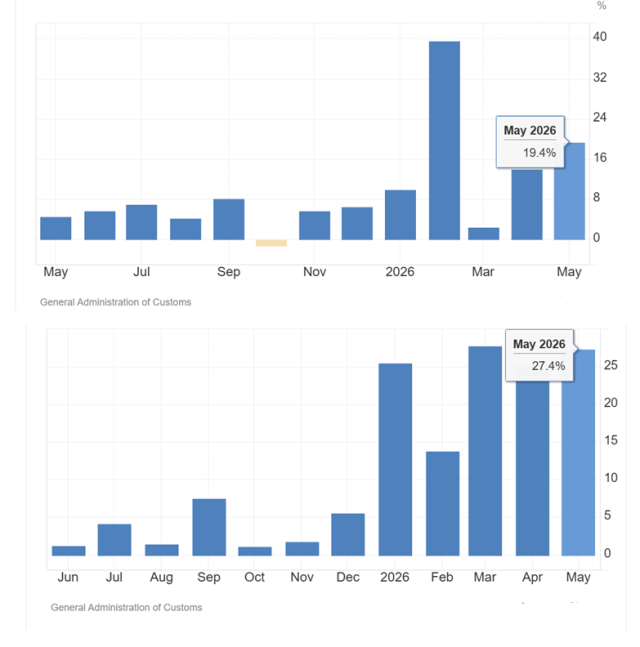
China's exports continued to exceed expectations in May, driven by a global boom in artificial intelligence (AI) investment and pre-orders related to the ongoing conflict in the Middle East.
According to the General Administration of Customs, exports in May rose 19.4% compared to the same period last year, surpassing the previous month's increase of 14.1% and exceeding Reuters' forecast of 15%.
Imports also saw a significant increase of 27.4%, exceeding both Reuters' estimate of 25% and the previous month's growth rate of 25.3%.
As a result, the trade surplus for May reached $105.4 billion (approximately 160 trillion won), surpassing Reuters' estimate of $92.1 billion and the previous month's surplus of $84.8 billion.
Analysts attribute the rise in exports to increased demand for electronics and information technology (IT) products driven by expanded AI investments. From January to May, China's semiconductor exports surged by 90%, while exports of automatic data processing systems rose by 38.7%.
The increase in imports is also linked to rising semiconductor prices due to the AI boom, as Chinese companies have ramped up purchases of foreign semiconductors and equipment. In fact, imports from South Korea during the first five months of the year increased by 56.5% compared to the same period last year, largely due to a spike in semiconductor imports. South Korea's semiconductor exports to China in May alone soared by 243% year-on-year.
Regionally, trade with the United States has declined due to ongoing trade tensions, but exports to Europe, Southeast Asia, and South Korea have significantly increased, supporting overall export growth. Specifically, exports and imports with the U.S. fell by 2.7% and 5.5%, respectively, while exports to Europe (up 16.4%), Southeast Asia (up 20.3%), South Korea (up 28.5%), Russia (up 26.4%), and Africa (up 25.8%) all showed double-digit growth.
However, it remains uncertain whether the current export boom will continue in the long term, as leading indicators of manufacturing activity show signs of slowing. China's manufacturing Purchasing Managers' Index (PMI) fell to 50.0 in May, the lowest level in three months. Notably, new export orders dropped sharply from 50.3 in April to 48.6, reflecting weakened overseas demand.
If export growth falters amid sluggish domestic demand and declining global demand, the downward pressure on the Chinese economy could intensify. This has led to speculation that Chinese authorities may introduce additional economic stimulus measures.
* This article has been translated by AI.

Copyright ⓒ Aju Press All rights reserved.