
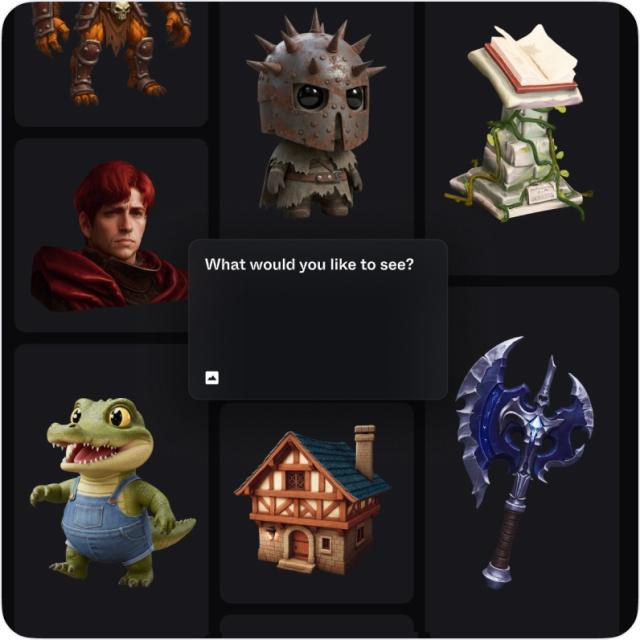
The new model builds on user feedback and in-house research gathered since the original Varco 3D launched last year, sharply boosting performance over its predecessor, the company said.
NC AI said Wednesday the upgrade tackles distortion of original shapes, long regarded as the biggest weakness of generative 3D AI, by faithfully preserving an image's silhouette and proportions while reproducing intricate ornamentation and fine structure with high accuracy.
Varco 3D 2.0 scored 0.449 on the Uni3D benchmark, an evaluation metric and standard used in artificial intelligence and computer vision, a 40.8 percent gain over version 1.1. The model supports textures of up to 4K resolution, rendering color, material and even wear with lifelike detail.
The tool can generate in about three minutes a 3D asset that once took an expert roughly four weeks to build, slashing data-construction costs and time, NC AI said. The model will be applied to the Varco 3D software-as-a-service platform in July, with existing users upgraded automatically.
"Varco 3D 2.0 will transform the working environment of content creators through unrivalled shape retention and high-quality texture expression," said NC AI chief executive Lee Yeon-soo, adding the company would grow it into core infrastructure for the era of physical AI and digital twins.
Kim Dong-young
Kim Dong-young is a bilingual journalist at AJU Press (AJP), covering Korean tech, energy, and bio/pharma.
He reports from the field at events like CES and APEC, runs AJP's YouTube channels,
and is pursuing a master's at Sogang's MOT program.
Copyright ⓒ Aju Press All rights reserved.
Related News
-
 Future of gaming in AI era, not new releases, dominates Nexon Developers Conference
Nexon Korea headquarters in Seongnam/ AJP Han Jun-gu SEONGNAM, June 16 (AJP) - Thousands of South Korean game developers flocked to Nexon's annual developers conference on Tuesday not to preview upcoming titles, but to confront a far more pressing question: what role humans will play as artificial intelligence increasingly learns to build games itself. At the 19th Nexon Developers Conference (NDC), which opened a three-day run at Nexon's Pangyo campus in Seongnam, discussions centered less on new releases than on how AI is reshaping one of the country's most important creative industries. The international conference hall across the road at the Gyeonggi Center for Creative Economy and Innovation was packed beyond capacity, with roughly a quarter of attendees standing throughout several sessions after seats ran out. The mood was both curious and uneasy. Visitors at the 19th Nexon Developers Conference wait in line for event pop-ups at Nexon Korea headquarters in Seongnam, June 16, 2026. AJP Han Jun-gu "Implementation is getting easier, but it is not only getting easier for us — it is getting easier for everyone," said Kang Dae-hyun, co-chief executive of Nexon Korea. As AI lowers technical barriers to game development, competitive advantages will increasingly come from human judgment and contextual depth that prompts alone cannot generate, he said. "A user's day is still 24 hours," Kang added, underscoring that the ultimate constraint is not technology but consumers' limited time and attention. The numbers illustrate the challenge. About 2,800 games were launched on Steam in 2015. By 2025, that number had surged to around 20,000. Yet only 608 titles released last year received more than 1,000 user reviews. Visitors passing by Nexon's Kartrider game characters at Nexon Korea's headquarters in Seongnam, June 16, 2026. AJP Han Jun-gu As AI writes more code and accelerates production, developers argued that human curation may become more valuable, not less. For many attendees, however, the concern was immediate and personal. South Korea's gaming industry is posting record profits while simultaneously shrinking its workforce, with AI sitting at the center of employee anxieties. A survey of 1,078 unionized employees at major publishers, including Nexon, NC and Netmarble, presented at a National Assembly forum in April found that 77.3 percent felt anxious about job security. While roughly two-thirds said they already use AI tools regularly and 80.3 percent acknowledged productivity gains, only 26.7 percent said management and labor had formally discussed how those gains should be shared. Their anxiety stands in sharp contrast to the industry's strongest earnings in years, particularly among publishers built around proprietary intellectual property. Artworks of Nexon's games hanging on walls at Nexon Korea's headquarters in Seongnam, June 16, 2026. AJP Han Jun-gu Nexon posted record first-quarter revenue of 1.42 trillion won ($938 million) and operating profit of 542.6 billion won, both quarterly highs, lifted by franchises including MapleStory and Arc Raiders. Krafton also logged record results, with revenue jumping 56.9 percent to 1.37 trillion won and operating profit rising 22.8 percent to 561.6 billion won as its PUBG franchise generated more than 1 trillion won in quarterly sales. The prosperity, however, has become increasingly concentrated. Studios with strong in-house intellectual property have widened their lead, while many mid-sized publishers lacking fresh hits have drifted toward losses, deepening the industry's reliance on a handful of blockbuster franchises. At the same time, companies have aggressively trimmed payrolls. NC reduced its workforce by 35.1 percent, from roughly 4,886 employees to 3,170, between 2024 and late 2025. Krafton accepted about 200 voluntary resignations since last November, while Nexon has largely frozen new hiring, according to industry observers. Research and development spending has also declined. A visitor takes photo of a painting in Nexon's game arts exhibition at Nexon Korea's headquarters in Seongnam, June 16, 2026. AJP Han Jun-gu Many visitors came precisely to navigate that uncertainty. Hwang Ji-gang, a 21-year-old game designer, said he attended to study live-service development strategies and was waiting for an afternoon panel featuring Kim Yong-ha, known among fans as the creative force behind Blue Archive. "AI often shows a lack of consistency in development," Hwang said. "I came to learn what improvements or countermeasures there are." Another attendee, Kim Jong-uk, 23, an aspiring developer, said he wanted to understand Nexon's long-term vision. "I came today to see Nexon's vision through the presentation sessions," he said. A surround sound booth showing footage of Neople's The First Berserker: Khazan at Nexon Korea's headquarters in Seongnam, June 16, 2026. AJP Kim Dong-young The conference reflected the industry's changing priorities. Sessions covered live-service operations, workplace AI agents and case studies on developing Arc Raiders, while speakers came not only from Nexon but also from Krafton, Roblox, NC AI, Google DeepMind and Snowflake. Their presence underscored how gaming is increasingly becoming a test bed for AI development itself. The industry is already producing both cautionary tales and success stories. Players discovered AI-generated artwork in Pearl Abyss's Crimson Desert, prompting an apology from the developer. At the same time, Nexon's Arc Raiders has earned praise for using procedural AI to enrich virtual environments. "AI output still reaches only about 90 percent of human quality," said Jung Nae-hun, a professor at the Tech University of Korea. "Studios tend to avoid using it for visible elements like characters or interfaces. When it slips through, it invites backlash." The expertise accumulated by Korean game studios is also attracting attention beyond entertainment. During a recent visit to Seoul, Jensen Huang met executives from Krafton and NC at gaming venues in Gangnam to explore how gaming engines and virtual-world technologies could help train so-called physical AI systems and humanoid robots. Nexon's art exhibition of its games at Nexon Korea's headquarters in Seongnam, June 16, 2026. AJP Han Jun-gu For Korean developers, the courtship offered a glimpse into a future where decades of game-building expertise may find applications far beyond games themselves. Back inside the conference halls, the NEXTAGE exhibition displayed sculptures, figurines and embroidered dolls inspired by MapleStory, Blue Archive and Mabinogi, returning offline for the first time in seven years. Nearby, in a darkened soundproof room, footage from The First Berserker: Khazan played through surround-sound speakers — a reminder that despite AI's rapid advance, some aspects of game-making still depend on human imagination. And that, perhaps, was the question hanging over NDC: not whether AI will build more games, but what kinds of creativity will remain uniquely human once it does.
-
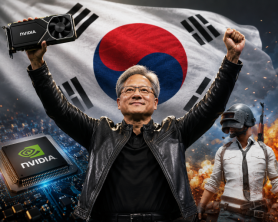 Nvidia CEO's Seoul trip signals shift from chip buyer to physical-AI partner
Image generated by artificial intelligence (AI). AJP Song Ji-yoon SEOUL, June 5 (AJP) - When Nvidia's CEO Jensen Huang stepped off his plane at Gimpo International Airport on Friday and made an esports cafe his first stop, the image was familiar: the chip merchant returning to the gaming culture that built him. The substance of this visit, however, points somewhere far off. This trip is less about who buys Nvidia's graphics cards than about who can help the company teach machines to act in the physical world. South Korea, a manufacturing power with chips, robots and factories in equal measure, is being recast from customer to co-developer. The pivot has a clear starting line. At the APEC summit in the southeastern city of Gyeongju last October, Huang unveiled a plan to deploy more than 260,000 Nvidia GPUs across South Korea, with Samsung, SK Group, Hyundai Motor Group and Naver each building artificial intelligence (AI)-dedicated factories to anchor the rollout. That announcement seeded the infrastructure. The current visit is about putting it to work, turning raw computing capacity into trained systems that can drive cars, run assembly lines and move robots through real space. The distinction matters because physical AI is where the next phase of the industry is being fought. Cloud-based chatbots run on data centers alone, but robots and self-driving cars must perceive, decide and act in a messy physical world, and the companies that can supply both the hardware and the real-world testing grounds stand to capture the value. Few countries pair those strengths as tightly as Korea. "Hyundai Motor has already said it would put Atlas to work on its factory floors. Korean firms are increasingly stressing automation through physical AI, embedding it in cars and then in humanoids," said Dr. Bum-jae You, principal research scientist and former head of humanoid development at the Korea Institute of Science and Technology. Nvidia's CEO Jensen Huang waves at Gimpo International Airport on June 5, 2026. AJP Han Jun-gu Nowhere is that clearer than at LG. Huang is expected to meet LG Group Chairman Koo Kwang-mo today, in talks centered squarely on physical AI, and the market has taken notice: shares of LG Electronics have more than tripled this year, hitting their daily limit twice on hopes of a deeper Nvidia tie-up. "LG isn't widely known for this outside the company, but internally it has been working on a mobile-controlled, two-armed home robot," said You. "Because it is a machine that could work in both factories and homes, it could stand out all the more as physical AI." LG Electronics has spent the past year pushing aggressively into the field, anchoring its effort on the AI home robot it calls CLOiD while developing actuators, robot sensing and smart-factory systems. It already runs Nvidia's Omniverse platform to build digital simulations of its own production lines. Those simulations are the heart of physical AI. Before a robot lifts a part or a car merges into traffic, it rehearses inside a lifelike digital twin, repeating the task through reinforcement learning across millions of virtual trials until the behavior holds up in reality. The conversation reaches well beyond a single company. Analysts expect cooperation to broaden across LG affiliates, drawing in the EXAONE generative model from LG AI Research, the semiconductor substrates and sensing technology of LG Innotek, and the AI cloud business of LG Uplus. Graphics by AJP Song Ji-yoon The visit also lands as Nvidia pushes into telecommunications, an arena some see as the connective tissue of physical AI. The chipmaker has been expanding an artificial intelligence—radio access network (AI-RAN) alliance with Nokia, a move expected to weigh on the choice of suppliers in Korea. "With Huang's visit, interest in AI-RAN is rising, as Nvidia focuses on expanding the business alongside data centers," said Kim Hong-sik, an analyst at Hana Securities. "The likely shape is a contest between a GPU-based Nvidia-Nokia camp and an Ericsson-Samsung approach built on CPUs with network solutions. More than market share, investors will watch how AI-RAN reshapes the equipment ecosystem, since it is likely to expand alongside the move to 5G standalone and 6G, completing the picture of physical AI." South Korea's other giants slot into the same logic. SK Group and Samsung Electronics supply the high-bandwidth memory that feeds AI accelerators and are building digital twins of their own chip lines, while Naver is converting a GPU supply deal into a deeper technology alliance. That last shift is telling. Naver Cloud said this week it would broaden its Nvidia relationship into a strategic alliance spanning AI infrastructure, models, services and physical AI, moving beyond a simple procurement arrangement. "Our partnership with Nvidia goes beyond a simple GPU supplier-and-customer relationship," Naver Cloud CEO Kim Yu-won said. "It is a strategic decision to develop AI technology together and expand the global AI ecosystem." Yet experts say Naver may be looking further ahead than simply becoming one of the country's top AI service providers. "Naver doesn't build physical robots, but its framework technology for orchestrating and operating fleets of robots is said to be quite advanced," said You. "Beyond AI data centers, there could well be talk of expanding into robot-framework services." Graphics by AJP Song Ji-yoon Even the gaming meetings that frame the trip belong to this thread rather than to nostalgia. Game studios have spent two decades building convincing virtual worlds, exactly the synthetic environments now prized as training grounds for physical AI. Krafton this year launched Ludo Robotics, a humanoid venture, and has woven Nvidia's ACE character technology into its PUBG and inZOI titles. NC, long a gaming partner of Nvidia, now develops a "world model" through its NC AI unit that teaches robots the laws of physics. The esports stop fits too. Korea turned competitive gaming into a national spectacle from the StarCraft era onward, an appetite that drove demand for graphics hardware and helped seed the computing culture Nvidia rode to dominance, and whose data-rich virtual arenas echo the simulations AI now learns from. In the evening, Huang is set to share grilled pork belly and soju with corporate heads including SK, LG and Naver at a restaurant near Hongik University, a sequel to last year's "chimaek" gathering over chicken and beer. The menu invites easy comparison with that earlier dinner, where the agenda does not: the chicken-and-beer night sealed Korea's role as a supplier of chips and memory, today’s is meant to bind the country into the harder, more lucrative business of making machines that think and move.
-
 Jensen Huang Discovers 'AI Cake' in South Korea, A Nation with All Five Layers
Graphic designer Song Ji-yoon Artificial intelligence (AI) is likened to a five-layer cake, a metaphor frequently emphasized by Jensen Huang, CEO of NVIDIA. During his four-day visit to South Korea, he appeared to discover this 'completed cake' in the country. NVIDIA views AI not as a single product but as a complex structure. The foundation consists of energy, followed by semiconductors, infrastructure that supports and drives the AI models, and finally, the application stage where economic value is generated. Huang believes that the demand across all application stages ultimately reaches the power plants. He asserts that the competition for supremacy in the AI era will hinge on the competitiveness of all five layers. Countries that possess all these layers are rare. China has vertically integrated energy, infrastructure, and applications, while the United States leads in advanced semiconductors and models. In contrast, Huang assesses that South Korea has the potential to fill all five layers. His enthusiasm throughout the tightly packed schedule supports this view. As he concluded his visit on June 10, Huang stated, "Now is your time. You must seize this opportunity." He added, "South Korea is in a very special moment, in a unique position." Building the Foundation with Energy and Infrastructure for AI Huang's agenda began at the bottom layer, focusing on energy and the physical infrastructure above it. However, the core emphasis was on 'cloud' services that provide computational power. SK Telecom plans to build a gigawatt-level AI cloud based on NVIDIA's DSX platform. The first AI factory is set to launch in 2027, providing sovereign and physical AI services domestically. Naver is also embarking on a similar phased expansion, starting with 55 megawatts in the first half of 2027, scaling to 100 megawatts that same year, and reaching 200 megawatts by 2028, ultimately aiming for gigawatt capacity. LG has joined the competition through LG Uplus, which will establish a large-scale AI data center based on NVIDIA DSX to accommodate the latest GPUs and support future AI cloud and GPU services. Its affiliate, LG Energy Solution, is developing an 800V direct current power system to power this initiative. These facilities are not traditional data centers but are referred to by NVIDIA as 'AI factories,' transforming power and data into tokens, the fundamental outputs of modern intelligence. This construction trend extends to the west coast. Huang expressed NVIDIA's willingness to participate in the AI data center project that Hyundai Motor Group is pursuing in Saemangeum. This marks a concrete manifestation of the infrastructure layer, with land, power, and cooling being realized in concrete, forming the physical foundation for the cloud services that SK Telecom, Naver, and LG will sell. Semiconductors: South Korea's Strongest Asset Graphic designer Song Ji-yoon South Korea's position in semiconductors, one layer above, is the most solid. NVIDIA and SK Hynix have established a long-term technological partnership to jointly develop memory across four NVIDIA platforms encompassing AI infrastructure, personal AI, and physical AI. This memory is designed to align with NVIDIA's computational roadmap rather than simply purchasing off-the-shelf products. After meeting with SK Group executives, Huang told reporters, "SK is our largest memory partner," and added, "We are expanding this collaboration into several new markets." Samsung Electronics marked the other end of his schedule. On the evening of June 9, Huang concluded his visit with a private meeting with Jeon Young-hyun, Vice Chairman of Samsung Electronics' Device Solutions Division. The two sides reportedly discussed broad cooperation encompassing next-generation high-bandwidth memory (HBM), advanced packaging, and foundry manufacturing. After the meeting, Huang returned to a recurring theme throughout his visit. He stated, "The next wave of AI is physical AI, where AI interacts with the physical world." He praised South Korea as a very unique country due to its social and cultural cohesion, noting, "Today, South Korea is a global leader in heavy industry and manufacturing." He added, "South Korea is also world-class in electronics, and interestingly, it ranks among the top in software and AI as well." He emphasized, "Countries excelling in manufacturing and heavy industry tend to be weak in software, and those strong in software often lag in heavy industry, but South Korea excels in all areas. It is a unique situation." AI Models: Homegrown Innovations The next layer, AI models, is often perceived as an area where South Korea relies on imports. However, this visit painted a different picture. NVIDIA and LG AI Research are collaborating to enhance EXAONE, one of South Korea's representative sovereign AI models. LG is training this model using NVIDIA's Blackwell GPU and NeMo framework, showcasing a homegrown model refined on Korean infrastructure. EXAONE is not alone. Naver possesses HyperCLOVA X, deeply rooted in the Korean language, while NC, highlighted by Huang for its technological prowess in gaming, has developed its own VARCO model series. Although many of the accelerators powering these major Korean AI models are foreign, there is a gradual shift toward domestic solutions. Applications: A Passion for Physical AI Above all these layers lies the application stage, which Huang sees as the realm where true economic value is generated and where his enthusiasm was most palpable. Huang stated, "South Korea excels in manufacturing, mechatronics, and AI, and the fusion of these strengths will make robotics and physical AI a major growth driver for the country." NVIDIA's concept of physical AI, particularly in robotics, led to the broadest collaborations during this visit. LG Electronics is considering applying NVIDIA's Isaac GR00T inference model to future home robots, while LG CNS is integrating NVIDIA technology into industrial automation and logistics systems. Doosan emerged as an unexpected beneficiary of this visit. The industrial group supplies advanced electronic materials used in AI accelerators and has established a reciprocal relationship by adopting NVIDIA's platform to develop and train its own robotic systems. Huang highlighted this relationship by throwing the first pitch for the Doosan Bears at Jamsil Baseball Stadium. Graphic designer Song Ji-yoon From Samgyeopsal to Shilla Hotel: A Journey Through the Ecosystem This tour itself reflected the breadth of the ecosystem NVIDIA perceives in South Korea. The itinerary began with a gathering over samgyeopsal and soju in Hongdae, attended by Chey Tae-won, Chairman of SK Group, Koo Kwang-mo, Chairman of LG Group, and Lee Hae-jin, founder of Naver. It continued with discussions on autonomous driving with Chung Eui-sun, Chairman of Hyundai Motor Group, memory negotiations at SK Hynix, and concluded with a meeting with Samsung Electronics' semiconductor division at the Shilla Hotel. As Huang prepared to leave Seoul, the 'five-layer cake' had evolved beyond a mere presentation slide. Energy was represented by South Korea's nuclear capabilities and the construction of AI factories, while semiconductors were embodied by SK Hynix and Samsung Electronics. Infrastructure was provided by SK Telecom, Naver, and LG, while models were represented by sovereign AIs like EXAONE and HyperCLOVA X. Applications were evident in various sectors, from autonomous vehicles to factory robots. Huang remarked, "South Korea is collaborating with NVIDIA across all layers of the AI ecosystem, from energy to semiconductors, infrastructure, robotics, and applications." His message to a country long identified solely as a semiconductor powerhouse was broader. South Korea's strength lies not in any single layer of the AI stack but in its rare ability to build nearly every layer independently.* This article has been translated by AI.