

Financial Services Commission Chairman Lee Eog-weon, Korea Exchange Chairman and CEO Jeong Eun-bo and other participants pose for a commemorative photo during the opening ceremony of Korea Premium Week 2026 at Lotte Hotel Seoul in Jung District, Seoul, Sept. 28, 2026.
Yoo Na-hyun
Photojournalist, AJU PRESS (AJP) Covering news, culture and society in South Korea through an Asian perspective.
Copyright ⓒ Aju Press All rights reserved.
Related News
-
 Global markets diverge amid AI concerns Q3: BOK
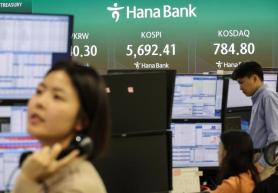
Employees work at a Hana Bank dealing room in Seoul on October 15, 2026. AJP Yoo Na-hyun. SEOUL, November 12 (AJP) — Global stocks and currencies have diverged while foreign investors continued to unloand Korean equities in the third quarter as doubts over artificial intelligence investment fueled risk aversion, according tko the Korean central bank Thursday. The Bank of Korea (BOK) in assessment on global finance said global risk aversion persisted amid concerns about the sustainability of AI investment even as uncertainty surrounding the Middle East eased. Major stock markets showed divergent performances, reflecting differences in their exposure to the AI investment cycle. The U.S. S&P 500 fell 1.7 percent from the end of September through November 10, while Japan's Nikkei 225 lost 9.4 percent and South Korea's KOSPI tumbled 23.4 percent. Britain's FTSE 100 gained 1.4 percent over the same period. The BOK attributed weakness in U.S. stocks partly to concerns over tighter regulations on data center construction following the midterm elections, while Japanese technology shares came under pressure from fears of slowing AI investment. Government bond yields generally declined as investors sought safer assets. The U.S. 10-year Treasury yield fell to 4.99 percent on November 10 from 5.28 percent at the end of September, while German and British yields also eased. The U.S. dollar strengthened, supported by better-than-expected employment data and expectations of tighter AI-related regulations. The dollar index rose 0.8 percent over the period, while the Japanese yen and euro weakened. In South Korea, foreign securities investment recorded a ninth consecutive month of net outflows, although the pace slowed as bond investment returned to positive territory. Net foreign portfolio outflows narrowed to $13.70 billion in October from $19.97 billion in September, according to the BOK. Equity outflows widened to $19.31 billion from $14.16 billion a month earlier as concerns over global AI investment profitability weighed on investor sentiment. Bond investment, however, swung to a $5.61 billion net inflow from a $5.81 billion outflow in September, supported by funds tracking the World Government Bond Index (WGBI) and improving short-term arbitrage incentives. The three-month arbitrage incentive turned positive at 2 basis points on average in October, compared with minus 31 basis points in September. Cumulative foreign securities outflows reached $160.75 billion in the first 10 months of 2026, driven overwhelmingly by equity withdrawals. The won nevertheless strengthened against the dollar, supported by increased dollar selling by exporters. The currency stood at 1,337.5 per dollar on November 10, compared with 1,352.8 at the end of September. It had strengthened to 1,334.3 at the end of October before giving back some gains. Currency volatility eased in October, with the won's average daily movement narrowing to 4.6 won from 7.0 won in September. Despite the continued portfolio outflows, the BOK assessed overseas borrowing conditions for Korean banks as broadly favorable. Short-term external borrowing spreads narrowed to 18 basis points in October from 27 basis points in September, although medium- to long-term spreads widened to 58 basis points from 40 basis points.
-
 Fed hike fears jolt Korean bonds, complicate BOK's choice
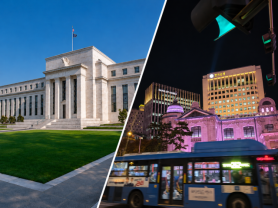
The U.S. Federal Reserve Board's headquarters in Washington, D.C. (left), and the Bank of Korea headquarters in Seoul on Nov. 3, 2026. Courtesy of the Federal Reserve Board (left) and AJP Kim Yeon-jae (right). SEOUL, November 11 (AJP) — The prospect of a bigger U.S. interest rate increase jolted South Korea’s bond market Wednesday, interrupting a rally and complicating the Bank of Korea’s decision on whether to tighten policy again this month. Stronger-than-expected U.S. inflation shifted investors’ attention from the fallout of the American midterm elections and uncertainty surrounding Nvidia to a more immediate threat: a possible half-percentage-point Federal Reserve rate increase in December. The three-year Korean government bond yield climbed 9.6 basis points to 3.729 percent, while the 10-year yield ended 10 basis points higher at 3.950 percent. Bond yields rise when prices fall. The moves followed a jump in U.S. Treasury yields as investors reassessed the scale of the Fed’s next move. The two-year yield rose nearly 18 basis points to around 4.73 percent, while the 10-year yield approached 5 percent. For Korean bonds, the selloff reversed part of a recent rally fueled by falling stock prices, demand for safer assets and expectations of reduced government bond issuance. The won and equities, however, moved in the opposite direction. The won closed 3.9 won higher at 1,333.6 per dollar, compared with Tuesday’s 3:30 p.m. close of 1,337.5. The benchmark KOSPI rose 2.60 percent to 5,375.36, while the KOSDAQ gained 5.62 percent to 705.10. The divergence suggested that investors were adjusting bond prices to higher U.S. rate expectations without staging a broad retreat from Korean assets. The trigger was Tuesday’s U.S. consumer price report. Headline inflation rose 0.4 percent in October from the previous month, exceeding the market forecast of 0.3 percent. Core inflation, which excludes food and energy, increased 0.3 percent against expectations of 0.2 percent, maintaining that pace for a third consecutive month. The figures reinforced expectations of a Fed increase at its December 8–9 meeting and revived debate over whether a quarter-point move would be enough. Fed Governor Christopher Waller had suggested that a half-percentage-point increase might warrant consideration if monthly core inflation remained around 0.3 percent or higher. "Hiking only 25 basis points would put our credibility at risk, a risk I am not eager to take," Waller said. The latest reading met that threshold, although a 25-basis-point increase remains the prevailing market expectation. For Korea, the immediate concern is how that repricing could affect foreign demand for government debt alongside the recent foreign selling of equities. Lim Jae-kyun, a bond analyst at KB Securities, said concerns about a larger Fed increase could weaken foreign purchases of Korean government bond futures. Higher yields could nevertheless offer opportunities to increase bond exposure. "Even without a 50-basis-point hike, upward pressure on yields is likely to persist through year-end," said Won Yoo-seung, a bond analyst at SK Securities. Edited and compiled by AJP. Graphics AI assisted. Won expects a quarter-point Fed increase in December, with both U.S. Treasury and Korean government bond yields remaining under pressure. That prospect complicates the Bank of Korea’s (BOK) final rate-setting meeting of the year on November 26. Holding steady would give policymakers more time to assess domestic risks, but could leave Korean debt facing stronger competition from higher-yielding U.S. assets. The BOK raised its base rate by 25 basis points in both July and August before holding it at 3.00 percent in October. It has kept further tightening on the table while assessing the effects of those increases. The Fed’s current target range of 3.75 to 4.00 percent already stands 0.75 to 1.00 percentage points above Korea’s rate. If the BOK holds this month and the Fed raises rates by a quarter point in December, the gap would widen to 1.00 to 1.25 percentage points. A half-point Fed increase would push it to 1.25 to 1.50 percentage points. A wider gap does not automatically weaken the won or trigger capital outflows. Wednesday’s currency gains underscored that exchange rates respond to more than interest rate differentials. But rising overseas yields can still push up Korean market borrowing costs even if the BOK leaves its own rate unchanged. Domestic inflation and household borrowing also give the central bank reasons to consider another increase. South Korea’s consumer prices rose 2.8 percent from a year earlier in October, remaining above the BOK’s 2 percent target. Bank household loans increased by 5 trillion won, sharply exceeding September’s revised 500 billion won gain, according to data released Wednesday. Yet further tightening would add to the burden on borrowers already struggling with interest payments. The BOK estimated in September that another 25-basis-point increase could add roughly 7 trillion won to annual household and corporate interest expenses. Delinquency among financially vulnerable self-employed borrowers had reached 12.71 percent in the second quarter. Uncertainty over global AI investment and semiconductor demand adds another reason for caution in an economy heavily dependent on chip exports. There may be some relief beyond December. "We maintain our view that the Fed will keep rates on hold after a December increase," said Park Sang-hyun, an economist at iM Securities. Park expects inflationary pressure to ease gradually as oil prices decline and wage growth slows, although persistent supply-side risks and strong investment demand could slow that process. For the BOK, however, the next decision comes before that outlook becomes clearer. Another increase could help restrain inflation and borrowing while deepening debt-servicing strains. A pause would buy time to assess domestic risks, but would offer no guarantee of stable financing costs. Wednesday’s bond selloff made that constraint clear: even if Seoul keeps its policy rate unchanged, borrowing in Korea can still become more expensive.
-
 AI shocks strengthen case for longer BOK pause
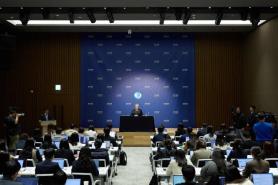
Bank of Korea Governor Shin Hyun-song answers reporters' questions during a press conference following the Monetary Policy Board meeting at the Bank of Korea's annex conference hall in Seoul on October 22, 2026. Courtesy of Bank of Korea. SEOUL, November 10 (AJP) – A pair of U.S. shocks — Democratic election victories in major data center states and a scandal engulfing Nvidia CEO Jensen Huang — is strengthening the case for the Bank of Korea to keep interest rates steady for longer as uncertainty clouds South Korea’s chip-driven economy. The won’s resilience offers policymakers some breathing room. Despite sharp equity market swings and continued foreign selling, the currency has held near its strongest levels in two years, cushioning imported inflation and giving the central bank more scope to assess whether the market turmoil will spill into the broader economy. The BOK held its benchmark rate at 3.00 percent in October after back-to-back increases in July and August and also retained a tightening bias, raising expectation for an increase in this year's final policy meeting on Nov. 26. That bet has sharply eased. The three-year government bond yield has averaged 3.678 percent so far this month, its lowest monthly average since May, when the base rate was still 2.50 percent. The 10-year yield has averaged 3.922 percent, down sharply from 4.464 percent in September following the two summer increases. The changing outlook reflects uncertainty over the industry underpinning much of Korea’s growth, exports and stock market gains. Democratic victories in Texas and Georgia have raised the prospect of tighter scrutiny of data center construction in two major U.S. development hubs. Texas Governor-elect Gina Hinojosa has called for extending a pause until lawmakers adopt new protections, while Georgia Governor-elect Keisha Lance Bottoms also campaigned for a moratorium. The election results increase the risk of delays, although campaign pledges have yet to become a uniform set of restrictions. For Korean chipmakers and AI infrastructure suppliers, the concern is whether tougher permitting rules, power constraints and political opposition will slow orders from U.S. hyperscalers and data center operators. An aerial view of Oracle's Stargate AI data center campus in Abilene, Texas, on July 15, 2026. Courtesy of Oracle. The KOSPI has fallen more than 12 percent since the midterm results, as foreign investors reassess Korea’s heavy exposure to the AI investment cycle. The controversy surrounding Huang has added a separate source of uncertainty at a company central to that cycle. Nvidia’s board said Sunday it had launched an independent investigation following reports that Huang had been targeted by a foreign intelligence effort. The board said it retained confidence in him and had no reason to believe national security or company secrets had been compromised. The investigation introduces uncertainty over leadership at a pivotal customer and partner for Korean chipmakers. Its implications for Nvidia’s operations and investment plans remain unclear, however, and it does not by itself establish that semiconductor orders will weaken, given the towering influence of Huang over management affairs. Together, the political and corporate shocks give the BOK more reason to examine whether the foreign exodus represents a repricing of expectations or an early warning of a broader slowdown in AI spending. A further rate increase while that distinction remains unsettled could add pressure to borrowers and domestic demand just as the export outlook becomes less predictable. Moreover, the won has been untouched by the storm. The currency closed at 1,337.5 per dollar Tuesday, remaining near October’s two-year highs. That resilience limits the additional inflation pressure that would arise if foreign equity selling were accompanied by a sharp depreciation. The Korea Institute of Finance (KIF) said Tuesday that large current account surpluses have helped offset foreign exchange pressures from direct and portfolio investment outflows, even as overseas investors reduced their holdings of Korean shares. The institute expects the surplus to widen to $563 billion in 2027 from an estimated $452 billion this year, supported by strong semiconductor exports and favorable trade prices. Those earnings provide a substantial currency buffer. "When the exchange rate climbed into the 1,360-won range Monday, exporters rushed to sell dollars, and foreign investors' stock-sale proceeds were not enough to offset that supply," said Min Kyung-won, an economist at Woori Bank. Equity volatility can weaken confidence and raise financing uncertainty, while a relatively firm currency helps contain the won cost of imported energy, raw materials and other goods. If that combination persists, the BOK would have more room to hold rates steady while assessing the effects of its earlier increases. The currency cushion nevertheless rests heavily on the same semiconductor cycle now unsettling investors. KIF estimates that the third-quarter merchandise trade surplus of $115.5 billion would have been about $47 billion without recent export and import price effects. The gap illustrates how favorable prices, including unusually strong semiconductor prices, have bolstered external earnings. A sharper downturn in AI investment could therefore weaken both growth and the currency support that currently makes a longer policy pause easier to contemplate. "If semiconductor demand falls sharply because expectations for AI profitability are revised or data center investment is delayed, the shock could spread beyond exports and investment to consumption," Kim Hyun-tae, head of KIF’s macroeconomic research division, said at a seminar in Seoul on Tuesday. Such a downturn could pressure the won through weaker export receipts and renewed foreign selling of Korean equities. The effects would not necessarily arrive together: share prices can adjust well before orders, export payments and corporate currency conversions. For now, continued semiconductor strength remains KIF’s baseline. The institute expects long-term memory chip contracts and firm export prices to sustain external earnings, with economic growth moderating to 3.1 percent next year from an estimated 3.8 percent in 2026. Domestic debt burdens add another reason for the BOK to proceed cautiously. In September, the central bank estimated that a 25-basis-point increase could add roughly 7 trillion won ($5.2 billion) to household and corporate interest expenses, although the actual impact would depend on loan repricing, economic conditions and policy support. The delinquency rate among financially vulnerable self-employed borrowers reached 12.71 percent in the second quarter, compared with 1.99 percent for self-employed borrowers overall. The vulnerable group comprised 411,000 borrowers, or 12.8 percent of the total, with outstanding loans of 119.2 trillion won. Edited and compiled by AJP. Graphics AI assisted. The BOK also found that delinquency pressures among vulnerable households and smaller firms tended to peak around nine months after rate increases, earlier than the roughly 15-month lag across overall bank lending. The full strain of the summer increases may therefore still lie ahead. That strengthens the argument for allowing more time to assess the existing tightening before adding to debt-servicing costs. Inflation still limits how far policymakers can relax. The BOK’s October assessment pointed to persistent price pressures, rising housing prices in Seoul and surrounding areas, and household debt risks. Its decision to pause left further increases on the table. KIF likewise expects inflation to ease to 2.4 percent next year from 2.7 percent in 2026, remaining above the BOK’s 2 percent target. Its forecast assumes a stronger won and lower oil prices, while its projected average three-year government bond yield rises to 4.1 percent from 3.7 percent. The case for a longer pause therefore depends on how the risks evolve. Persistent market volatility and growing uncertainty over chip demand would favor patience, particularly while the won remains firm enough to cushion imported costs.