
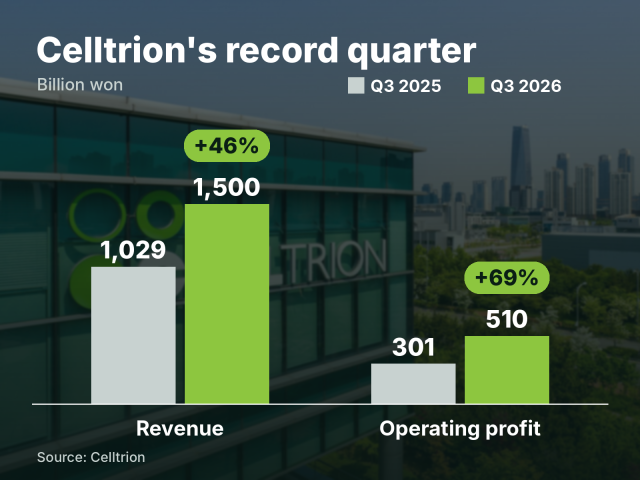
Celltrion on Oct. 12 earnings guidance filed its largest-yet quarterly operating profit of 510 billion won ($381 million) for the quarter ended September, up 69.2 percent from a year earlier, driven by higher-margin newer biosimilars. Revenue rose 45.8 percent on year to 1.5 trillion won.
The result marked the first time Celltrion’s quarterly operating profit topped 500 billion won and the third straight quarter it beat its own profit targets set early this year. Operating profit for the first nine months jumped 85.2 percent to 1.28 trillion won.
Kim Dong-young is a bilingual journalist at AJU Press (AJP), covering Korean tech, energy, and bio/pharma.
He reports from the field at events like CES and APEC, runs AJP's YouTube channels,
and is pursuing a master's at Sogang's MOT program.
Copyright ⓒ Aju Press All rights reserved.
Related News
-
 Celltrion's Q3 profit hits record on newer biosimilars
Celltrion's plant/ Courtesy of Celltrion SEOUL, October 12 (AJP) - Celltrion’s third-quarter operating profit surged 69.2 percent from a year earlier to a record 510 billion won ($380.3 million), powered by higher-margin newer biosimilars, the South Korean drugmaker said in a preliminary earnings filing Monday. Revenue climbed 45.8 percent to 1.5 trillion won, also a quarterly high, and the operating margin widened 4.7 percentage points to 34 percent. Quarterly operating profit topped 500 billion won for the first time since the company’s founding. Operating profit for the first nine months jumped 85.2 percent to 1.28 trillion won. Omlyclo, Celltrion’s near-identical version of the asthma and allergy drug Xolair, led gains in Europe. The drug is sold in 26 countries there and held more than 90 percent of Spain’s market as of July, according to local market data cited by the company. Steqeyma and Yuflyma, its versions of Stelara and Humira, took 15 percent and 11 percent of the U.S. market in August. Omlyclo launched in the United States this month as the first Xolair biosimilar there and won preferred status with a major pharmacy benefit manager. “We will do our utmost to achieve our fourth-quarter and annual business plans, building on growth drivers such as the U.S. launch of Omlyclo and expanded supply in Europe,” a Celltrion official said. AJP Takeaways - Celltrion reported preliminary third-quarter 2026 operating profit of 510 billion won on Oct. 12, 2026, up 69.2 percent from a year earlier and a quarterly record. - Third-quarter revenue rose 45.8 percent to 1.5 trillion won, and the operating margin widened to 34 percent, up 4.7 percentage points. - Celltrion beat its own quarterly profit targets for a third straight quarter and launched its omalizumab biosimilar Omlyclo in the United States in October 2026.
-
 Celltrion's Aptozma Approved for Pediatric COVID-19 Treatment in the U.S.
Celltrion's tocilizumab biosimilar, Aptozma, has been approved for use as a treatment for pediatric COVID-19 in the United States. On October 7, Celltrion announced that the U.S. Food and Drug Administration (FDA) has granted additional approval for the intravenous (IV) formulation of Aptozma for treating COVID-19 in children aged 2 and older. This expands the patient population eligible for Aptozma treatment from adults to include children and adolescents. Aptozma is a biosimilar of Roche's autoimmune disease treatment, Actemra. It works by blocking the action of interleukin-6 (IL-6), which triggers inflammatory responses in the body. Celltrion received approval for both the IV and subcutaneous (SC) formulations of Aptozma in the U.S. in January 2022. Since then, it has added indications for cytokine release syndrome (CRS) for the IV formulation and now for pediatric COVID-19. Aptozma is also approved in the U.S. for rheumatoid arthritis, giant cell arteritis, and polyarticular and systemic juvenile idiopathic arthritis. With the expansion of indications, Celltrion is expected to gain momentum in the market. The original Actemra generated approximately 2.47 billion Swiss francs (about $2.7 billion) in global sales last year. Market research firm IQVIA estimated the U.S. tocilizumab market size at around $1.978 billion (approximately 2.77 trillion won) last year. Since the IV formulation is administered directly by healthcare professionals in hospitals, prescriptions are likely to be concentrated in general hospitals and specialized medical institutions. Celltrion plans to increase prescriptions in the U.S. by expanding its connections with healthcare providers treating pediatric patients. A Celltrion representative stated, "With this additional indication, we can provide new treatment options for pediatric patients. We will strengthen communication with healthcare professionals to promote the expansion of Aptozma prescriptions in the U.S." Since launching its first biosimilar, Remsima, in 2012, Celltrion has been expanding its product lineup with subsequent biosimilars and new drugs. The company has also strengthened its local production base by acquiring a manufacturing facility in Branchburg, New Jersey. Earlier this year, Celltrion set a target of 5.3 trillion won in annual revenue and 1.8 trillion won in operating profit, expecting to exceed these goals.* This article has been translated by AI.
-
K-Bio Companies Samsung, Celltrion, and Lotte Target Global Contracts at Major Events
Korean pharmaceutical and biotech companies are set to participate in major events this month in Milan, Yokohama, and San Diego, aiming to secure global contracts. Samsung Biologics, Celltrion, and Lotte Biologics are focusing on contract development and manufacturing (CDMO) orders, technology transfers, and open innovation.According to industry sources, leading biotech firms kicked off their schedule on October 6 with the opening of 'CPHI Milan 2026' in Italy, followed by 'Bio Japan 2026' in Yokohama from October 7 to 9, and 'World ADC' in San Diego from October 12 to 15.The 'CPHI Milan' event, which runs until October 8, is the world's largest exhibition for pharmaceutical raw materials and production, featuring over 2,400 companies from more than 170 countries and attracting over 60,000 attendees.Samsung Biologics is showcasing its contract manufacturing organization (CMO) capabilities and next-generation modalities such as antibody-drug conjugates (ADC) and bispecific antibodies at its standalone booth. The company is also promoting its 'three-pillar' expansion strategy based on production capacity, portfolio, and global presence.Celltrion is hosting its own booth for the fifth consecutive year, complete with dedicated meeting rooms and lounges. The company is seeking partners for new drugs targeting cancer, obesity, metabolic, and autoimmune diseases while also diversifying its raw material supply chain and securing CDMO clients. Celltrion plans to expand its business from biosimilars to new drugs and CDMO services.Lotte Biologics is highlighting its dual-site production system, which connects its Incheon Songdo Bio Campus, recently approved for manufacturing in June, with its facility in Syracuse, USA. The Songdo plant is currently in the 'GMP ready' stage and is set to hold its completion ceremony in November.Additionally, GC Green Cross is promoting its plasma-derived products and vaccines, while Kolon Life Science is focusing on key raw materials for RNA therapeutics. Dongkook Pharmaceutical is seeking co-development partners for its long-acting drug delivery platform, 'DK-LADs'.'Bio Japan,' taking place in Yokohama, marks its 40th anniversary this year as Asia's largest biotech event, with over 1,000 companies participating. The event will focus on discussions around technology transfers and joint development through one-on-one partnering.Samsung Biologics, which has had a standalone booth for four consecutive years, emphasized its production capacity of 845,000 liters and its 'end-to-end' services from development to production during its opening day presentation. The company also announced research on optimizing ADC processes using computational fluid dynamics (CFD).Lotte Biologics will showcase its production efficiency technologies, including automated manufacturing systems, digital twins, and CFD simulations. Biotech firms such as Alteogen, LG Chem Bio, Peptron, G2G Bio, and Organoid Science are seeking technology transfer opportunities during partnering meetings.K-Bio companies are also heavily participating in international events focused on ADCs. Samsung Biologics is presenting its strategy for expanding ADC production capacity and research on bispecific ADCs, while Lotte Biologics will showcase its ADC platform technology. Kanaph Therapeutics, a new drug developer, will publicly present its antibody design strategy and preclinical data for its bispecific ADC candidate 'KNP-701' in collaboration with GC Green Cross.The industry is closely watching whether this three-week series of events will lead to year-end CDMO order achievements and technology export successes. A Samsung Biologics representative stated, "Through continuous participation in these events, we aim to showcase our differentiated production capabilities and technological expertise."* This article has been translated by AI.