

Robots perform during a special event marking World Failure Day at Galaxy Robot Park in Gangdong-gu, Seoul, on October 13, 2026.

Yoo Na-hyun
Photojournalist, AJU PRESS (AJP) Covering news, culture and society in South Korea through an Asian perspective.
Copyright ⓒ Aju Press All rights reserved.
Related News
-
 KAIST turns fat droplets into enzyme workbenches
Courtesy of KAIST SEOUL, November 26 (AJP) - By controlling which way enzymes face on the surface of a fat droplet inside yeast cells, a South Korean research team raised output of a natural pigment by up to 13 times, a result that puts enzyme orientation alongside enzyme placement in the design of microbes built to manufacture fragrances, cosmetics ingredients and drug materials. KAIST said Thursday that the technology came from Lee Ju-young's team at its Graduate School of Engineering Biology, working with Son Chang-yun at Seoul National University and Oh Seung-soo at POSTECH. The work was published in the journal Science Advances on Nov. 6. A microbial cell factory is a microbe engineered to produce a target substance as it grows. Inside the cell, enzymes, the proteins that drive chemical reactions, work in sequence, each one converting the material it receives and passing it along, much as workers on an assembly line each perform a single step before handing the piece to the next station. That chain falters when the substances change character along the way. A step that acts on a water-soluble compound and a step that acts on an oily one need different surroundings, and an enzyme sitting in the wrong part of the cell struggles to meet the material it is meant to work on. Yield falls as a result. The team looked for an answer at the lipid droplet, the small compartment a cell uses to store fat. Its core is oily, the cytoplasm around it is watery, and a thin lipid membrane separates the two, making the droplet surface one of the few places inside a cell where water and oil meet along a stable boundary. Lee's group treated that boundary as a workbench. The researchers designed a structure that anchors a protein to the droplet surface, then tuned it so an enzyme attached to it would point either outward into the watery cytoplasm or inward into the oil, according to the kind of material that enzyme handles. Son's team at Seoul National University (SNU) traced how the orientation control works at the level of individual molecules, using computer simulations. Son called the result an achievement that "successfully fused computational science and cell experiments." Applied to prodeoxyviolacein, a natural pigment that also serves as a pharmaceutical material, the method produced its largest gain when the enzymes acting early in the pathway were placed on the outer, watery side and those acting later were placed on the inner, oily side. Production rose by as much as 13 times. Clustering enzymes in one spot was not what delivered that. The gain came from matching each enzyme's position and facing to the chemistry of the material it works on, which turned a fat store into a space where a multi-step reaction could run without stalling between steps. How far the approach carries is still open. The results come from a single pathway in laboratory yeast, and the team said the effect has yet to be confirmed with other substances and under the large-scale culture conditions industrial production would require. Lee described the method as a design strategy that weighs the character of a cell's internal microenvironment together with the spatial arrangement of enzymes. "I expect this to open a new paradigm for precisely controlling the position and orientation of enzymes in synthetic biology and metabolic engineering," he said. Son So-hee at KAIST and Bae Sang-won, a doctoral student at SNU, were co-first authors, and KAIST's Mun Su-young was among the co-authors. The research was funded by the Ministry of Science and ICT and the National Research Foundation of Korea through programs on environmentally friendly chemical technology to replace petroleum, individual basic research, and the Boston-Korea joint research and development project. Journal/Source: Science Advances Title: Spatial control of enzyme orientation at lipid droplet interfaces enables regio- and chemo-selective metabolic flux Link/DOI: 10.1126/sciadv.aeg5924
-
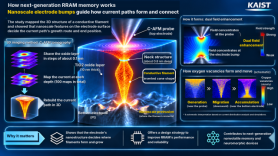 KAIST maps memory's hidden current path, finds what guides it
Courtesy of KAIST SEOUL, November 12 (AJP) - Tiny bumps on an electrode, far too small to see, can decide where electricity flows inside a next-generation memory chip, South Korean researchers found after reconstructing the chip's inner current path in three dimensions. KAIST said Thursday that a team led by Hong Seung-bum, a professor in its Department of Materials Science and Engineering, working with fellow materials science professor Park Sang-hee's group, observed the current path inside a resistive memory device in full and traced where it forms and connects to the shape of the electrode surface beneath it. The device they studied, called resistive random access memory (RRAM), stores information by creating or breaking a path for electricity inside a thin insulating material. When a fine conductive thread, known as a conductive filament, bridges the layer, current flows. When the thread breaks, current stops, and the two states store the digital values of one and zero. RRAM keeps data even when the power is off, has a simple structure and switches quickly, which makes it a leading candidate for next-generation storage. Researchers are also studying it for hardware that processes information the way the human brain does, a direction tied to artificial intelligence chips. The trouble is that the filament does not form in the same place or shape every time. When the path changes, the voltage needed to write or erase data changes with it, and the memory becomes harder to operate reliably. Knowing how the path takes shape is the starting point for fixing that. The team approached the question the way a CT scanner builds an image of the body, by stacking many cross-sections. Using the hard diamond tip of a conductive atomic force microscope, the researchers shaved a titanium dioxide layer 10 nanometers thick, removing about 0.1 nanometer per pass over 100 passes and mapping the current at each depth. One nanometer is one-billionth of a meter. Stacked together, the current maps revealed the filament's full shape. It was wide near the probe at the top and narrowed toward the platinum electrode at the bottom, like a funnel, with a sudden pinch just below the probe. The most striking result was where the filament ended. Its tip tended to land on nanoscale protrusions on the platinum electrode rather than on flat areas, a pattern the team confirmed across five filaments formed at different locations. Electrodes look flat to the eye, but at that scale their surfaces rise and fall. The researchers attributed the pattern to the electric field, which concentrates around pointed features in the same way it gathers at the tip of a lightning rod. Computer simulations backed the reading, showing the field strengthening around the protrusions on the bottom electrode as well as under the probe above, a double concentration that steers the filament's growth. The team also examined how current flowed within the filament. Titanium dioxide can lose oxygen atoms, leaving vacant sites that help carry current, and the researchers interpreted the current data as showing these vacancies gathering toward the filament's core near the bottom electrode. The pinch near the top, they said, could arise as new vacancies form while existing ones migrate downward. The work remains basic research. The team has not yet demonstrated that deliberately shaping an electrode can place filaments at chosen spots in a working device, and the behavior of the oxygen vacancies was inferred from current measurements rather than observed directly. If the bumps can eventually be controlled in manufacturing, filaments could be guided to form where designers want them, making write and erase operations more uniform. The team plans to test how the paths change across different electrode materials, surface shapes, oxide compositions and operating conditions. "This study goes beyond simply observing the three-dimensional shape of conductive filaments. Its significance lies in connecting their shape and end positions to the actual nanostructure of the electrode," Hong said. "If the surface structure of the electrode is considered as a design variable going forward, we expect this to become an important foundation for developing next-generation resistive memories that operate more reliably." Park Kun-woo, a student in KAIST's integrated master's and doctoral program, was the first author of the paper, and Hong was the corresponding author. The findings were published online in Nano Letters on Aug. 11. The research was supported by a National Research Foundation of Korea grant and an industry-academia project with Samsung Electronics' Device Solutions Division. Journal/Source: Nano Letters Title: Three-Dimensional Visualization of Conductive Filaments in TiO2 via Conductive Atomic Force Microscopy Tomography Link/DOI: https://doi.org/10.1021/acs.nanolett.6c02423
-
 KAIST rewrites file system to unclog next-generation flash storage
Courtesy of KAIST SEOUL, November 11 (AJP) - Next-generation flash storage can run up to three times faster with a software fix alone, KAIST researchers have found, after tracing the technology's performance bottleneck to the computer's central processor rather than the storage hardware itself. KAIST said Wednesday that a team led by Won You-jip, a professor in its School of Electrical Engineering, identified the software chokepoint and developed a new file system technology called GAZE to remove it. A file system is the software that decides where a computer stores files and how it reads and writes them. The work targets Zoned Namespace, or ZNS, flash storage, a next-generation design that divides storage space into large sections called zones and records data in sequence. The approach lightens the management burden inside the storage device, but it hands the host computer a demanding job in return. To reuse space, the operating system must move the data worth keeping out of a zone and reclaim the emptied area, a routine known as garbage collection. Existing file systems were built to clean up relatively small areas at a time. On ZNS devices, a single cleanup can involve moving hundreds of megabytes to several gigabytes of data, which stretches cleanup times and delays other data work. When the team measured the problem, cleaning a one-gigabyte zone took about 1.7 seconds. Most of that burden came not from the storage device but from the central processing unit, which accounted for about 73 percent of the processing load in the read stage and about 84 percent in the write stage as it tracked data status and managed memory. Faster storage hardware alone could not solve the problem. GAZE reworks the cleanup in three ways. It splits the job of checking, reading and rewriting data into four stages that run at the same time, like a factory production line, instead of one after another. It sets aside dedicated memory for cleanup in advance rather than requesting new memory for every task. And instead of freezing all incoming writes until cleanup finishes, it keeps accepting the write requests that can wait in memory. The team built GAZE into F2FS, the file system that manages flash storage on the Linux operating system, and tested it under a range of workloads. Compared with the existing ZNS version of F2FS and earlier research prototypes, data throughput rose by as much as three times, and garbage collection time fell to about a third of the baseline. The technology requires no new dedicated hardware and no change to the format of the data written on the device, which means it can be adopted through software alone. The researchers said its core design principles could also carry over to other log-structured file systems, which record new data in sequential layers. The gains matter most where storage must feed large volumes of data without pause, including data centers and artificial intelligence inference, the process by which a trained AI model produces answers. However fast a processor runs, its output slows if it sits waiting for data. The study measured file system performance, and whether the technology shortens actual AI response times remains to be verified in deployment. "For AI to answer quickly, supplying the needed data on time matters as much as computing power," Won said. "We expect this technology to become a foundation for faster AI inference by cutting the time and waiting that storage cleanup consumes." KAIST postdoctoral researcher Kim Ju-won was the first author of the study, with master's student Yoo Hwan-seok and doctoral student Yoo Seung-won as co-authors and Won as corresponding author. The research was supported by the National Research Foundation of Korea, the Institute of Information and Communications Technology Planning and Evaluation, and SK hynix. The results were presented on Sept. 30 at ACM SOSP 2026 in Prague, one of the top international conferences in operating systems research. Journal/Source: ACM SOSP 2026 Title: GAZE: Rearchitecting Log-Structured Filesystem for Garbage Collection on Zoned Namespace Flash Storage Link/DOI: 10.1145/3830418.3843870