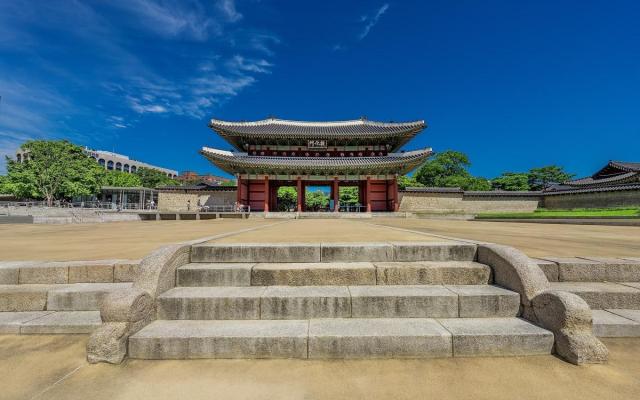
Changdeokgung was inscribed on the UNESCO World Heritage List in 1997.
The Royal Palaces and Tombs Center under the Korea Heritage Service said Monday that workers will begin removing roof tiles from Donhwamun this month as part of an extensive restoration project expected to continue through 2028.
Donhwamun, the main entrance to Changdeokgung Palace in central Seoul, is believed to be the oldest surviving main gate of the country's royal palaces.
Originally built in 1412 during the reign of King Taejong of the Joseon Dynasty, the gate was destroyed during the Japanese invasions of Korea in the late 16th century and rebuilt in 1609.
The two-story structure, designated a national treasure in 1963, measures five bays across and two bays deep and is regarded as the largest surviving palace gate in Korea.
The restoration comes after repeated safety inspections identified structural problems.
A 2014 inspection found structural problems, while follow-up checks between 2020 and 2022 repeatedly showed that the gate was in poor condition and needed repairs.
Experts warned in 2022 that damage to the building's interior and exterior could develop into structural deterioration and called for prompt measures, including dismantling and repairing sections of the upper roof.
The upcoming work marks the first large-scale restoration of Donhwamun since 1997.
Workers will first remove the roof tiles to inspect the condition of the structure and determine the extent to which key components have been deformed. Experts will then decide which parts should be replaced or reinforced.
Major wooden components, including rafters and purlins, will subsequently be dismantled in stages.
Officials also plan to conduct detailed measurements of individual components, document the gate's traditional decorative coloring and use tree-ring dating to study the age of wooden materials.
About 13.5 billion won (US$9.9 million) will be spent on the restoration, which is scheduled to be completed around October 2028. The timetable could be extended if inspections after dismantling reveal that more extensive repairs are required.
During construction, visitors will enter Changdeokgung through Geumhomun Gate and a nearby secondary entrance instead of Donhwamun.
The restoration site will be opened to the public twice a month starting Nov. 25 through an advance online reservation system. A viewing area has also been installed inside the temporary structure surrounding the construction site.
The Royal Palaces and Tombs Center said the project is intended to restore the original form of the aging and deformed gate, improve visitor safety and preserve the historic value of the national heritage site.
Changdeokgung served for centuries as one of the principal royal residences of the Joseon Dynasty and is particularly noted for the way its architecture blends with the surrounding natural landscape.
Copyright ⓒ Aju Press All rights reserved.