
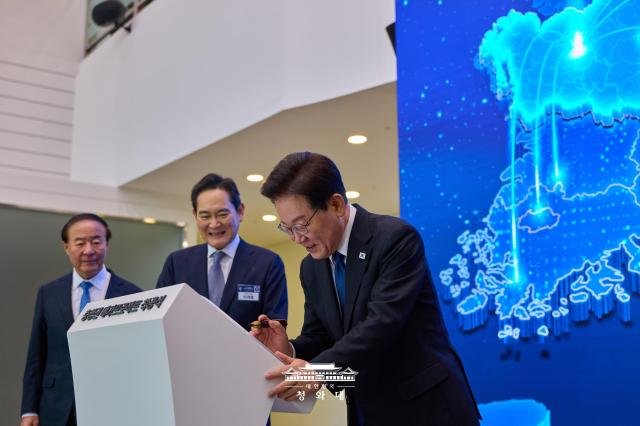
SEOUL, November 13 (AJP) - President Lee Jae Myung called Friday for measures to encourage corporate takeovers and urged lawmakers to resolve a dispute over mandatory tender offers without further delay, arguing that a more active market for mergers and acquisitions would benefit shareholders.
Speaking at a capital market policy meeting at the Korea Exchange in Seoul, Lee said facilitating takeovers, including hostile bids, could help address what he described as the abnormal undervaluation of Korean companies.
The debate centers on how much stock buyers should be required to purchase when acquiring control of a listed company, and whether controlling and minority shareholders should have equal opportunities to sell.
A proposal before the National Assembly would require buyers acquiring at least 25 percent of a listed company and becoming its largest shareholder to offer to raise their holdings to at least 50 percent plus one share, including shares already acquired.
Critics argue that allowing buyers to purchase the controlling shareholder’s entire stake first leaves minority investors with fewer opportunities to sell at the same takeover premium. Alternatives include requiring an offer for all remaining shares or allocating purchases proportionally among controlling and minority shareholders.
Lee indicated that he leaned toward encouraging dealmaking to expand the market’s overall value, while acknowledging that the competing interests required further political discussion.
“The party will need to continue its discussions, and I hope there will not be too much delay,” Lee said.
He held an impromptu vote among participants on the competing approaches. A proposal retaining the 50-percent-plus-one-share threshold while applying proportional allocation equally to controlling and minority shareholders drew relatively strong support.
Lee did not announce a final decision on the purchase threshold or allocation method.
He separately urged officials to examine mechanisms that obstruct hostile takeovers and consider whether listed companies effectively operated as their owners’ private businesses should remain on the market.
The Financial Services Commission has favored proceeding with the parliamentary compromise, saying the effects on minority shareholders and dealmaking could be assessed before considering broader purchase requirements.
Korea introduced a mandatory tender-offer rule in 1997 but abolished it in February 1998 amid concerns that it would impede acquisitions and delay corporate restructuring. The current debate revisits the tension between giving minority investors access to takeover premiums and limiting the cost of acquiring corporate control.
Lee Jung-woo
I studied philosophy in college, and sociology and journalism in graduate school. I cover North Korea, South Korean politics, foreign affairs and films. I enjoy Nordic cinema, Indian cuisine and Japanese detective novels. I have a cat and like bright, acidic coffee.
Copyright ⓒ Aju Press All rights reserved.
Related News
-
 President Lee Jae-myung: Migrant Workers Are Colleagues and Neighbors Who Deserve Respect
President Lee Jae-myung is donating winter clothing to migrant workers as the cold season approaches. He emphasized that migrant workers are colleagues and neighbors who contribute to our industries and communities, and he promised to ensure a safe working environment.On November 10, President Lee posted on X (formerly Twitter) under the title "We will spend a warm winter with migrant workers by our side," stating, "The campaign to share with migrant workers has been ongoing across the country, and on the 15th, various organizations in Ulsan will come together to deliver winter clothing and work uniforms. I also plan to send winter clothing to contribute a small gesture of kindness."He added, "Winter feels particularly cold for those who have left their hometowns and families to come to a foreign land. While a single piece of clothing may not block out all the cold, I believe the warmth contained within it will last for a long time."President Lee remarked, "Migrant workers are our colleagues and neighbors who help build our industries and communities. Regardless of nationality or language, the value of labor is the same. The government will ensure that everyone can work safely and be respected."He shared an article about the government's crackdown on fraudulent applications for housing in major regulated areas, revealing that 354 cases had been identified. He warned, "If confirmed as fraudulent, there will be criminal penalties and significant financial losses, including cancellation of winning applications."He assured that comprehensive investigations would continue, stating, "We will create a sensible country where those who break the rules cannot benefit, and those who follow the rules do not suffer losses."Regarding claims circulating online that individuals can receive a combined 1.2 million won in living and housing benefits by being homeless at Seoul Station, he pointed out, "Distorted information can misrepresent policies meant to help those in need."President Lee stated, "Incorrect information can distort not only simple misunderstandings but also judgments about policies. Claims not based on facts should not obscure the intent of welfare systems or hinder necessary discussions."* This article has been translated by AI.
-
Lee Yong-cheol Delays Response on Prosecutorial Discretion in Lee Jae-myung Case
Lee Yong-cheol, the nominee for Minister of Justice, has postponed his response regarding whether he will direct the cancellation of charges in the criminal case involving President Lee Jae-myung. He indicated that clarifying the allegations of fabricated indictments is a priority, leaving observers eager to see how he will address the possibility of charge cancellation based on the special prosecutor's investigation results.On the morning of November 10, while on his way to the Defense Acquisition Program Administration in Gwacheon, Lee was asked by reporters if he intended to direct the cancellation of charges based on the findings of the investigation. He replied, "It seems that the hearing preparation team will be ready tomorrow, and I will speak then."He did not respond to questions regarding his views on criticisms of the special prosecutor's investigation into fabricated indictments or his assessment of the investigations into the Daejang-dong development scandal and the Ssangbangwool North Korea remittance case before entering the government building.Lee, who is currently the head of the Defense Acquisition Program Administration, was originally scheduled to work there until November 11 before starting at the hearing preparation team on November 12. He is now considering moving his first day of work to November 11.The day before, Lee also refrained from clearly stating his position on directing the cancellation of charges. He explained that the president had suggested to the National Assembly to focus on clarifying the facts, excluding the transfer of existing cases to the special prosecutor, and that the National Assembly had enacted the special prosecutor law accordingly. He added, "It is correct to focus solely on clarifying the facts," emphasizing that other matters should be handled according to law and principle.This stance differs from that of his predecessor and previous nominee, Jeong Seong-ho, who stated that neither the Ministry of Justice nor he had considered charge cancellation. Kim Seung-won, a member of the Democratic Party who was nominated but withdrew, also indicated he had no intention of directing charge cancellation through the Prosecutor General.The People Power Party criticized Lee's remarks, suggesting they leave open the possibility of charge cancellation in the president's case. However, Lee has not expressed any intention to direct such a cancellation thus far.The controversy stems from the special prosecutor law that passed the National Assembly on November 6. The investigation targets include allegations related to the Daejang-dong, Wirye, and Baekhyeon-dong developments, as well as the Ssangbangwool North Korea remittance case. Although provisions regarding the decision on whether to maintain charges for existing cases were removed, debates continue over how the findings of the fact-finding investigation will impact the handling of these cases.Lee actively rebutted criticisms regarding his alleged involvement in the Daejang-dong scandal and claims that his appointment was due to his friendship with the president.He explained that the circumstances surrounding the appointment of Yoo Dong-kyu, the former head of planning at the Seongnam Urban Development Corporation, were unrelated to the Daejang-dong project at the time of his appointment in 2010. Regarding the Daejang-dong project itself, he stated, "I know very little about it, both then and now."In response to claims that Yoo had engaged in high-stakes gambling with him, Lee denied the allegations, calling them "malicious slander," asserting that he has never participated in high-stakes gambling beyond occasional recreational activities with family or friends.When questioned about the suggestion that his long-standing friendship with the president influenced his appointment, he countered, "Friendship itself is not a disqualification for a minister." He argued that if appointments were made solely based on friendship, it would be problematic, but one cannot deem someone unqualified merely for having a friendship.Addressing concerns about his lack of experience in legal administration, he highlighted his experience in judicial reform and prosecutorial reform issues. He stated, "I will utilize my 30 years of legal experience and administrative experience leading the Defense Acquisition Program Administration to address any shortcomings."* This article has been translated by AI.
-
Oh Se-hoon Criticizes Lee Jae-myung's Special Prosecutor Bill as Judicial Overreach
Oh Se-hoon, the mayor of Seoul, urged on November 6 for the ruling Democratic Party to halt its push for a "manipulated indictment special prosecutor law," calling it a "final version of privatizing the judicial system for President Lee Jae-myung."In a Facebook post titled "Is President Lee Jae-myung Dreaming of an Absolute Monarchy Like in the Joseon Dynasty?" Oh criticized, "While housing prices and rents are skyrocketing, and citizens are struggling to make ends meet, the ruling party seems completely indifferent to the people's livelihoods."He expressed dismay at the current situation, stating, "It is unacceptable that all efforts are focused solely on eliminating the president's trial risks," labeling the special prosecutor as a "judicial defense mechanism exclusively for the president." Oh's main concern extends beyond the removal of the indictment cancellation clause to the issue of conflicts of interest. He argued, "The structure where the president is the subject of the investigation and appoints the special prosecutor remains unchanged," suggesting that this raises suspicions that the investigation results could be used to overturn existing indictments and trials against the president.The bill that passed through the legislative committee allows the Democratic Party, the People Power Party, and the largest opposition party, the Justice Innovation Party, to each recommend one candidate for the special prosecutor, who will then be appointed by the president. Although the president does not choose candidates arbitrarily, the controversy lies in the fact that he ultimately selects the special prosecutor who will investigate cases related to him.However, it is necessary to distinguish between the allegations of crimes against President Lee and the accusations of manipulated investigations and indictments by the prosecution. The Democratic Party argues that the legislation aims to clarify whether there were illegal acts during the investigation process by state agencies. In contrast, Oh criticized that such investigations could undermine the legitimacy of existing indictments and be used to defend the president in his trial.The Democratic Party stated that the revised bill removes the special prosecutor's authority to decide on maintaining indictments and the right to request the transfer of existing cases, asserting that the establishment of the special prosecutor does not mean that existing trials will be immediately canceled or overturned.Oh also pointed out that the operation of the special prosecutor is estimated to cost around 30 billion won (approximately $22 million), with over 300 personnel mobilized to conduct investigations for up to 200 days. He remarked, "This is an unprecedented abuse of power, using national budget and investigative resources to defend the president's personal judicial risks."He referenced the three institutions of the Joseon Dynasty—Saganwon, Saheonbu, and Hongmungwan—stating, "Even in an era when royal power was strong, there were institutional mechanisms to prevent the abuse of power. In a 21st-century democratic republic where the people are the masters, if laws are being created, investigative agencies mobilized, and judicial judgments swayed for the sake of one president, what era of governance are we aiming for?"He concluded, "To protect one president, we must stop the reckless disruption of the judicial system in South Korea and the trampling of the rule of law, which would turn back the history of democracy. If they are not afraid of the people's eyes, what remains is only the stern judgment of public sentiment."* This article has been translated by AI.