
More than 4,700 flights were canceled and 10,000 delayed Friday, with another 700 flights scheduled for Saturday already canceled, according to flight tracker Flightradar24. U.S. officials said there was no evidence of a cyberattack, while aviation analysts warned that disruptions could take several days to resolve. The shutdown was the longest nationwide flight stoppage since the Sept. 11, 2001 attacks.
Tags: United States, FAA, Aviation, Flight Cancellations, Flight Delays, Air Traffic Control, Ground Stop, Airlines, Airport Disruptions, Sean Duffy, Transportation, Flightradar24, Travel, Aviation Safety

Kim Hee-su
Kim Hee-su is a bilingual reporter at AJU Press, covering defense and foreign affairs. Before joining AJP in 2025, she worked at The Korea Times, where she wrote interview stories, including a profile of North Korean defector Kim Gum-hyok, and produced digital content. She also previously worked as a researcher for KBS News 9’s International News Department, supporting correspondents in 10 countries around the world. She graduated from the University of Toronto in Canada with a double major in Book and Media Studies and East Asian Studies.
Copyright ⓒ Aju Press All rights reserved.
Related News
-
 Nationwide Air Traffic Control Outage Halts Flights from Europe to the U.S.
Air traffic operations were completely halted across U.S. airports on November 13 due to a suspected outage in the air traffic control communication system. This disruption also affected flights from Europe to the United States.According to reports from Reuters and others, the European Organization for the Safety of Air Navigation announced that it suspended all flights from European countries to the U.S. at the request of the Federal Aviation Administration (FAA).The European Organization for the Safety of Air Navigation has 42 member countries in the region.Canada's air navigation service provider, NAV CANADA, also implemented traffic management measures at its airports in Toronto, Montreal, Calgary, and Vancouver in response to the FAA's actions.They advised customers to expect delays and to check with their airlines for updates.NAV CANADA stated that it is closely monitoring the FAA's ground stop situation.Meanwhile, the outage at U.S. airports began around 4 p.m. local time, leading to a complete suspension of flight operations due to the suspected air traffic control communication system failure.* This article has been translated by AI.
-
 South Korea's air traffic rises 15 % in third quarter: Yonhap
South Korea's air traffic soared from a year earlier in the third quarter on a sharp increase in international flights to and from the country, the government said Thursday. In the July-September period, the country's overall air traffic came to 192,913 flights, up 15.2 percent from the same period last year, according to the Ministry of Land, Infrastructure and Transport. The increase was largely attributed to a steep rise in the number of international flights to and from the country. In the three months ended Sept. 30, international flights to and from South Korea jumped 23.6 percent on-year to 117,863 for a daily average of 1,281 flights. Domestic flights gained 5.6 percent on-year to 63,079 over the cited period, while international flights passing through the country's airspace slipped 2.9 percent to 11,971. "Air traffic increased 15.2 percent from the same period last year in the third quarter due to a high demand around the summer vacation season," the ministry said in a press release. The ministry earlier said the country's international air passenger traffic spiked 26.5 percent on-year to 6.97 million in August, with its domestic air passenger traffic also gaining 6.9 percent to 2.88 million in the same month. (Yonhap)
-
 Southwest CEO Says Air Traffic Fizzling in May
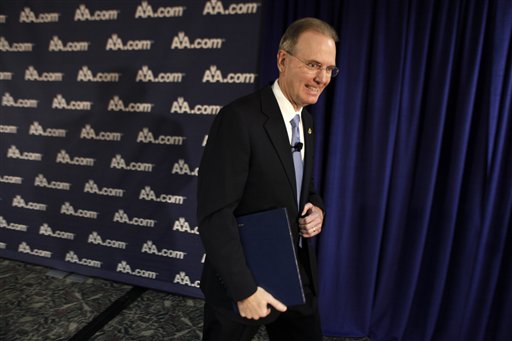
AMR Corp. Chairman and CEO Gerard J.Arpey concludes a news conference after the AMR shareholders meeting in Fort Worth, Wednesday, May 20, 2009. The CEO of Southwest Airlines says an April pickup in travel has fizzled in May, forcing the company to speed up plans to raise more revenue. Chief Executive Gary Kelly said Wednesday that the airline has been hurt by the swine flu outbreak, which made travelers nervous about getting on a plane. And the global economic slowdown has left Southwest uncertain what the rest of the year will bring. "June is typically our strongest month of the year, so I think June will tell us a lot," Kelly told reporters after the company's annual shareholder meeting. American Airlines parent AMR Corp. also held its annual meeting a few miles away in Fort Worth. Employees — and in one case, the teenage son of employees — challenged CEO Gerard Arpey over AMR's reluctance to approve pay raises. For its part, Southwest has struck tentative or final agreements with all of its major labor groups, most calling for annual pay raises of about 3 percent. Times are tough at American, until last year the world's largest airline, and at Southwest, which now carries more U.S. passengers than any carrier. Delta Air Lines Inc., which bought Northwest Airlines last year, is now the world's largest carrier. Both airlines have been losing money as demand for travel shrinks, and they've been eliminating some flights. On Wednesday, both CEOs gave guarded views of the future. "Things are not getting worse, but they're certainly not getting a lot better," Arpey said. Kelly said he didn't see the economy rebounding anytime soon, and added that there is often a longer delay before business travel returns to pre-recession levels. Kelly said Southwest was moving more quickly to enact revenue-raising measures, which he declined to detail. He wouldn't rule out fees even though Southwest advertises that it doesn't charge "hidden fees," which Kelly explained meant charges for checking one or two pieces of luggage and other levies that customers dislike. Southwest is testing in-flight Internet access, for which it would charge a fee, and it will tinker with its fares. Kelly suggested that the airline will be more aggressive about lowering some fares in specific markets, although he gave no details. "We're preparing ... for a sustained recessionary environment where low fares will be needed and will carry the day," he said. Southwest announced Wednesday that it would begin service later this year to Milwaukee, bringing to four the number of new points on its route map in 2009. The airline began flying to Minneapolis in March and plans to add New York's LaGuardia Airport and Boston later this year. Lower fuel prices have been a gift for airlines this year, partly offsetting the slump in revenue. But the Southwest and American CEOs both complained that after the big plunge last year, oil prices are climbing again — up about 80 percent since February. On the flip side, Arpey said there are signs that tight credit markets are beginning to ease, and that American has received offers to refinance planes. "Last year, no one would answer the phone," he said "Now we are getting some interest coming to us about what we are going to do with those airplanes and that collateral." However, the terms of that refinancing still might be unacceptable, he added. For a change, American's unions didn't picket outside the annual meeting Wednesday. But inside the hall, the event was dominated by complaints from employees and union leaders about stalled negotiations on new labor contracts. Unions are seeking pay raises to make up for wage cuts in 2003, but the company argues that its labor costs are already too high. Eighteen-year-old Ian Merriman, the son of two American flight attendants, said his parents were working more yet earning less. Merriman said he had to quit his school's baseball team and get a job to help his family, and he echoed employees who complain that Arpey and other managers get stock-based bonuses. "Great leaders lead by example," Merriman said. "Great leaders share in successes and share in their failures." Arpey congratulated Ian Merriman on becoming an Eagle Scout and getting a job. Then he said the company needed to balance employees' desires with the need to earn a profit. Arpey said AMR spends about $250 million a year on retiree health, something many other airlines don't provide. "That's a seminal competitive disadvantage for our company," he said. By David Koenig (AP)