

Candice Kim
Candice Kim is a dedicated business and technology reporter specializing in the intersection of high-tech innovation and fast-paced consumer trends. Her core beats span the semiconductor, IT, cosmetics, and retail sectors, where she provides in-depth coverage of industry titans including Samsung Electronics, SK hynix, and LG Electronics, alongside leading consumer brands like Olive Young and Musinsa. Whether analyzing complex silicon supply chains or tracking the latest shifts in beauty and fashion retail, Candice is committed to delivering sharp, accurate reporting that keeps readers informed on the forces shaping today's most dynamic markets.
Copyright ⓒ Aju Press All rights reserved.
Related News
-
 China accessed Nvidia chips via Southeast Asia: WSJ
SEOUL, November 15 (AJP) -Megaspeed, an Asian cloud-computing partner of Nvidia linked to ousted CEO Jensen Huang, arranged orders for nearly $12 billion worth of advanced Nvidia chips destined for Chinese buyers between March 2024 and June 2025, The Wall Street Journal reported. Citing shipment records, the newspaper said the orders covered several hundred thousand chips subject to U.S. export restrictions. The records did not establish how much hardware was actually delivered or where it originated. The Journal's investigation found that Chinese AI developers had gained access to restricted U.S. technology through intermediaries and overseas data centers, particularly in Malaysia, where they could rent computing power without importing the chips directly into China. Malaysia has attracted more than $34 billion in data-center investments, with Chinese technology giants including ByteDance and Alibaba among the major customers. The network built under Huang has come under increasing scrutiny following revelations about his relationship with Megaspeed executive Alice Huang.
-
 Korea's AI export boom extends beyond chips
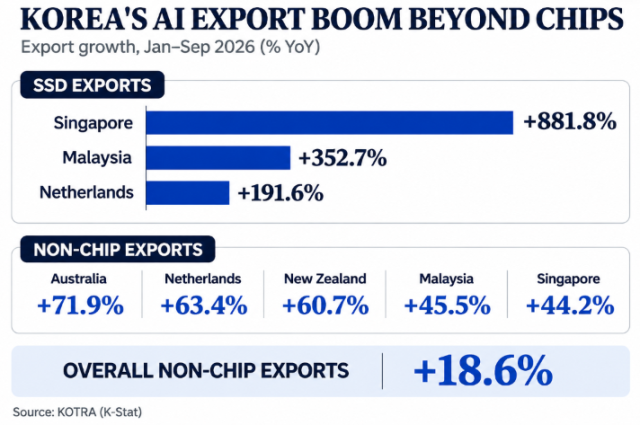
Visitors browse Korean consumer products at the 2026 Melbourne Korean Wave Expo in Australia, held Nov. 5–7. Courtesy of KOTRA SEOUL, November 15 (AJP) - South Korea's AI-driven export boom is spreading beyond semiconductors, with shipments of data center storage devices, chipmaking equipment and power infrastructure products surging across major overseas markets, according to data released Sunday by the Korea Trade-Investment Promotion Agency (KOTRA). Exports of solid-state drives (SSDs) to Singapore jumped 881.8 percent in the first nine months of 2026 from a year earlier, while shipments to Malaysia and the Netherlands surged 352.7 percent and 191.6 percent, respectively. Semiconductor manufacturing equipment exports to Malaysia rose 188.4 percent, while those to Singapore increased 63.6 percent. Power equipment shipments to the two countries climbed 61.1 percent and 39.6 percent, respectively, reflecting demand for infrastructure supporting AI and advanced manufacturing. Overall, South Korea's non-semiconductor exports grew 18.6 percent during the January-September period, according to KOTRA's analysis of K-Stat trade data. Australia recorded the fastest growth among South Korea's 30 largest export destinations, with non-chip shipments rising 71.9 percent to $18.04 billion, driven largely by petroleum products, industrial materials and ships. The Netherlands followed with a 63.4 percent increase to $10.13 billion, while New Zealand posted 60.7 percent growth. Malaysia and Singapore recorded gains of 45.5 percent and 44.2 percent, respectively. Consumer products also contributed to the expansion. Korean cosmetics exports to the Netherlands surged 282.5 percent, while shipments to Australia rose 65 percent. Pharmaceutical exports to Australia increased 116.4 percent. KOTRA President Kang Kyung-sung said double-digit growth in non-chip exports and the spread of high-growth markets across multiple regions were encouraging signs of export diversification. The figures suggest that South Korea's export growth is broadening beyond semiconductor chips, supported by demand for AI infrastructure, industrial products and Korean consumer goods.
-
K-Beauty Expands Global Reach with Focus on Hair and Dermacosmetics
K-Beauty, which has been active overseas primarily in skincare, is now advancing into hair care and dermacosmetics to expand its market presence. The United States, now the largest market for K-Beauty, surpassing China, is a key target. Companies are increasing specialized products to meet the demand for scalp and hair care, while also expanding their sales networks and nurturing core products.According to the Korea Customs Service's trade statistics released on the 15th, the total export value of shampoos from January to September this year reached $179.57 million, a 39% increase compared to the same period last year, already surpassing last year's total. Notably, exports of shampoos to the U.S. amounted to $40.85 million, marking an impressive 83.1% increase year-on-year.In the U.S., there is a growing trend for hair care products tailored to address hair damage and scalp conditions. Market research firm Circana reported that sales of hair care products in premium retail channels in the U.S. increased by 11% in the first half of this year compared to the previous year. Sales of hair serums surged by approximately 60%, along with growth in masks, oils, and scalp care products.Amorepacific is expanding its hair care business to cater to the diverse hair types and care habits in North America. The company is targeting the scalp essence and oil markets with brands like Mise en Scène, Ryo, and Laboh. Leveraging its research capabilities in scalp and hair care, Amorepacific aims to achieve 1 trillion won in hair care sales and over 60% of its revenue from overseas by the BY30 period (July 2029 to June 2030).LG Household & Health Care operates a dedicated line for its Dr. Groot brand in North America, which is not sold in South Korea. The product lineup includes shampoos, treatments, and scalp serums, primarily targeting the premium hair care market with a price range around $30.Key products include the 'Hair Thickening Shampoo' and 'Miracle In-Shower Treatment,' along with a 'Roll-On Serum' for direct application to the scalp. After launching sales online through platforms like Amazon, the company expanded its distribution to 424 Sephora stores across the U.S. in August.Dalba Global is broadening its business by developing specialized brands in hair and dermacosmetics. The existing hair product line will be separated into 'Dalba Professional,' with plans to launch a dedicated online store in the first quarter of next year. The company aims to establish a professional brand that can be sold in overseas salons and is also planning to introduce a new dermacosmetics brand next year.An industry insider noted, "Whether to develop localized products or target existing flagship products depends on the characteristics of the products and the consumer's usage environment. Increasing overseas sales channels and establishing a foothold in the market are different; thus, it is crucial to have product competitiveness that local consumers will continue to seek."* This article has been translated by AI.