
Testing fairness in the age of AI
AI ups exam-day tensions
in Korea
AI-assisted cheating is seeping into everyday classrooms and looming over state-run tests, including this year’s College Scholastic Ability Test (CSAT), South Korea’s national college entrance exam.
When devices hidden in everyday objects, some as small as an earpiece, can feed exam questions to AI, how can examiners be sure test-takers are showing their own ability?
CSAT cheating
CSAT cheating by the numbers
Most cheating cases on the CSAT have nothing to do with large-scale copying. They involve bringing in a phone, marking answers after time is called, or breaking the rules for the social studies and science section. A good number of students have had their whole exam voided because they didn’t know a rule, even when they meant no harm. The figures below cover all cheating on the CSAT, not AI-related cases.
Years refer to the academic year an exam serves. The 2025 CSAT, for example, was taken in November 2024.
Leading violations, 2021–2025 (out of 1,182 cases)
This is the most common violation. Students must put down their pens as soon as the bell rings.
Opening the test booklet for the second elective subject during time allotted to the first, or keeping both booklets on the desk at once, counts as cheating.
Simply having a banned item can count as cheating, even if it is never used.
Separately from these figures, cheating with smart glasses and tiny devices has come to light in other exams.
Cases caught so far
Not just the CSAT:
cases caught so far
Cheating with small electronic devices has turned up in university essay exams, professional licensing tests and language proficiency tests. Here are the cases that have come to light, and what they show about the limits of exam supervision.
The applicant was failed and barred from applying in the 2028 early admissions round.
The applicant was barred from university entrance exams for three years.
The top scorer of the 63rd exam admitted to cheating in both the first and second rounds using a micro camera, a smartphone and generative AI.
Test-takers handed in their phones but still received answers from outside through separate devices. A proctor found a transmitter on the back of a test-taker’s neck. Police have booked 101 people who paid for cheating or for someone else to take the test.
Case study · Certified tax accountant exam
Cheating right in front of the proctors
In the first round, the cheating took place directly in front of the podium, where two proctors were watching. The case suggests that seating a test-taker close to the proctors is not enough to stop cheating.
New rules for the 2027 CSAT
How the CSAT is responding to
smart glasses
Starting with the 2027 CSAT, simply wearing smart glasses during the exam will be treated as using them. The test-taker’s exam will be voided, and they will be barred from the following year’s CSAT. These are the prevention rules and screening procedures for the exam:
What screeners will look for
How smart glasses differ
from ordinary glasses
This illustration is based on reported features taught to screening staff in their training. Shapes and component locations vary by product. Detailed screening techniques are not disclosed because they could help cheaters.
The Ministry of Education will assign one staff member trained to detect smart glasses to each of the 1,312 test sites across the country, starting with the 2027 CSAT. It also plans legal action, including criminal complaints and requests for police investigations, against cheating with smart glasses and similar devices.
How glasses will be checked
Banned items must be handed to the proctor. Test-takers wearing suspicious glasses will be asked to remove them and place them on the desk, where the proctor and the screening staff member will inspect them. If they can’t tell, they will consult the exam control room. Glasses that raise suspicion during the exam will be checked after that period ends.
The reality of supervision
At the 2027 CSAT, smart glasses will be screened by proctors’ visual checks and one dedicated staff member per test site. Teachers’ groups point to the limits of visual inspection and a shortage of staff. Distributing radio-frequency detectors to test sites is under review starting next year.
How the devices are changing
Will taking off the glasses
be enough?
The cases raise a question: Can cheating be stopped by judging devices on how they look? Video footage shows cameras disguised as ballpoint pens and erasers. The screenshots below come from sales and demonstration materials and are not evidence that these devices were used in real exams.
Cameras that look like stationery
Screenshot of a sales page
Cameras made to look like erasers
Screenshots of a device demonstration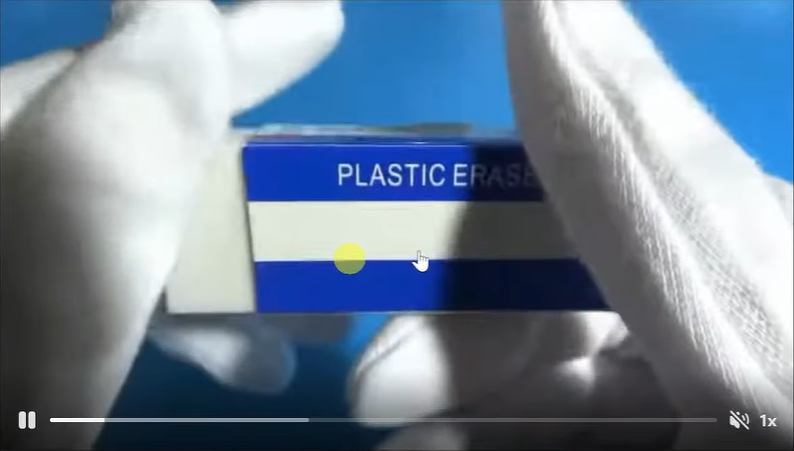

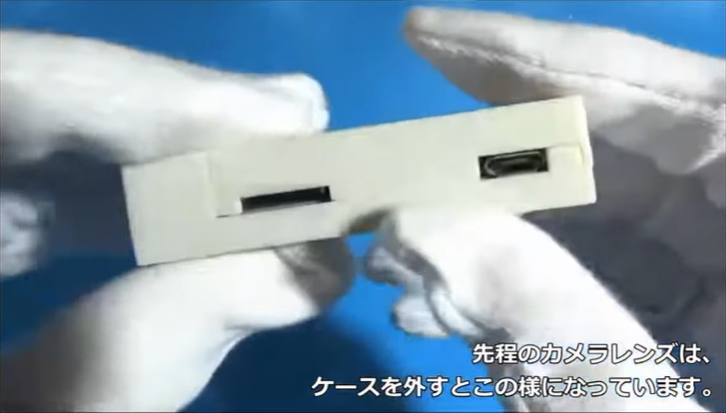
As devices shrink, telling everyday objects from electronics by eye gets harder. But a device that can take pictures is not necessarily one that connects to AI or relays answers in real time. These screenshots cannot confirm a product’s full capabilities or its use in an actual exam.
Note: Why AI answers in the video need checking
An answer from AI is not a fact. Screenshots about receivers implanted under the skin show an exchange with an AI chatbot. They do not prove any real implant cases or show whether such devices can be detected. A photo of a medical cochlear implant is not evidence of a cheating device either.
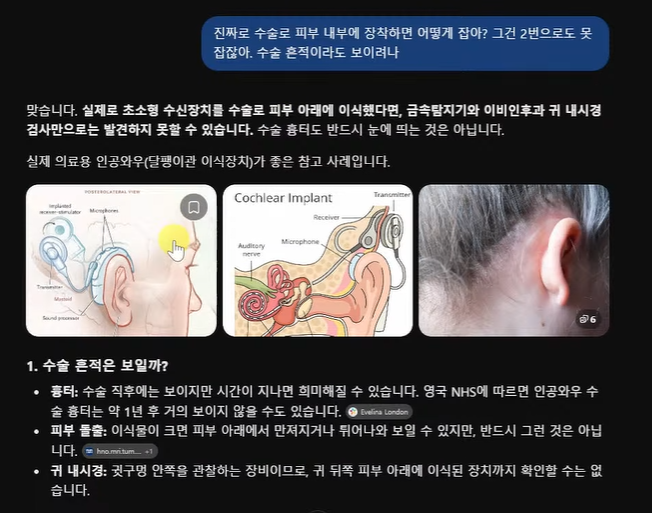
Screenshot source: captures provided from the JoCoding YouTube channel. Sales and demonstration footage has been kept separate from confirmed cheating cases.
The limits of enforcement
How far can
screening go?
After glasses, will exam sites have to check pens, and then ears? Expanding screening means not only finding devices but also taking on a heavier burden in running the exam.
- Telling devices apart
- Devices that resemble everyday objects are hard to spot by appearance alone. A procedure that catches one type of device is no guarantee it will catch other kinds.
- Time and staffing
- Each added check means planning for longer entry times, more staff and procedures for cases that are hard to call.
- Limits of physical inspection
- If inspections extend to ears or devices worn close to the body, how far should they be allowed to go, and how? Privacy and medically necessary devices also need to be considered.
If these measures keep expanding, what will the entrance to a test site look like?
Imagining the future
What if exam sites someday
looked like this?
From metal detectors to ear and glasses inspections, we imagined a test site where anti-cheating procedures keep piling up.

This is not a settled future. It is a thought experiment that asks how far screening should go in the name of preventing cheating, and how to protect test-takers’ comfort and privacy along the way.
Appendix · What you can bring to the 2027 CSAT
Check your items before the exam
Select an item to check the rules. These rules apply to the 2027 CSAT. For other exams, check the guidance of the organization running them.
From November 18, black pencils are the only writing supplies test-takers may bring themselves. Education offices will centrally purchase correction tape, erasers, mechanical-pencil lead and other affected supplies for distribution to test sites. The change aims to prevent cheating with miniature cameras hidden in writing supplies.
Smart glasses are a prohibited item. Merely carrying them, even without using them, voids the current exam. Using them during the exam also bars the test-taker from the following year’s CSAT.
The safest choice is to leave all electronic devices at home. Anyone who has one with them must hand it to the proctor before the first period begins.
Copyright ⓒ Aju Press All rights reserved.
Related News
-
 If only I'd known this before moving to Korea
AJPFIELD NOTES Living in Korea, in their own wordsReporting by Ryu Yuna Cover ← Previous Next → Living in Korea If Only I'd Known This Before Moving to Korea We stopped people on the streets of Sinchon to ask what surprised them about life in Korea — and what they wish they'd known sooner. Pick someone from the filmstrip or use Next to read in order. Valeria Ally and Ian Natalie Morgane Ozi Nelson It works really well.We gave up.Trust me, you'll love it.People are really respectful.Keep that card close to you.I just pretend not to notice.Get crazy.It works really well.We gave up.Trust me, you'll love it.People are really respectful.Keep that card close to you.I just pretend not to notice.Get crazy. South Korea, March 2026 2.1million South Korea was home to more than 2.1 million long-term foreign residents as of March 2026. AJPBut what does it really take to adjust to life here? 01 / 06Getting around Don't be afraid of public transit. Valeria Guerrero22, from the U.S. Valeria GuerreroDon't be afraid of the public transportation system.Valeria GuerreroIt works really well.Valeria GuerreroAnd I just use my Naver Maps.Replay No Korean neededPublic transit is easy to figure out, Valeria says, even if you don't speak Korean.The rivalry is a big dealAs an exchange student, Valeria was shocked by the rivalry between Yonsei and Korea University.They take it seriouslyStudents learn the cheers and the dances. “It's such a huge deal,” Valeria says. 02 / 06Paying your way Paying your way can be confusing. Ally Matei and Ian Minor27 and 30, from Canada Ally and IanWe were confused 'cause in Canada you can pay cash.Ally and IanBut here you can't pay cash.Ally and IanWe gave up.Ally and IanNow we're just getting a taxi.Replay Carry your passportTo get a bus pass, they had to scan a passport. They went all the way back for theirs.Your debit card may not workThe ATM wouldn't take their Canadian card. They had to find a special ATM that would.If someone makes eye contact, nodYou don't have to talk or say anything. Ally and Ian say the nod is enough.A smile can get you a strange lookAlly got some odd looks for smiling at people. Maybe, they say, people can tell they're tourists. 03 / 06Staying connected Get your own number. Natalie Garrison NatalieSo you get unlimited data.NatalieYou get voice, text, email.NatalieAnd you get to pick how long.NatalieGet your eSIM number.NatalieTrust me, you'll love it.Replay Pick a plan on your phoneNatalie shows us one: unlimited data, a number, voice, text and email. You choose how long it lasts.Wi-Fi is everywhere, and it isn't enoughWithout your own number, Natalie says, you suddenly can't order at a restaurant. 04 / 06Safety and shopping A surprising sense of safety. Morgane27, from France MorganeYou can put your phone or computer and no one takes it.MorganePeople are really respectful.MorganeAs a woman, I can walk alone at night.MorganeAnd you need to take an empty luggage when you're coming to Korea.MorganeBecause you will buy a lot here, really.Replay She walks alone at nightSecurity is her second surprise. “Nothing's happened to me,” she says.Pack an empty suitcaseYou will buy a lot here, she says, so come prepared.She isn't the only one buyingForeign tourists' card spending in Seoul, January to August.+59.9%20254.87T won20267.78T wonSource: Seoul Metropolitan Government, Oct. 6, 2026 05 / 06Nunchi Hear what isn't said. Ozi20s AJPWhen do you feel you have to read the room in Korea?OziYou can choose when you want to have nunchi, I will say that.OziKeep that card close to you.OziIf I don't want to do something, I just say, 'I don't want to.'OziPeople see me as a foreigner anyway.OziSo even when I feel pressured to read the room, I just pretend not to notice.Replay Nunchi is confusing at firstOzi found nunchi culture confusing. You have to understand things that are not said.Foreigners get away with moreThat's the other side of it, says Ozi. Your “foreigner card” lets you choose. 06 / 06Language Learn the language. Nelson Cho30s, from Brazil Nelson ChoOne of my biggest tips for living in Korea as a foreigner is to learn the language.Nelson ChoThe language is the only thing stopping you from getting along with other Koreans.Nelson ChoSo put in the time, get crazy, and just invest in learning Korean.Replay Learn the culture as wellDo that, he says, and you'll be able to get along with people. Adjusting to life in Korea isn't always easy. We heard how foreign residents have overcome challenges and learned valuable lessons along the way. Watch the full video on YouTube Back to the cover Reporting & ProductionRyu Yuna Cover ← Previous Next →
-
 Beyond the bridge
AJPFIELD NOTES JANGDAN, PAJU / PHOTO JOURNEY PHOTOS · JOONHA YOO / VIDEOS · KIM HEESU Jangdan · A journey in photographs Beyondthe bridge. Ride with us into Jangdan, all the way to Tongilchon.A village seen through the windscreen — and on foot. A DIFFERENT PACE. A CLOSER LOOK. click to begin 01 — THE DEPARTURESILVER GRANDEUR TG EXPLORE AT YOUR OWN PACE 01 / On the road Come along for the ride. Through the windscreen. Into the village. PAUSE ENTER THE VILLAGE → Play the drive YOUR JOURNEY THROUGH JANGDAN ↺ START AGAIN STORY SEQUENCE · NOT A NAVIGATION MAP ALL LINES ↺ REPLAY ⤢ VIEW PHOTO TALK · ON CONVERSATION × ← → Next stop → SCROLL ↓ ← PREVIOUS STOP CLOSE ×