
SEOUL, November 18 (AJP) - South Korea must prepare for a long effort to end North Korea’s nuclear threat, as the arsenal creates dangers that go well beyond the risk of a nuclear attack, according to a former nuclear envoy turned lawmaker.
“North Korea’s denuclearization is a goal we cannot abandon,” Rep. Kim Gunn of the main opposition People Power Party (PPP) told AJP in an interview marking the release of his book, "On a Knife’s Edge: Diplomacy over North Korea’s Nuclear Program” published Monday.
In the book, Kim recounts his experience as a junior diplomat during the 1994 nuclear crisis and later as South Korea’s chief nuclear negotiator.
“As long as North Korea possesses nuclear weapons, we cannot escape that nuclear shadow.”
For the former chief nuclear negotiator, the shadow translates into confidence emboldening a regime to take risks with conventional forces in the belief that its opponents will hesitate to retaliate.
It is a judgment shaped by more than three decades in diplomacy since he entered the foreign service in 1989, including negotiations over North Korea’s nuclear program, crisis management at the presidential office and postings as ambassador to Britain and consul general in Vancouver.
His understanding of nuclear deterrence took on a sharper meaning during his assignment to Cheong Wa Dae, the presidential office, beginning in 2010.
That March, the sinking of the South Korean warship Cheonan killed 46 sailors in an attack Seoul attributed to a North Korean torpedo. In November, North Korea shelled Yeonpyeong Island. Kim and his colleagues maintained round-the-clock coverage, taking turns sleeping on a folding bed in the office.
“At the time, we could not understand why this was happening. We were overwhelmed with responding to it,” he said. “Looking back, I think it was the nuclear shadow.”
North Korea had conducted its second nuclear test in 2009. In Kim’s assessment, its growing confidence in its nuclear capability helps explain its willingness to take military risks the following year. He linked that to the “stability-instability paradox”: the theory that fear of nuclear escalation can discourage all-out war while making confrontations below that threshold seem more manageable.
“North Korea thought that because it had nuclear weapons, it could take these actions and the other side would be afraid to retaliate properly,” he said.
That calculation, he argued, creates another problem for Pyongyang. If confrontations stay below the nuclear threshold, missiles, warships, drones and other conventional capabilities still matter.
Kim sees that burden as one reason to maintain pressure and keep denuclearization as the destination, even when progress appears remote.
Asked whether he would support a verifiable agreement negotiated by a Democratic Party administration that reduced the nuclear threat without achieving complete denuclearization, he said abandoning the ultimate objective would leave South Korea permanently exposed.
“Denuclearization serves North Korea’s interests, too,” he said, arguing that ordinary North Koreans have gained little from decades of nuclear development, isolation and economic hardship.
His time horizon extends well beyond a presidential term. “In international relations, achieving a major goal often takes 40 to 50 years,” he said.
He cited the struggle against apartheid, South Africa’s system of institutionalized racial segregation, and the U.S. policy of containing Soviet expansion. Apartheid was formally established in 1948, and South Africa held its first fully democratic national election in 1994. American containment took shape in 1947, more than four decades before the Soviet Union dissolved in 1991.
For Kim, these examples show how sustained effort and changing international conditions can eventually open a path through seemingly intractable problems. He suggested South Korea should be prepared to stay committed to denuclearization for another two decades or so, a strategic horizon rather than a prediction of when a settlement would come.
The patience he advocates in policy has a counterpart in the personal relationships behind diplomacy.
Kim described how those relationships helped him secure American support for the “Audacious Initiative,” the North Korea policy unveiled by then-President Yoon Suk Yeol on Aug. 15, 2022, which offered substantial economic assistance linked to progress toward denuclearization. The foreign ministry’s Office of Korean Peninsula Peace and Security Affairs, which Kim headed, developed the proposal using material supplied by the presidential office.
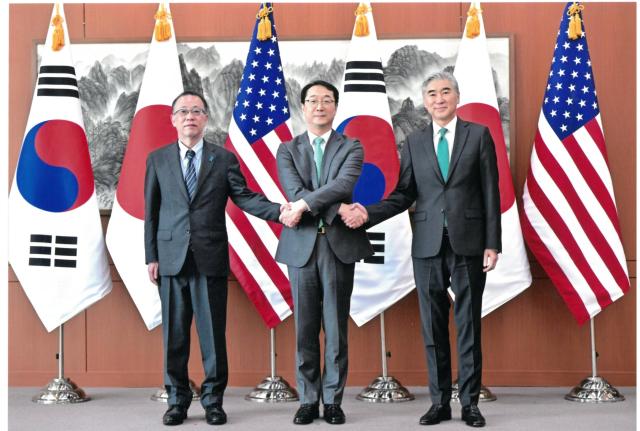
Before the announcement, he was asked to help ensure that Washington would promptly express support. He traveled to Indonesia to discuss it with Sung Kim, then the U.S. special representative for North Korea and ambassador to Indonesia. Rather than trying to settle every detail of the roadmap, the two concentrated on what the American side could endorse: the plan’s objective.
“Once you start getting into the details, there is no end to it,” he said.
Back in Seoul, he met Edgard Kagan, then a senior White House National Security Council official visiting the city. The two had known each other since serving in Beijing as liaison officers for the six-party talks involving the two Koreas, the United States, China, Japan and Russia. Kim explained what Seoul hoped to achieve and what he had already discussed with Sung Kim.
“When you have known each other for a long time, there is trust. You have worked on the same issues,” he said. “You do not have to explain everything at length. With just a few words, you understand what the other person is thinking and what they want.”
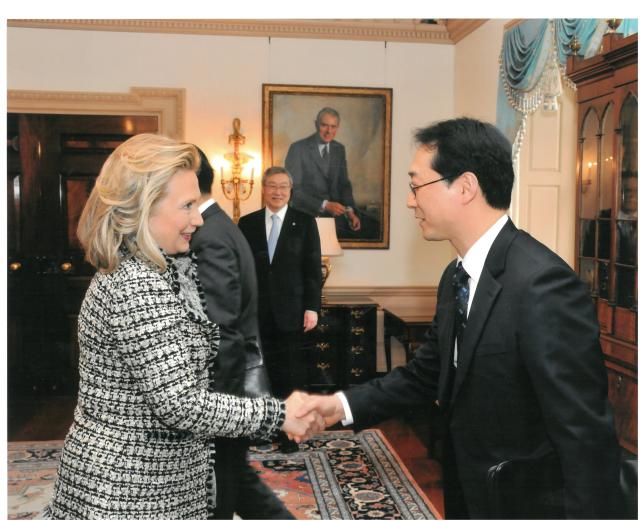
Such work rarely gives the public a full view of what diplomats do. Kim encountered another example in London, where he served as ambassador to Britain and as the first head of South Korea’s permanent mission to the International Maritime Organization, established within the embassy in 2021.
The IMO, a United Nations agency, develops international rules governing shipping safety, security and environmental performance. For a major shipbuilding and trading country, Kim said, the stakes are substantial. Rules intended to cut ships’ greenhouse gas emissions can influence the fuels vessels use, the technologies shipyards develop and the investments shipping companies make.
“The decisions made there can completely change the landscape of our shipping and shipbuilding industries,” he said. “Our jobs, the future of our shipbuilding industry and the future of our shipping industry are all at stake.”
He said South Korea needs to take an active part in shaping those standards and contribute more to the institution. “It may not attract much attention, but it is enormously important,” he said.
Years before those assignments, a visit to Liberia had given him a more immediate understanding of the responsibility carried by a diplomatic title.
Kim was serving as first secretary and deputy head of mission in Côte d’Ivoire when he traveled to Liberia in the aftermath of its first civil war. He remembers a damaged airport, severe shortages and a hotel where the noise of a generator made sleep difficult.
Around 50 Koreans were living in Liberia, he recalled, and members of the community came to the airport to welcome him with flowers. During visits to their homes, his hosts repeatedly served janchi-guksu, Korean noodles in broth.
Kim liked noodles. After several consecutive meals, however, he began to wonder why they appeared everywhere he went. He eventually learned that the community had asked people in Côte d’Ivoire what the visiting diplomat enjoyed eating.
“They had specially brought the noodles in from overseas to serve me,” he said. “When I found out, I was deeply moved.”
Before leaving, he invited the community to dinner at his hotel and handed out calendars and towels supplied by government ministries, modest gifts that drew a response he had not expected. Some people cried.
After years of war and isolation, Kim said, “They seemed to feel that their country was finally looking after them.”
The gathering brought another unexpected development. The small community had been divided by a dispute, but over dinner and drinks, people began reconciling.
“Who was I, for them to regard me as so important?” he said. “It suddenly hit me that I represented my country.”
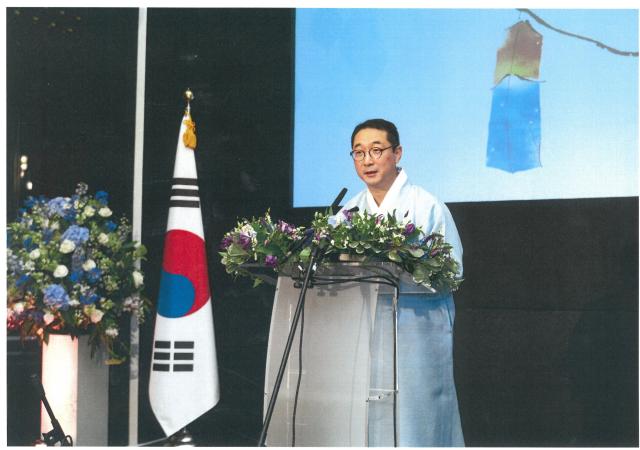
That understanding stayed with him through later assignments, including Vancouver, where he visited a gravely ill Canadian veteran of the 1950-53 Korean War. The veteran had become a successful businessman, contributed to his community and maintained a generous regard for Koreans, and Kim wanted to express his country’s gratitude while there was still time.
He took a commemorative medal to the hospital and thanked him for his service.
According to Kim, the veteran, who had been barely responsive, regained some strength afterward. His family told Kim that he had been able to speak with them and share his final wishes before he died several weeks later.
“The family sent me a letter thanking me,” he said. “That has stayed with me.”
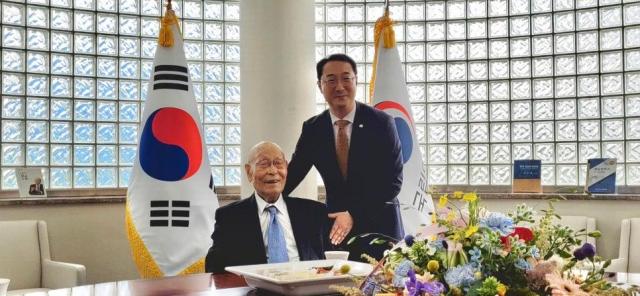
Asked which single photograph he would keep from his diplomatic life, Kim chose one with former Foreign Minister Gong Ro-myung, taken at a ceremony honoring Gong after Kim had entered the National Assembly. As a younger diplomat, Kim had served as an aide to both Gong and former Foreign Minister Han Sung-joo.
“There are several people who were like teachers to me, who taught me diplomacy,” he said. “I learned a great deal from those two ministers.”
“I had reached that position through the guidance of many mentors,” he added. “That is why the photograph feels so precious.”
Public service also demanded sacrifices he now describes with equal candor.
Before leaving for an overseas assignment expected to last five years, Kim visited his maternal grandfather, who had helped raise him and was a deeply loving presence in his childhood. His grandfather was already very old, and Kim feared he would not see him again.
“After saying goodbye, I cried and cried in the car on the way back,” he said.
His grandfather died while Kim was abroad, and Kim was unable to return. It remains one of the most painful memories of his diplomatic career.
Asked what he would tell the young man who passed the foreign service examination in 1989, he spoke about family. “Spend a little more time with your family,” he said.
“I thought I was doing important work for our country, so I poured all my energy into it. That meant I did not spend much time with my children.”
When he was stationed in Seoul, weekends disappeared into work, and there were periods when he saw his children mainly as they slept.
“Looking back, even if it meant sacrificing something else, I should have spent a little more time with them and been that kind of father,” he said. “I regret living that way.”
In the National Assembly, Kim wants to make the connection between diplomacy and everyday life more visible. South Korea’s geography, dependence on overseas markets and extensive investment abroad make foreign relations central to its prosperity, he argued. Yet much diplomatic work takes place confidentially, leaving the public with an incomplete understanding of its importance, and when its value is poorly understood, diplomacy struggles to receive the resources it needs.
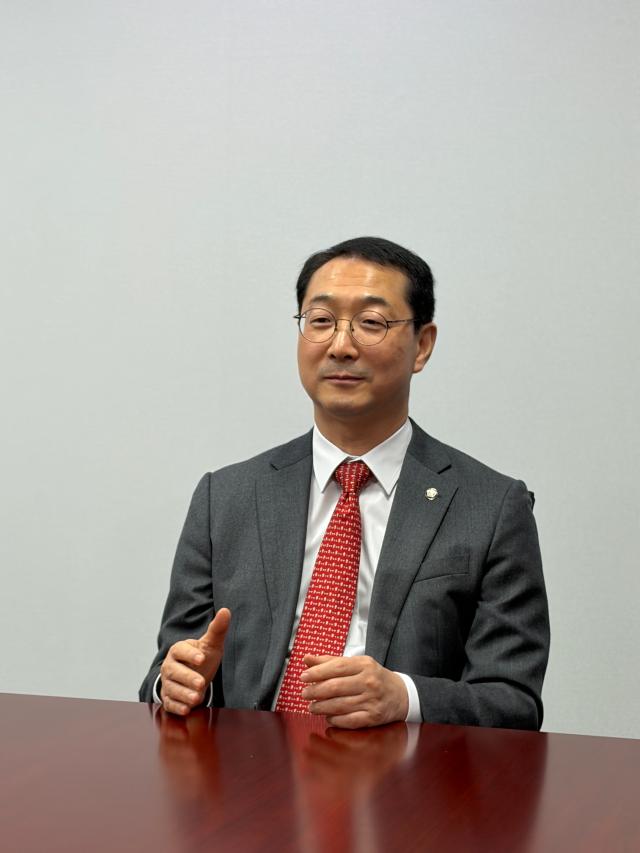
“Someone has to serve as the link between the public and diplomacy,” he said. “I think that is the most important responsibility of former diplomats who enter the National Assembly.”
The same concern for protecting people shapes his legislation. A bill he introduced in January would strengthen coordination and information sharing among the foreign ministry, other central government agencies and local authorities when Koreans encounter trouble abroad. Another, introduced in June, would require authorities to automatically notify stalking victims of developments in proceedings involving their alleged perpetrators, rather than leaving victims to request the information themselves.
For Kim, those efforts belong to the same responsibility he first felt so sharply among the Korean community in Liberia.
“The goal of a foreign affairs and security specialist is to help people live safely and well,” he said.
“I want to pursue more legislation and activities that directly help people in their everyday lives,” he added. “That is my ambition as a politician.”
Lee Jung-woo
I studied philosophy in college, and sociology and journalism in graduate school. I cover North Korea, South Korean politics, foreign affairs and films. I enjoy Nordic cinema, Indian cuisine and Japanese detective novels. I have a cat and like bright, acidic coffee.
Copyright ⓒ Aju Press All rights reserved.
Related News
-
 Kim Sung-won, Chair of the National Assembly's Industry Committee, 'I will closely examine the systems for corporate innovation'
“I will closely examine whether the institutional and policy environment is a hindrance to corporate innovation and growth,” said Kim Sung-won, Chair of the National Assembly's Industry, Trade, and Energy Committee, in a written address during the '2026 K-Global Innovation Awards' ceremony held at the Korea Press Center in Jung-gu, Seoul, on November 17. Kim noted, “The transition to artificial intelligence and digital transformation is rapidly changing the structure of industries, and the global supply chain and trade environment are also in an unpredictable phase.” He added, “In such an environment, the strength of small and medium-sized enterprises and venture companies to endure and advance ultimately comes from innovation.” He continued, “Advancing technology, changing management methods, and improving quality are a series of choices that may not be immediately visible. The companies that have not stopped making those choices are the protagonists of today’s event,” and emphasized that “the achievements of the award-winning companies will serve as a foundation for K-industry to maintain its competitiveness in the global market, beyond the success of a single company.” Kim stated, “The roots of the South Korean economy lie in small and medium-sized enterprises, venture companies, startups, and small business owners. If they are strong, the South Korean economy will also be strong,” and expressed hope that the award-winning companies would have a stepping stone for greater leaps and that all challenging small and venture companies would have a solid milestone.* This article has been translated by AI.
-
Lawyers' Group Urges National Assembly to Reject Oman Deployment Extension
The Lawyers' Group for Democracy's Korea Peace Committee has requested that the National Assembly reject the government's proposal to extend the Cheonghae Unit's deployment in the Aden Gulf while expanding its operational area to the southern waters of Oman. The committee argues that the decision on whether to continue existing ship escorts and assign new missions to troops in the new area should be made separately by the National Assembly.On November 16, the committee submitted a statement to the National Assembly's Defense Committee outlining its position.The government's revised proposal for the deployment extension, submitted to the National Assembly on November 10, includes an additional mission for the Cheonghae Unit to participate in international efforts to ensure maritime safety and freedom of navigation. It also proposes adding one maritime patrol aircraft and unmanned mine-clearing equipment to the existing deployment of one destroyer, increasing the personnel cap from 320 to 395.The committee noted that while the government cited piracy response as the reason for the deployment, the accompanying documents referenced the military situation in the Hormuz Strait concerning the patrol aircraft and mine-clearing equipment. The Defense Minister stated during a Defense Committee meeting on November 9 that the Hormuz Strait and the Gulf of Oman are excluded from the mission area, and that expanding the operational scope to include the strait would require separate procedures.The committee pointed out that, contrary to the minister's explanation, the proposal does not explicitly state that National Assembly approval would be required for entering the strait. However, the basic deployment plan includes a clause stating that "in case of emergencies involving the protection of our citizens, the designated area will be included." According to the committee, the government used this clause in 2020 to expand the Cheonghae Unit's operational area to include the Hormuz Strait.The scope approved by the National Assembly is also significant for the commanders on the ground and the troops carrying out their orders. The Military Service Act prohibits commanders from issuing orders beyond their authority and obligates soldiers to obey lawful orders from their superiors. For instance, if a request is made to clear mines within the strait, and it is specified that separate National Assembly approval is needed, the on-site commander cannot accept that request as part of the existing mission. This means that before soldiers take on new risks, both the government and the National Assembly must reassess the deployment.For the government, this also alleviates the pressure to respond immediately to requests from allied nations for mission expansion. It allows for an explanation that the proposal exceeds the scope approved by the National Assembly, providing room to negotiate participation and conditions while reviewing the necessity of additional deployment and safety measures for the troops.* This article has been translated by AI.
-
National Assembly Committee Postpones Meeting Over Budget Disagreements
The National Assembly's Industry, Trade, and Small and Medium Enterprises Committee was set to hold a meeting on November 16 to discuss the budget proposal for the upcoming year. However, the meeting was postponed due to a lack of consensus in the Budget Review Subcommittee.According to reports from Aju Economy, disagreements between the Democratic Party and the People Power Party over the Future Response Fund prevented the subcommittee from reaching an agreement, leading to the cancellation of the committee's meeting originally scheduled for 2 p.m. to vote on the budget proposal.Previously, the committee had postponed its schedule on November 13 due to ongoing disagreements regarding the budget proposal. Kim Sung-won, the committee chair from the People Power Party, expressed disappointment, stating, "It is regrettable that the differences between the ruling and opposition parties regarding the budget proposal have not been narrowed, and we plan to revisit the discussions later."Since November 11, both parties have been reviewing the budgets for the Ministry of Trade, Industry and Energy, the Ministry of SMEs and Startups, and the Korean Intellectual Property Office through the Budget Subcommittee. The ongoing conflict over the semiconductor cluster in the southwestern region and the Future Response Fund has led to repeated disruptions in the committee's proceedings.As the Democratic Party and the People Power Party continue to struggle to find common ground on issues related to the semiconductor cluster and the Future Response Fund, it appears that the review of the budget proposal for the upcoming year will face further challenges.* This article has been translated by AI.