

It was their fifth straight session of net buying, lifting the five-day total to 25,808 contracts, while they also net bought 48,730 three-year contracts over the period, according to Korea Exchange data.
Long-dated bonds tend to rally near the end of a tightening cycle, as short-term yields stay anchored to the policy rate while longer yields begin pricing slower growth and eventual cuts.
The three-year yield rose 1.7 basis points to 3.640 percent on Tuesday, while the 10-year fell 0.8 basis point to 3.819 percent.
The gap between the two narrowed to 17.9 basis points, the narrowest in more than a year and a half.
The flattening extended Wednesday, with the 10-year yield falling 3.8 basis points to 3.785 percent as of 11 a.m. while the three-year yield was little changed.
Markets see 3.50 percent as the likely peak but expect more dots at 3.25 percent in the BOK's six-month rate projections, a bond sales official at a local futures firm said, citing growing unease over the AI rally.
"If two or more dots come in at 3.75 percent, three-year yields will jump," he said. "But whether the decision is unanimous matters more than the dot plot."
In August, 10 of 21 dots sat at 3.25 percent, six at 3.50 percent and five at 3.00 percent.
When the BOK paired a hold with two dissents in favor of a hike and higher-than-expected dots in May, the three-year yield jumped 5.5 basis points, outpacing a 4.5-basis-point rise in the 10-year.
In August, dots that topped out at 3.50 percent pulled the three-year yield down 6.1 basis points even as the bank raised rates.
Previews from all 10 local brokerages expect a quarter-point hike to 3.25 percent, which would follow increases in July and August and a hold in October.
U.S. personal consumption expenditures data due later Wednesday will be the last major input before the decision, which is expected around 9:40 a.m. Thursday.
Kim Yeon-jae
Kim Yeon-jae is a journalist at AJU Press (AJP's English platform),
covering macroeconomics, international finance, and geopolitics.
He closely tracks central bank monetary policies, global energy supply chains,
and the Korean defense industry.
Copyright ⓒ Aju Press All rights reserved.
Related News
-
 BOK's other worries ease, leaving Fed in focus
The Bank of Korea headquarters in Seoul, April 30, 2026. AJP Yoo Na-hyun SEOUL, November 24 (AJP) — South Korea's tightening cycle — whether rate hikes end at 3.25 percent as early as this week or continue into next year — appears increasingly tied to the path of U.S. interest rates. A quarter-point hike to 3.25 percent on Thursday looks all but certain. Whether the Bank of Korea moves again in February, waits until April or stops there depends partly on how far the Federal Reserve goes, as domestic inflation expectations ease and the stock market rebounds. Previews from 10 local brokerages unanimously forecast a hike this week, with most expecting the rate to peak at 3.50 percent. The Fed, however, could push that ceiling higher. New York Fed President John Williams said Monday that "inflation is simply too high," with the central bank's preferred gauge running at about 3.5 percent. He linked some of the pressure to robust demand from AI investment — the same boom powering Korea's chip exports. Williams later told reporters he would not rule out raising rates at consecutive meetings if necessary, according to Reuters. A December hike is fully priced in, while futures indicate a 66.9 percent probability that the Fed's target range will reach 4.25–4.50 percent by January, according to CME FedWatch. At home, inflation expectations have become less pressing. Consumers' expectations for inflation over the next year slipped 0.1 percentage point to 2.6 percent in November, matching February's low, the BOK said Tuesday. Expectations for three and five years ahead held at 2.6 percent. The bank attributed the easing to reduced concerns over farm and fuel prices as global oil prices fell and government price measures took effect. Actual inflation remains above target. Headline and core consumer prices both rose 2.8 percent from a year earlier in October, against the BOK's 2 percent goal. The bank also signaled last month that its core inflation forecast for next year would exceed its earlier projection of 2.5 percent. Cheaper oil should help contain prices, although chip-sector bonuses and larger fiscal spending could sustain domestic demand. The stock rout has also done little to dislodge expectations for Thursday's hike. The KOSPI jumped 6.32 percent to 5,006.03 on Tuesday, recovering the 5,000 mark but remaining well below its record high. Foreign investors bought a net 725.5 billion won of KOSPI shares after selling more than 5 trillion won over the preceding seven sessions. "The recent plunge in stock prices is unlikely to have a big impact on the November decision, as real economic indicators remain solid," Cho Yong-gu, a fixed-income analyst at Shinyoung Securities, told AJP. The BOK's growth case rests on chip exports rather than chip stocks. Exports in the first 20 days of November surged 101.5 percent from a year earlier to a record $77.4 billion for the period, with semiconductors accounting for 49.7 percent. Cumulative exports passed $1 trillion for the first time, and the finance ministry upgraded its economic assessment from a "recovery" to "solid growth" on Monday. Authorities have responded to the selloff with targeted market measures. Governor Shin Hyun-song joined Sunday's emergency meeting, which led to a three-month relaxation of daily share buyback limits for listed companies starting Tuesday. "If the market slump drags on, it could affect the timing of the next hike or the terminal rate," Cho said. A hawkish Fed nevertheless cuts both ways for Korea: it raises financing costs for the AI investment supporting chip exports while adding pressure on the BOK to maintain tight policy. iM Securities analyst Kim Myeong-sil wrote Monday that if markets begin pricing in a Fed peak of 4.75 percent next year, the BOK would have stronger grounds to consider 3.75 percent, provided domestic consumption holds up. Matching quarter-point increases would leave the gap between Korea's base rate and the upper end of the Fed's range at 1 percentage point. A January Fed hike with the BOK on hold would widen it to 1.25 percentage points. Edited and compiled by AJP. Graphics AI assisted. Currency pressure has eased, however. The won finished daytime trading 3.5 won stronger at 1,342.4 per dollar Tuesday. Although it surrendered some early gains despite foreign stock buying, it remains substantially stronger than its early-July low near 1,560. The Fed's influence now runs more through financial conditions and the timing of further tightening than through an immediate need to support the won. Analysts remain divided over whether a final BOK hike to 3.50 percent will come in February or April, after the U.S. rate outlook becomes clearer. Government bond yields barely responded to Tuesday's stock rally. The three-year yield edged up to 3.640 percent from 3.623 percent, while the 10-year fell to 3.819 percent from 3.827 percent as of 3:30 p.m. Several analysts expect one board member to dissent in favor of a hold on Thursday. The decision is due around 9:40 a.m., followed by revised forecasts at 1:30 p.m. The BOK has already signaled that growth this year and next will considerably exceed its August projections of 3.3 percent and 2.9 percent. The immediate hike appears settled. The harder question is how much further the BOK will go if the Fed keeps tightening — and whether Korea's export strength can withstand the financial strain.
-
 AJP poll: Korea's year-end rate seen at 3.25% despite stock volatility
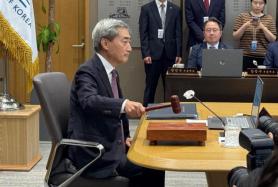
Bank of Korea Gov. Shin Hyun-song bangs the gavel at a Monetary Policy Board meeting at the central bank's headquarters in Seoul on July 16, 2026. Courtesy of the Bank of Korea SEOUL, November 23 (AJP) — The Bank of Korea is expected to bump up its base rate to 3.25 percent at its final rate-setting meeting of 2026 on Thursday, regardless of stock volatility from the AI crash, in a preemptive move ahead of an expected Fed hike in December, an AJP poll showed. All six economists agreed on the year-end rate, which would be the third raise by a quarter of percentage point following two consecutive hikes in the summer. Five expect another quarter-point move in the first quarter of 2027, most likely in February, taking the rate to a peak of 3.50 percent, a firmer consensus than in October's poll, when four of six respondents saw 3.50 percent as the peak. The same five expect the median of board members' six-month-ahead rate projections to rise to 3.50 percent from 3.25 percent in August, signaling another hike after this week. "Stronger growth and sticky underlying inflation justify pre-emptive tightening, although still-weak domestic demand could prevent unanimity," said Park Chong-hoon, chief economist at Standard Chartered in Seoul. Respondents were evenly split on Thursday's vote, with three expecting at least one board member to dissent in favor of a hold and three expecting a unanimous decision. The stock market's slide has not changed their rate call, even as the KOSPI fell 3.31 percent Monday to stand nearly 50 percent below its June record. But currency strength, which has helped ease import-price pressure, and concerns about repayment difficulties among leveraged investors have complicated the case for further tightening. The chip boom has done little for household spending, and the negative wealth effect from falling stocks is now weighing on consumption, said Park Sang-hyun, a senior researcher at iM Securities. He nevertheless expects the rate to peak at 3.50 percent in the first quarter. Real interest rates are already restrictive and financial vulnerabilities are building, making hikes beyond 3.50 percent likely to do more harm than good, said Kim Ji-na, an analyst at Eugene Investment & Securities. UOB was the lone exception on the peak, expecting the BOK to hold at 3.25 percent through 2027 as growth and inflation moderate. An additional hike would come into view only if inflation reaches 3 percent in the first quarter, said Ho Woei Chen, an economist at UOB. Edited and compiled by AJP. Graphics AI assisted. The poll's consensus runs ahead of bond-market expectations. The three-year government bond yield has fallen about 22 basis points since the October meeting, from 3.840 percent to 3.623 percent at Monday's close. The 10-year yield has dropped about 33 basis points from 4.152 percent to 3.827 percent. Bond markets are still pricing in a peak policy rate below 3.50 percent, Yoon Yeo-sam, a bond analyst at Meritz Securities, wrote in a report Monday. The BOK's guidance has nevertheless kept economists leaning toward another hike. When the board held rates last month, Governor Shin Hyun-song said growth and inflation were running stronger than projected in August. He pledged to keep policy tight until inflation settles at the 2 percent target, which he expects around 2028. Shin said the timing and pace of further hikes would depend on third-quarter growth and October inflation. The economy subsequently reported growth of 1.0 percent in the third quarter from the previous three months, well above the BOK's August forecast of 0.3 percent. Consumer and core inflation both ran at 2.8 percent in October. The BOK expects November inflation to remain in the high-2 percent range, citing persistent core price pressure. Minutes of the October meeting showed one board member warning that the surge in nominal growth could prolong core inflation, while another said the board should weigh the timing and size of further hikes. Some members also flagged the broader interest burden of higher rates, a concern that could produce a dissent Thursday. Finance Minister Lee Hyoung-il said Monday that economic growth could reach the high-3 percent range this year. The state-run Korea Development Institute, which raised its 2027 growth forecast to 3.9 percent this month, has also recommended maintaining a tight policy stance. The won weakened 9.7 won to close at 1,345.9 per dollar Monday after briefly slipping past 1,350. Renewed currency weakness would reinforce the case for tightening, Park Chong-hoon said. Thursday's rate projections will be watched as closely as the decision itself for signs of whether the board shares economists' view that one more hike lies ahead in 2027.
-
 AJP Poll: BOK likely to hold this week, with rate peak seen at 3.50%
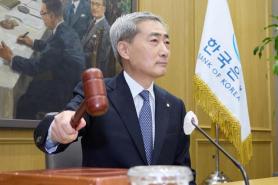
Bank of Korea Gov. Shin Hyun-song bangs a gavel during a Monetary Policy Board meeting at the central bank’s headquarters in Seoul on Aug. 27, 2026. The BOK raised its benchmark interest rate by 25 basis points to 3.00 percent from 2.75 percent. Bank of Korea. SEOUL, October 19 (AJP) — The Bank of Korea (BOK) will likely wait to assess the impact of back-to-back rate hikes at its first rate-setting meeting since the latest increase, even as hot U.S. inflation data bolstered the odds of another Federal Reserve hike on Oct. 27–28, an AJP poll of seven economists found. Governor Shin Hyun-song too projected policymakers will likely stay pat at Thursday's meeting, and economists agreed as a third consecutive increase would be excessive with domestic inflation below 3 percent and bond yields more stable. During a parliamentary audit last week, Shin said the central bank’s preemptive moves had eased the pressure to respond to further U.S. Federal Reserve rate hikes, while keeping additional hike possibility open depending on the inflationary pressures. “The hold would not signal the end of monetary tightening, but rather a brief pause,” said Kim Ji-na, a fixed-income analyst at Eugene Investment & Securities. The BOK delivered a rare quarter-point increases in July and August that lifted the benchmark rate from 2.50 percent to 3.00 percent. With a pause already priced in, the bond market will scrutinize the BOK’s post-meeting statements for clues to how far and how long the tightening cycle will run. The three-year bond yield fell 0.9 basis point to 3.845 percent, while the 10-year yield dropped 1.7 basis points to 4.165 percent at the end of Monday’s morning session. Both remained well below their recent peaks of 4.126 percent and 4.605 percent, respectively. Of six respondents who specified when they expect the next move, five forecast another quarter-point increase in November, while one sees either November or January as the likely window. Among six who provided a view on the peak rate, four expect 3.50 percent, one forecasts 3.75 percent and another says 3.75 percent remains possible if semiconductor-led growth stays strong. The survey points to broader agreement on the direction of policy than on the pace of tightening. Respondents generally view an October hold as a chance to assess the lagged effects of the two earlier increases, rather than a signal that the cycle is over. Generated with ChatGPT Strong growth and above-target inflation support further increases, while higher borrowing costs for households and companies give policymakers reason to avoid raising rates at every meeting. Hot U.S. inflation data have also complicated the backdrop ahead of the Federal Reserve’s Oct. 27–28 meeting. The BOK cited stronger-than-expected growth, persistent inflation and financial stability risks when it raised rates in August. Its outlook that month projected economic growth of 3.3 percent this year and 2.9 percent next year, supported by strong semiconductor exports and investment. It forecast consumer inflation at 2.7 percent and core inflation at 2.5 percent this year. The central bank’s six-month conditional rate outlook also pointed to further tightening, although at a relatively gradual pace. Of 21 dots published in August, five were at 3.00 percent, 10 at 3.25 percent and six at 3.50 percent, leaving the median at 3.25 percent. Shin said at the time that the median implied roughly one additional increase over the following four meetings. Some economists see a steeper path. JPMorgan economist Park Seok-gil expects three more quarter-point hikes — in November and once each in the first and second quarters of next year — taking the benchmark rate to 3.75 percent. Kiwoom Securities analyst Ahn Ye-ha also sees room for a higher peak if the current expansion proves durable. “If semiconductor-led growth continues, the possibility of raising the rate to 3.75 percent should remain open,” Ahn said. Thursday’s vote split could offer a more immediate signal. Of four respondents who explicitly forecast the vote, two expect one Monetary Policy Board member to favor an immediate hike, while two expect a unanimous hold. Shinyoung Securities economist Cho Yong-gu expects one dissenting vote for an increase, while NH Investment & Securities analyst Kang Seung-won forecasts a unanimous hold. Both nevertheless expect tightening to resume in November and the rate eventually to reach 3.50 percent. The October meeting will not include a new six-month conditional rate projection, which the BOK releases alongside its quarterly economic outlook in February, May, August and November. That leaves the vote split, policy statement and Shin’s press conference as the main clues to whether policymakers are leaning toward the higher rate paths forecast by private economists. The next formal update comes Nov. 26, when the BOK holds its final scheduled rate-setting meeting of the year. For markets, the focus this week will be less on the expected pause than on how clearly the BOK signals that it is temporary.