
SEOUL, November 24 (AJP) — South Korea's tightening cycle — whether rate hikes end at 3.25 percent as early as this week or continue into next year — appears increasingly tied to the path of U.S. interest rates.
A quarter-point hike to 3.25 percent on Thursday looks all but certain. Whether the Bank of Korea moves again in February, waits until April or stops there depends partly on how far the Federal Reserve goes, as domestic inflation expectations ease and the stock market rebounds.
Previews from 10 local brokerages unanimously forecast a hike this week, with most expecting the rate to peak at 3.50 percent.
The Fed, however, could push that ceiling higher.
New York Fed President John Williams said Monday that "inflation is simply too high," with the central bank's preferred gauge running at about 3.5 percent. He linked some of the pressure to robust demand from AI investment — the same boom powering Korea's chip exports.
Williams later told reporters he would not rule out raising rates at consecutive meetings if necessary, according to Reuters.
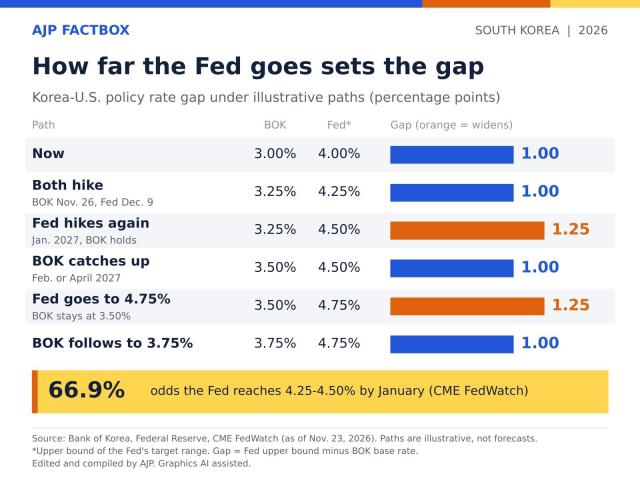
A December hike is fully priced in, while futures indicate a 66.9 percent probability that the Fed's target range will reach 4.25–4.50 percent by January, according to CME FedWatch.
At home, inflation expectations have become less pressing.
Consumers' expectations for inflation over the next year slipped 0.1 percentage point to 2.6 percent in November, matching February's low, the BOK said Tuesday. Expectations for three and five years ahead held at 2.6 percent.
The bank attributed the easing to reduced concerns over farm and fuel prices as global oil prices fell and government price measures took effect.
Actual inflation remains above target. Headline and core consumer prices both rose 2.8 percent from a year earlier in October, against the BOK's 2 percent goal. The bank also signaled last month that its core inflation forecast for next year would exceed its earlier projection of 2.5 percent.
Cheaper oil should help contain prices, although chip-sector bonuses and larger fiscal spending could sustain domestic demand.
The stock rout has also done little to dislodge expectations for Thursday's hike.
The KOSPI jumped 6.32 percent to 5,006.03 on Tuesday, recovering the 5,000 mark but remaining well below its record high. Foreign investors bought a net 725.5 billion won of KOSPI shares after selling more than 5 trillion won over the preceding seven sessions.
"The recent plunge in stock prices is unlikely to have a big impact on the November decision, as real economic indicators remain solid," Cho Yong-gu, a fixed-income analyst at Shinyoung Securities, told AJP.
The BOK's growth case rests on chip exports rather than chip stocks.
Exports in the first 20 days of November surged 101.5 percent from a year earlier to a record $77.4 billion for the period, with semiconductors accounting for 49.7 percent. Cumulative exports passed $1 trillion for the first time, and the finance ministry upgraded its economic assessment from a "recovery" to "solid growth" on Monday.
Authorities have responded to the selloff with targeted market measures. Governor Shin Hyun-song joined Sunday's emergency meeting, which led to a three-month relaxation of daily share buyback limits for listed companies starting Tuesday.
"If the market slump drags on, it could affect the timing of the next hike or the terminal rate," Cho said.
A hawkish Fed nevertheless cuts both ways for Korea: it raises financing costs for the AI investment supporting chip exports while adding pressure on the BOK to maintain tight policy.
iM Securities analyst Kim Myeong-sil wrote Monday that if markets begin pricing in a Fed peak of 4.75 percent next year, the BOK would have stronger grounds to consider 3.75 percent, provided domestic consumption holds up.
Matching quarter-point increases would leave the gap between Korea's base rate and the upper end of the Fed's range at 1 percentage point. A January Fed hike with the BOK on hold would widen it to 1.25 percentage points.
The Fed's influence now runs more through financial conditions and the timing of further tightening than through an immediate need to support the won.
Analysts remain divided over whether a final BOK hike to 3.50 percent will come in February or April, after the U.S. rate outlook becomes clearer.
Government bond yields barely responded to Tuesday's stock rally. The three-year yield edged up to 3.640 percent from 3.623 percent, while the 10-year fell to 3.819 percent from 3.827 percent as of 3:30 p.m.
Several analysts expect one board member to dissent in favor of a hold on Thursday. The decision is due around 9:40 a.m., followed by revised forecasts at 1:30 p.m. The BOK has already signaled that growth this year and next will considerably exceed its August projections of 3.3 percent and 2.9 percent.
The immediate hike appears settled. The harder question is how much further the BOK will go if the Fed keeps tightening — and whether Korea's export strength can withstand the financial strain.
Kim Yeon-jae
Kim Yeon-jae is a journalist at AJU Press (AJP's English platform),
covering macroeconomics, international finance, and geopolitics.
He closely tracks central bank monetary policies, global energy supply chains,
and the Korean defense industry.
Copyright ⓒ Aju Press All rights reserved.
Related News
-
 Korea's consumer sentiment hits 7-month low on stock bear
A large LED screen at CGV Yongsan I’Park Mall in Seoul advertises a discount promotion for teenagers and college entrance exam takers as retailers launch post-CSAT discount promotion on Nov. 23, 2026. AJP Han Jun-gu. SEOUL, November 24 (AJP) -South Korean consumer sentiment fell for a second consecutive month to a seven-month low in November as a global stock slide and rising lending rates weighed on household finances, central bank data showed Tuesday. The Composite Consumer Sentiment Index (CCSI) fell 2.3 points from October to 103.1, its lowest since April's 99.2, the Bank of Korea (BOK) said. The reading remained above 100, indicating that consumers were more optimistic than the long-term average from 2003 to 2025. The BOK attributed the decline to continued stock market corrections at home and abroad and rising lending rates. The survey was conducted from Nov. 9 to 16, before the KOSPI plunged 5.21 percent on Nov. 20. The index measuring current economic conditions fell 4 points to 78, its lowest since April, as stock market losses continued and uncertainty over the chip industry grew. The outlook for economic conditions six months ahead dropped 2 points to 86. The employment outlook fell 3 points to 83, also the lowest since April, reflecting persistently weak youth employment and concerns that advances in AI would cut jobs. The current living conditions index fell 2 points to 91 as falling stock prices and rising lending rates squeezed household finances. Household income expectations slipped 1 point to 100, while the consumer spending outlook fell 1 point to 108. The current household savings index dropped 4 points to 89, its lowest since March 2023. The decline matched the steepest monthly fall since April 2020. Housing price expectations fell 6 points to 118, the lowest since May, as apartment prices declined in parts of Seoul amid government property measures and rising lending rates. The interest-rate outlook fell 3 points to 124 but stayed well above 100, indicating that more households expected rates to rise than fall ahead of the BOK's rate decision Thursday. An AJP poll found that the central bank was expected to raise its base rate by a quarter percentage point to 3.25 percent. Households' inflation expectations for the year ahead eased 0.1 percentage point to 2.6 percent, the lowest since February. The BOK said falling global oil prices and government price-stabilization measures eased concerns about agricultural and fuel prices despite strong core inflation. Three- and five-year inflation expectations held at 2.6 percent, while perceived inflation over the past year stayed at 2.9 percent. Petroleum products remained the most-cited driver of inflation, named by 49.7 percent of respondents, down 2.9 percentage points from October. The share citing public utility charges rose 4.4 percentage points to 34.8 percent. The survey covered 2,500 urban households nationwide, with 2,236 responding. Tags: South Korea, consumer sentiment, Bank of Korea, CCSI, household finances, KOSPI, lending rates, inflation expectations, housing prices
-
 Fed hike fears jolt Korean bonds, complicate BOK's choice
The U.S. Federal Reserve Board's headquarters in Washington, D.C. (left), and the Bank of Korea headquarters in Seoul on Nov. 3, 2026. Courtesy of the Federal Reserve Board (left) and AJP Kim Yeon-jae (right). SEOUL, November 11 (AJP) — The prospect of a bigger U.S. interest rate increase jolted South Korea’s bond market Wednesday, interrupting a rally and complicating the Bank of Korea’s decision on whether to tighten policy again this month. Stronger-than-expected U.S. inflation shifted investors’ attention from the fallout of the American midterm elections and uncertainty surrounding Nvidia to a more immediate threat: a possible half-percentage-point Federal Reserve rate increase in December. The three-year Korean government bond yield climbed 9.6 basis points to 3.729 percent, while the 10-year yield ended 10 basis points higher at 3.950 percent. Bond yields rise when prices fall. The moves followed a jump in U.S. Treasury yields as investors reassessed the scale of the Fed’s next move. The two-year yield rose nearly 18 basis points to around 4.73 percent, while the 10-year yield approached 5 percent. For Korean bonds, the selloff reversed part of a recent rally fueled by falling stock prices, demand for safer assets and expectations of reduced government bond issuance. The won and equities, however, moved in the opposite direction. The won closed 3.9 won higher at 1,333.6 per dollar, compared with Tuesday’s 3:30 p.m. close of 1,337.5. The benchmark KOSPI rose 2.60 percent to 5,375.36, while the KOSDAQ gained 5.62 percent to 705.10. The divergence suggested that investors were adjusting bond prices to higher U.S. rate expectations without staging a broad retreat from Korean assets. The trigger was Tuesday’s U.S. consumer price report. Headline inflation rose 0.4 percent in October from the previous month, exceeding the market forecast of 0.3 percent. Core inflation, which excludes food and energy, increased 0.3 percent against expectations of 0.2 percent, maintaining that pace for a third consecutive month. The figures reinforced expectations of a Fed increase at its December 8–9 meeting and revived debate over whether a quarter-point move would be enough. Fed Governor Christopher Waller had suggested that a half-percentage-point increase might warrant consideration if monthly core inflation remained around 0.3 percent or higher. "Hiking only 25 basis points would put our credibility at risk, a risk I am not eager to take," Waller said. The latest reading met that threshold, although a 25-basis-point increase remains the prevailing market expectation. For Korea, the immediate concern is how that repricing could affect foreign demand for government debt alongside the recent foreign selling of equities. Lim Jae-kyun, a bond analyst at KB Securities, said concerns about a larger Fed increase could weaken foreign purchases of Korean government bond futures. Higher yields could nevertheless offer opportunities to increase bond exposure. "Even without a 50-basis-point hike, upward pressure on yields is likely to persist through year-end," said Won Yoo-seung, a bond analyst at SK Securities. Edited and compiled by AJP. Graphics AI assisted. Won expects a quarter-point Fed increase in December, with both U.S. Treasury and Korean government bond yields remaining under pressure. That prospect complicates the Bank of Korea’s (BOK) final rate-setting meeting of the year on November 26. Holding steady would give policymakers more time to assess domestic risks, but could leave Korean debt facing stronger competition from higher-yielding U.S. assets. The BOK raised its base rate by 25 basis points in both July and August before holding it at 3.00 percent in October. It has kept further tightening on the table while assessing the effects of those increases. The Fed’s current target range of 3.75 to 4.00 percent already stands 0.75 to 1.00 percentage points above Korea’s rate. If the BOK holds this month and the Fed raises rates by a quarter point in December, the gap would widen to 1.00 to 1.25 percentage points. A half-point Fed increase would push it to 1.25 to 1.50 percentage points. A wider gap does not automatically weaken the won or trigger capital outflows. Wednesday’s currency gains underscored that exchange rates respond to more than interest rate differentials. But rising overseas yields can still push up Korean market borrowing costs even if the BOK leaves its own rate unchanged. Domestic inflation and household borrowing also give the central bank reasons to consider another increase. South Korea’s consumer prices rose 2.8 percent from a year earlier in October, remaining above the BOK’s 2 percent target. Bank household loans increased by 5 trillion won, sharply exceeding September’s revised 500 billion won gain, according to data released Wednesday. Yet further tightening would add to the burden on borrowers already struggling with interest payments. The BOK estimated in September that another 25-basis-point increase could add roughly 7 trillion won to annual household and corporate interest expenses. Delinquency among financially vulnerable self-employed borrowers had reached 12.71 percent in the second quarter. Uncertainty over global AI investment and semiconductor demand adds another reason for caution in an economy heavily dependent on chip exports. There may be some relief beyond December. "We maintain our view that the Fed will keep rates on hold after a December increase," said Park Sang-hyun, an economist at iM Securities. Park expects inflationary pressure to ease gradually as oil prices decline and wage growth slows, although persistent supply-side risks and strong investment demand could slow that process. For the BOK, however, the next decision comes before that outlook becomes clearer. Another increase could help restrain inflation and borrowing while deepening debt-servicing strains. A pause would buy time to assess domestic risks, but would offer no guarantee of stable financing costs. Wednesday’s bond selloff made that constraint clear: even if Seoul keeps its policy rate unchanged, borrowing in Korea can still become more expensive.
-
 AJP poll: Korea's year-end rate seen at 3.25% despite stock volatility
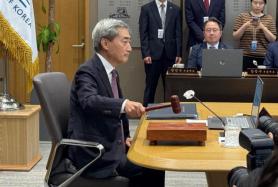
Bank of Korea Gov. Shin Hyun-song bangs the gavel at a Monetary Policy Board meeting at the central bank's headquarters in Seoul on July 16, 2026. Courtesy of the Bank of Korea SEOUL, November 23 (AJP) — The Bank of Korea is expected to bump up its base rate to 3.25 percent at its final rate-setting meeting of 2026 on Thursday, regardless of stock volatility from the AI crash, in a preemptive move ahead of an expected Fed hike in December, an AJP poll showed. All six economists agreed on the year-end rate, which would be the third raise by a quarter of percentage point following two consecutive hikes in the summer. Five expect another quarter-point move in the first quarter of 2027, most likely in February, taking the rate to a peak of 3.50 percent, a firmer consensus than in October's poll, when four of six respondents saw 3.50 percent as the peak. The same five expect the median of board members' six-month-ahead rate projections to rise to 3.50 percent from 3.25 percent in August, signaling another hike after this week. "Stronger growth and sticky underlying inflation justify pre-emptive tightening, although still-weak domestic demand could prevent unanimity," said Park Chong-hoon, chief economist at Standard Chartered in Seoul. Respondents were evenly split on Thursday's vote, with three expecting at least one board member to dissent in favor of a hold and three expecting a unanimous decision. The stock market's slide has not changed their rate call, even as the KOSPI fell 3.31 percent Monday to stand nearly 50 percent below its June record. But currency strength, which has helped ease import-price pressure, and concerns about repayment difficulties among leveraged investors have complicated the case for further tightening. The chip boom has done little for household spending, and the negative wealth effect from falling stocks is now weighing on consumption, said Park Sang-hyun, a senior researcher at iM Securities. He nevertheless expects the rate to peak at 3.50 percent in the first quarter. Real interest rates are already restrictive and financial vulnerabilities are building, making hikes beyond 3.50 percent likely to do more harm than good, said Kim Ji-na, an analyst at Eugene Investment & Securities. UOB was the lone exception on the peak, expecting the BOK to hold at 3.25 percent through 2027 as growth and inflation moderate. An additional hike would come into view only if inflation reaches 3 percent in the first quarter, said Ho Woei Chen, an economist at UOB. Edited and compiled by AJP. Graphics AI assisted. The poll's consensus runs ahead of bond-market expectations. The three-year government bond yield has fallen about 22 basis points since the October meeting, from 3.840 percent to 3.623 percent at Monday's close. The 10-year yield has dropped about 33 basis points from 4.152 percent to 3.827 percent. Bond markets are still pricing in a peak policy rate below 3.50 percent, Yoon Yeo-sam, a bond analyst at Meritz Securities, wrote in a report Monday. The BOK's guidance has nevertheless kept economists leaning toward another hike. When the board held rates last month, Governor Shin Hyun-song said growth and inflation were running stronger than projected in August. He pledged to keep policy tight until inflation settles at the 2 percent target, which he expects around 2028. Shin said the timing and pace of further hikes would depend on third-quarter growth and October inflation. The economy subsequently reported growth of 1.0 percent in the third quarter from the previous three months, well above the BOK's August forecast of 0.3 percent. Consumer and core inflation both ran at 2.8 percent in October. The BOK expects November inflation to remain in the high-2 percent range, citing persistent core price pressure. Minutes of the October meeting showed one board member warning that the surge in nominal growth could prolong core inflation, while another said the board should weigh the timing and size of further hikes. Some members also flagged the broader interest burden of higher rates, a concern that could produce a dissent Thursday. Finance Minister Lee Hyoung-il said Monday that economic growth could reach the high-3 percent range this year. The state-run Korea Development Institute, which raised its 2027 growth forecast to 3.9 percent this month, has also recommended maintaining a tight policy stance. The won weakened 9.7 won to close at 1,345.9 per dollar Monday after briefly slipping past 1,350. Renewed currency weakness would reinforce the case for tightening, Park Chong-hoon said. Thursday's rate projections will be watched as closely as the decision itself for signs of whether the board shares economists' view that one more hike lies ahead in 2027.