
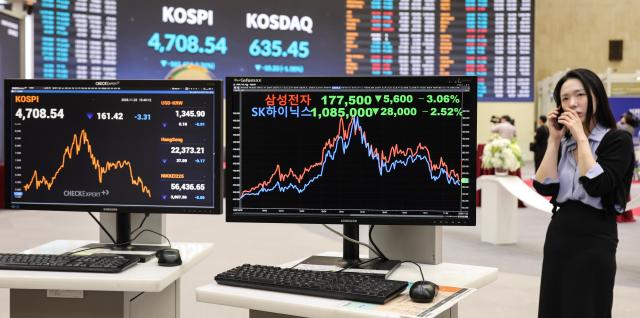
After a brief bump, it was back to the downward slide. By 1:20 p.m., the KOSPI had tumbled 5.59 percent to 4,726.32, giving back almost all of Tuesday’s 6.32 percent surge to 5,006.0. The KOSDAQ was down 1.86 percent at 653.51.
For investors who chased the comeback rally, the market had barely allowed time to celebrate before snatching the gains away. The benchmark was again hovering just above Monday’s 4,708.54 finish — back to January levels.
Foreigners made a sharp about-turn, selling a net 1.6 trillion won after buying roughly 1.02 trillion won on Tuesday. Institutions joined the retreat.
The selling came hard and early. A sell-side sidecar was activated at 9:08 a.m., temporarily suspending certain program trades just eight minutes after the opening bell.
Samsung Electronics and SK hynix, responsible for about 45 percent of the KOSPI’s market value, did most of the damage. At 11:22 a.m., Samsung was down 9.19 percent at 172,000 won and SK hynix had dropped 8.55 percent to 1,059,000 won.
Elsewhere in Asia, Japan’s Nikkei 225 fell about 2.8 percent and the Shanghai Composite lost roughly 1 percent in early afternoon trading.
Huang returning or not, the realistic check remains.
Investors still wanted to know whether AI services could earn enough to justify the enormous sums pouring into chips and data centers — and whether the companies financing that expansion could keep spending at the same pace.
Han Ji-young, an analyst at Kiwoom Securities, warned against reading too much into Tuesday’s fireworks.
“It is more appropriate to view it as an early stage in the retreat of excessive pessimism built up over the past two months, rather than a clear signal of a sustained trend reversal,” he wrote in a Wednesday report.
Wall Street had already delivered that message overnight.
Nvidia slid 5.86 percent. Micron plunged 11.01 percent and AMD dropped 8.86 percent, dragging the Philadelphia Semiconductor Index down 7.88 percent. The Nasdaq Composite fell 1.48 percent and the S&P 500 slipped 0.50 percent. The Dow Jones Industrial Average, by contrast, gained 0.85 percent.
Investors were selling the AI story far more aggressively than the broader market. Han said some of the retreat amounted to investors cashing in on the Huang rally. But the selling also showed that his return had done little to settle the industry’s deeper problems.
Anthropic’s repeated share-price declines following its initial public offering offered another uncomfortable signal: even a prominent new AI listing was struggling to hold investors’ enthusiasm.
For Korean chipmakers, a warning about tomorrow’s memory supply landed particularly badly.
BNP Paribas downgraded Micron to neutral and slashed its price target to 775 dollars from 1,700 dollars, according to Mirae Asset Securities strategist Seo Sang-young.
The bank cited uncertainty over major cloud companies’ investment plans for 2028, lower high-bandwidth memory requirements for Nvidia’s Vera Rubin Ultra platform, slowing computer and smartphone sales, and expanding wafer production capacity.
The worry is familiar to anyone who has watched a memory-chip cycle turn: fat profits encourage new factories, only for the extra supply to arrive as customers start trimming orders.
Higher interest rates threaten to make that adjustment more painful.
The Bank of Korea delivers its rate decision Thursday. In the United States, speculation about a half-percentage-point Federal Reserve increase in December has added to unease over the cost of financing AI expansion.
Data centers built with borrowed money become harder to justify when interest bills climb and expected earnings remain uncertain. More expensive credit also leaves less room for projects to run late or disappoint.
Washington has meanwhile reached for the tariff lever again.
The Trump administration is preparing findings from an excess-capacity investigation covering 16 economies, including South Korea, China and the European Union. Further tariffs could add to inflation pressure and complicate the interest-rate outlook.
Han nevertheless judged AI uncertainty to be the stronger force in share prices. The tariff investigation has been underway since March, giving investors time to absorb the threat.
The unresolved AI questions are harder to price: chipmakers financing their own customers, weakening free cash flow at major technology companies and the possibility of a memory glut from 2028.
The U.S. Thanksgiving break could leave fewer buyers and sellers to absorb sudden moves. American markets close Thursday and trade only until 1 p.m. Friday.
Tags: KOSPI, South Korea stock market, Jensen Huang, Nvidia, Samsung Electronics, SK hynix, AI selloff, retail investors, foreign selling, semiconductor stocks, memory oversupply, Bank of Korea

Ryu Yuna
Yuna Ryu covers finance, capital markets and Southeast Asian affairs.
She is drawn to the questions that numbers raise and the stories that data alone cannot answer.
Prior to journalism, she worked at Hyundai Motor Company and the Singapore Chamber of Commerce, focusing on business strategy and international affairs. She has also hosted diplomatic receptions and international conferences as an MC.
Ryu holds a master's degree in Media and Communication from Korea University, where her research focused on neuroscience-based studies of media effects.
Copyright ⓒ Aju Press All rights reserved.
Related News
-
 KOSPI Falls Below 4700 Amid Foreign Selling of 1.6 Trillion Won
The KOSPI index fell below 4700 during trading due to heavy selling by foreign investors. Following the news of Jensen Huang's return as CEO of NVIDIA, the index had reclaimed the 5000 mark the previous day, but concerns over the profitability of artificial intelligence (AI) investments resurfaced, leading to a sharp decline within a day. Samsung Electronics and SK Hynix both dropped more than 9%, adding downward pressure to the index.According to the Korea Exchange, as of 1:24 PM, the KOSPI index recorded a drop of 279.01 points (5.57%) to 4727.02 compared to the previous trading day. At one point, it fell to 4687.51, dipping below the 4700 mark, but later partially recovered some of the losses.In the securities market, foreign investors and institutions have net sold 1.62 trillion won (KRW) and 125.6 billion won (KRW), respectively. In contrast, individual investors have net bought 1.38 trillion won (KRW).The KOSPI, which initially showed a decline of over 4% in early trading, expanded its losses as foreign selling increased. A sell-side circuit breaker was triggered earlier in the day due to a sharp drop in KOSPI 200 futures prices, halting program sell orders for five minutes.Most of the top market capitalization stocks are in decline. Samsung Electronics (-9.03%) and SK Hynix (-9.50%) both experienced significant drops, while Samsung Electro-Mechanics (-10.61%), Samsung Electronics Preferred (-10.46%), and SK Square (-10.07%) also recorded double-digit declines.KB Financial (-2.18%), Hyundai Motor (-1.45%), and LG Energy Solution (-1.11%) are also underperforming. Conversely, bio stocks such as Samsung Biologics (3.80%) and Celltrion (3.59%) are on the rise.The KOSDAQ index recorded a drop of 12.55 points (1.88%) to 653.33 compared to the previous trading day. After an initial decline of over 3%, the KOSDAQ has shown signs of reducing its losses in the afternoon.In the KOSDAQ market, foreign investors have net sold 66.7 billion won (KRW), while institutions and individuals have net bought 38.4 billion won (KRW) and 22.4 billion won (KRW), respectively.Among the top KOSDAQ stocks, semiconductor-related stocks such as JUSUNG Engineering (-9.55%), IOTech (-8.08%), Rino Industry (-4.54%), and Simtech (-4.31%) are particularly weak. Other stocks like EcoPro (-3.30%), EcoPro BM (-2.94%), Roboteers (-1.19%), and Rainbow Robotics (-0.21%) are also declining. In contrast, Alteogen (4.45%) and HLB (1.08%) are rising.Market analysts have diagnosed that uncertainty surrounding the AI industry is a key factor increasing market volatility, more so than the potential for additional tariffs from the United States. Despite Jensen Huang's return as CEO, concerns about cash flow deterioration from AI investments, data center regulations, and oversupply in memory semiconductors remain unresolved.Han Ji-young, a researcher at Kiwoom Securities, stated, "Unlike last year, the current market pricing power is held more by AI uncertainty than tariff risks," adding, "It is appropriate to maintain a high sensitivity to stock price changes of AI stocks and related news flow rather than tariff news flow in the future."He further explained, "Rather than interpreting the previous day's surge as a definitive signal of a trend reversal, it is necessary to recognize it as an initial phase where the overly pessimistic outlook that had expanded over the past two months is beginning to recede."The researcher maintained that the existing judgment that the benefits of mechanical selling responses are limited remains intact, predicting that this week will continue to confirm the bottom while digesting major events such as the U.S. October Personal Consumption Expenditures (PCE) price index and Black Friday consumer results, as well as South Korea's November export figures next week.* This article has been translated by AI.
-
Kospi plunges 4.6 percent, sell-side sidecar triggered
SEOUL, November 25 (AJP) - South Korean stocks plunged Wednesday morning, triggering a sell-side trading curb on the Kospi at 9:08 a.m. as heavy selling in semiconductor shares dragged the benchmark index below 4,800. As of 9:13 a.m., the Kospi stood at 4,773.70, down 232.33 points, or 4.64 percent, while the Kosdaq dropped 3.42 percent to 643.14. The Korea Exchange activated a sell-side sidecar, temporarily suspending program sell orders for five minutes to contain market volatility. Foreign investors sold a net 243.1 billion won worth of Kospi shares, while institutions offloaded 22.9 billion won. Retail investors bought a net 253 billion won. Samsung Electronics fell 6.92 percent to 176,300 won, while SK hynix declined 6.74 percent to 1,080,000 won. Samsung Electro-Mechanics sank 8.39 percent and SK Square lost 8.25 percent, extending losses across major technology stocks. The won also weakened, with the dollar trading at 1,346.10 won, up 3.60 won from the previous session. Tags: Kospi, Kosdaq, SellSideSidecar, KoreaExchange, StockMarketSelloff, SamsungElectronics, SKHynix, SemiconductorStocks, ForeignInvestors
-
KOSPI Reacts to NVIDIA's Market Movements as K-Stock Market Strengthens
NVIDIA's fluctuations impact KOSPI, and rebounds bring smiles to the domestic stock market. The influence of NVIDIA's stock price, regarded as a barometer for the global artificial intelligence (AI) industry, is becoming increasingly evident on the Korean stock market. The high dependence on major semiconductor stocks like Samsung Electronics and SK Hynix is closely tying the sentiment of global AI investments to the domestic stock market, resulting in larger swings in both upward and downward trends.According to the Korea Exchange on November 24, as of 1:02 PM, Samsung Electronics and SK Hynix were trading at 192,700 won (KRW) and 1.18 million won (KRW), respectively, up 8.56% and 9.12% from the previous trading day. Both stocks, which surged nearly 10% in pre-market trading, continued their strong performance during regular trading hours. This was influenced by NVIDIA's 31.48% surge in the U.S. stock market, which led to a rise in tech stocks overall. The return of Jensen Huang, NVIDIA's CEO, has alleviated uncertainties, allowing positive momentum from the U.S. to quickly spread to domestic semiconductor stocks.Previously, when global AI investment sentiment weakened, the domestic stock market also experienced significant declines. On October 30, the KOSPI closed at 5,730.74, down 3.48% from the previous trading day. As the market fell sharply, a sell-side circuit breaker was triggered, with Samsung Electronics and SK Hynix leading the decline, dropping 3.02% and 7.08%, respectively.A similar trend was observed in cumulative declines. NVIDIA's stock price fell from $213.66 to $125.53, a 41.2% drop, between October 29 and November 20, amid rising uncertainties. Considering the trading lag, from October 30 to November 23, SK Hynix fell by 28.9%, and Samsung Electronics dropped by 23.49%. The KOSPI also decreased by 20.7%.The background of this synchronization lies in the high dependence of the Korean stock market on semiconductors. Samsung Electronics and SK Hynix hold significant weight in the KOSPI, and both companies are key players in the global AI supply chain. NVIDIA's performance and AI investment outlook influence the growth expectations of domestic semiconductor companies, which is reflected in the allocation of foreign investors' funds. The uncertainties in the global AI industry spread through domestic semiconductor stocks to affect overall investment sentiment in the stock market.However, the sensitive reaction was not limited to the Korean stock market. According to Investing.com, during the same period, Taiwan's TAIEX fell by 20.6%, and Japan's Nikkei 225 dropped by 12.7%. Taiwan's foundry industry, centered around TSMC, and Japan's semiconductor equipment and materials industry are deeply connected to the global AI supply chain. The decline in AI investment sentiment due to corrections in U.S. tech stocks has also weighed on the stock markets of major semiconductor supply countries in Asia. The rebound on this day has also spread to Asian stock markets, with Taiwan's TAIEX rising by 9.04% and the Nikkei 225 increasing by 1.12%.The key issue is the sustainability of the rebound. Analysts suggest that for the short-term recovery in investment sentiment following NVIDIA's surge to lead to a trend reversal, improvements in foreign investor demand must support it. Seo Sang-young, an executive at Mirae Asset Securities, stated, "The key to determining the sustainability of the rebound is the change in foreign investor demand," adding, "Given that the recent decline was exacerbated by uncertainties and supply-demand pressures rather than an actual slowdown in semiconductor demand, if foreign selling calms and shifts to buying, the sustainability of the rebound will increase."* This article has been translated by AI.