
Türkiye maintains ties with both sides and previously mediated talks in October. The latest visit comes amid rising tensions after two Russian vessels were reportedly sunk in a Ukrainian maritime drone attack near Benghazi on Nov. 22. Two soldiers from Haftar's Libyan National Army (LNA) were killed, prompting his forces to threaten retaliation against Ukraine.
Tags: Turkey, Libya, Khalifa Haftar, Libyan National Army, LNA, Libyan Civil War, Benghazi, Ukraine, Russia, Maritime Drones, Military Conflict, Diplomacy, North Africa, Mediterranean, Geopolitics

Kim Hee-su
Kim Hee-su is a bilingual reporter at AJU Press, covering defense and foreign affairs. Before joining AJP in 2025, she worked at The Korea Times, where she wrote interview stories, including a profile of North Korean defector Kim Gum-hyok, and produced digital content. She also previously worked as a researcher for KBS News 9’s International News Department, supporting correspondents in 10 countries around the world. She graduated from the University of Toronto in Canada with a double major in Book and Media Studies and East Asian Studies.
Copyright ⓒ Aju Press All rights reserved.
Related News
-
 South Korea to send special envoy to UN climate summit in Türkiye
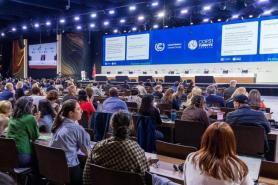
Courtesy of the United Nations Climate Change Conference (COP31) SEOUL, November 9 (AJP) - Kang Geum-sil, South Korea's ambassador for global climate and the environment and a former justice minister, is set to attend the COP31 World Leaders' Summit in Türkiye this week as a presidential special envoy, the Ministry of Foreign Affairs said on Monday. The two-day summit, which takes place in Antalya on Wednesday and Thursday as part of the 31st United Nations Climate Change Conference (COP31), is expected to bring together leaders and senior officials from more than 80 countries. The gathering will give participating countries an opportunity to reaffirm their commitment to fighting climate change, strengthen international cooperation and build momentum for putting climate pledges into action. During the summit, Kang plans to highlight the South Korean government's commitment to playing a greater role in global efforts to address climate change. She will also outline the country's plans to cut carbon emissions and call for broader international participation in efforts to implement the Paris Agreement, which aims to substantially reduce global greenhouse gas emissions. According to the ministry, Kang will also attend several events on the sidelines of the summit on climate resilience and energy cooperation. She will explore ways to strengthen collaboration with other countries on early warning systems for natural disasters, the transition to cleaner energy and related issues.
-
 Korea's Lee to host Türkiye, Timor-Leste leaders this week
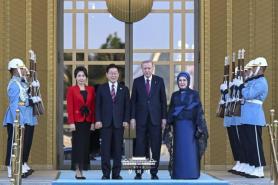
South Korean presidential couple attends welcome dinner hosted byTurkish President Erdoğan amid the NATO summit in Ankara on July 8, 2026. South Korea joined the NATO summit as a guest state. SEOUL, November 02 (AJP) -Turkish President Recep Tayyip Erdogan begins a three-day state visit to South Korea on Monday, with nuclear power and defense cooperation to top agenda for talks with President Lee Jae Myung. Erdogan’s visit is his first state visit to South Korea in eight years. It follows Lee’s state visit to Türkiye last November and comes about four months after the two leaders met at the NATO summit in Ankara in July. The leaders will hold a summit on Tuesday afternoon following an official welcoming ceremony. A memorandum-signing ceremony and state banquet are also scheduled, according to South Korea’s presidential office. The talks will review progress on projects agreed upon at last year’s summit and explore further cooperation in trade, investment, nuclear power and defense. Biotechnology, energy, science and technology, and cultural and people-to-people exchanges are also on the agenda. The leaders will discuss developments on the Korean Peninsula and in the Middle East, along with other international issues. Türkiye, a major NATO member and one of the principal contributors of troops during the Korean War, established diplomatic relations with South Korea in 1957. The countries elevated their ties to a strategic partnership in 2012. The presidential office said Erdogan’s visit would help strengthen that partnership ahead of the 70th anniversary of diplomatic relations next year. José Ramos-Horta, a co-recipient of 1996 Nobel Peace Prize, serves as the 7th president of Timor-Leste for a second term since 2022. (Courtesy of the presidential office) Timor-Leste President José Ramos-Horta will make an official visit to South Korea from Thursday through Saturday at Lee’s invitation. It will be the first bilateral official visit by a Timorese head of state since the two countries established diplomatic relations in 2002. Lee and Ramos-Horta will hold talks on Friday morning, followed by a memorandum-signing ceremony, an official luncheon and a joint press statement. Their discussions will cover diplomacy and security, intellectual property, climate change, education and people-to-people exchanges, as well as regional and international affairs. Ramos-Horta, a 1996 Nobel Peace Prize laureate, has praised the South Korean people’s efforts to defend democracy, the presidential office said. South Korea has supported Timor-Leste’s peacebuilding and development through the deployment of its Sangnoksu military unit for United Nations peacekeeping operations, assistance with election administration and development cooperation. Timor-Leste, which gained independence in 2002, became the 11th member of the Association of Southeast Asian Nations (ASEAN) last year, giving it a growing role in South Korea’s engagement with the regional bloc. The presidential office said the visit would deepen practical cooperation ahead of the 25th anniversary of diplomatic relations next year.
-
 Five centuries of standing in between makes Türkiye indispensable
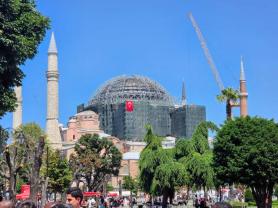
Hagia Sophia stands encased in scaffolding in Istanbul on July 17, 2026, as workers carry out a sweeping restoration of its nearly 1,500-year-old dome. The project, launched in 2025 and described by Turkish officials as the most extensive in the building's modern history, includes reinforcement against earthquakes and continues while the mosque remains open for worship. Built as a Byzantine cathedral in 537, Hagia Sophia later served as an Ottoman mosque and a museum before returning to use as a mosque in 2020. AJP Park Sae-jin SEOUL, July 20 (AJP) - There is a reason the only direct peace talks between Russia and Ukraine in four years of war have happened in one city, and that city is Istanbul. Earlier this month, NATO leaders gathered in Ankara for the first summit the alliance has ever held in the Turkish capital. The choice of venue was not a courtesy. It was an acknowledgment that the country long treated as the alliance's difficult southeastern flank has become something closer to its hinge. To understand why, it helps to look past the headlines and at a much older habit. Türkiye has spent most of its history as the country in between. Istanbul was the capital of Christian Byzantium for a thousand years before it became the seat of the Islamic caliphate for nearly five hundred more. Hagia Sophia has been a cathedral, a mosque, a museum, and a mosque again, and the city has somehow absorbed each conversion without losing itself. The Ottoman Empire governed Greeks, Armenians, Jews, Arabs, and Slavs under a system that let each community keep its own courts, schools, and houses of worship. When Spain expelled its Jews in 1492, the sultan sent ships to collect them. None of this was modern liberalism. It was something more durable: the practical knowledge that a state straddling two continents survives by holding differences together rather than resolving them. A Byzantine-era mosaic of the Virgin Mary holding the Christ Child adorns the apse of Hagia Sophia in Istanbul on July 17, 2026. Completed in 867 after the end of Byzantium's ban on religious images, the mosaic was plastered over following the Ottoman conquest of 1453 and uncovered during later restorations. The building has served as a cathedral, a mosque, a museum, and, since 2020, a mosque again. AJP Park Sae-jin That knowledge came at a price, paid mostly at home. The republic that Mustafa Kemal Atatürk built from the empire's ruins has spent a century arguing with itself about what it is: secular or religious, European or Middle Eastern, democratic or strong-handed. The argument has repeatedly turned violent. The military overthrew governments in 1960, 1971, and 1980, and pressured another from office in 1997. In July 2016, a faction of the armed forces bombed the parliament and fired on citizens. 253 people died stopping them. I spent last week in Istanbul interviewing survivors of that night, and what struck me was not their anger but their vocabulary. A businessman who lost part of his foot to a bullet told me that everyone living on Turkish soil is his family. The purges that followed the coup swept up tens of thousands and drew lasting criticism from Europe, and the wound is not closed. A country that has nearly torn itself apart this many times does not romanticize division. It learns to manage it. That learned reflex is now worth a great deal, because Türkiye's neighborhood is on fire on two sides. The Deesis mosaic, a 13th-century Byzantine work depicting Christ flanked by the Virgin Mary and John the Baptist, is seen inside Hagia Sophia in Istanbul on July 17, 2026. Hidden under plaster during the building's centuries as an Ottoman mosque, it was uncovered in the 20th century and is regarded as one of the finest surviving works of Byzantine art. AJP Park Sae-jin To the north, the war in Ukraine grinds into its fifth year. Ankara has armed Kyiv with drones, closed the Turkish straits to warships, and affirmed Ukraine's territorial integrity, while refusing to join sanctions on Moscow and keeping its channels to the Kremlin open. Western capitals once called this fence-sitting. They call it something else now that it has produced the grain deal that fed markets across Africa and Asia, the largest prisoner exchanges of the war, and the only venue both sides will accept. Just last week, Türkiye's foreign minister stood in Kyiv proposing a truce covering the Black Sea and energy infrastructure, an interim step no other government is positioned to broker. To the southeast, this year's war between Israel, the United States, and Iran left Türkiye in a position no other NATO member occupies: alliance air defenses shot down Iranian ballistic missiles crossing Turkish airspace even as Ankara kept talking to Tehran. The radar at Kürecik in eastern Türkiye is the front line of Europe's missile defense against Iran. Remove Türkiye from the map, and Europe's early warning starts a thousand kilometers further west. The European Union has kept Türkiye's membership application frozen for decades, with reasons ranging from principled to reflexive. Yet the continent now finds it needs the country it would not admit. America's rethinking of its security guarantees has left Europe rearming in a hurry, and the arithmetic is uncomfortable. Türkiye fields NATO's second-largest army, will command the alliance's rapid reaction force from 2028, and has grown its defense exports from under $2 billion a decade ago to a projected $11 billion this year, with its drones already embedded in European arsenals. The sultan's loge and a giant calligraphic roundel bearing the name of the Prophet Muhammad are seen inside Hagia Sophia in Istanbul on July 17, 2026. White curtains, upper right, cover the ninth-century Byzantine mosaic of the Virgin and Child in the apse, a practice adopted after the building returned to use as a mosque in 2020. Built as a cathedral in 537, Hagia Sophia has also served as a mosque and a museum over its history. AJP Park Sae-jin In Ankara, alliance members announced more than $50 billion in new procurement and pledged roughly $80 billion in military support for Ukraine in 2026. Brussels still debates whether to open its new defense programs to a non-member it does not fully trust. Ankara warns that a European security architecture built without Türkiye will protect less of Europe. On the evidence of the past four years, the warning is hard to dismiss. Critics have a sharper word for all this balancing, transactionalism, the accusation that Ankara simply sells its position to every side. I would suggest the older word is better. What looks like playing both sides is, in the long Turkish habit, openness, the refusal to let any single identity, bloc, or patron claim the whole country. A state that contained Orthodox Christians and Sunni Muslims for five centuries does not find it strange to host Russians and Ukrainians at the same table. A society that argues perpetually about religion and secularism is not scandalized that the world disagrees with itself too. This openness has hard limits, and Türkiye's own citizens know them best; the decade since the coup has tested civil liberties at home even as flexibility flourished abroad. But the leaders of the Western alliance, having just left Ankara, might consider that the ally they have found hardest to categorize is valuable for precisely that reason. In a world splitting into camps, somebody has to stand in between. Türkiye has had five hundred years of practice.