
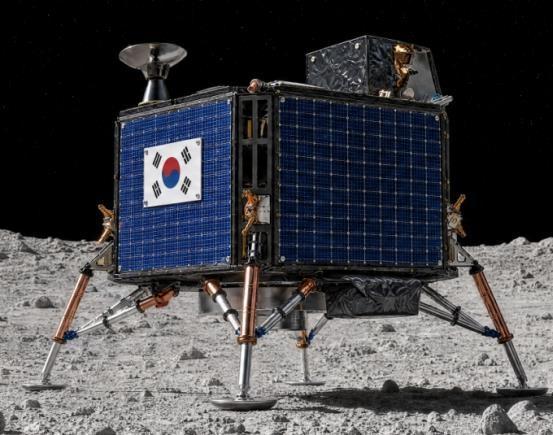
KAI said Wednesday it signed the contract with the Korea Aerospace Research Institute (KARI) on Nov. 23 and plans to deliver four structural units by December 2030, including two for testing and two for flight verification.
The structure serves as the backbone of the lunar lander, supporting and protecting its instruments and major equipment while withstanding the vibrations and shocks generated during launch and landing.
The contract forms part of South Korea's second-phase lunar exploration program, led by the Korea AeroSpace Administration (KASA). The program aims to develop a lunar lander for launch in 2032 aboard the country's next-generation rocket, KSLV-III, which is being developed based on technologies gained from the Nuri rocket.
The unmanned mission aims to demonstrate a soft landing on the Moon and conduct scientific experiments on its surface.
South Korea completed the first phase of its lunar exploration program with the successful launch of Danuri, the country's first lunar orbiter, in 2022. The spacecraft subsequently entered lunar orbit, establishing a foundation for future exploration missions.
KAI played a key role in the Danuri project, contributing to structural development, the localization of electronic components, spacecraft design, assembly and testing.
The company expanded its involvement in lunar exploration in November 2025 by joining a project to develop a qualification model for the lunar lander's landing gear.
The latest contract further broadens KAI's participation in the national lunar exploration program as it seeks to strengthen its capabilities in spacecraft development.
"It is highly meaningful for us to participate in the lunar lander project following Danuri," a KAI official said.
"Based on the technological expertise we have accumulated through satellite and space exploration projects, we will work to successfully complete the program and contribute to South Korea's independent lunar exploration capabilities."

Kim Hee-su
Kim Hee-su is a bilingual reporter at AJU Press, covering defense and foreign affairs. Before joining AJP in 2025, she worked at The Korea Times, where she wrote interview stories, including a profile of North Korean defector Kim Gum-hyok, and produced digital content. She also previously worked as a researcher for KBS News 9’s International News Department, supporting correspondents in 10 countries around the world. She graduated from the University of Toronto in Canada with a double major in Book and Media Studies and East Asian Studies.
Copyright ⓒ Aju Press All rights reserved.
Related News
-
 KAI to Develop Core Structure for Korean Lunar Lander with 15 Billion Won Contract
Korea Aerospace Industries (KAI) has signed a contract with the Korea Aerospace Research Institute (KARI) to develop the core structure of the lunar lander. KAI announced on the 25th that the contract is worth approximately 15 billion won (KRW), and it plans to deliver a total of four core structures, including two for testing and two for flight verification, by December 2030. The core structure serves as the backbone of the lunar lander. It plays a crucial role in withstanding vibrations and shocks during the launch and landing processes while supporting and protecting the payload and key equipment. The lunar lander must endure the loads, vibrations, shocks, and extreme space environment throughout its operational phases, from launch to lunar orbit insertion, descent, and landing, making the reliability of the core structure essential. This contract is part of the Phase 2 lunar exploration project promoted by the Korea Space Agency. The goal is to independently develop the lunar lander by 2032 and conduct a soft landing demonstration on the lunar surface while performing scientific and technological missions. Through the Phase 1 lunar exploration project, Korea successfully launched its first lunar orbiter, Danuri, in 2022 and achieved lunar orbit insertion. The Phase 2 project builds upon this foundation. KAI also played a key role in the development of Danuri, participating in the localization of structures and electronic components, as well as in the design, assembly, and testing of the core and substructures. A KAI official stated, "It is very meaningful to participate in the lunar lander project following Danuri. We will successfully carry out the project based on the technology accumulated through satellite and space probe development, contributing to Korea's independent lunar exploration capabilities." Meanwhile, KAI is also overseeing the development of next-generation medium-sized satellites 2 to 5.* This article has been translated by AI.
-
 Hanwha Qcells to supply tandem solar cells for NASA-funded lunar experiment
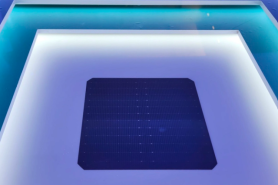
Hanwha Qcells successfully reached a world record for tandem solar cell efficiency on a full-area M10-sized cell. Courtesy of Hanwha Group SEOUL, June 09 (AJP) - Hanwha Qcells will supply its next-generation tandem solar cells for a lunar surface solar power demonstration project, the company said Tuesday, as it seeks to test the technology’s potential use in space environments. Hanwha Q CELLS GmbH, the company’s German unit, will provide samples of its perovskite-based tandem cells for the Space Science & Technology Evaluation Facility – First Flight Lunar In-Situ Solar Cell Experiment, or SSTEF-1, a project funded by NASA and led by U.S.-based Aegis Aerospace Inc. The Georgia Tech Research Institute, a nonprofit applied research unit under the Georgia Institute of Technology, selected Hanwha Qcells’ tandem cells for the demonstration mission to evaluate solar cell performance in space. The samples will be installed on the surface of a lunar lander and exposed to the space environment to collect data under conditions different from those on Earth, including vacuum, extreme temperature fluctuations, ultraviolet radiation and cosmic radiation. The research will be led by W. Jud Ready, principal research engineer at GTRI and director of Georgia Tech’s Space Research Institute. Hanwha Qcells said it plans to use data from the project to shape its research and development roadmap for highly reliable space solar power technologies. Tandem technology, seen as a potential game changer for the future terrestrial solar market, uses a perovskite top cell and a silicon bottom cell to capture different wavelengths of light. The company said the technology could also offer advantages for space applications by achieving high efficiency while reducing weight compared with conventional solar cells with the same installed capacity. Hanwha Qcells is aiming to commercialize tandem products for terrestrial use by 2029, while also expanding the technology into the space solar power sector. Hanwha Qcells said it is also testing its tandem modules outdoors at its Thalheim R&D center and a third-party site, where they have maintained stable power generation for about one year and six months, respectively. “Space solar power is not only a future energy source that can effectively respond to rapidly growing electricity demand beyond the limits of terrestrial solar power, but also a platform industry with major ripple effects across key industries closely linked to security, including AI data centers, defense and communications,” said Park Seung-deok, CEO of Hanwha Qcells. “Based on the technological capabilities and market competitiveness we have built in solar manufacturing, Hanwha Qcells will leap forward as a global renewable energy solutions company opening the era of space solar power,” he said. “This project will be an important turning point in expanding the potential of sustainable energy into space.”
-
 National Museum of Korea Draws 86,464 Visitors Over Lunar New Year Holiday
Visitors view the Daedongyeojido map. The National Museum of Korea is increasingly becoming a popular holiday destination. The museum said on the 20th that 86,464 people visited during the Lunar New Year holiday period from Feb. 16 to 18, with the museum closed on the 17th. Holiday attendance has climbed sharply: 32,193 in 2024, 50,512 in 2025 and more than 80,000 this year, up 71.2% from last year. The museum credited strong interest in its special exhibitions, “Our Yi Sun-sin” and “From Impressionism to Early Modernism,” as well as a display of all 22 volumes of the “Daedongyeojido” map unfolded along the “Path of History” on the first floor of the permanent galleries. Director Yu Hong-jun said, “Despite the cold weather, I want to express my gratitude to visitors who came to the museum during the Lunar New Year holiday.” He added, “We will continue to raise the quality of our exhibitions and steadily improve the viewing environment so visitors can encounter our cultural heritage from new perspectives.”* This article has been translated by AI.