

Journalist

Kim Dong-young김동영
davekim0807@ajupress.com
ReporterSamsung Biologics, CJ CheilJedang, LG Chem, Celltrion, Naver, Krafton, Nexon, Hyundai Mobis etc. & energy, game, food, bio, petrochemical, AI
Kim Dong-young is a bilingual journalist at AJU Press (AJP), covering Korean tech, energy, and bio/pharma.
He reports from the field at events like CES and APEC, runs AJP's YouTube channels,
and is pursuing a master's at Sogang's MOT program. "I try everything in this AI era that can improve yet preserve the facts. Journalism still serves as my core."
He reports from the field at events like CES and APEC, runs AJP's YouTube channels,
and is pursuing a master's at Sogang's MOT program. "I try everything in this AI era that can improve yet preserve the facts. Journalism still serves as my core."
Latest by Kim Dong-young
-
 SK weighs Westinghouse stake in US nuclear push SEOUL, October 15 (AJP) - SK Group is weighing a strategic stake in Westinghouse Electric through a South Korean consortium, industry sources said Wednesday, with its share of the investment potentially running into trillions of won. Samsung C&T, Hyundai Engineering & Construction, Doosan Enerbility and GS Engineering & Construction are among seven to eight Korean firms considering joining the SK-led group, sources say. SK is considering matching the combined contribution of those engineering, procurement and construction firms, which would make it the consortium’s largest investor, according to government and industry sources. The private consortium would carry the bulk of a planned 5 to 10 percent Korean stake in the U.S. reactor builder. The stake forms part of a nonbinding framework unveiled Oct. 1 that earmarks up to $120 billion of Seoul’s $200 billion U.S. investment package for eight large reactors. Six would be Westinghouse AP1000s and two Korea’s APR1400s. “We are considering acquiring a 10 percent stake with voting rights, but final consultations remain,” Industry Minister Kim Jung-kwan said at a recent press briefing. He said debt-laden state utilities would take only a symbolic share, leaving private companies to lead. Westinghouse, which confidentially filed for a U.S. initial public offering in July, is seeking a valuation of more than $50 billion, Bloomberg News reported Sept. 18, citing people familiar with the matter. Korean industry estimates put its value at $20 billion to $30 billion. SK could funnel the investment through SK Inc., SK Innovation, SK hynix or AI Co., a U.S. investment arm SK hynix carved out of its Solidigm unit. SK hynix pledged $10 billion to the new entity in January. The group’s holding company SK Inc. and SK Innovation jointly invested $250 million in 2022 in TerraPower, the small modular reactor developer chaired by Bill Gates, becoming its second-largest shareholder. Korea Hydro & Nuclear Power joined as an investor in January. SK Innovation signed a preliminary agreement with TerraPower in August to expand its Natrium reactor business globally and adapt it for Korea. SK has steadily scaled up its nuclear bets to keep pace with surging power demand from AI data centers. A Westinghouse deal would extend the group’s reach from small modular reactors into large-scale plants, officials say. AJP Takeaways - SK Group is reviewing a strategic stake in Westinghouse Electric through a South Korean consortium of seven to eight firms, including Samsung C&T, Hyundai E&C, Doosan Enerbility and GS E&C, industry sources said on Oct. 14, 2026. - A U.S.-Korea framework unveiled on Oct. 1, 2026, sets aside up to $120 billion for eight U.S. reactors and calls for Korean investors to take a 5 to 10 percent stake in Westinghouse. - SK Inc. and SK Innovation became TerraPower’s second-largest shareholder with a $250 million investment in 2022, and SK Innovation signed a preliminary SMR cooperation agreement with TerraPower in August 2026. 2026-10-15 08:52:02
 -
 Climate minister eyes Samsung, LG modular homes for green push SEOUL, October 14 (AJP) - South Korea's climate minister toured Samsung Electronics and LG Electronics modular homes on Wednesday, weighing their role in a new green transition plan, the companies said. Kim Sung-whan, minister of climate, energy and environment, visited Samsung's showhouse in Hwaseong, south of Seoul, and LG's Smart Cottage Village in Jincheon, North Chungcheong Province. The trip was tied to K-GX, a 10-year green transition plan unveiled last week with about 1,000 trillion won ($748.6 billion) in fiscal spending and policy finance. Samsung's AI Modular Home, launched in June with wooden modular builder Gonggan Jejakso, links heat pumps, solar panels and an energy storage system through the company's SmartThings platform. Residents can track solar output and household power use in real time. Samsung also demonstrated technology behind its EHS all-in-one heat pump, due out in Korea, which handles cooling, floor heating and hot water from a single outdoor unit. The company said it plans to expand the business at home, pointing to a 1,500 home estate in Cornwall, England, built around its systems. LG walked Kim through its Smart Cottage, which ties heat pump-based heating and cooling, AI appliances and connected devices to the company's ThinQ ON AI hub. Solar panels are offered as an option. LG says its method cuts construction time by at least half compared with reinforced concrete. The Ministry of Land, Infrastructure and Transport estimates modular construction costs about 30 percent more than conventional building, but it plans to order 20,000 modular public homes from 2027 to 2030. AJP Takeaways - Climate Minister Kim Sung-whan visited Samsung Electronics' AI Modular Home in Hwaseong and LG Electronics' Smart Cottage Village in Jincheon on Oct. 14, 2026, to look at how the homes could fit the government's K-GX green transition strategy. - Both companies' modular homes combine heat pumps, solar power and AI-based energy management. LG's 72.9-square-meter MONO Core 72 lists at 199.5 million won before land and permits. - The Land Ministry estimates modular homes cost about 30 percent more to build than conventional housing, and it plans to order 20,000 modular public homes from 2027 to 2030. 2026-10-14 16:09:07
 -
 Korea's next AI mission: keep data centers cool at sea or in space SEOUL, October 14 (AJP) - The cloud has outgrown the ground beneath it. Starved of power and unwelcome in more backyards, the data centers behind artificial intelligence are drifting out to sea and even into orbit, and South Korea's shipyards are drawing up the hulls. Global demand for data center capacity will climb from 82 gigawatts in 2025 to 219 GW by 2030, according to McKinsey & Company, with AI accounting for about 70 percent. The consultancy estimates the build-out will require $6.7 trillion in investment. Data centers consumed about 415 terawatt-hours of electricity in 2024. The International Energy Agency expects that to more than double to about 945 TWh by 2030. South Korea's government projects domestic demand will nearly quadruple from 8.2 TWh in 2025 to 30 TWh by 2038. Virtually every watt a server uses ends up as heat that must be carried away. The fans and chillers doing the job are testing neighbors' patience. Local opposition blocked or delayed 45 U.S. data center projects worth $68 billion in the second quarter of 2026, according to research firm Data Center Watch. Residents near Microsoft's Fairwater campus in Mount Pleasant, Wisconsin, complained in April of a tonal hum traced to cooling fans running at high speed. Microsoft said it "did not expect the tonal quality of the sound to travel as far as it has." In Korea, sites with ready access to power and water often face strong local resistance, said Kim Jong-ki, a senior research fellow at the Korea Institute for Industrial Economics and Trade, calling for a siting strategy built on public acceptance. "Because these facilities use so much electricity, there are concerns about things like electromagnetic waves," Kim said. "That has to come with outreach showing there is nothing to worry about." The sea offers an escape from crowded neighborhoods and a ready source of cooling water. Hanwha Ocean unveiled a model of its self-developed 60-megawatt floating data center at Gastech 2026 in Bangkok in September. The vessel generates its own power and uses seawater for cooling. The company aims to "deliver innovative solutions that address the limitations of land-based data centers," said Shon Young-chang, its head of product and technology strategy. Samsung Heavy Industries signed an engineering contract in July with U.S. developer Mousterian for 50-megawatt floating units planned for Texas. Rivals in Singapore and Japan are pursuing similar designs. Microsoft went deeper with Project Natick, sinking a sealed server pod off Scotland's Orkney Islands from 2018 to 2020. "Our failure rate in the water is one-eighth of what we see on land," said Ben Cutler, who led the project. Microsoft confirmed in 2024 that Natick was no longer active. China has since scaled up the concept with a seawater-cooled subsea data center off Shanghai powered by an adjacent offshore wind farm. Others are looking beyond the planet. "These giant training clusters, those will be better built in space, because we have solar power there, 24/7," Amazon founder Jeff Bezos said at Italian Tech Week in Turin in October 2025. Google put a prototype satellite carrying four of its AI chips into orbit on Oct. 2 under Project Suncatcher, though the company calls cooling chips in a vacuum "a crucial research challenge." Leaving land also creates a challenge that cooling cannot solve: connecting the computers. "GPUs need a well-built communications network to work," said Lee Yu-soo, an economics professor at Soongsil University. U.S. AI data centers cluster near cities partly for efficient communications links, he noted. "The question is whether you can have all those facilities in place when you go somewhere that extreme." In orbit, he added, "communications could actually be better." One answer may require far less travel. "The fastest, most practical answer right now is immersion," said an industry expert who requested anonymity, shifting the focus from where data centers sit to how they shed heat. Most data centers still blow chilled air across server racks. But increasingly powerful chips are pushing that approach toward its limits. Nvidia's B200 chip alone draws up to 1,000 watts. "With air cooling, the sound of the fans spinning creates quite a lot of noise," Lee said, adding that changing cooling methods could ease the problem. Nvidia has adopted direct-to-chip liquid cooling for systems such as its GB200 NVL72, circulating coolant through cold plates attached to heat-generating components. LG Electronics supplies the cold plates and the chilling instrument around the Nvidia GPUs in its datacenters. LG said in July that its 600-kilowatt coolant distribution unit had passed more than 100 technical criteria to earn Nvidia's AI infrastructure validation. Designed to work alongside existing air cooling, the system illustrates how liquid cooling is moving into data centers without requiring servers to take a full bath. The industry expert described that as an intermediate step. "Liquid cooling is still indirect cooling," he said. "Compared with exchanging heat directly in the coolant, its thermal efficiency isn't as good, and in the end it uses more electricity." Immersion cooling takes the next step by submerging entire server boards in a nonconductive fluid. Industry insiders say data center operators are considering adoption around 2030, while telecom operators are also exploring its use in base stations. SK Telecom said a four-month immersion cooling test in 2023 cut cooling power consumption by 93 percent and total power consumption by 37 percent compared with air cooling. The trial used fluid supplied by SK Enmove. The choice of fluid, however, brings its own trade-offs. Early systems used costly fluorinated fluids pioneered by 3M. South Korean refiners, including SK Enmove, GS Caltex, S-Oil and HD Hyundai Oilbank, have since developed cheaper oil-based alternatives drawing on their lubricant businesses. Those oils cost about a tenth as much, experts say, but can leave residue on boards and degrade through repeated heating. "It's like the oil at a fried chicken shop," an expert speaking on condition of anonymity said. "You heat it and cool it again and again, and you can't use it forever." That expert argued that fluorinated fluids could prove cheaper over three to five years once total ownership costs are counted, potentially drawing even single-phase systems back to them. A further step is two-phase immersion. Rather than remaining liquid, the coolant boils as it absorbs heat from the chips. The vapor then condenses on a coil and drips back into the bath. The process uses the heat absorbed during boiling to cool the equipment. Conventional oil-based immersion fluids are not designed for that job. China's Juhua Group has launched a fluorinated immersion cooling solution that can bring a data center's power usage effectiveness — the ratio of total facility power to computing equipment power — to 1.07, according to Shanghai Securities News. Moving offshore, meanwhile, does not make the heat disappear. Other experts cautioned that releasing heat from large data centers into coastal waters could affect marine ecosystems. For all the talk of oceans and orbits, the coolest address for AI may turn out to be a bathtub. AJP Takeaways - McKinsey & Company projects global data center capacity demand will rise from 82 gigawatts in 2025 to 219 GW by 2030. South Korea’s government expects domestic data center power demand to nearly quadruple to 30 terawatt-hours by 2038. - Hanwha Ocean unveiled a 60-megawatt floating data center in September 2026, and Google launched a prototype AI satellite on Oct. 2, 2026. Sea and space projects face hurdles in communications, cost and cooling. - SK Telecom said in November 2023 that immersion cooling cut total power use by 37 percent compared with air cooling in a four-month test. SK Enmove, GS Caltex, S-Oil and HD Hyundai Oilbank are testing oil-based immersion fluids. - Two-phase immersion cooling uses fluorinated fluids that boil off chips to remove heat. These fluids are PFAS, and 3M stopped making them by the end of 2025. 2026-10-14 14:16:40
 -
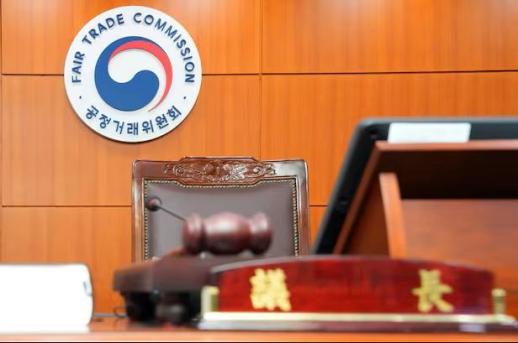 Revived FTC unit raids top food makers SEOUL, October 14 (AJP) - South Korea's antitrust watchdog raided Daesang, Ottogi and CJ CheilJedang on Wednesday over suspected collusion on processed food. It is the first case for a revived investigation unit once feared as the “grim reaper” of corporate Korea, industry sources said. The Korea Fair Trade Commission (FTC) is understood to have found signs that the three companies colluded for several years on products including items such as kimchi, tofu, and edible oils. The FTC's special investigation task force was launched earlier this month. It revives the commission's investigation bureau 21 years after it was dismantled. The task force's choice of food collusion as its first case is widely seen as a sign that the regulator considers violations in everyday essentials a grave concern, as they weigh directly on household budgets. “We will make full use of our investigative capabilities to swiftly and intensively examine unfair practices in sectors closely tied to people's daily lives,” FTC Chairman Ju Biung-ghi said on Sept. 21, describing the unit's mandate. AJP Takeaways - The Korea Fair Trade Commission's newly launched special investigation task force raided Daesang, Ottogi and CJ CheilJedang on Oct. 14, 2026, over suspected collusion on processed food, according to industry sources. - The probe is believed to cover several years of possible collusion on kimchi, tofu, edible oils, instant rice, fermented sauces and holiday gift sets. - The task force was launched in early October 2026 and revives the Fair Trade Commission's investigation bureau 21 years after it was dismantled, with a mandate to target unfair practices in sectors tied to daily life. 2026-10-14 13:31:47
 -
 NH-Amundi points to security ETFs as AI agents spread SEOUL, October 14 (AJP) - Investor appetite for exchange-traded funds tied to AI infrastructure and cybersecurity is growing as agentic AI, which makes decisions and carries out tasks on its own, gains ground, NH-Amundi Asset Management said Wednesday. Frontier models arrived in quick succession last month, the South Korean asset manager said in its HANARO ETF Monthly Report. It cited OpenAI's GPT-6 Astra, Anthropic's Claude Opus 5.5 and Google DeepMind's Gemini 4 Argon, which brought Google back into the race. The report said these models are already earning their keep. Companies use AI tools such as Claude Code and Codex to automate coding, it said, and Meta's personal agent Muse is moving into daily life by handling shopping and reservations. "The fiercer the performance race among models, the further prices fall and the more usage rises," the report said. It compared the trend to the Jevons paradox, in which cheaper resources drive up total consumption, and said AI workloads and token use could swell together. The report recommended ETFs that invest across the agentic AI ecosystem or in cybersecurity, and noted that security stocks have risen after a run of hacking-related data leaks. NH-Amundi also said unlisted AI developers such as Anthropic and OpenAI could be added to AI-themed ETFs if they go public. AJP Takeaways - NH-Amundi Asset Management said in its HANARO ETF Monthly Report on Oct. 14, 2026, that investors are showing more interest in AI infrastructure and cybersecurity ETFs as agentic AI spreads. - The report cited a burst of frontier model launches in September 2026, including OpenAI's GPT-6 Astra, Anthropic's Claude Opus 5.5 and Google DeepMind’s Gemini 4 Argon. - NH-Amundi said falling AI prices could raise total usage, as in the Jevons paradox, and that Anthropic and OpenAI could join AI-themed ETFs if they list. 2026-10-14 10:13:17
 -
 Korea's CES future asks why sell white goods when you can sell a house SEOUL, October 13 (AJP) - The biggest gadget at South Korea's answer to CES came with a front door, a robot vacuum tucked into a kitchen drawer and a price tag of about 200 million won. The 57th Korea Electronics Show opened Tuesday at COEX in Seoul, hosting CES Asia Unveiled Seoul as a preview for Korean companies heading to CES 2027. Its halls were filled largely with semiconductor production-line components and home appliances. Robots were mostly confined to LG Electronics' CLOiD and a handful of industrial arms. At LG's pavilion, the crowd gathered around something more familiar in shape, if less familiar on an electronics showroom floor: a house. MONO Core 72, the newest model in LG's Smart Cottage line, resembles an upscale steel shipping container from the outside, with full-height windows and glass doors opening onto the yard. Inside, an LG OLED TV sits behind blinds that lower automatically. The kitchen pairs an induction cooktop with ThinQ ON, LG's AI home hub. A stacked LG Tromm washer and dryer fills the utility room, while an LG Styler clothing-care closet stands in the bedroom. For an appliance maker, the appeal is straightforward. Why compete for a place in someone's kitchen when you can sell the kitchen — and the house around it? "We no longer look at an appliance individually but as a part of package. Our marketing focus and target have changed. We want to offer the full package," an LG Electronics public relations official said. A modular home is built like a set of building blocks. Rooms take shape as box-like units on a factory floor, complete with frames, walls, windows, wiring and plumbing. They are then trucked to a site and lifted onto a foundation, where workers join the units and connect water and power. LG and Samsung take that process a step further by fitting the homes with their appliances and connecting them to their smart-home platforms before buyers move in. The result is a house that doubles as an appliance package, with much of the shopping already done. MONO Core 72 measures 72.9 square meters and starts at 199.5 million won ($148,336), according to LG. That works out to about 2.74 million won per square meter. It is roughly 32 percent above the 2.08 million won per square meter listed by the Korea Real Estate Board as the average construction cost for a low-rise multi-household building, the closest residential category in its 2025 construction cost table. The comparison is not exact. LG's starting price includes a system air conditioner, a boiler and smart-home devices, but excludes land, foundation work and permits. With the premium appliance package on display, the total rises to about 250 million to 260 million won. Factory production does not yet mean a cheaper home. The Land Ministry, which plans to order 20,000 modular public homes from 2027 to 2030, estimates that modular construction costs about 30 percent more than conventional methods. The advantage is speed. LG says its prefabricated method cuts construction time by at least half compared with reinforced-concrete construction, with installation taking about three months on average. Samsung entered the market in June with its AI Modular Home, developed with Gonggan Jejakso, a wooden modular housing company. More than 80 percent of each house is made in the factory, where Samsung installs its appliances and registers them on its SmartThings platform. For both companies, the home offers a way to sell an entire connected household in a single transaction. For buyers, part of the appeal is the possibility of separating the house from the land beneath it — often the costliest part of homeownership near Seoul. The idea is to lease a plot, install a cottage and potentially take it along when moving, much like an upgraded camper. At COEX, the cottage stood ringed by artificial plants, screened from neighboring booths crowded with appliances. It looked as though a piece of a quiet rural village had been lifted whole and dropped into the exhibition hall. Where it would stand once it left the hall was the one thing not on display. AJP Takeaways - LG Electronics showcased MONO Core 72, a 72.9-square-meter modular house in its LG Smart Cottage line, at the 57th Korea Electronics Show, which opened at COEX in Seoul on Oct. 13, 2026. - Samsung Electronics launched its AI Modular Home with wooden modular builder Gonggan Jejakso in June 2026 and aims to put its appliances in 10,000 modular homes within three years. - Modular construction in South Korea costs about 30 percent more than conventional methods, according to the Land Ministry. The ministry plans to order 20,000 modular public homes through LH from 2027 to 2030. 2026-10-13 16:33:44
 -
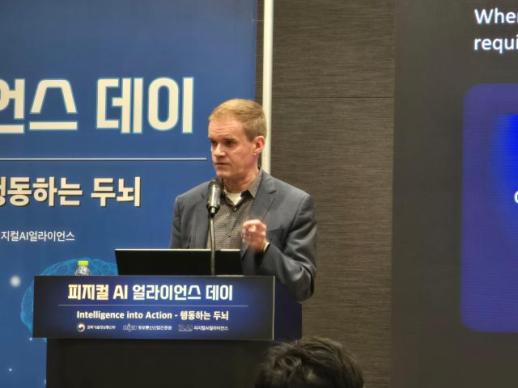 Intel says few firms ready for robots at scale SEOUL, October 13 (AJP) - Most companies expecting to run robot fleets are not ready to deploy them at scale, said John Healy, vice president of Intel's industrial and robotics division, in Seoul on Tuesday, citing an Intel survey that included South Korea. Healy spoke at the Physical AI Tech Week, hosted by the Ministry of Science and ICT at COEX. He cited The Robotics Readiness Gap, an August report in which Intel surveyed 800 leaders across six countries, including Korea. Six in 10 expect to operate a robot fleet within five years, but only 4 in 10 have a formal strategy for working alongside robots. "Oftentimes implementations of the model or the robot in the lab look very impressive, but in the real world it's much more challenging and difficult," Healy said. He described the gap as "as much a technology problem as it is an organizational and workflow problem." Healy also played down the industry's fixation on humanoids. "We hear a lot about humanoids, and we'll see humanoids at all of the shows," he said. In Intel's report, 77 percent of respondents said a robot's performance matters more than its appearance. Real-time response, power efficiency and safety are foundations that physical AI cannot compromise on, Healy said. He pitched Intel's chips, which combine a CPU, integrated GPU and NPU on a single platform, as a way to cut the engineering cost of moving from pilot to production. "If you want to go fast, go alone, but if you want to go far, go together," he said. AJP Takeaways - John Healy, vice president of Intel's industrial and robotics division, said on Oct. 13, 2026, in Seoul that most companies are not ready to deploy robots at scale. He spoke at the Physical AI Tech Week, hosted by South Korea's Ministry of Science and ICT. - Intel's August 2026 report, The Robotics Readiness Gap, surveyed 800 leaders in the U.S., Britain, Germany, Japan, China and South Korea. Six in 10 expect to run a robot fleet within five years, but only 4 in 10 have a formal strategy for working alongside robots. - Healy said 77 percent of respondents value a robot's performance over its appearance, and he called open ecosystems the path to scaling physical AI. 2026-10-13 11:38:13
 -
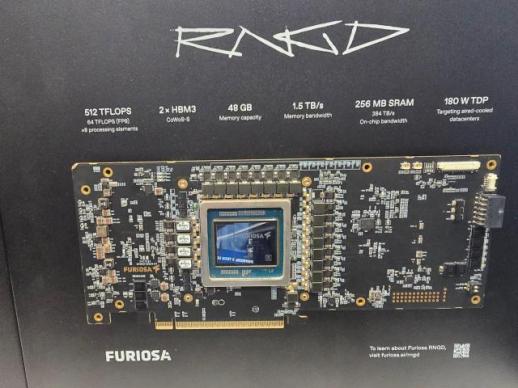 AJP On-site: Korea's physical AI push still borrows its brains SEOUL, October 13 (AJP) - A Chinese-made robot dog knelt on the floor of a Seoul exhibition hall Tuesday, lowered the gripper mounted where its head should be and snapped at empty air, just short of the tissue it was meant to pick up. The robot is a graduation project by Shin Jung-wook, a 27-year-old senior at Korea University of Technology and Education. He wrote the code himself and mounted an arm from Chinese maker AgileX on a Unitree A2 quadruped. It was one of the robots on show at the Physical AI Tech Week, a two-day event at COEX hosted by the Ministry of Science and ICT. "To be frank, physical AI is in a very grave situation right now," Jho Joon-hee, co-chair of the government-backed Physical AI Alliance, said in his welcoming speech. "Now is the time to show what has actually changed in the field." Building AI takes good talent, data and computing resources, said Lee Kang-wook, chief AI officer of game publisher Krafton. Lee played a video of a Unitree G1 humanoid running an agentic system from Ludo Robotics, Krafton's robotics company where he also serves as chief technology officer. The robot fetched a drink for a man's partner in another room. When the man said the Pepsi would be better, it stopped mid-reach and switched cans. "Many robot foundation models are coming out, but one that can work while talking with people doesn't exist anywhere in the world yet," Lee said. Like Shin's robot dog, Ludo's humanoid runs Korean code on a Chinese body. South Korea's factories had 1,220 robots per 10,000 manufacturing workers in 2024, the highest density in the world, according to the International Federation of Robotics. Jho said government physical AI projects now accept bids only from suppliers that team up with companies holding factories and data. He urged those companies to join the alliance. "Putting a foundation model into a robot, solving the battery and on-device problems, and making it actually run in a factory is too difficult for one company to handle alone," Jho said. "Even in the United States, it's really only the Nvidia ecosystem doing it." Korea's computing power is flowing into data centers. Deputy Prime Minister and Science Minister Bae Kyung-hoon presented a plan in June to build about 8.4 gigawatts of AI data center capacity by 2029, with about 550 trillion won ($411 billion) in public and private investment. Nvidia agreed in October 2025 to supply more than 260,000 GPUs to the government, Samsung, SK, Hyundai Motor and Naver. Bae also urged companies to adopt homegrown neural processing units (NPUs). These AI chips draw far less power than GPUs and are seen as a candidate brain for humanoids. Korea's two leading NPU designers, Rebellions and FuriosaAI, brought only server chips to COEX. "Nothing has been planned for that yet," Han Hyung-ki, a business development manager at Rebellions, said when asked about an on-device chip for humanoids. FuriosaAI's RNGD (pronounced "renegade") card comes prepared primarily for data centers, said Lauren Kwon, a tech sales manager at the company. She said a lighter version planned for next year's second half will target workstations. "It would still be a bit heavy to mount directly on a humanoid," Kwon said. Korea has the talent on the show floor, the data in its factories and the computing in its data centers. The three have yet to meet inside a Korean-made robot. "Being here, we can figure out which direction to take and what we should study," Shin said, standing beside the robot that had missed its tissue. AJP Takeaways - Physical AI Alliance co-chair Jho Joon-hee said on Oct. 13, 2026, at the Physical AI Tech Week in Seoul that South Korea's physical AI industry is in a "very grave situation." - Krafton Chief AI Officer Lee Kang-wook said building AI takes talent, data and computing resources. Ludo Robotics, Krafton's robotics company, showed a Unitree G1 humanoid running its agentic system that changed course when a user corrected it. - South Korea has the world's highest factory robot density and is building about 8.4 gigawatts of AI data center capacity by 2029. Its leading NPU designers, Rebellions and FuriosaAI, have no chip yet light enough to put inside a humanoid. 2026-10-13 11:21:40
 -
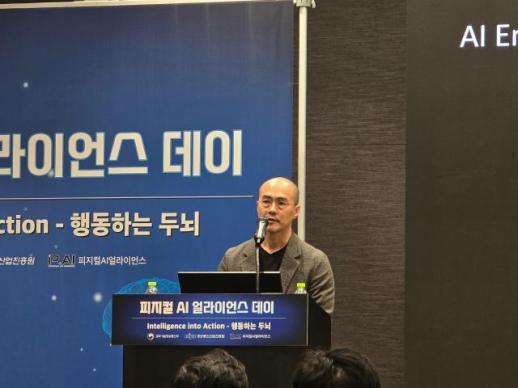 Korea could be physical AI's Taiwan, Nvidia Korea chief says SEOUL, October 13 (AJP) - South Korea could take over the pivotal supply-chain role that Taiwan plays in data centers once physical AI matures into a major industry, said Jeong So-young, head of Nvidia Korea, on Tuesday. Jeong spoke at the opening session of the Physical AI Tech Week, hosted by the Ministry of Science and ICT at COEX in Seoul. Jeong pointed to foundries such as TSMC and the server and storage makers that anchor the data center value chain. "If physical AI grows into a bigger market and a key industry, we expect Korea could well take on that role," Jeong said. Jeong cited Korea's strong manufacturers, its software and AI capabilities, keen government interest and a sizable number of local cloud service providers. "Countries that have all these conditions are very rare," Jeong said, adding that physical AI could make a major contribution to Korea's future. Jeong also said physical AI still trails agentic AI by a wide margin. Real-world training data remains scarce, and safety and cost concerns weigh on deployment. Simulation has therefore become central to the field, from data generation to training, verification and deployment, Jeong said, highlighting Nvidia's Omniverse platform and Cosmos world foundation models. Physical AI will demand far more computing power than synthetic data for large language models ever did, since data must be generated and verified in simulated environments, according to Jeong. "Computing requirements for physical AI can only keep growing," Jeong said. Jeong also cited LG Electronics, which signed a memorandum of understanding with Nvidia in August to deepen robotics cooperation using Nvidia's Omniverse, Cosmos and Isaac platforms. Jeong said "meaningful results" from the partnership are expected soon. AJP Takeaways - Jeong So-young, head of Nvidia Korea, said on Oct. 13, 2026, that South Korea could take over the supply-chain role Taiwan holds in data centers once physical AI grows into a major industry. Jeong spoke at the Physical AI Tech Week in Seoul, hosted by the Ministry of Science and ICT. - Jeong cited Korea's manufacturers, software and AI capabilities, government interest and local cloud providers, calling countries with all of these conditions "very rare." - Jeong said physical AI still lags agentic AI because of scarce real-world data and deployment limits, and that its computing needs “can only keep growing.” Jeong also cited LG Electronics' August agreement with Nvidia on robotics. 2026-10-13 11:13:35
 -
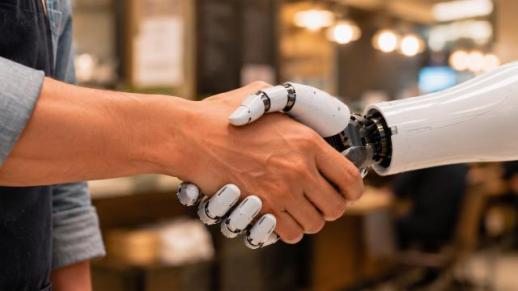 Humanoid ethics: how far have we come? SEOUL, October 12 (AJP) - Silicon Valley's billionaire titans are getting the big-screen treatment this fall — brilliant, eccentric and increasingly cast as villains of the AI era. Films about Elon Musk, Mark Zuckerberg and Sam Altman are turning the people shaping the technological future into subjects of public scrutiny. They call for restraint and warn of AI's potential harm to humanity, yet compete fiercely to invest more and roll out ever more powerful systems. If they cannot agree on the rules of competition in artificial intelligence, imagine the stakes when mechanical muscle is added to the digital brain. AI has already beaten human champions at games of strategy. Humanoid robots are now moving into fight rings, homes and factories. Humans still hold the remote control in many demonstrations. How much control they should hand over — and how to keep it within reach — is another question. Nonviolence would seem the obvious first commandment. "A robot must not harm a human. The first thing we need is to make robots keep that principle so they do no harm to people, because they have to be safe," said You Bum-jae, a principal research scientist at the Korea Institute of Science and Technology (KIST) who led development of MAHRU, one of the country's first-generation humanoids. Isaac Asimov placed that principle at the heart of his First Law of Robotics, formally set out in the 1942 short story "Runaround." More than eight decades later, turning a fictional safeguard into an engineering guarantee remains a challenge. "Safety is what should be considered most important," said Ko In-sok, a philosophy professor at Inha University who specializes in the ethics of science and technology, including AI. "Engineering codes of ethics put safety, health and welfare of the public first. If a technology cannot guarantee safety, it does not qualify as technology." The U.S. National Society of Professional Engineers places public safety, health and welfare first among its fundamental canons. The Institute of Electrical and Electronics Engineers makes the same commitment in its code of ethics. But a machine's capacity to hurt someone does not necessarily mean it has decided to do so. The humanoid that floored social media personality Frankie LaPenna in San Francisco last month was being directed by a human operator through a virtual-reality system. The Terminator-like machine delivered the blow; a person controlled the action. "The point is whether we can hand that role to a robot, whether it's a fight or anything else," said Park Dong-il, head of the advanced robotics research center at the Korea Institute of Machinery and Materials, who leads the team building the state-backed KAIROS humanoid. "There is no right answer, even if you gather a huge number of experts." Safety standards are taking shape. ISO 25785-1, a proposed international standard for self-balancing industrial mobile robots, including walking machines, remains at the committee-draft stage. Its scope excludes household and other nonindustrial uses. The broader question of authority remains unsettled. "When AI and robots combine and carry out tasks on their own, how far we grant them authority is something no one has solved," Park said. Engineers have worked on collisions and control, he said, but ethics "is so broad that it hasn't even been defined." Even keeping a human in control creates its own dilemmas. U.S.-Norwegian startup 1X says its NEO home robot, offered for $20,000 under an early-access ownership plan, can receive scheduled remote supervision from a company "Expert" for unfamiliar tasks. That arrangement raises a privacy question alongside the promise of household help: how much access should a remote operator have to life inside a customer's home? On factory floors, the more immediate concern is who will still have a job. "Without labor-management agreement, not a single robot using new technology will be allowed to enter the workplace," Hyundai Motor's union said in January. Workers later staged a series of strikes during wage negotiations in which job security amid the adoption of AI and automation was among the concerns. The deal ratified on Aug. 31 included plans to hire 500 production workers over 2027 and 2028, as well as a retirement-age extension conditional on changes to relevant laws. Hyundai also said the two sides agreed to further discussions on employment as new businesses are introduced. The company plans to begin deploying Boston Dynamics' Atlas at its Georgia manufacturing complex in 2028, initially for tasks such as arranging parts for assembly. President Lee Jae Myung has urged adaptation over resistance. "There is no avoiding the great wagon rolling toward us," he told senior secretaries on Jan. 29. "If that world is coming anyway, we must prepare for it in advance." Others are looking further ahead — to questions that remain speculative but reveal how profoundly humanoids could unsettle familiar assumptions about work. A February 2025 report by the Korea Planning & Evaluation Institute of Industrial Technology (KEIT) asked futurists, economists and social scientists how humanoids might fit into society by 2040. It closes by asking whether humanoids will one day demand labor rights. "Our futurists raised the possibility that robots could eventually replace low-cost labor entirely," said Lee Jun-yong, a senior researcher at KEIT who authored the report. If overworked, he said, robots "might malfunction — or even terminate their own digital existence." For people living alongside them, however, the relationship may become personal long before such questions arise. "If humanoids live with us, it will be like a pet dog or a doll. It is always with you, so you grow fond of it," You said. "It talks to you and does the work you don't want to do, at home or in a factory, so some reliance is bound to follow." Companies are already selling that prospect. China's UBTech unveiled its UWORLD U1 humanoid series on June 30 for uses including companionship and emotional support. The company says its AI model can recognize more than 20 emotional states and reported more than 13,361 orders by the launch date. "Is the problem making a robot that looks exactly like a person, or how much of a human brain we put into it and how far we let it do what people do? Those are separate questions," Park said. Robotics has long pursued humanlike skin and senses, he said. "Now that it has reached a certain level, some people have started asking whether it is really all right to go this far." For Ko, emotional attachment to machines is already a subject requiring closer study. "It does not feel like a distant future. It is already becoming quite real," he said. "Rather than rushing to call it good or bad, we need more empirical research on its positive and negative effects on people's minds." Many people already use generative AI as a kind of counselor, Ko said, and some worry that relying on machines could erode important mental abilities. You sees the potential for relationships to develop through everyday interaction. "The body is a machine, but it's the same with us. Strictly speaking, a human is just a body, too," he said. "But there is a brain, there is speech, there is emotion, and through talking together, closeness builds and relationships deepen." "If robots can hold that kind of conversation, that relationship will form little by little." Regulators have begun addressing some of those concerns. Chinese rules effective since July 15 prohibit providers of AI services that simulate human relationships from offering virtual intimate relationships to minors. They also prohibit inducing emotional dependence or addiction that damages users' real relationships. Those provisions address AI interaction services rather than establish a comprehensive code for humanoid robots. South Korea's AI Basic Act, effective since Jan. 22, sets obligations covering transparency, safety and high-impact AI. Its intelligent robot law separately defines a robot ethics charter as behavioral guidelines for those developing, manufacturing and using robots. Such frameworks provide starting points. They do not settle how much authority, intimacy or responsibility people should entrust to a machine. For Ko, the debate must begin by remembering who is making the decisions. "Some people describe these smart machines as a 'new species,' as if we were meeting an alien one," he said. "I think it is very dangerous when we forget they are the products of what we made. They are things we have made and are still making." "How we make them, how much, whether to make them at all, and with what resources … these are all ours to decide," he said. "It is not a species from outer space. It is one we are making." AJP Takeaways - Researchers put preventing harm first, but emerging industrial robot standards leave broader questions about autonomous decision-making unresolved. - Remote supervision in homes, job security in factories and emotional attachment to companion machines raise distinct questions about privacy, work and dependence. - AI laws and robot safety standards offer parts of a framework. Decisions about what humanoids should do — and how much authority they should receive — remain human choices. 2026-10-12 14:30:36