

Journalist

Kim Hee-su김희수
khs@ajupress.com
ReporterMinistry of Foreign Affairs, Seoul City Hall & Defense, Foreign Affairs
Kim Hee-su is a bilingual reporter at AJU Press, covering defense and foreign affairs. Before joining AJP in 2025, she worked at The Korea Times, where she wrote interview stories, including a profile of North Korean defector Kim Gum-hyok, and produced digital content. She also previously worked as a researcher for KBS News 9’s International News Department, supporting correspondents in 10 countries around the world. She graduated from the University of Toronto in Canada with a double major in Book and Media Studies and East Asian Studies.
"I'm driven by storytelling."
Latest by Kim Hee-su
-
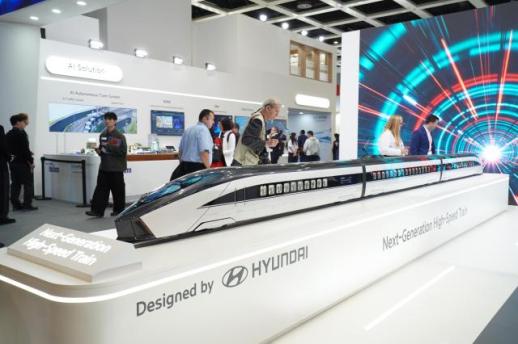 Hyundai Rotem showcases future rail tech at InnoTrans 2026 SEOUL, September 23 (AJP) - Hyundai Rotem is showcasing a next-generation high-speed train and autonomous hydrogen tram technology at InnoTrans 2026 in Berlin. The company said Wednesday it is participating in the international rail exhibition from Sept. 22 to 25. Hyundai Rotem is unveiling its next-generation high-speed train concept for the first time. Developed in cooperation with Hyundai Motor Group’s Hyundai Design Center, the train features an aerodynamic exterior inspired by biomimicry and a passenger-focused interior designed to improve legroom, storage space and overall comfort. The company is also displaying an EMU-320 high-speed train, the platform used for South Korea’s KTX-Cheongryong, which has a top operating speed of 320 kilometers per hour. Hyundai Rotem is also presenting a model of a hydrogen-electric tram equipped with autonomous driving and AI technologies. The system is designed to handle tasks ranging from pre-operation inspections to autonomous driving and maintenance, while onboard AI-based CCTV can detect emergencies and alert control systems in real time. The company said it aims to further develop the technology toward fully autonomous hydrogen tram operations. AJP Takeaways - Hyundai Rotem is showcasing a next-generation high-speed train and autonomous hydrogen tram technology at InnoTrans 2026 in Berlin. - The company is also displaying the EMU-320, the platform used for South Korea’s KTX-Cheongryong high-speed train. - Hyundai Rotem aims to advance AI-based autonomous driving technology toward fully autonomous hydrogen tram operations. 2026-09-23 11:20:37
 -
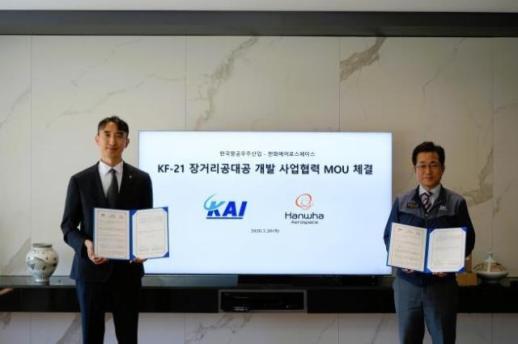 Hanwha, KAI team up on KF-21 long-range air-to-air missile SEOUL, September 23 (AJP) - Hanwha Aerospace and Korea Aerospace Industries (KAI) are strengthening cooperation to develop a domestically produced long-range air-to-air missile and integrate it with South Korea’s KF-21 Boramae fighter jet. The companies said Wednesday they signed a memorandum of understanding to support the successful development of the missile system, including its integration with the KF-21 and eventual deployment. The latest agreement builds on memorandums signed in February covering cooperation on domestically developed aircraft, exports and aviation weapons. Hanwha Aerospace and KAI are also seeking to combine their overseas networks to pursue package exports of Korean fighter aircraft and locally developed weapons. KAI has built an international aircraft sales network, while Hanwha Aerospace has expanded its global defense presence through products including the K9 self-propelled howitzer and Chunmoo multiple rocket launcher system. Hanwha Aerospace already supplies major components for the KF-21, including the aircraft’s engine, landing gear and flight control systems. Affiliate Hanwha Systems provides equipment including the active electronically scanned array, or AESA, radar, electro-optical targeting pod, infrared search and track system and mission computer. Hanwha Aerospace is also developing technology with the Agency for Defense Development (ADD) to enable communication and integration between the KF-21 and air-to-air missiles. The project is scheduled for completion in the first half of next year. The company submitted its final proposal on Sept. 7 for the ADD-led long-range air-to-air missile development program. A ducted ramjet uses oxygen from the surrounding air to burn fuel, allowing a missile to sustain high speeds over longer distances, a key requirement for long-range air-to-air weapons. “We will make companywide efforts to ensure the successful localization of the long-range air-to-air missile, which is directly linked to the competitiveness of Korea’s indigenous fighter aircraft,” a Hanwha Aerospace official said. “We will also contribute to strengthening the competitiveness of domestically developed aviation weapons through continued cooperation between companies.” AJP Takeaways - Hanwha Aerospace and KAI will cooperate on a Korean-made long-range air-to-air missile for the KF-21. - The two firms also aim to pursue package exports of Korean fighter jets and weapons. - Hanwha Aerospace has submitted a proposal for South Korea’s long-range air-to-air missile program. 2026-09-23 10:52:21
 -
 Hanwha Solutions eyes China's offshore wind power cable market SEOUL, September 22 (AJP) - Hanwha Solutions is showcasing next-generation extra-high-voltage cable materials and recycling technologies at Wire China 2026 in Shanghai as it seeks to expand its presence in China's offshore wind and power transmission markets. The company said Tuesday that its Wire & Cable division is participating in the exhibition from Sept. 21 to 24, displaying materials for super extra-high-voltage (SEHV) cables as well as circular solutions. Among the products on display is a 500-kilovolt-class cable model using cross-linked polyethylene, or XLPE, insulation and semiconductive materials designed for extra-high-voltage transmission. Hanwha Solutions is also presenting its "Closed Loop" solution, which uses its proprietary decrosslinking technology to recycle discarded XLPE cable materials for use in new cables. Hanwha Solutions also plans to sign separate memorandums of understanding with Chinese cable makers ZTT and Hengtong during the exhibition. Under its planned agreement with ZTT, the companies will jointly develop 132-kV wet-type offshore wind cable materials using tree-retardant XLPE (TR-XLPE) and semiconductive compounds. Hanwha Solutions will supply the materials and technical support, while ZTT will manufacture cable samples and conduct type tests. The company will also partner with Hengtong to develop cable materials for extra-high-voltage, submarine and high-voltage direct current (HVDC) power transmission. "China is an important market that is rapidly growing in extra-high-voltage transmission and offshore wind," said Carlo Scarlata, head of Hanwha Solutions' Wire & Cable division. He said the company aims to expand business opportunities in China and global markets through technology verification and joint development with local customers. AJP Takeaways - Hanwha Solutions is targeting China’s offshore wind and high-voltage power cable markets with advanced insulation materials and recycling technologies at Wire China 2026. - The company plans to jointly develop 132-kV offshore wind cable materials with ZTT and expand cooperation with Hengtong on extra-high-voltage, submarine and HVDC cable materials. - Hanwha Solutions is also showcasing 500-kV-class cable materials and its “Closed Loop” technology, which recycles used XLPE into new cable materials. 2026-09-22 17:49:44
 -
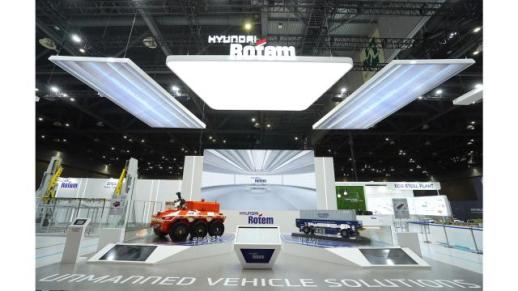 Hyundai Rotem taps Hyundai Motor smart factory tech for aerospace operations SEOUL, September 22 (AJP) - Hyundai Rotem will introduce Hyundai Motor's artificial intelligence-based smart factory technology into its aerospace production operations to improve workplace safety and manufacturing quality. The company said Tuesday it recently signed a memorandum of understanding with Hyundai Motor for comprehensive technology cooperation aimed at automating production processes and reducing safety risks. Under the agreement, Hyundai Rotem plans to apply Hyundai Motor's automated manufacturing technologies to high-risk aerospace production processes. The company said greater automation could help prevent workplace accidents while improving production quality and minimizing potential disruptions to development and manufacturing schedules. The move comes as Hyundai Rotem expands its aerospace business. The company is working on ducted ramjet engines, hypersonic engines and methane engines for reusable launch vehicles, while also developing key technologies for a long-range air-to-air missile. Hyundai Rotem also signed an investment agreement with North Jeolla Province and Muju County in March to invest about 300 billion won ($220 million) through 2034 in an aerospace production and research and development hub. "We will use advanced unmanned technologies to create a workplace free of safety accidents while ensuring the stable supply of high-quality engines and propulsion systems," a Hyundai Rotem official said. AJP Takeaways - Hyundai Rotem will adopt Hyundai Motor’s AI-based smart factory technology at its aerospace production sites to improve workplace safety and manufacturing quality. - The automation technology will be applied to high-risk aerospace processes as Hyundai Rotem expands work on ramjet, hypersonic and reusable launch vehicle engine technologies. - Hyundai Rotem plans to invest about 300 billion won through 2034 to build an aerospace production and R&D hub in Muju, North Jeolla Province. 2026-09-22 17:15:01
 -
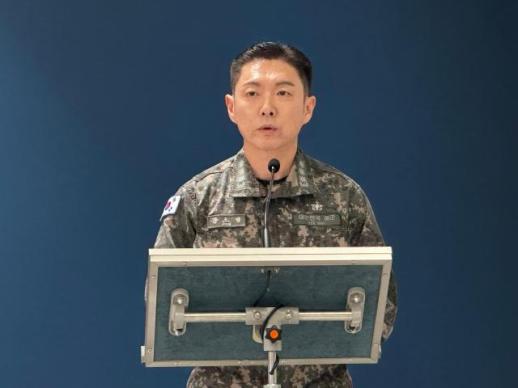 DMZ blast hits troops ahead of UNC inspection SEOUL, September 22 (AJP) - South Korean troops hit by a suspected land mine explosion inside the Demilitarized Zone were clearing a route ahead of a planned United Nations Command inspection of terrain changes detected near the inter-Korean military demarcation line, the military said Tuesday. The Joint Chiefs of Staff said South Korean surveillance assets had detected changes to the terrain near the Military Demarcation Line, or MDL, on the western front, prompting Seoul to request an on-site inspection by the UNC. The inspection had been scheduled for early next week, and Monday's operation was intended to open a search route and prepare access to the area before the UNC team entered, according to the JCS. Troops were using mine detectors while clearing the route when an explosion believed to have been caused by a land mine occurred. The blast site was "in close proximity to the MDL," the JCS said, without disclosing its precise location. The disclosure provided new details about the mission underway when the explosion occurred Monday morning in the western sector of the DMZ under the Army's 25th Infantry Division. The JCS initially said three South Korean officers were injured in the explosion. Two were airlifted to the Armed Forces Capital Hospital, where they underwent surgery for serious injuries and were confirmed to be in stable condition. A third officer was transported by land along with other troops and was later assessed by medical staff as not seriously injured, the JCS said Tuesday. About 10 troops had been taking part in the operation, with the remaining personnel also taken to the hospital for medical examinations. The two seriously injured officers had been wearing protective gear, including protective clothing and mine-protection overshoes, according to the JCS. The cause of the explosion remains under investigation. Military authorities are considering multiple possibilities, including an unidentified South Korean mine, a North Korean mine displaced by flooding or other natural causes, or a mine recently planted by North Korean troops. "We are keeping all possibilities open and will thoroughly determine the cause before taking necessary measures," the JCS said. The military has so far declined to say how far the blast site was from areas where North Korean mine-laying has been suspected, despite repeated questions during Tuesday's briefing. The JCS said the lack of details was not due to operational security, but because a field inspection and investigation had yet to establish the precise location and cause of the explosion. It said further information would be released after the investigation. Rep. Yoo Yong-won of the main opposition People Power Party said Monday that the accident occurred near areas where North Korean troops are suspected of creating minefields south of the MDL. Yoo had earlier claimed that minefields and other structures at six locations in the 25th Infantry Division's sector extended about 10 to 15 meters south of the MDL. The JCS said Monday that the blast site was some distance from the areas cited by Yoo, but has not provided a specific distance. North Korea has been carrying out extensive construction along the MDL since declaring inter-Korean relations to be between "two hostile states," including laying mines, erecting fences and barriers and building tactical roads near the border. The South Korean military said it has responded to North Korean MDL violations in accordance with established rules and principles. A JCS official also confirmed Tuesday that the military has taken responsive measures in the western sector, but could not immediately provide the number or timing of such actions. No unusual North Korean military activity was detected at the time of Monday's explosion, the JCS said. It remains unclear when the UNC inspection will now take place following the accident. The JCS said dealing with the aftermath of the explosion and ensuring safety would come first before further steps are decided. AJP Takeaways - South Korean troops were clearing a DMZ route for a planned UNC inspection when a suspected land mine exploded, seriously injuring two officers. - The JCS said the cause remains under investigation, including whether the mine was linked to North Korea. - The blast comes amid North Korea’s ongoing mine-laying, fencing and tactical road construction near the MDL. 2026-09-22 11:31:48
 -
 Iran war reaches UN crossroads as Hormuz emerges as possible deal SEOUL, September 21 (AJP) - Trump-Xi diplomacy is not the only high-stakes encounter commanding attention this week. The United Nations General Assembly is opening a rare diplomatic window for the United States and Iran after nearly seven months of war, with the Strait of Hormuz emerging as the most plausible starting point for a limited deal. Middle East experts caution that New York may reveal the direction of the conflict rather than produce an immediate breakthrough. U.S. President Donald Trump and Iranian President Masoud Pezeshkian are both heading to New York for the U.N. General Assembly's high-level week as Washington and Tehran leave the door open to diplomacy while warning of further escalation. The General Debate begins Tuesday. Trump said last week he hoped the war was nearing an end. "Well, hopefully we are towards the end of the war," Trump told reporters, adding that Iran "want to make a deal." The U.S. president has also kept renewed military action on the table. Tensions intensified over the weekend following fresh attacks by Yemen's Iran-aligned Houthis on Saudi Arabia, while Trump publicly pressed Tehran to reach an agreement. The competing signals have turned the U.N. gathering into a test of whether Washington and Tehran can rebuild the diplomatic channel that opened under a 60-day memorandum in June, or move closer to another round of escalation. A first indication could come Tuesday, when Trump is expected to meet leaders or senior officials from all six Gulf Cooperation Council states on the sidelines of the General Assembly. The talks are expected to focus heavily on Iran and the regional fallout from the war. Attention will then shift to the Iranian delegation and Pezeshkian's message in New York. Washington has approved entry for a core Iranian delegation including Pezeshkian and Foreign Minister Abbas Araghchi despite the continuing conflict, although their movements in New York will be tightly restricted. No formal Trump-Pezeshkian meeting has been announced. Tehran opens a door, but on hard terms The diplomatic activity comes days after Mohsen Rezaei, secretary of Iran's Supreme National Security Council, said Tehran had sent Washington seven conditions through Qatar for renewed negotiations. Only three have been publicly identified. Iran wants an end to the war on all fronts, the release of frozen Iranian assets and an end to the U.S. naval blockade. Tehran says it is awaiting Trump's response. The demands carry echoes of the June U.S.-Iran memorandum, which called for an end to military operations and set a 60-day period for negotiating a broader settlement. Washington agreed to begin lifting its naval blockade and make frozen Iranian funds available, while Tehran undertook to restore commercial passage through Hormuz and reaffirmed that it would not develop or acquire nuclear weapons. The latest signal nevertheless carries weight because it came from Rezaei, a prominent figure in Iran's security establishment, said Kim Deok-il, a research fellow at Korea University's Middle East and Islamic Center. "Rezaei is not someone who normally talks about negotiations," Kim told AJP. "The fact that he has expressed a willingness to negotiate suggests that Iran is not completely ruling out talks." Kim cautioned that Tehran is unlikely to soften its position quickly. Jang Ji-hyang, a principal fellow and director of the Center for Regional Studies at the Asan Institute for Policy Studies, was more skeptical that the terms could form the basis of an immediate settlement. The demands presented by Rezaei, who represents a harder-line current in Tehran, would be difficult for Trump to accept in their current form, she said. Both sides therefore arrive in New York with a similar contradiction. Each is leaving room for diplomacy while making clear it is prepared to keep fighting. Pezeshkian's room to maneuver The presence of Pezeshkian and Araghchi does not mean the Iranian delegation has authority to make all the concessions required for a broader settlement. Kim pointed to the influence of the Islamic Revolutionary Guard Corps in wartime decision-making and said Pezeshkian has considerably less freedom over security policy than a U.S. or South Korean president. Indirect exchanges could still occur through mediators such as Qatar and Pakistan even without a Trump-Pezeshkian meeting, he said. Baek Seung-hoon, a research professor at Myongji University's Institute of Middle Eastern Affairs, cautioned against drawing too sharp a division between a negotiation-minded civilian leadership and a Revolutionary Guard establishment committed to war. Mohammad Bagher Ghalibaf, Iran's parliament speaker and chief negotiator with Washington, is a former Revolutionary Guard commander and conservative figure. Yet he has publicly backed the conditions Tehran is putting forward. Ghalibaf said Sunday that Hormuz would remain closed unless Iran's conditions were met and U.S. commitments implemented. "You can't simply divide it into the president wanting negotiations and the Revolutionary Guards wanting war," Baek told AJP. Iran's hard-liners also appear to support the current negotiating terms, he said, suggesting the security establishment does not automatically oppose diplomacy. Iran also needs an exit Economic pressure gives Tehran and its security establishment reasons to consider a way out of a prolonged conflict. "Even to fight a war, you need money," Baek said. Recovering frozen assets or securing other economic relief could therefore give Iran an incentive to negotiate. A concrete timetable setting out when funds would be released and what Tehran would receive in return could give even the Revolutionary Guards reason to consider an agreement, Baek said. Iran's seven conditions can consequently be read both as hard demands and as an opening bargaining position from a government searching for a workable exit. Rezaei's decision to communicate the terms through Qatar also suggests negotiations have not been ruled out. "Both sides are in a situation where negotiations would be better for them," Baek said. Hormuz could provide the first deal The Strait of Hormuz may offer the clearest path toward a limited agreement. Washington is unlikely to accept Iran's conditions exactly as presented, particularly if Tehran demands the immediate release of frozen assets or other major concessions before substantive negotiations begin, Baek said. Room may exist, however, to revive elements of the earlier 60-day arrangement. The June memorandum linked the easing of the U.S. naval blockade with the restoration of commercial shipping through Hormuz, making the waterway one of the few areas where each side can offer something the other wants. Reopening Hormuz could also provide Trump with a visible economic payoff by easing pressure on energy prices and allowing Washington to claim progress in restoring navigation through one of the world's most important oil routes. Oil has remained around or above $100 a barrel amid disruptions in Gulf shipping, keeping energy costs among the clearest global economic stakes surrounding the conflict. Washington and Tehran could then extend negotiations for several more weeks or another 60 days over more difficult questions involving frozen assets, sanctions and maritime restrictions without claiming to have settled the war. "Even if there is an agreement, it would not mean that everything has been resolved," Baek said. "If an interim agreement restored traffic through Hormuz and helped bring oil prices down, Trump could gain time while delegations worked on the more difficult questions," he said. Baek sees negotiating room even with a final settlement still distant. "The possibility is not zero," he said. Trump's threats may be part of the bargaining Trump's renewed threats of military action can also be read through the lens of coercive diplomacy. Baek said the rhetoric may be intended to convince Tehran that rejecting talks now could leave Iran facing higher costs and worse terms later. The larger question is how much additional pressure Washington is prepared to impose. The United States would have to weigh the costs of deeper involvement in a conflict already approaching seven months, while Iran understands its own ability to sustain economic and military pressure is limited. Mutual constraints leave some space for bargaining even as both sides maintain hard public positions. Gulf states could help decide the direction Trump's discussions with Gulf governments could provide another signal of whether Washington leans toward renewed military pressure or gives diplomacy more time. Kim expects the U.S. president to listen closely to regional governments exposed to Iranian retaliation and Houthi attacks. "If the Gulf states agree with taking a harder approach, the United States could move more strongly," Kim said. "If they instead ask for restraint and say they want negotiations, it could move toward talks." The Houthis add another complication. Jang said Tehran is likely to argue that although the group belongs to its wider "axis of resistance," Iran does not exercise complete control over its decisions. Recent Houthi operations have strengthened Iran's bargaining leverage by increasing pressure on Saudi Arabia and threatening shipping around the Red Sea, Baek said. The leverage has limits. Further disruption around the Bab el-Mandeb Strait could threaten Egypt's Suez Canal revenues and invite stronger regional opposition. The coming days in New York therefore offer a narrow diplomatic opening rather than a clear path to peace. An agreement restoring more normal navigation through Hormuz and opening another defined period of negotiations could mark the beginning of a new diplomatic phase. Failure would provide a different kind of clarity. It would show how far Washington and Tehran remain from an exit and how close the region may be to another round of escalation. AJP Takeaways - U.S. President Donald Trump and Iranian President Masoud Pezeshkian head to the U.N. General Assembly as Washington and Tehran test whether diplomacy can reopen after nearly seven months of war. - The Strait of Hormuz has emerged as the clearest path to a limited U.S.-Iran deal, potentially linking restored shipping with talks over frozen Iranian assets, sanctions and the U.S. naval blockade. - Iran’s economic strain, Trump’s pressure campaign, Gulf state concerns and Houthi attacks could determine whether the U.N. week opens a new negotiating phase or pushes the region toward renewed escalation. 2026-09-21 18:01:29
 -
 Care leavers remain on South Korea's social periphery SEOUL, September 21 (AJP) - Home is easily taken for granted. Some people grow up never quite knowing what it means to have one. A Korean activist in her 20s, who asked not to be named because she does not want her childhood history to follow her into adulthood, is one of them. When she was six or seven, she and her younger sibling were placed in a residential child care facility after their father found himself unable to raise them alone. She remained in institutional care into her early 20s. But when the time came to leave, she had something many young care leavers — those who must leave foster or institutional care as they enter adulthood — do not have: an adult she could turn to. Her father had continued to visit her while she was growing up, and she eventually moved in with him and her grandmother after leaving the facility. “I was fortunate because I had at least one adult I could rely on emotionally,” said the woman, who has since married. “That helped me get through it. Young people who do not have even one person like that can face much greater difficulties.” Government assistance has expanded, but support can still fall short when it comes to the relationships, reassurance and everyday guidance young adults often rely on as they make the transition to independent living. More than 8,500 young people left South Korea's institutional or foster care system over the five years through 2024, while another 5,177 remained in extended care before transitioning to independent living, according to government figures. Those in extended care can remain under protection until age 24. A 2023 government survey found that 46.5 percent of young care leavers had thought about suicide at some point in their lives, while 18.3 percent said they had experienced serious suicidal thoughts during the previous year. Their average life satisfaction was 5.6 out of 10, compared with 6.7 among the broader population aged 19 to 34. Young people in residential facilities grow up surrounded by other children and staff. Then one day, some find themselves returning alone to a home with no one waiting inside. “They go from a place that was always full of children's voices and people around them to coming home alone, with the lights off,” said Park Hyun-jin, a team leader at nonprofit organization YANA, or You Are Not Alone. “That feeling that you are completely alone can bring a great deal of emptiness and anxiety.” Signing a housing contract, dealing with a bank, choosing a career or finding out what government assistance is available are tasks that many people in their early 20s discuss with their parents. Some care leavers have no such person to call. “Some call and ask, ‘How do I use this washing machine?’” Park said. “What seems basic to us may not have been basic for them.” Regional self-reliance support agencies contact young people after they leave care, but some do not answer calls or messages. Those who are already socially withdrawn can be among the hardest to reach because meeting people or asking for help has itself become difficult. Park recalled young adults who repeatedly canceled appointments or disappeared from contact for extended periods. Some spent most of their time at home and struggled even with basic self-care. “Even if they did not want to meet, the worker would keep calling and asking, ‘Have you eaten? Is anything difficult?’” Park said. “One young man I met again a year later proudly told me that he had gotten a haircut.” What stays with them is often something much smaller than formal assistance. “What they remember is often not something big,” Park said. “It can be making gimbap together or going for a walk with a family.” Such experiences, she said, can give children a model of family life and a sense of what it feels like to receive one-on-one attention from an adult. “Experiences of being loved have to build up from childhood,” Park said. “What children experience and the adults they meet when they are young can make a difference when they become adults.” Some recipients have described the support itself as a reminder that people they have never met still care about what happens to them. “Some tell us they are grateful that people who do not even know them are willing to help,” Park said. “They say they want to remember that support and not waste their lives.” But access to such support is not automatic. YANA operates an emergency medical assistance program called YANA 119, but young care leavers first have to know that the program exists and be willing to seek help. The organization publicizes it through social media, notices sent to residential care facilities and partner organizations that work with care leavers. Once a case is referred or an application is submitted, YANA reviews whether financial assistance is needed. Park said the nonprofit's board members, who are physicians, assess the medical circumstances before deciding who will receive support. “Our board members who are doctors review whether the young person genuinely needs the assistance, and support is provided to those selected through that process,” Park said. The program provides emergency medical assistance to care leavers who might otherwise struggle to pay for treatment, including those facing serious illnesses or conditions requiring urgent care. It is not limited to people considered at risk of suicide. Those who know about available programs and are willing to ask for help have a route into the support system. Those who are deeply isolated, or simply unaware that help exists, are much harder to reach. Yoo In-kyung, general operations director for RISE UP, a charity bazaar held in southern Seoul last week to support suicide prevention and medical care for young care leavers, said organizers became more closely involved with the issue after YANA contacted them and shared cases of young people needing medical assistance. They included young people working delivery jobs who had been injured but could not afford treatment, as well as others suffering from illnesses requiring longer-term care. “They have no one to turn to for help,” Yoo said. At the time of the interview, Yoo said YANA had referred several young people in need of medical support to the organizers. Details of the individual cases were kept off the record. The 2023 government survey found that 20.7 percent of young care leavers had needed medical treatment during the previous year but were unable to receive it, with cost cited as the biggest reason. Their employment rate stood at 52.4 percent in 2023, compared with 61.3 percent among South Koreans aged 20 to 29, while nearly 70 percent lived alone. Organizers said proceeds from the event would be delivered to YANA to support emergency medical care and psychological counseling. “Instead of saying, ‘I’ll help someday when I can afford to,’ we wanted people to start with something small they can do now,” Yoo said. Few care leavers volunteer to speak to the press. Many do not want a childhood spent in institutional care to become a stigma they carry into adulthood. Silence can make the people most in need of help the least visible. Park said those willing to speak publicly are often more comfortable discussing their background or have reached a relatively stable point in their lives. Those who are more socially isolated are often the hardest to reach. Society may group them under the label “young care leavers” and classify them as a vulnerable population. But leaving care is a circumstance, not an identity — and what many lack is not simply financial assistance, but the ordinary network of people most others call home. AJP Takeaways - More than 8,500 young care leavers exited South Korea’s institutional or foster care system over the five years through 2024, while thousands more remain in extended care. - A 2023 government survey found 46.5 percent had experienced suicidal thoughts, while many also face gaps in medical care, employment and everyday support after leaving care. - Groups such as YANA and RISE UP are providing medical, psychological and practical assistance, but socially isolated young people can still be difficult to reach. 2026-09-21 17:29:19
 -
 Hanwha Qcells, POSCO team up to expand agrivoltaics in Seoul SEOUL, September 21 (AJP) - Hanwha Qcells and POSCO have agreed to jointly develop and supply agrivoltaic systems in South Korea as the country prepares to implement a new law aimed at expanding solar power on farmland. The companies signed an agreement on Sept. 17 to jointly develop agrivoltaic systems using Qcells modules and POSCO structures. They also plan to build an alliance of domestic companies to provide broader agrivoltaic solutions. Agrivoltaics allows crops and solar panels to share the same land by adjusting the placement and angle of modules to maintain sufficient sunlight for farming while generating electricity from the remaining solar energy. The sector has so far remained largely limited to pilot projects in South Korea, partly because existing farmland regulations required solar facilities to be removed after eight years even though such equipment can typically operate for more than 30 years. That is set to change under legislation passed by the National Assembly in May and promulgated in June. The new law extends the maximum operating period for agrivoltaic projects from eight years to 23 years, creating a longer-term business model for farmers and agricultural cooperatives. Under the partnership, Hanwha Qcells will manufacture high-efficiency modules designed for agrivoltaic projects at its Jincheon plant in North Chungcheong Province. POSCO will supply durable support structures designed for Korean farmland and develop mounting systems that protect crops and minimize disruption to farming. The two companies will jointly develop an integrated module-and-structure package for the Korean market. “Agrivoltaics can expand renewable energy while also improving the sustainability of rural communities,” Yoo Jae-yeol, head of Hanwha Qcells’ Korea business, said. POSCO said the technology could help preserve farmland and allow farming to continue while adding renewable power generation. “We will use our materials technology and business capabilities to develop structural solutions suited to Korea’s agricultural environment and contribute to building the domestic industry ecosystem,” said Hong Sam-soo, head of POSCO’s cold-rolled and coated steel marketing office. AJP Takeaways - Hanwha Qcells and POSCO will jointly develop agrivoltaic systems for South Korea’s farmland. - A new law extends the maximum operating period for agrivoltaic projects from eight years to 23 years. - Qcells will supply solar modules, while POSCO will provide support structures designed for Korean farming conditions. 2026-09-21 10:57:26
 -
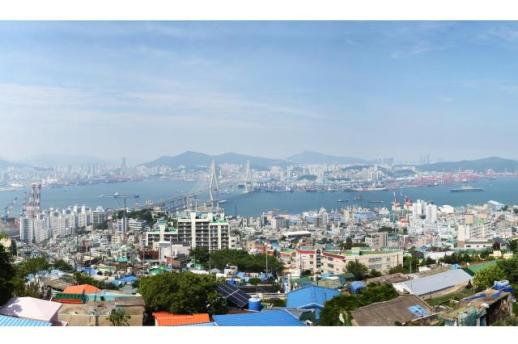 Seoul kicks off preparations for 2028 UN Ocean Conference in Busan SEOUL, September 18 (AJP) - Seoul has begun preparations for the 2028 United Nations Ocean Conference in Busan, holding its first consultation with foreign diplomats to discuss key ocean issues and priorities. Vice Minister of Oceans and Fisheries Nam Jae-heon met diplomats from Norway, Chile, the Netherlands, Germany, Greece and Brazil in Seoul on Thursday to discuss preparations for the fourth UN Ocean Conference, or UNOC4. The conference, scheduled to be held in Busan in 2028, is one of the world’s largest high-level forums on ocean issues and supports the implementation of UN Sustainable Development Goal 14, which focuses on conserving and sustainably using oceans and marine resources. About 20,000 participants from 193 UN member states, international organizations and nongovernmental groups are expected to attend. During the meeting, participants discussed marine environmental protection, the sustainable use of ocean resources and responses to sea-level rise, while sharing policy experiences and areas of interest. “These ocean challenges require cooperation among many countries, and what is especially important is putting the measures discussed into practice,” Espen Fredrik Larsen, Norway’s ambassador-designate to South Korea, said. He added that Norway would work closely with South Korea and Chile, the co-hosts of UNOC4. The ministry plans to hold two additional meetings with foreign diplomatic missions in South Korea, one with Asia-Pacific countries and another with African countries, to gather views and priorities for the conference. “It is important for UNOC4 to lead to practical action and cooperation in addressing global ocean challenges,” Nam said. “We will continue communicating with the international community and reflect a wide range of national experiences and views in the preparation process.” AJP Takeaways - South Korea has begun preparations for the 2028 UN Ocean Conference in Busan, launching its first consultation with foreign diplomats on key ocean policy priorities. - UNOC4 is expected to bring about 20,000 participants from 193 UN member states, with discussions focused on marine protection, sustainable ocean use and sea-level rise. - South Korea and Chile will co-host the conference, while Seoul plans further consultations with Asia-Pacific and African countries to gather priorities and policy input ahead of UNOC4. 2026-09-18 17:19:59
 -
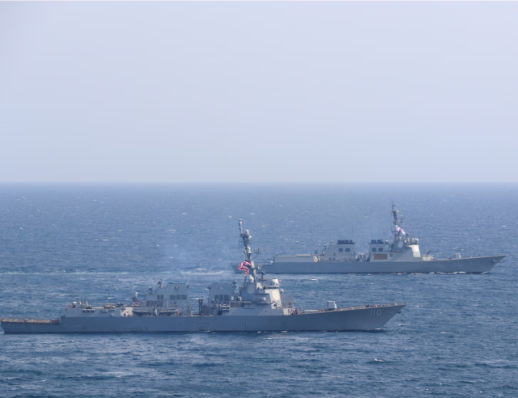 Seoul draws Hormuz line as Tokyo weighs mine-clearing role SEOUL, September 18 (AJP) - President Lee Jae Myung on Friday ruled out any South Korean military deployment that would draw the country into the war involving Iran, while leaving room for a narrowly defined mission to protect Korean vessels, citizens and energy routes around the Strait of Hormuz. The remarks marked Lee’s clearest attempt yet to draw a line between joining a war and contributing to maritime security as Seoul faces sustained U.S. pressure over Hormuz. “There will be no deployment that involves or intervenes in war,” Lee said during a press conference at Cheong Wa Dae. “We will not make such a troop deployment or dispatch military assets.” Lee said the principle of noninvolvement would remain unchanged but added that South Korea still needed to conduct a “minimum level of activities” to protect its merchant ships, crude oil transportation routes and citizens, as other countries do. He specifically pointed to the Cheonghae Unit, South Korea’s long-running anti-piracy naval contingent, saying Seoul was reviewing ways to strengthen its role in responding to threats to ships and Korean nationals. But Lee rejected sending forces or military assets in a way that would involve South Korea in the fighting. “To make it clear once again, there will be no deployment to the war,” Lee said. Lee’s comments came after weeks of government preparations to examine what a potential South Korean contribution could look like. A government assessment team made up of defense and foreign ministry officials traveled to the United Arab Emirates earlier this month and returned on Sept. 10 after examining military facilities and ports that could support South Korean assets, as well as maintenance, logistics and operational conditions. The UAE, which lies near the Strait of Hormuz, hosts Al Dhafra Air Base, one of the main U.S. military facilities in the region and a possible operating location for P-8A Poseidon maritime patrol aircraft. The Defense Ministry has stressed that the assessment mission was intended to review local conditions and the security environment and did not presuppose a deployment. U.S. President Donald Trump has repeatedly criticized South Korea for not providing military support related to the Iran conflict. In August, Trump said Lee had declined when asked to assist U.S. efforts involving Iran and cited Seoul’s stance when ordering the Pentagon to substantially reduce a major South Korea-U.S. military exercise. “If we operate under U.S. command and control, that means participating in the war,” said Paik Seung-hoon, a senior researcher at the Institute of Middle East Studies at Hankuk University of Foreign Studies, adding that the most important dividing line was who controlled the mission and what its purpose was. “But if we retain our own operational control, as we did in 2020, and define the mission as protecting our civilian merchant vessels, that is something we can do.” South Korea expanded the operating area of the Cheonghae Unit in 2020, originally deployed for anti-piracy operations in the Gulf of Aden, so it could protect South Korean merchant vessels amid heightened tensions in the region. The unit remained under South Korean command rather than operating as part of a U.S.-led force. Paik said, however, that an independent mission under current wartime conditions would require a much larger force than South Korea currently has deployed in the region. “If we want to conduct an independent operation, we would need at least around 10 vessels,” he said, explaining that South Korea would have to provide its own command and control, surveillance and defensive capabilities against threats ranging from anti-ship rockets and drones to fast attack boats and mines. That would not mean deploying 10 Aegis destroyers, Paik said, but assembling a broader naval formation that could include destroyers, mine-countermeasure assets and potentially submarines. One or two South Korean vessels could operate with far fewer supporting assets if integrated into U.S. intelligence and command networks — a scenario Paik said would blur the line between maritime protection and participation in the war. Lee on Friday appeared to leave open the possibility of reinforcing the existing Cheonghae mission without crossing that line. “We are reviewing and carefully considering ways to strengthen that role,” Lee said. Unlike the war in Ukraine, where South Korea has sought to manage relations with both Kyiv and Moscow, the conflict with Iran directly involves the United States, South Korea’s treaty ally, said Kim Hong-yoo, a professor at Kyung Hee University and a policy committee member at the Korea Defense Industry Association. “This is a war involving our ally because the United States itself is directly fighting,” Kim said. “If an ally is under attack and the other ally simply stands aside, it raises the question of what the alliance means.” Japan faces a similar calculation as Washington presses allies to do more to help secure the Strait of Hormuz. Tokyo has emphasized legal constraints on overseas Self-Defense Forces operations and has not decided on a deployment. Japanese officials have instead raised mine-clearing as a possible contribution once active hostilities have ended. Japan has particular expertise in the area. The Maritime Self-Defense Force sent minesweepers to the Persian Gulf after the 1991 Gulf War. Under Japan’s existing legal framework, however, minesweeping during active hostilities could amount to combat activity, making a ceasefire a critical condition for such a mission. Hosaka Yuji, a specially appointed professor at Korea University specializing in international politics and Korea-Japan relations, said Prime Minister Sanae Takaichi has favored a more active security role alongside the United States but faces domestic and legal constraints on a direct deployment. Hosaka said mine-clearing would be one of Japan’s most realistic options once the fighting stopped. “If there is a ceasefire, Japan can move quickly to send the Self-Defense Forces to the Strait of Hormuz,” Hosaka told AJP in an earlier interview, pointing in particular to Japan’s mine-clearing capabilities. Foreign Minister Toshimitsu Motegi said in March that minesweeping could be considered if a ceasefire were reached and mines continued to obstruct navigation. Takaichi has likewise said any dispatch would depend on conditions at the time and Japanese law. South Korean Foreign Minister Cho Hyun is due to meet U.S. Secretary of State Marco Rubio in Washington on Friday local time, with cooperation over the Strait of Hormuz expected to be among the issues on the agenda. Lee has now defined what South Korea will not do. The harder question is how far Seoul can expand a maritime-protection mission without allowing command, intelligence and operational requirements to turn that mission into participation in the war — a line Tokyo, too, is having to navigate. AJP Takeaways - President Lee Jae Myung ruled out South Korean military involvement in the Iran war, drawing a clear line against troop or military asset deployments tied to combat. - Seoul is still considering limited maritime measures around the Strait of Hormuz, including strengthening the Cheonghae Unit to protect Korean vessels, citizens and energy routes. - South Korea faces continued U.S. pressure over Hormuz, raising questions over how far Seoul can support its treaty ally without becoming directly involved in the conflict. - Japan is another key variable in the regional response, with Tokyo considering post-ceasefire mine-clearing while remaining constrained from joining active hostilities. 2026-09-18 17:06:25