

Journalist

Kim Hee-su김희수
khs@ajupress.com
ReporterMinistry of Foreign Affairs, Seoul City Hall & Defense, Foreign Affairs
Kim Hee-su is a bilingual reporter at AJU Press, covering defense and foreign affairs. Before joining AJP in 2025, she worked at The Korea Times, where she wrote interview stories, including a profile of North Korean defector Kim Gum-hyok, and produced digital content. She also previously worked as a researcher for KBS News 9’s International News Department, supporting correspondents in 10 countries around the world. She graduated from the University of Toronto in Canada with a double major in Book and Media Studies and East Asian Studies.
"I'm driven by storytelling."
Latest by Kim Hee-su
-
 Drone pratfalls expose gap in Korea's battlefield testing SEOUL, October 02 (AJP) - South Korea builds machines that patrol the depths, fly faster than sound and power entire cities. Yet at its military showcases, drones have lately struggled with something more basic: staying in the air. In just over five weeks, two loitering munitions plunged into the sea after launch from a Navy warship, six of 17 demonstrations faltered at a Defense Ministry technology showcase, and a small target drone fell from the sky during a nationally televised Armed Forces Day event attended by President Lee Jae Myung. The incidents involved different systems and circumstances. The latest involved a modified civilian target drone, rather than a domestically developed military aircraft. They offer no evidence of a single defect running through South Korean drone technology. But the succession of public mishaps has exposed an uncomfortable gap between the country’s manufacturing confidence and its preparations for unmanned warfare. Developers need repeated opportunities to discover how their machines behave when conditions depart from the script. That gap came into focus at the Defense Ministry’s September exhibition in Pocheon, north of Seoul. Officials described the event as the first opportunity for many participating private developers to operate at a military training ground, beyond their own facilities and more controlled testing environments. Some systems that had performed normally in rehearsals faltered during the main event. Participating companies pointed to possible radio-frequency interference as more drones operated and crowds gathered, although the ministry has not confirmed that as the cause. A drone that flies successfully on its own must also function amid competing signals, disrupted navigation, difficult weather and other aircraft. Those demands become harder to anticipate when developers have limited access to the environments in which soldiers will operate their equipment. “Countries that have actually fought wars can be ahead because they have real battlefield experience. South Korea needs places where these systems can be tested and where we can train under conditions similar to actual combat,” said Ryu Yeon-seung, director of the Defense Security Research Institute. Ryu said South Korea has plenty of companies developing drones and unmanned aircraft, including major defense contractors. What it lacks is the accumulated experience of countries that have operated such systems extensively in combat. The recent failures show how seemingly small vulnerabilities can undo sophisticated machinery. On Aug. 25, two loitering munitions — attack drones designed to remain airborne before striking a target — crashed after launch from the Navy’s ROKS Marado. The Agency for Defense Development’s preliminary assessment traced the failure to a misaligned launcher door. The problem had not appeared during previous ground operations. An aircraft that had worked on land came to grief at the point where it was supposed to begin proving itself at sea. “Launching drones from a ship is fundamentally different from doing so on land, given factors such as weather conditions and the limited space aboard a vessel,” defense industry expert Chae Woo-seok said at the time. At Pocheon on Sept. 16, six of 17 demonstration missions were unsuccessful. Multiple unmanned systems operated alongside a large audience, creating a more crowded radio-frequency environment than developers had encountered during rehearsals. Ryu cited that difference as one reason repeated field trials matter. A successful rehearsal establishes that a system can work under a particular set of conditions. Military users need to know how far those conditions can change before it stops working. The Armed Forces Day incident presented another problem. The target drones had been modified to use fiber-optic cables for control, reducing their exposure to radio interference. According to the military, one fell after its cable broke. Another was deliberately brought down after weather conditions carried it outside the designated safe area. Two others were successfully intercepted by the Cheongwang laser air-defense weapon being demonstrated. The episode cannot be treated as a failure of a Korean military drone or, by itself, of the laser weapon. It nevertheless added to scrutiny of the preparation and operating arrangements behind the military’s public displays. South Korea is hardly short of places to fly and inspect drones. The Korea Institute of Aviation Safety Technology operates six dedicated flight-test centers in Yeongwol, Goseong, Boeun, Hwaseong, Incheon and Uiseong. Their shared facilities support flight monitoring and performance checks, while specialized equipment subjects aircraft to particular stresses. Yeongwol can assess equipment operation and thrust at temperatures from minus 40 to 80 degrees Celsius. Goseong tests controllability in winds reaching 15 meters per second. Boeun examines electromagnetic resilience, while Hwaseong tests structural loads and Incheon measures flight precision. These facilities help establish whether an aircraft meets individual performance requirements. The operational challenge is to find out what happens when several stresses arrive together. Public descriptions of civilian facilities do not establish how routinely developers can combine disrupted navigation, competing communications signals, simultaneous drone operations, weapons integration and launches from military platforms in a single exercise. Access to military training grounds therefore becomes an important part of turning a promising prototype into equipment troops can depend on. The Defense Ministry has begun expanding that access. In June, it announced plans to open military training grounds more widely to private drone and counter-drone developers and increase the number of dedicated testing units to nine. The initiative was intended to give companies more opportunities to demonstrate their technologies, collect operational data and refine equipment with military users. At the September exhibition, the ministry formally expanded the network. The nine units will operate private-sector technologies and conduct combat experiments in different environments. The program is to extend progressively from the Army to the Navy, Air Force and Marine Corps. The value of that arrangement will emerge through repeated use: a failure identified, a design modified, another flight attempted under different conditions. A showcase can reveal a weakness in seconds. Working out its cause and establishing that it has been corrected can take much longer. Ukraine has acquired that experience through war. Drones repeatedly encounter electronic interference, interception and other combat stresses, while military users feed their experience back into development and purchasing decisions. Ukraine’s Defense Ministry has explicitly tied drone procurement to frontline performance data and introduced mechanisms for troops to rate equipment used in combat. North Korean troops fighting alongside Russian forces have also gained exposure to a battlefield shaped by drones, adding urgency to South Korea’s preparations. For Seoul, trials and training must supply much of the operational knowledge that others are accumulating in combat. That requires developers and soldiers to work together often enough for problems to surface, be understood and be corrected before equipment is fielded. South Korea’s factories can turn out the hardware. The harder job is to put it through enough punishment on the training ground that soldiers do not discover its limits on the battlefield. 2026-10-02 16:09:37
 -
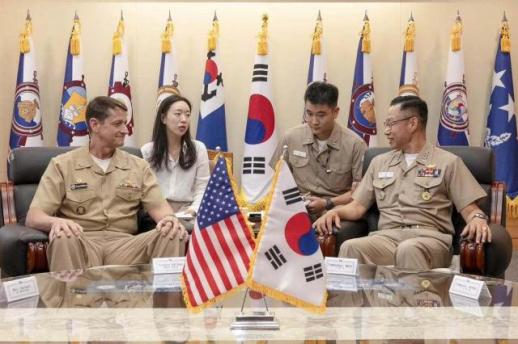 Samsung chief's son spotted interpreting at South Korea-U.S. Navy meeting SEOUL, October 02 (AJP) - Lee Ji-ho, the eldest son of Samsung Electronics Chairman Lee Jae-yong, served as an interpreter at a high-level South Korea-U.S. Navy meeting last month, according to military officials and a photograph published by the Korea Defense Daily. Lee, a Navy ensign serving as an interpreter officer, supported talks between Vice Adm. Kang Jung-ho, commander of South Korea's Navy Education and Training Command, and Rear Adm. Gregory C. Huffman, commander of the U.S. Naval Education and Training Command, in Jinhae, Changwon, on Sept. 9. A photograph published by the Korea Defense Daily showed Lee seated behind Kang as he interpreted the South Korean commander's remarks. His presence at the meeting was not widely noticed when the image was initially published but drew attention this week after Lee was identified in the photograph. The two commanders discussed expanding exchanges to train future naval personnel and improving education and training programs in response to a changing security environment. The meeting was arranged after Kang proposed establishing regular consultations during a visit to the U.S. Naval Education and Training Command and recruiting command last year. The two sides plan to continue holding the talks regularly. Discussions covered areas including artificial intelligence, space and manned-unmanned teaming, as well as improvements to officer and noncommissioned officer training and naval recruitment programs. Lee is assigned to the information and operations staff of the Navy's 5th Mine Countermeasures and Amphibious Operations Flotilla, a unit under the Navy Operations Command specializing in mine warfare and amphibious operations. He was sent to support the nearby education command because an interpreter was needed for the meeting. Born in the United States, Lee previously held dual South Korean and U.S. citizenship but renounced his U.S. citizenship to serve as a commissioned officer in the South Korean Navy. He entered the Navy's 139th officer candidate class in September 2025 and was commissioned as an ensign in November after completing officer training at the Republic of Korea Naval Academy. He is scheduled to be discharged on Nov. 30, 2028. Lee is expected to be promoted to lieutenant junior grade on Dec. 1, according to military sources. AJP Takeaways - Lee Ji-ho, the eldest son of Samsung Electronics Chairman Lee Jae-yong, served as a Navy interpreter during a South Korea-U.S. naval education and training meeting in September. - The ROK-U.S. Navy meeting in Jinhae brought together senior commanders to discuss cooperation in training, recruitment and emerging areas including AI and manned-unmanned systems. - Lee, who was commissioned as a South Korean Navy ensign in 2025, is serving as an interpreter officer and is expected to be promoted to lieutenant junior grade in December. 2026-10-02 14:14:12
 -
 Hanwha Foundation to hold emerging artists exhibition in New York SEOUL, October 02 (AJP) - The Hanwha Foundation of Culture will bring together emerging Korean artists and international writers for a group exhibition in New York, the foundation said Thursday. Titled “MacGuffin,” the exhibition will run from Oct. 8 through Dec. 19 at Space ZeroOne in Manhattan’s Tribeca neighborhood, featuring five Korean visual artists and five international writers in collaboration with Art Omi, a New York-based international arts residency program. The participating Korean artists are Dongho Kang, Goyoson, Jongwan Jang, Jenny Jisun Kim and Ian Ha. Five writers who previously took part in Art Omi’s writing residency will each present a written response to the artists’ works. Rather than explaining the artists’ intentions, the writers will interpret the works from their own perspectives and develop new narratives around them. The exhibition takes its title from the cinematic term “MacGuffin,” referring to an object or device that sets a story in motion without necessarily being its ultimate purpose. Paintings, sculptures and other works in the exhibition are similarly intended to serve as starting points for multiple interpretations rather than lead viewers toward a single meaning. The exhibition also expands cooperation between the Hanwha Foundation and Art Omi. The foundation said the new exhibition connects its overseas residency support program with Space ZeroOne and Art Omi’s international network of creators. Space ZeroOne, located in Manhattan’s Tribeca neighborhood, was established by the Hanwha Foundation to support Korean contemporary artists and promote international cultural exchange. AJP Takeaways - Hanwha Foundation of Culture will hold its “MacGuffin” group exhibition at Space ZeroOne in New York from Oct. 8 to Dec. 19. - The exhibition brings together five emerging Korean visual artists and five international writers in collaboration with Art Omi. - The project combines contemporary Korean art and literature, expanding Hanwha Foundation’s support for emerging artists and international cultural exchange. 2026-10-02 13:47:11
 -
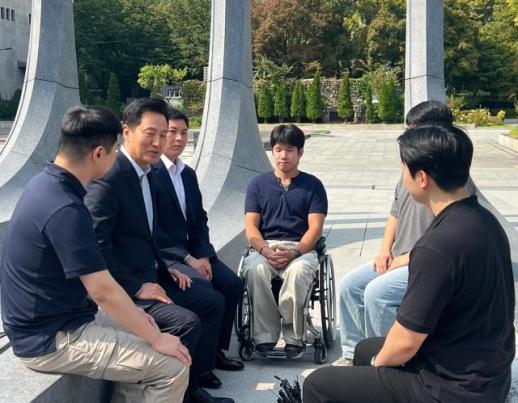 DMZ mine blast highlights long road to recovery for injured troops SEOUL, September 30 (AJP) - A landmine blast in the Demilitarized Zone has become a political and security flashpoint after the United Nations Command attributed the explosions to North Korean mines and declared a violation of the Korean War armistice. Away from the dispute, three South Korean servicemen remain hospitalized. Officials are debating responsibility for the mines found south of the Military Demarcation Line separating the two Koreas, and Seoul’s defense chief has vowed to seek accountability for the soldiers’ injuries. With or without an apology, the consequences for the injured servicemen will endure. For them, the longer ordeal lies at home. All 18 personnel involved in the Sept. 21 operation were evacuated to the Armed Forces Capital Hospital after the explosions. Two seriously injured troops and one with minor injuries remained hospitalized. In South Korea, treatment during military service and veterans benefits after discharge are handled through separate processes. While personnel remain in service, injuries recognized as duty-related are covered under the Military Accident Compensation Act, including surgery, hospitalization and other medical care. Treatment is generally covered for up to two years, with extensions available when further care is medically necessary. That coverage does not automatically confer recognition as a “person of national merit,” a legal designation that determines eligibility for a particular category of veterans benefits. Recognition requires a separate review by the Ministry of Patriots and Veterans Affairs. Those injured during duties or training directly related to national defense or security may qualify if they meet the required disability threshold. Those injured during other official duties or training may qualify instead for a separate veterans compensation category. For injured troops, the transition can involve gathering records, establishing how an injury relates to military duties and undergoing assessments that determine their longer-term support. Young veterans who met Seoul Mayor Oh Se-hoon on Wednesday described the difficulties that can arise along the way. The meeting at the Garden of Gratitude in central Seoul’s Gwanghwamun Square brought together veterans who have received legal, psychological or housing assistance from the Seoul Center for Young Injured Veterans. Among them was Jeon Sung-bo, 31, who said he had to assemble much of the evidence for his application himself. “I had to find the evidence myself and prove it,” Jeon told AJP in a brief interview. “I went all the way to court, but in the end I was not recognized as a person of national merit.” Jeon was a trainee when he was seriously injured in a military bus accident on Jan. 2, 2018. He had received outpatient treatment for an ankle injury sustained during training and was returning to his unit when the bus crashed through a guardrail near Yanggu in northeastern Gangwon Province. It rolled about 20 meters down a slope, injuring all 22 service members aboard. Jeon suffered severe spinal and neck injuries that left him paralyzed below the chest. More than a year later, he was still undergoing rehabilitation, having moved between seven hospitals. He postponed his discharge because the Defense Ministry was covering his treatment while he remained in service. His application for national-merit status took about two years to review. He was ultimately classified as a veterans compensation beneficiary. Although he was injured while returning from medical treatment during his military service, Jeon said the journey was not considered part of formal training. “It was because it wasn’t during training hours,” he said, explaining his understanding of the decision. A separate court ruling in January this year illustrated the distinction. A trainee injured when a military bus overturned while returning to his unit after medical isolation was denied national-merit status. The court found that returning to a unit was different from traveling as part of military training. The circumstances of the latest DMZ injuries differ. The military has said the troops were conducting an official search operation when the explosions occurred. Jeon’s case does not establish how their applications would be assessed, but it illustrates the administrative and legal demands that can accompany recovery from a serious military injury. Lee Han, a staff member at the Seoul center who is himself an injured veteran, said its four-person team handles roughly 1,000 consultations and cases a year. Demand for legal assistance exhausted the center’s allocated budget in the first half of this year, he said, requiring staff to seek other ways to assist those still awaiting support. Legal recognition is only one part of the transition to civilian life. Injured veterans may also need sustained rehabilitation, psychological care and assistance with housing and employment. The center offers individual psychological counseling and monthly peer-support meetings where veterans can speak with others who have had similar experiences. Around 10 people typically attend, with some participating regularly since 2023. Access to rehabilitation remains a significant concern. In a needs survey Lee cited at Wednesday’s meeting, around eight out of 10 injured veterans said they needed rehabilitation treatment or related support. For people with serious leg injuries or limited mobility, repeated travel to hospitals can make that care difficult to obtain. Providing more rehabilitation services closer to their homes could help, Lee said. Many people seeking the center’s assistance were injured in their early 20s, when they were beginning to plan their careers and adult lives. Some continue to pay for treatment or rehabilitation themselves because existing programs do not cover all their needs. Nearly 185,000 South Korean men entered active-duty enlisted service in 2025, according to the Military Manpower Administration. The Ministry of Patriots and Veterans Affairs recorded 48,386 registered service-injured veterans in its 2025 statistics. The figure is cumulative rather than an annual injury count and includes qualifying police officers and firefighters. For the three troops hospitalized after the DMZ explosions, the immediate priority remains treatment. The experiences of other injured veterans show why access to rehabilitation and continuing support will matter long after the investigation ends. AJP Takeaways - Military medical coverage and post-discharge veterans benefits involve separate reviews in South Korea. - The circumstances of an injury and the assessed disability level determine eligibility for different categories of support. - Injured veterans describe continuing needs for legal assistance, rehabilitation, psychological care and help returning to civilian life. - The Seoul Center for Young Injured Veterans says demand exhausted its legal-assistance budget in the first half of this year. 2026-09-30 17:50:37
 -
 "Our wish is unification" falls out of fashion among South Koreans SEOUL, September 30 (AJP) - “Our wish is unification, and even in our dreams, we wish for unification.” The familiar song South Koreans know by heart is losing its resonance as a new survey shows seven out of 10 have little interest in their hostile neighbor and fewer than half see unification as necessary. The 2026 survey by the Korea Institute for National Unification (KINU) found that 48.2 percent considered unification necessary, down from 49 percent last year, when support slipped below a majority for the first time. Meanwhile, 70.3 percent expressed little or no interest in North Korea, the highest share since KINU began asking the question in 2015. The figure has climbed from 50.8 percent that year and 68.1 percent last year. KINU described the trend as closer to "structural disengagement" than a temporary reaction to changes in inter-Korean relations. The estrangement is reshaping how South Koreans envisage the peninsula’s future, with peaceful coexistence drawing far more support than reunification. Some 66.9 percent agreed with the statement that unification would not be necessary if South and North Korea could coexist peacefully without war, up from 63.2 percent last year and 43.1 percent in 2016. Asked whether the future of inter-Korean relations should prioritize eventual unification into a single state or peaceful coexistence while maintaining separate systems, 57.6 percent chose peaceful coexistence and 16.4 percent chose unification. Views on unification also differed sharply by generation. The share saying unification was necessary stood at 61.6 percent among the war generation and 61.3 percent among the industrialization generation, compared with 33.4 percent among millennials and 36.3 percent among Generation Z. Public attention to North Korea's nuclear threat also declined. Interest in the issue fell from 45.6 percent in 2016 to 27.9 percent this year, while anxiety dropped from 58.5 percent to 44.3 percent. KINU said the trend could reflect fatigue with repeated nuclear threats and the normalization of the risk. Yet declining interest in the North did not translate into weaker support for deterrence. Support for South Korea developing its own nuclear weapons stood at 68 percent, while 59.6 percent favored the redeployment of U.S. nuclear weapons to South Korea. KINU described the results as a paradox in which emotional attention to the threat has declined while demand for substantive deterrent capability remains strong. The survey also showed weakening trust in the United States despite continued strong support for the alliance. Some 37.5 percent said South Korea-U.S. relations had worsened over the past year. Among those respondents, 66.2 percent attributed the deterioration to the United States. Trust in U.S. policy toward the Korean Peninsula fell 15.2 percentage points to 47.7 percent. Still, 87.3 percent said the South Korea-U.S. alliance remained necessary and 82 percent said the current presence of U.S. Forces Korea was necessary. KINU said the findings point to a broader preference for security autonomy while maintaining the alliance as a core security institution. The survey was conducted through face-to-face interviews with 1,003 adults nationwide from April 2 to 24. It has a maximum sampling error of plus or minus 3.1 percentage points at the 95 percent confidence level. 2026-09-30 15:47:45
 -
 UNC says DMZ mine incident violated Korean War armistice SEOUL, September 30 (AJP) - The United Nations Command said Wednesday that the recent DMZ mine incident violated the Korean War armistice after an operable North Korean mine was found south of the Military Demarcation Line. The UNC said it conducted a joint on-site investigation with the South Korean military into the Sept. 21 mine explosions in the western sector of the DMZ. During the investigation, the team found an operable North Korean antipersonnel mine on the South Korean side of the MDL, the command said. "Based on the findings of the investigation, UNC determined that an Armistice Agreement violation occurred," the command said in a statement, adding that it was addressing the violation through established armistice mechanisms. The UNC did not specify what measures it would take in response. It said it would remain committed to maintaining and enforcing the 1953 Armistice Agreement, preserving stability on the Korean Peninsula and preventing further escalation. The statement came a day after South Korean investigators found a North Korean resin-bodied antipersonnel mine near the site of the explosions during the third day of a joint field investigation with the UNC. It was assessed to be different from an unexploded mine-like object that soldiers reported seeing immediately after the Sept. 21 blasts. Three South Korean officers were injured in two explosions on Sept. 21 while troops from the Army's 25th Infantry Division were clearing an access route inside the western DMZ ahead of a planned UNC inspection. The operation was launched after South Korean surveillance detected terrain changes near the MDL and suspected North Korean mine-laying activity in the area. Defense Minister Kang Shin-chul went further during a National Assembly defense committee meeting Tuesday, saying the newly discovered mine appeared to have been planted rather than washed into the area and describing the case as a clear violation of the armistice. The UNC's statement marks its first formal determination that an armistice violation occurred in connection with the Sept. 21 incident, adding weight to Seoul's assessment as the joint investigation continues. AJP Takeaways - UNC said the recent DMZ mine incident violated the 1953 Korean War Armistice Agreement. - Investigators found an operable North Korean antipersonnel mine south of the Military Demarcation Line. - The UNC said it is addressing the violation through established armistice mechanisms. 2026-09-30 10:09:53
 -
 Seoul suspects Pyongyang of mine planting. So what now? SEOUL, September 29 (AJP) - An expanded investigation by South Korea’s military and the United Nations Command on Tuesday uncovered a North Korean resin-bodied antipersonnel mine near the site of last week’s DMZ explosions, adding to mounting evidence pointing to North Korean mines as the cause of the blasts. The discovery strengthens the military’s assessment of the explosions’ cause. It does not yet establish when or how the mines came to be on the southern side of the border — a distinction that could determine Seoul’s response. The Joint Chiefs of Staff (JCS) said the newly discovered mine appeared to be different from the mine-like object troops reported seeing as they withdrew after the Sept. 21 explosions, suggesting additional North Korean mines may remain in the immediate area. If investigators establish that North Korean troops deliberately planted mines south of the Military Demarcation Line (MDL), the findings would support a formal determination of an armistice violation and put President Lee Jae Myung’s pursuit of rapprochement with Pyongyang under pressure. Since formally identifying the South as an enemy state, North Korea has spent much of the past two years reinforcing its side of the Demilitarized Zone with fences, mines and other barriers. South Korea’s military has at times described those activities as armistice violations. The United Nations Command (UNC) took a narrower view in June, saying fencing, road construction and defensive mine-laying did not violate the 1953 Korean Armistice Agreement as long as they remained north of the MDL and did not introduce heavy weapons. Its fact sheet drew a clear line at the MDL itself: placing mines south of the line would cease to be defensive activity and automatically constitute an armistice violation. The investigation also raises questions about how South Korea handled earlier signs of suspected mine-laying. The military detected suspicious terrain changes through satellite imagery in the 25th Infantry Division’s sector as early as September 2025 and suspected they could be linked to North Korean mines. Nearly a year later, South Korean troops were clearing a new route for a joint inspection with the UNC when two mines exploded. The JCS says it had been consulting with the UNC about an inspection during that period. But when pressed Tuesday, officials could not say when South Korea first requested one or provide a detailed account of the consultations over the intervening year. Earlier this month, Rep. Yoo Yong-won of the main opposition People Power Party said six minefields and other structures in the division’s sector appeared to extend 10 to 15 meters south of the MDL. The Sept. 21 explosions occurred about 10 meters south of the line and roughly 10 meters from an area where terrain changes suggesting North Korean mine-laying had been detected. Investigators must still determine whether the mines were deliberately planted at the site, when they arrived and whether natural forces could have displaced them. The distinction matters since a North Korean-made mine found south of the MDL is evidence of its origin, but does not necessarily prove that North Korean troops recently crossed the line to plant it. If deliberate emplacement is confirmed, the issue would extend beyond Seoul’s North Korea policy to enforcement of the armistice. The agreement prohibits hostile acts within, from or against the DMZ and bars personnel from crossing the MDL without authorization from the Military Armistice Commission. It also restricts entry into territory under the other side’s military control. The 2015 mine attack provides a precedent. A UNC investigation concluded that North Korean forces had planted wooden-box mines along a known South Korean patrol route in the southern half of the DMZ, injuring two soldiers. It found violations of Paragraphs 6, 7 and 8 of the armistice, covering hostile acts, unauthorized MDL crossings and unauthorized entry into the other side’s area. Evidence that an older mine had drifted or shifted south would require a different assessment from proof of deliberate placement. The mine’s origin alone would not resolve questions about responsibility for its location. The Sept. 19, 2018, inter-Korean military agreement offers another political reference point. The pact required both sides to cease hostile acts and refrain from infiltrating, attacking or occupying each other’s areas. North Korea declared in November 2023 that it would no longer be bound by the accord, and South Korea fully suspended it in June 2024. Lee has pledged to restore it as part of his effort to reduce military tensions. A confirmed armistice violation would give the UNC a central role in the response. Its Military Armistice Commission Secretariat investigates suspected violations, manages authorized access to the DMZ and crossings of the MDL, and communicates with the North Korean military. Those functions provide channels for documenting the findings and raising them with Pyongyang. A formal finding would not, however, automatically trigger sanctions or prescribe Seoul’s military response. The UNC’s armistice enforcement role is separate from the U.N. Security Council’s authority to impose sanctions. Sill, the Lee government can find itself in a pickle. If investigators find that an old mine was displaced by natural forces, the immediate response could center on mine clearance, troop safety and border management. Evidence of deliberate North Korean mine-laying south of the MDL would put greater pressure on the administration to hold Pyongyang accountable while pursuing dialogue. The JCS has pledged “appropriate and corresponding” measures if the final investigation establishes that the soldiers were injured by mines planted by North Korean forces. What those measures would entail remains unresolved. For Seoul, identifying the mines is only part of the investigation. Establishing how they got there will shape what comes next. 2026-09-29 17:54:46
 -
 Defense chief says North Korean mines breached armistice SEOUL, September 29 (AJP) - South Korea's defense minister said Tuesday that North Korean mines found south of the inter-Korean border appeared to have been planted rather than washed into the area, vowing corresponding measures against Pyongyang. Defense Minister Kang Shin-chul made the remarks during a National Assembly defense committee meeting as the military disclosed that investigators had found an intact North Korean resin-bodied antipersonnel mine near the site of last week's explosions in the Demilitarized Zone. Asked whether the mines could have been displaced by flooding or other natural causes, Kang said that possibility appeared unlikely. "It does not appear to have been washed away," Kang said, adding that the military believes the mine was placed as North Korea fortified areas around the Military Demarcation Line. Kang said, however, that investigators still need to determine when the mine was planted, including whether it was placed during North Korean fortification work detected in 2025 or belonged to an older minefield dating back decades. He also described North Korea's actions as a "clear" violation of the 1953 Armistice Agreement. "Responsibility lies with North Korea, so we will take corresponding measures," Kang said, adding that the military has options prepared and would implement them in stages. He declined to provide details, citing operational security. The remarks marked a firmer assessment than the military's interim findings announced Monday, when the Joint Chiefs of Staff said it was "highly likely" that North Korean mines caused the Sept. 21 explosions. Three South Korean officers were injured in two explosions on Sept. 21 while troops from the Army's 25th Infantry Division were clearing a route inside the western DMZ ahead of a planned inspection with the United Nations Command. The JCS said Tuesday that investigators conducting another on-site search found a North Korean resin-bodied antipersonnel mine about one meter behind the site of the second explosion. The South Korean military and the UNC are continuing their joint investigation before issuing a final conclusion on when and under what circumstances the mines were planted. AJP Takeaways - Defense Minister Kang Shin-chul called the DMZ mine incident a clear violation of the 1953 Armistice Agreement. - Seoul says North Korean mines likely caused the Sept. 21 blasts that injured three South Korean officers. - South Korea vowed corresponding measures as the military and U.N. Command continue their investigation. 2026-09-29 17:16:01
 -
 Lee urges faster nuclear submarine, hypersonic missile push SEOUL, September 29 (AJP) - President Lee Jae Myung on Tuesday called for faster development of nuclear-powered submarines and hypersonic missiles, while ordering a probe into last week's DMZ mine blast. "A strong national defense is a key pillar for protecting the national interest," Lee said during a Cabinet meeting at the presidential office, calling for greater speed in building nuclear-powered submarines and advancing missile technologies, including hypersonic weapons. The remarks came a week after Lee and U.S. President Donald Trump discussed nuclear-powered submarines during a meeting on the sidelines of the United Nations General Assembly in New York. The two leaders revisited cooperation on nuclear submarine fuel and other security issues as Seoul seeks to move the program forward. The push also comes amid advances in North Korea's missile capabilities, including a recent missile test that analysts said appeared to involve a hypersonic glide vehicle. Lee said South Korea should continue developing and deploying cutting-edge weapons systems based on its own technology to defend the country across land, sea, air and space. He pointed to the KF-21, South Korea's first domestically developed fighter jet, which was formally delivered to the Air Force last week, as an example of the country's defense capabilities. Lee said South Korea was one of only eight countries to have independently developed a 4.5-generation fighter, describing the KF-21 program as particularly significant from the standpoint of self-reliant defense. During the same meeting, Lee addressed the Sept. 21 mine explosion in the western sector of the DMZ, ordering the military to work closely with the United Nations Command to determine what caused the blast. "The military authorities should closely cooperate with the United Nations Command and quickly and thoroughly investigate the incident to transparently establish the facts," Lee said, adding that the government would take "necessary measures" depending on the findings. Three South Korean officers were injured in the explosion while troops were operating inside the western DMZ near the Military Demarcation Line. The Joint Chiefs of Staff said Monday that its interim investigation found it "highly likely" that the explosion was caused by a North Korean mine rather than a South Korean one. The military has yet to determine whether the mine was deliberately planted by North Korean forces or had been displaced from another location, a distinction that could affect Seoul's response. The military has said it would consider corresponding measures if the investigation ultimately concludes that North Korea deliberately planted the mine. Lee also cautioned against politicizing the incident before the investigation is completed. "There can be no ruling or opposition party when it comes to national security," Lee said. "I hope there will be no attempt to endanger national security by fueling baseless conspiracy theories regarding this incident." He also expressed sympathy for the injured service members and their families and wished them a speedy recovery. AJP Takeaways - Lee called for faster development of nuclear-powered submarines and hypersonic missiles. - Seoul is seeking closer U.S. cooperation on its nuclear submarine program. - Lee also ordered a probe into last week’s DMZ mine blast. 2026-09-29 12:28:28
 -
 South Korea says North Korean mines 'highly likely' behind DMZ blasts SEOUL, September 28 (AJP) - North Korean land mines “highly likely” caused the two explosions that seriously injured patrolling South Korean soldiers in the southern side of the Demilitarized Zone last week and must be accountable if found to have planted them, the South’s military said Monday. "We assess that there is a very high probability that North Korean mines were the cause of the explosions," Lt. Gen. Kwon Dae-won, vice chairman of the Joint Chiefs of Staff and head of the joint investigation task force, said in a briefing after an interim investigation. The military said the two explosions occurred about 10 meters south of the Military Demarcation Line and roughly 10 meters from an area where terrain changes were detected that South Korea suspects were caused by recent North Korean mine-laying activities. Three South Korean service members were injured in the Sept. 21 incident, two seriously and one lightly, while troops were clearing a new search route toward the MDL ahead of a planned on-site inspection with the United Nations Command. The military said all 18 personnel involved in the operation were evacuated to the Armed Forces Capital Hospital. Fifteen have since been discharged, while the three injured personnel remain hospitalized. Investigators on Monday reached the immediate vicinity of the blast site for the first time, coming within about 2 meters of the second explosion point. They visually identified two small crater-like depressions believed to have been formed by the blasts. The two explosion points were about 2 meters apart, according to the JCS. Investigators also recovered military equipment left at the scene, although several objects described by troops as possible mines have yet to be fully examined. The National Forensic Service delivered its preliminary analysis to the military at around 4 p.m. Monday. The JCS said TNT and brownish foreign material were detected on equipment belonging to the troops, including a ballistic helmet and two pieces of body armor. The military said the absence of steel fragments, combined with the brown material and the pattern of injuries, did not match the characteristics expected from South Korean mines. The military also cited the shape of the blast craters, witness descriptions of the flames and the severity of the soldiers' injuries in reaching its interim assessment. Another key piece of evidence is an unexploded mine-like object that troops said they saw while withdrawing from the area after the blasts. According to the JCS, engineering personnel spotted a rectangular object buried about 5 to 10 centimeters below the surface roughly 1 meter from the first blast point. Witnesses described it as brown or reddish-brown, with a smooth plastic or resin-like exterior. The military said the description resembles a brown, resin-bodied North Korean antipersonnel mine of the PMN type, but stressed that investigators must physically examine the object before identifying it conclusively. North Korean wooden-box mines are known to typically contain about 220 grams of TNT. The JCS estimates that three mines may have been present in the immediate area — the two that exploded and the additional unexploded object reported by troops. The military's reconstruction also provided new details on how the accident unfolded. The 18-member team had advanced about 200 meters while engineers alternated between mine detection and vegetation clearing. After commanders assessed that they had moved close enough to the MDL, they decided to end the operation and withdraw. As the team prepared to leave, an engineer noncommissioned officer stepped to his left and triggered the first explosion. A reconnaissance battalion commander then rushed toward the injured soldier before a second explosion occurred. The JCS also said there are no records of South Korean forces laying mines in the area, while terrain changes suspected of being linked to North Korean mine-laying were identified nearby in September 2025. Those factors were among the reasons the military said a South Korean mine was unlikely to have caused the blasts. Kwon said the preliminary forensic findings further strengthened that assessment. "Considering the brown foreign material detected in the preliminary forensic analysis and the absence of steel fragments, it is certain that the explosion was not caused by one of our mines," he said. What remains unresolved is how a suspected North Korean mine came to be on the southern side of the MDL. Military officials said they need to examine the unexploded object, its burial position, the surrounding terrain and its relationship to the nearby suspected North Korean mine-laying area before determining how it came to be there. "If the final investigation determines that our troops were injured by mines planted by North Korea while lawfully conducting operations south of the MDL, all responsibility lies with North Korea," Kwon said, adding that the military would take "appropriate and corresponding measures." The JCS said no specific military response has yet been decided and that all options would be considered after the final investigation is completed. South Korean and United Nations Command personnel have conducted field investigations since Sunday. The military said additional work is planned because Monday's inspection was not completed. Final findings will be announced after an assessment with the United Nations Command. 2026-09-28 22:18:08