
Journalist

AJP
-
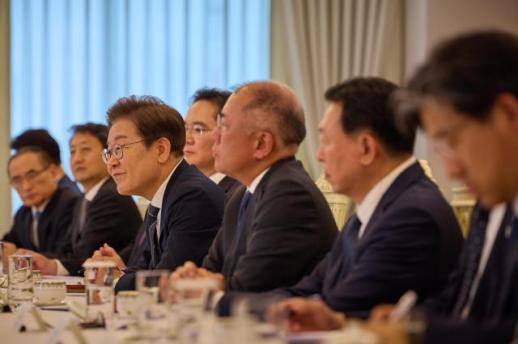 Korea’s Top Business Groups Head Into Annual Meetings With Focus on Stability Major South Korean business groups will hold annual general meetings late this month to set business plans and discuss key issues. Attention is on whether Sohn Kyung-shik, chairman of the Korea Employers Federation (KEF), will win a fifth term, and whether the heads of the country’s four largest conglomerates will return to the leadership council of the Federation of Korean Industries (FKI). Also in focus is whether the Korea Chamber of Commerce and Industry (KCCI) will reshuffle executives after a controversy over what it called false information about inheritance tax. According to the business community on Thursday, FKI, KEF, KCCI and the Korea International Trade Association (KITA) will hold annual meetings from Feb. 24 to 27 to approve business plans and budgets and review last year’s results. KEF will meet Feb. 24 to decide whether Sohn will serve a fifth term. Sohn, who took office in 2018, has led the group for eight years through four renewals. If approved again, he would lead KEF for 10 years and become its longest-serving chairman. KEF has no separate rule limiting renewals, meaning another term is possible if Sohn agrees. Sohn, born in 1939, is said to have decided after lengthy deliberation given his age. With major business issues pending — including a revised labor union law set to take effect in March and proposed revisions to the Commercial Act — business leaders have argued he is best positioned to convey management’s views to the government. He has been credited with actively delivering the business community’s positions and concerns about what the article describes as anti-business legislation since the Lee Jae-myung government took office. A business community official said Sohn has built extensive networks over about 65 years of work and is widely seen as having elevated KEF from a labor-management specialist group to a broader economic organization. The official said Sohn is among the few who can communicate candidly with the government on difficult issues such as labor regulation and Commercial Act revisions, adding that many inside and outside the business community view his working relationship with the Lee government, launched last year, as solid. FKI will hold a board meeting and annual general meeting Feb. 27. With Chairman Ryu Jin having won another term last year, the meeting is expected to focus on last year’s performance, this year’s plans, and budget and settlement items. Interest has centered on whether the owners of the four largest conglomerates — Samsung, SK, Hyundai Motor and LG — will return to FKI’s leadership council, though that is seen as unlikely. The four groups rejoined FKI as member companies in 2024, but their owners have not returned to the council. The leadership council is FKI’s top decision-making body, where major business leaders discuss economic issues and policy direction. Under FKI’s predecessor, the Federation of Korean Industries, about 20 conglomerate chiefs — including Samsung’s Lee Kun-hee, SK’s Chey Tae-won, Hyundai Motor’s Chung Mong-koo and LG’s Koo Bon-moo — met regularly, but the council was dismantled after the 2017 political scandal involving state affairs. A business community official said Ryu was reported to have tried to persuade the four group owners, but they declined. The official cited heavy corporate agendas and lingering public skepticism about such a top decision-making body as reasons for their reluctance. KITA will hold its annual meeting Feb. 25 at COEX in Seoul’s Samseong-dong to report 2025 results and approve its 2026 plan and budget, as well as vote on additional appointments of non-standing vice chairmen and directors. Chairman Yoon Jin-sik, who took the post in 2024 under the Yoon Suk Yeol administration, is serving a term through February next year, and there is little discussion of selecting a new chairman. KCCI will also hold its regular general meeting late this month to report major plans and strategy and last year’s results. After the meeting, discussions are expected to begin in earnest on an executive reshuffle that Chairman Chey Tae-won has signaled. Chey previously announced five reform steps tied to the inheritance-tax false-information controversy, including a review of whether to reappoint executives and a halt to events hosted by the chamber. A business community official said leaders of major business groups were often replaced when administrations changed, drawing criticism as “parachute appointments,” but this year there are few signs of leadership changes even as terms near expiration. The official said the government and business community appear aligned in wanting practical, working-level leaders amid high uncertainty at home and abroad. * This article has been translated by AI. 2026-02-20 18:04:15
 -
 Korean Pharma, Biotech Firms Adjust Treasury Stock Plans Ahead of Commercial Code Revision As a third revision to South Korea’s Commercial Code nears passage, pharmaceutical and biotech companies are moving faster to reorganize their treasury stock holdings. The proposal centers on making treasury stock cancellations mandatory, prompting companies to adjust plans for cancellations or share swaps. Industry officials said the government is pushing a bill that would require newly acquired treasury shares to be canceled within one year, and existing holdings to be canceled after a six-month grace period. Pharma and biotech firms are preparing responses. Celltrion said it plans to cancel 6.11 million shares, excluding about 3 million shares set aside for compensation such as stock options, from its 12.34 million treasury shares. It also said it aims to reach an average shareholder return rate of 40% by 2027. Yuhan Corp. last month disclosed a decision to cancel treasury shares worth 36.2 billion won, following a 25.3 billion won cancellation in May last year. Under its “Value-up” program, the company has said it will cancel 1% of its outstanding common shares by 2027 and raise dividends per share by more than 30% in total compared with 2023. Some companies have opted for swaps instead of cancellations. Treasury shares held by a company carry no voting rights, but swapping them can create friendly stakes. Many listed pharma and biotech companies have friendly stakes for their largest shareholders of around 30%. Daewoong, the holding company of Daewoong Pharmaceutical, in December swapped treasury shares worth 13.8 billion won with Kwangdong Pharmaceutical, citing cancer-drug co-promotion and joint development of new drugs. Daewoong then transferred 564,745 treasury shares to U2Bio through an in-kind contribution. Kwangdong Pharmaceutical, in addition to the swap with Daewoong, sold 3.82% of its treasury shares to business partner Dongwon Systems. Samjin Pharmaceutical carried out a treasury-share swap with Ilsung IS, and Whanin Pharmaceutical conducted swaps with Dongkook Pharmaceutical, Jinyang Pharmaceutical and Kyungdong Pharmaceutical. As such transactions have increased, some in capital markets have raised concerns. Swaps between companies with overlapping interests could be used to defend management control or avoid regulation, critics say. The industry has pushed back, saying the moves are strategic rather than an end run. An industry official said, “It’s true treasury stock transactions have increased compared with before, but it’s a strategic move for co-promotion.” Jung Yoon-taek, head of the Korea Pharmaceutical Industry Strategy Institute, said the sector is more sensitive to changes in treasury stock policy. “Pharmaceutical companies have lower controlling shareholder stakes than other manufacturers, making them more vulnerable to changes in treasury stock policy,” he said, adding that “a certain level of ownership stability is needed in an industry that must sustain long-term R&D investment and tolerate high volatility.” Kim Dae-jong, a professor of business administration at Sejong University, said canceling treasury shares can lift stock prices by reducing the number of shares, but could also threaten management control because South Korea does not have a dual-class share system. “Companies have no choice but to consider all of these structural pros and cons,” he said.* This article has been translated by AI. 2026-02-20 18:03:00
 -
 Kakao Pay board approves CEO Shin Won-geun for reappointment, pending March vote Kakao Pay’s board on Thursday approved an agenda item to reappoint CEO Shin Won-geun, the company said. His reappointment will be finalized at the company’s annual shareholders meeting scheduled for late March. The board said Shin improved the company’s fundamentals through responsible management and a strategic expansion of its platform business, delivering both top-line growth and stronger profitability and completing a turnaround. Kakao Pay posted its first annual profit last year on a consolidated basis. Subsidiaries also showed clearer results: Kakao Pay Securities recorded its first annual profit since its launch, and Kakao Pay Insurance has continued to grow as revenue rises rapidly. Shin joined Kakao Pay in February 2018 as executive vice president and chief strategy officer, where he set growth strategies for its consumer finance platform. He was appointed CEO in March 2022 and won one reappointment in March 2024. With Thursday’s board vote, he will proceed with the process for another term.* This article has been translated by AI. 2026-02-20 18:00:00
 -
 Trot Singers Eun Ga-eun and Park Hyun-ho Welcome Baby Girl 10 Months After Wedding Trot singers Eun Ga-eun and Park Hyun-ho have welcomed a daughter. An official at MOM Entertainment said Feb. 20 that Eun gave birth at about 3 p.m. and that she is in stable condition and resting. Her agency previously announced in October last year that she was 22 weeks pregnant. Eun, born in 1987, is five years older than Park, who was born in 1992. The couple held their wedding ceremony in April last year.* This article has been translated by AI. 2026-02-20 17:48:15
 -
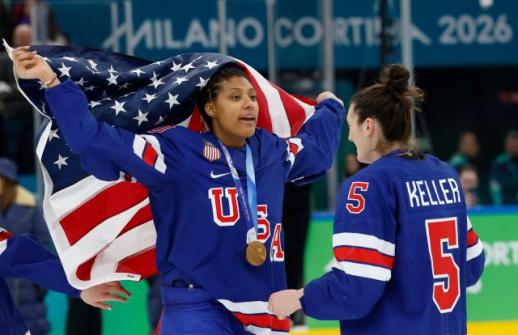 Laila Edwards, First Black Player on U.S. Women’s Hockey Team, Wins Olympic Gold Laila Edwards, the first Black player on the U.S. women’s national hockey team, won an Olympic gold medal with her family in the stands. The United States beat rival Canada 2-1 in the women’s ice hockey final at the 2026 Milan-Cortina Winter Olympics at Santa Giulia Arena in Milan on Feb. 20 (Korea time), returning to the top of the podium for the first time in eight years. Edwards played a key role throughout the tournament and helped drive the attack in the final. With the U.S. trailing 1-0 late in the third period, she assisted Hilary Knight’s tying goal. The Americans then scored the winner in overtime. After the game, Edwards raised her hand toward her family in the crowd. Her 91-year-old grandmother, Ernestine Gray, was among those watching in person. According to The Associated Press, cost initially made the trip difficult. Bringing 10 family members from Cleveland Heights, Ohio, required significant expenses, and the family could afford to send only some of them. Local residents and fans then organized fundraising, and a GoFundMe started by her father raised $61,000. NFL players Travis Kelce and Jason Kelce, both from Cleveland, donated $10,000 and initially did so anonymously. In the end, 10 family members and four friends made it to the arena, and Edwards clinched the title with them watching. “Having my family here means everything to me,” Edwards said after the game. “It’s hard to put into words what it means to show the people who helped me get here my dream coming true.”* This article has been translated by AI. 2026-02-20 17:39:41
 -
 BTS Comeback-29: How K-pop is woven into the Korean heritage SEOUL, February 20 (AJP) - On a chilly afternoon during the Lunar New Year holiday, the long line outside the National Museum of Korea curled past the plaza and into the nearby park. Families carrying gift boxes, grandparents holding grandchildren’s hands, and young couples in padded coats waited patiently for their turn to enter. For many, this was not a detour between holiday meals. It was the destination. Over two days of the Seollal break — Feb. 16 and 18 — more than 86,000 people passed through the museum gates. An average of 43,232 visitors a day, nearly three times the facility’s recommended capacity, filled its galleries. It was 2.7 times higher than the turnout during the 2024 holiday. In January alone, more than 730,000 people visited. By mid-February, another 428,000 had followed. If the pace continues, annual attendance is expected to approach six million, close to last year’s record of 6.5 million — the highest since the museum’s founding in 1945. Foreign visitors accounted for just 1.7 percent. This was, overwhelmingly, a domestic pilgrimage. A museum official described the institution as becoming a “holiday cultural sanctuary.” The phrase is telling. What was once a quiet, weekday destination for students and scholars has become, on major holidays, a shared civic space — where leisure, memory and identity converge. In this crowd lies a deeper shift. For decades, Korea’s popular culture has traveled outward — through music, drama and fashion. Heritage, by contrast, remained largely inward-looking, confined to textbooks and special exhibitions. Today, the two currents are beginning to meet. From Stage to Heritage: K-pop Enters Cultural Stewardship That convergence is increasingly visible in the actions of artists such as RM, leader of BTS. K-pop is no longer content to borrow tradition as visual ornament. It is beginning to participate in the preservation of cultural substance itself. In 2021 and 2022, RM donated a total of 200 million won to the Overseas Korean Cultural Heritage Foundation, supporting the restoration of a Joseon-era bridal robe, or hwarot, housed at the Los Angeles County Museum of Art. Made of red silk and densely embroidered with phoenixes, peonies and longevity symbols, the robe represents one of the most fragile and rare categories of Korean artifacts. The funds were used to stabilize deteriorating fabric and preserve its intricate embroidery. After conservation work by Korean specialists, the restored garment was exhibited in Korea in 2023 before returning to the United States. It was a modest project in scale. Its implications were not. Beyond Symbolism The restoration demonstrated how the global influence of a pop artist can be channeled into institutional heritage work. The donation was administered within Korea’s formal conservation framework, linking private cultural capital with public preservation systems. In the comment section of a K-Heritage Channel video documenting the project, one overseas fan wrote: “Thanks to BTS & Namjoon I have studied Korean history… The beauty of Korean culture & heritage is preserved & spread.” It was not a promotional slogan. It was a record of transmission — from entertainment to historical curiosity, from fandom to scholarship. This is where the shift lies. K-pop’s relationship with tradition has long been visual: hanbok-inspired costumes, palace backdrops, classical motifs. What is emerging now is structural. Artists are participating in the long, technical and often invisible work of conservation. Heritage in Institutional Context The hwarot project also illustrates a broader model. Cultural assets held overseas can be managed through cooperation between domestic specialists and international museums. Restoration is no longer an isolated act of recovery, but part of a transnational governance system for heritage. RM’s role was catalytic, not performative. His resources enabled professionals to do their work. His name drew attention. The institutions carried the process. That balance matters. It suggests that popular culture, when embedded in formal frameworks, can reinforce — rather than dilute — the authority of heritage institutions. The Present Momentum This cultural expansion is unfolding alongside RM’s growing presence in the art world. The San Francisco Museum of Modern Art has announced “RM x SFMOMA,” scheduled for October 2026 to February 2027, featuring works from his personal collection alongside the museum’s holdings. His collection spans Korean modern masters such as Yun Hyong-keun and Kim Whanki, and Western figures including Mark Rothko and Georgia O’Keeffe. The impulse is consistent: not to isolate traditions, but to place them in dialogue. On stage, he is a global idol. Inside museum walls, he operates as a cultural intermediary. Two spheres, once separate, are converging. Cultural Stewardship Back at the National Museum, as families drifted from the Silla gold crowns to the Joseon calligraphy halls, few were consciously tracing this connection. They were there for rest, curiosity, and a shared holiday experience. Yet their presence is part of the same story. K-pop once helped popularize hanbok as fashion. Today, it is helping sustain it as heritage. The restoration of a single Joseon bridal robe may seem minor in a world of billion-view videos and stadium tours. But it signals a direction. Tradition is no longer a decorative remnant. It is being repositioned as a strategic asset and a shared public trust. From packed museum halls to overseas conservation labs, Korea’s cultural ecosystem is widening. Popular culture is no longer merely consuming history. It is learning, quietly, to take responsibility for it. 2026-02-20 17:33:43
 -
 Korea's main index touches new ceiling, defying regional caution SEOUL, February 20 (AJP) - Korea’s main KOSPI played solo with eyes set on the next historic milestone of 6,000, regardless of simmering tensions in the Middle East that weighed on markets across the region and the globe. The key index rose 2.3 percent to close Friday at 5,808.5, bouncing right back after dipping to 5,684.9. The blue-chip KOSPI 200 advanced 2.3 percent to 859.6. It diverged from regional peers. Japan’s Nikkei 225 fell 1.1 percent to 56,825.7, while Hong Kong’s Hang Seng Index slipped 0.8 percent to 26,491.1. Mainland Chinese markets remained closed for the Lunar New Year holiday through Feb. 23, limiting broader regional participation. In Seoul, institutional investors dominated the trade floor on the main bourse, buying a net 1.61 trillion won. Foreign investors sold 742.8 billion won, while retail investors offloaded 987.2 billion won throughout the session. Large-cap semiconductors led the advance. SK hynix surged 6.2 percent to 949,000 won, approaching the 950,000-won level, after the company disclosed that BlackRock had acquired 100,808 shares through market transactions as of Jan. 10. BlackRock’s combined holdings now total 5 percent, marking the first time it has held a stake of 5 percent or more since May 9, 2018, nearly eight years ago. Samsung Electronics edged up 0.1 percent to 190,100 won, holding above the 190,000 level after recently setting record highs. Despite mild profit-taking, the stock maintained technical strength. Industrial and defense names also outperformed. Doosan Enerbility gained 5.2 percent to 103,500 won after announcing a 320 billion won turbine supply contract linked to the Czech Dukovany nuclear project. Hanwha Aerospace jumped 8.1 percent to 1,242,000 won amid heightened geopolitical tensions in the Middle East, boosting defense-sector sentiment. The tech-heavy KOSDAQ slipped 0.6 percent to close at 1,154.0. Institutional investors bought a modest 3.4 billion won, while retail investors added 318.6 billion won. Foreign investors, however, sold 274.5 billion won, weighing on overall momentum despite selective buying in growth names. The Korean won strengthened to 1,446.5 per dollar, up 4.5 won, or 0.3 percent, from the previous session. Investors are nervously watching the nonstop KOSPI rally, with investment banks scurrying to raise their next targets toward 7,000. 2026-02-20 17:28:12
 -
 Impeached ex-president apologizes but still defends botched martial law bid SEOUL, February 20 (AJP) - Former President Yoon Suk Yeol on Friday apologized for the pain caused by his botched declaration of martial law in 2024, while defending it as a "measure solely intended to save the country and its citizens." His remarks came just a day after the Seoul Central District Court handed down a life sentence on charges of insurrection and abuse of power over his Dec. 3 declaration of martial law. Despite the apology, Yoon insisted that deploying troops to the National Assembly did not amount to insurrection. "It is hard to accept the argument that simply sending military personnel to the National Assembly constitutes insurrection," Yoon said, denouncing the investigation and trial as a "politically motivated attempt to remove opponents and rival factions." He expressed skepticism about appealing, casting doubt on the judiciary's independence. Nonetheless, he hoped the ruling would be reassessed, saying he could be cleared "on the day liberal democracy and the rule of law stand upright." Yoon also criticized additional probes by prosecutors, urging politicians not to undermine democracy and to focus on people's lives. In a final message to his supporters, he said, "Our fight is not over. We must unite and rise." Yoon did not appear to forgo an appeal, however, as his lawyers clarified that Friday's statement merely reflected his personal feelings and was not intended to drop the case. 2026-02-20 17:15:06
 -
 Korean Shipbuilders Poised to Extend LNG Boom as China’s Delivery Slots Fill Up Korean shipbuilders are expected to keep their “supercycle” going this year as major Chinese yards run out of building capacity through 2029, pushing owners seeking deliveries in that window toward Korea. Demand expectations are also rising as large LNG projects in the United States and Qatar move into full swing. Industry officials said Qatar plans to double its LNG production capacity by 2030. The International Energy Agency also forecast that global LNG supply will rise this year at the fastest pace since 2019, led by the United States. To meet the increase in supply, the industry expects additional orders for about 70 LNG carriers. Chinese shipyards are winning LNG carrier orders at prices about $30 million lower than Korean rivals. Still, owners have continued to choose Korean yards, citing confidence in technology and on-time delivery. With Chinese yards’ 2029-2030 delivery slots effectively sold out, analysts said owners wanting ships delivered in that period will have fewer options, narrowing choices to Korea and strengthening Korean builders’ pricing power. “In 2025, shipowners were watching geopolitical developments, so orders leaned more toward container ships than LNG carriers,” an industry official said. “This year, LNG development projects in various countries are expected to move forward in earnest, so expectations for more LNG carrier orders are high.” Clarksons Research data showed global ship orders in January totaled 5.61 million CGT, or 158 vessels, up 27% from 4.43 million CGT a year earlier. LNG carrier prices were about $248 million, and Korean shipbuilders’ market share was about 40%. Hanwha Ocean said in a conference call this month that it expects to achieve revenue on par with last year and that overall market conditions should improve as U.S. LNG export projects accelerate. Samsung Heavy Industries said in a conference call last month that Chinese yards have allocated Qatar-related work through 2031 deliveries, consuming available slots, and stressed that Korea could benefit from upcoming U.S. orders. HD Korea Shipbuilding & Offshore Engineering also projected Korean builders would maintain market share, saying Chinese-built LNG carriers still lag Korea in quality and technology. Hanwha Ocean posted 12.6884 trillion won in revenue last year, up 18% from a year earlier, with balanced performance in its commercial and special-purpose ship businesses. HD Korea Shipbuilding & Offshore Engineering said revenue rose 17.2% to 29.9332 trillion won, citing a higher share of high-priced ships, improved productivity and increased output. Samsung Heavy Industries also exceeded its revenue guidance and returned to the “10 trillion won club” with 10.65 trillion won in revenue.* This article has been translated by AI. 2026-02-20 17:03:27
 -
 KAIST confers honorary doctorate on Formosa Group Chair Sandy Wang SEOUL, February 20 (AJP) - The Korea Advanced Institute of Science and Technology (KAIST) announced on February 20 that it has awarded an honorary doctorate in business administration to Sandy Wang, Standing Member of the Formosa Group Executive Management Committee and Chair of Formosa Bio. The ceremony took place during the university's 2026 commencement exercises. Wang was recognized for her role in leading the strategic growth of Formosa Group by prioritizing sustainability and corporate social responsibility. Following the business philosophy of the late founder Wang Yung-ching, she has steered the conglomerate beyond its traditional petrochemical manufacturing roots into sectors such as biotechnology, clean energy, energy storage systems, and resource circulation. According to KAIST, Wang has successfully implemented a corporate model where industrial growth, scientific advancement, and talent development are closely linked. The university highlighted her efforts in building a long-term biomedical research partnership with KAIST, which included expanding research infrastructure and creating a platform for international joint projects. A key result of this partnership was the establishment of the KAIST-Formosa Biomedical Research Center. This center serves as a hub for multidisciplinary research between Formosa Group's medical and academic institutions and the KAIST College of Life Science and Bioengineering. Wang has also been credited with institutionalizing a system that reinvests corporate earnings back into society through consistent funding for research and education. University officials noted that these initiatives have helped create a cycle where scientific breakthroughs are effectively funneled into industrial and social applications. In her remarks, Wang stated that she was honored to receive the degree and felt a strong connection to the university’s mission of contributing to a sustainable future through research. She expressed her hope that the students at KAIST would use their scientific training to lead global development and pledged to continue her support for long-term investments in talent and technology. KAIST President Lee Kwang-hyung described Wang as a leader who has put scientific strategy at the center of responsible management. He added that the university valued her practical support for international cooperation and research infrastructure. 2026-02-20 16:59:09