


Latest by
-
 Han Dong-hoon and Opposition Clash Over Kim Seung-won's Allegations Independent lawmaker Han Dong-hoon and the Democratic Party are engaged in a heated exchange over allegations involving Kim Seung-won, the nominee for Minister of Justice, regarding solicitation for clinical trial approvals. Han has intensified his offensive by releasing additional text messages, labeling the situation as the 'Democratic Party Brothers Gate,' while the Democratic Party has countered by questioning the source of the information and the manner of its disclosure.According to political sources on September 8, Han revealed text messages from a female broker, Yang, who mentioned Kim and other Democratic politicians in relation to the clinical trial approval allegations in October 2021.Han characterized the situation as 'Democratic Party Brothers Gate,' raising the stakes in his accusations. On his Facebook page, he stated, "More Democratic brothers are coming out. The poison lobbying gate is the 'Democratic Party Brothers Gate.'"In response, the Democratic Party criticized the source and method of Han's disclosures. Han Byung-do, the party's floor leader, stated during a morning meeting, "It is unacceptable to distort facts with materials that do not even disclose their source under the pretext of verification, and to use selectively edited recordings. This is typical political prosecution-style cabinet politics that only brings out information favorable to oneself."Democratic Party leader Kim Min-seok also criticized Han, calling him an "immature attention seeker." He added during an official YouTube appearance, "He will do anything to attract attention, even if it backfires on him." Fellow lawmaker Song Young-gil joined in, saying, "Stop acting like a private investigator and engage in proper politics. It seems like he is struggling to establish his presence without shedding his special prosecutor identity."In response, Han retorted, "Kim Min-seok, Song Young-gil, Han Byung-do, and other Democratic brothers, keep pushing. Is there nothing else to say besides personal attacks? Will you still push for Kim Seung-won? This is what Democratic Party-style drum politics looks like," he posted on Facebook. Additionally, Han continued to criticize lawmakers Park Joo-min and Park Ji-won on his social media.* This article has been translated by AI. 2026-09-08 17:32:00
 -
Sungwoo Travel Becomes a Venture Company with 28 Years of Trekking Expertise Sungwoo Travel, a company specializing in trekking tours for 28 years, has been recognized as a venture company. This acknowledgment comes as the company’s tourism model, which connects areas facing population decline with stay-type trekking, has been deemed both technologically innovative and commercially viable.On September 8, Sungwoo Travel announced that it has been selected as an 'Innovative Growth Type' in the venture company verification system overseen by the Ministry of SMEs and Startups.During the evaluation, Sungwoo Travel presented its core technology as a 'local trekking tour service model based on big data analysis of tourism, aimed at addressing population decline.' This business model combines the experience gained from operating outdoor and trekking products since its establishment in 1997 with tourism data.The company is also enhancing its research and development capabilities. In July, it received recognition for its corporate research institute, where it conducts data analysis and studies on local tourism content.Sungwoo Travel has been securing intellectual property rights for its trekking content, holding nine trademarks, including 'korea3peakschallenge,' 'Three Peaks Challenge,' 'Baekmi Daegan,' and 'Triple Aksan.' The company won the grand prize at the Korea Tourism Organization's tourism innovation competition in 2021 and received a commendation from the Prime Minister for contributions to tourism promotion in 2022.With its venture company verification, Sungwoo Travel plans to expand its trekking products aimed at both domestic and foreign tourists. The company intends to launch products that connect the tourism resources of small cities in Korea with walking tours, utilizing its inbound brand 'DULLEKOREA.'Lee Won-geun, CEO of Sungwoo Travel, stated, 'It is significant that the experience and data accumulated over the past 28 years in the field have been recognized as assets for future business. We will expand our outdoor tourism business to revitalize local tourism based on traveler data and trekking routes.'* This article has been translated by AI. 2026-09-08 17:32:00
-
 Korea's data breaches get personal as latest exposes cosmetic choices SEOUL, September 8 (AJP) - South Korea has grown accustomed to large-scale data breaches. The latest one is also unusually personal. Nearly 220,000 users of Gangnam Unni, a platform for comparing cosmetic procedures and clinics, were affected by unauthorized access discovered last week. The affected users included about 160,000 in South Korea and roughly 48,000 in Japan. Exposed information could include names, phone numbers, email addresses, clinics and doctors users contacted, preferred appointment times and, in some cases, treatment and payment details. "When an external attack occurs, it leaves technical records such as access logs, and we found records of abnormal access," an official from Gangnam Unni told AJP. "Based on those records, we believe the data of about 220,000 users was exposed by a single attacker." For some users, the records could reveal not only their identities but private choices about their appearance that they may never have intended to share with others. Gangnam Unni is operated by South Korean health-tech company Healing Paper. According to an official notice posted by Healing Paper, abnormal access was detected on Sept. 4 through an application programming interface, or API, connected to consultation records. An API is a digital channel that allows different parts of an online service to exchange information. The company said it detected the abnormal activity in real time, immediately blocked the access route and carried out emergency security measures across the service. While the company was responding to the incident, the same attacker tried to access the system again through a different route on Sept. 5, according to the notice. Healing Paper said it blocked that route as well. The company then conducted a full system review and completed several technical measures, including stronger authentication procedures, upgraded abnormal-access detection and a reworking of authorization checks. The number of affected users stands at 219,665. Beyond South Korea and Japan, 4,218 affected users were in Taiwan and 1,591 in Thailand. Another 481 were in China, while 5,308 were from English-speaking and other markets. The figures show the breach extended well beyond South Korea. What sets the case apart, however, is the type of information exposed. A leaked phone number may lead to spam, while a password can be changed. A consultation photo or a record showing which cosmetic procedure someone considered can reveal something far more personal. Healing Paper said the exposed records could also include consultation motives and status, as well as, for some users, payment details and information about procedures they actually received. In its notice to affected users, Healing Paper warned of possible phishing attempts involving calls, messages or emails impersonating Gangnam Unni or medical institutions. It urged users to be particularly wary of contacts offering discounts, directing them to links or asking for personal or financial information. Healing Paper said it voluntarily reported the breach to the Korea Internet & Security Agency (KISA) and individually notified affected customers. Users can check which categories of their information were exposed through the Gangnam Unni website for 30 days from the date of the notice. The company also said it had gathered multiple indications that could help identify the attacker and requested a police investigation on Sept. 6 to determine exactly what happened and prevent further harm. "Our priority is to cooperate fully with the police investigation," the official said. "We understand how concerned our users are, and we want to take responsibility and do what we need to do." Chief Executive Hong Seung-il also apologized in the company's official notice. "We take this incident very seriously and sincerely apologize once again to the customers who have trusted and used Gangnam Unni," Hong said. He said the company would review the effectiveness of its existing safeguards, strengthen its security systems and make additional investments to prevent a recurrence. A country already uneasy about its data The breach comes after a string of major data-security incidents that have put digital trust under pressure in South Korea. The country's Personal Information Protection Commission, the government regulator responsible for enforcing privacy laws, received 447 personal-data leak reports in 2025, up 45.6 percent from 307 a year earlier. Hacking accounted for 276 of those cases. Some of South Korea's biggest companies have been caught up in major data breaches. Coupang reported a breach affecting more than 33 million users in November 2025. In June 2026, the Personal Information Protection Commission imposed a 624.68 billion won ($464 million) penalty on the e-commerce company over the breach and other privacy violations. In July, the commission imposed a 53.98 billion won penalty on telecom carrier KT after personal information belonging to 16,647 subscribers was exposed. The regulator said 368 customers also suffered about 240 million won in fraudulent mobile-payment transactions linked to the incident. Streaming platform TVING also came under investigation in June after unauthorized access to a database containing user information. Against that backdrop, the Gangnam Unni case stands out because consultation photos and treatment records can reveal private decisions about a person's body and appearance. Such information can be particularly sensitive in South Korea, where appearance can play an important role in how some young people view their social and employment prospects. A 2019 study titled "Beliefs and trends of aesthetic surgery in South Korean young adults," published in Archives of Plastic Surgery, surveyed 103 South Korean job seekers aged 18 to 29. Participants generally believed cosmetic surgery could improve their employment prospects, while dissatisfaction with appearance was the most common reason for undergoing or considering a procedure. The small, self-selected sample was not representative of all young South Koreans, but the findings help illustrate why information about cosmetic procedures may be particularly personal for some users. Meanwhile, South Korea is strengthening penalties for major personal-data breaches. An amended privacy law taking effect on Sept. 11 will allow fines of up to 10 percent of total revenue in cases involving repeated leaks caused intentionally or through gross negligence within three years, or incidents in which such conduct affects at least 10 million people. The previous ceiling was 3 percent. A platform built on information Gangnam Unni launched in 2015 as a platform where users could compare clinics, treatment prices and reviews in one place. The company later expanded overseas, introducing a Japanese-language service in 2019, followed by English in 2023, Thai in 2024 and Chinese in 2025. By March 2026, more than 700,000 foreign users had completed consultation requests or reservations at South Korean dermatology and plastic-surgery clinics through the service, according to Healing Paper. Japan was its largest overseas market. The company said in April that around 200,000 Japanese users had made new consultation requests or reservations over the previous year. Users from English-speaking markets including the United States, Canada and Britain increased 3.2-fold, while Thailand rose about 20-fold and Taiwan 25-fold, according to the company. The expansion came alongside a broader rise in foreign demand for cosmetic and medical treatment in South Korea. More than 2 million foreign patients received medical treatment in the country in 2025, according to the Ministry of Health and Welfare. About 1.31 million, or 62.9 percent, visited dermatology clinics. Dermatology and plastic surgery together accounted for more than 74 percent of the total. In July, Healing Paper unified its overseas services under the brand name Unni as it sought to expand further in the global beauty-care market. Compensation at home and abroad Healing Paper said any compensation plan would cover affected users regardless of nationality. "We plan to prepare and provide compensation as quickly as possible for all affected users, both in Korea and overseas," the official said. The company has not yet announced the form or size of the compensation. "We finished organizing the exposed data categories and notifying users on the evening of Sept. 7, while also completing the mandatory reporting procedures," the official said. "We are now focused on preparing compensation and communicating with our customers." The official said the company is discussing the compensation plan internally and would announce details once finalized. "Following this incident, we plan to redesign the overall service system and the way our information architecture is structured from the beginning," the official added. "We believe the technical safeguards need to be strengthened as much as possible," the official added. "We will do our best." As Gangnam Unni expands overseas, protecting the highly personal information its users provide is becoming part of the trust the platform sells. The test now is whether users will still feel safe sharing the information that made the service useful in the first place. 2026-09-08 17:29:45
 -
Arrest Warrant Issued for Independent Lawmaker Kim Byung-ki Amid Ongoing Legal Issues in 22nd National Assembly As an arrest warrant has been requested for independent lawmaker Kim Byung-ki, the 22nd National Assembly is expected to hold a vote on the fifth arrest motion against a sitting lawmaker. The assembly has already seen four votes on arrest motions involving current lawmakers, including former People Power Party member Kwon Seong-dong, Daegu Mayor Choo Kyung-ho, independent lawmaker Kang Sun-woo, and former Democratic Party member Shin Young-dae, marking a period heavily marred by legal controversies.As of September 8, a total of four current and former lawmakers, including Shin, Kang, Kwon, and Choo, have had arrest warrants requested and have undergone votes on their arrest motions.Shin faced allegations of manipulating public opinion during the party primary against candidate Kim Ui-gyeom in the 2024 general election. An arrest motion was presented on November 2 of the same year, but it was ultimately rejected with 93 votes in favor, 197 against, and 5 abstentions.In contrast, Kang, who was implicated in the alleged acceptance of 100 million won in bribes related to party nominations, saw his arrest motion pass on February 24 with 164 votes in favor, 87 against, 3 abstentions, and 9 invalid votes. Following a court review, he was subsequently detained. If Kim's arrest motion passes, he would become the second sitting lawmaker from the Democratic Party to have an arrest motion approved, following Kang.Former People Power Party member Kwon and Mayor Choo were both implicated in allegations of receiving illegal political funds from the Unification Church and charges related to insurrection. Their arrest motions were voted on September 11 and November 27 of last year, respectively. Both received 173 and 172 votes in favor, leading to Kwon's detention, while Choo's arrest warrant was rejected after a court review.On September 7, police investigating 13 allegations against Kim, including bribery and obstruction of business, submitted a request for a pre-arrest warrant to the prosecution under the Act on the Aggravated Punishment of Specific Crimes.The prosecution will review the investigation records, and if they find sufficient grounds for arrest, they will file a request with the court. Following this, the court will submit a request for arrest approval to the government, which will then seek the National Assembly's consent for the arrest motion.* This article has been translated by AI. 2026-09-08 17:28:10
-
Yoon Suk Yeol Claims Innocence in Appeal Over Election Law Violation Yoon Suk Yeol, who was sentenced to a disqualification ruling for publishing false information during the 20th presidential election, asserted his innocence during the first hearing of his appeal, stating, "If I intended to deceive the public, I would have avoided answering questions." Yoon's legal team raised issues of fairness by referencing a proposal from Cho Kuk, head of the Innovation Policy Research Committee, and the case involving President Lee Jae-myung.The Seoul High Court's Criminal Division 2-1, presided over by judges Baek Seung-yeop, Hwang Seung-tae, and Kim Young-hyun, held the first hearing of Yoon's appeal on September 8.Yoon's defense argued that the statements in question were not premeditated but rather spontaneous and defensive responses to reporters' inquiries. They cited factual errors, legal misunderstandings, and inappropriate sentencing as grounds for their appeal, requesting the court to overturn the first ruling and declare Yoon not guilty.Yoon also took the opportunity to speak, saying, "If it was difficult to answer the questions, I could have simply gotten into my car. I could have easily avoided the questions, so would I have answered them to deceive the public?" He added, "If a response of 'that’s not true' in 2-3 seconds is considered the publication of false facts, I question whether it is realistically possible to conduct an election campaign. I ask that you thoroughly review this in the appeal process."The defense team also mentioned a Facebook post by Cho on September 6, suggesting the removal of the 'act' requirement from the definition of the crime of publishing false facts. They argued that the ambiguity of the 'act' could lead to arbitrary punishment. They pointed out that the case against President Lee, which was sent back to the Supreme Court with a guilty ruling, has been suspended, raising concerns about fairness.The special prosecutor's team, led by Min Joong-ki, argued that Yoon's statements were prepared in response to media inquiries and requested the court to dismiss the appeal and uphold the first ruling.The court noted that Yoon had explained the meaning of 'introduction' differently at various times. The judges stated, "The key to determining whether the defendant's claim of not introducing someone is a publication of false facts lies in how an average voter would interpret that statement."Yoon is accused of stating that he did not introduce Lee Nam-seok, a former prosecutor from the Central Investigation Department, to Yoon Woo-jin, the former head of the Yongsan Tax Office, during a Kwanhun Club discussion in December 2021. He is also accused of publishing false information in a January 2022 media interview, claiming he had not been introduced to Jeon Seong-bae (a figure associated with the party) along with Kim Geon-hee.The first trial found him guilty on both charges, sentencing him to one year and six months in prison, suspended for three years. If this sentence is confirmed, the People Power Party will have to return 39.7 billion won in election expenses received during the 20th presidential election to the National Election Commission.The court plans to summon Yoon Dae-jin, the former prosecutor and brother of Yoon Woo-jin, as a witness on the 22nd. Following the defendant's testimony and the special prosecutor's closing arguments, the court is expected to conclude the proceedings on that day.* This article has been translated by AI. 2026-09-08 17:24:00
-
Science and Technology Committee Resumes After 20-Day Stalemate The National Assembly's Science and Technology Committee held a full meeting on September 8, addressing overdue issues such as agency reports and budget reviews. This marked the committee's first session in 20 days, following a disruption caused by controversy surrounding Lee Jin-sook, a lawmaker from the ruling party, on August 19. In addition to the Science and Technology Committee, the Finance and Economy Committee, the Land and Transport Committee, the Industry, Trade, and Energy Committee, and the Climate, Energy, Environment, and Labor Committee also convened to process their agendas.During the meeting, the Science and Technology Committee presented 86 bills and petitions, referring them to the appropriate subcommittees. The agency reports and budget reviews that were scheduled for August 19 but canceled due to the disruption were also conducted. Tensions rose when the Democratic Party, leading the session, introduced and passed a resolution urging Lee Jin-sook to avoid voting on matters related to herself, prompting all ruling party members to walk out.In this context, Democratic Party member Lee Yeon-hee criticized Lee Jin-sook, stating, "A skunk has entered the people's assembly, polluting the National Assembly with its stench," which heightened the atmosphere. However, the ruling party returned for the afternoon session, preventing further disruption.The Finance and Economy Committee, which had faced difficulties in forming its subcommittees, also held a full meeting on the same day, completing its subcommittee formation. The Land and Transport Committee presented 179 bills and petitions, referring them to its subcommittees. Moon Jin-seok from the Democratic Party was appointed as the chair of the budget and settlement subcommittee.After the subcommittee formation was completed, Finance and Economy Committee Chairman Cho Seung-rae noted, "There are still 223 bills that have not been presented in the full assembly, along with 1,350 bills awaiting review." He urged that, with the subcommittee now formed, pending bills should be reviewed diligently and in a timely manner.Additionally, personnel hearing-related matters for candidates for the Minister of Finance, Minister of SMEs and Startups, and Minister of Land, Infrastructure, and Transport were approved in their respective committees. The Culture, Sports, and Tourism Committee and the Agriculture, Food, Rural Affairs, and Ocean Affairs Committee also held subcommittee meetings to review their respective bills. The Special Committee on Budget and Settlement also convened a subcommittee to expedite the review of last year's government settlement.In the political arena, analysts suggest that with the completion of the speeches by the representatives of the ruling and opposition parties, both sides will move into legislative competition. Notably, this regular session is expected to see personnel hearings for six government minister candidates, leading to intense clashes between the ruling and opposition parties during the hearings, government inquiries, and national audits.* This article has been translated by AI. 2026-09-08 17:24:00
-
 Seoul beats back fine dust, and the next test: ozone SEOUL, September 8 (AJP) - Ozone has become a bigger pollution headache than fine dust for South Korea. Its capital has sharply reduced particulate air pollution over the past decade, but ground-level ozone concentrations have risen nearly 50 percent, exposing a new challenge after years of policy focused heavily on fine dust. The annual average ozone concentration in Seoul rose from 0.022 parts per million in 2015 to 0.0326 ppm in 2025, an increase of more than 48 percent, according to the Seoul Metropolitan Government. Over the same period, the annual average concentration of PM10, commonly referred to in South Korea as fine dust, fell 29 percent to 32 micrograms per cubic meter from 45. PM2.5, or ultrafine dust, dropped about 22 percent to 18 micrograms per cubic meter from 23. The divergence has become increasingly visible in the number of high-ozone days. Seoul said ozone advisories were issued on 16 days in 2025, up from just three in 2015, a more than fivefold increase. The figures contrast with the substantial progress Seoul has made in tackling particulate matter over a longer period. PM10 concentrations fell 47 percent to 32 micrograms per cubic meter in 2025 from 60 in 2006, while PM2.5 declined 40 percent to 18 from 30 over the same period. The number of days classified as having "bad" PM2.5 levels also dropped to 32 from 108. But Rep. Kim Ju-young of the ruling Democratic Party warned that improvements in particulate pollution should not be treated as evidence that the broader air-quality problem has been solved. "We should not assume that the air our people breathe has become sufficiently clean and safe simply because fine dust and ultrafine dust levels have improved," Kim, a member of the National Assembly’s Climate, Energy, Environment and Labor Committee, told AJP Tuesday. "If Seoul's ozone concentration has increased by more than 48 percent over a decade, we now need to take a hard look at what has been left in the blind spots of our air-quality policies," Kim said. He called for a shift beyond South Korea's long-standing focus on particulate matter toward tighter management of the pollutants that produce ozone. "With heat waves and intense solar radiation likely to increase because of climate change, potentially making the ozone problem even more serious, the government needs to move beyond an air-quality policy centered on fine dust and systematically manage ozone precursors such as nitrogen oxides and volatile organic compounds," Kim said. "I will also examine the causes of the increase in ozone and the government's response system during this year's parliamentary audit," he added. "The ultimate measure of air-quality policy should not be the numerical level of a single pollutant, but how clean and safe the air people actually breathe is." Ground-level ozone differs from particulate matter because it is generally not emitted directly. It forms through photochemical reactions involving nitrogen oxides, or NOx, and volatile organic compounds, or VOCs, in the presence of sunlight. Vehicles, industrial facilities and the use of solvents and fuels are among the sources of those precursor pollutants. The World Health Organization says ground-level ozone is a major component of smog and excessive exposure can cause breathing difficulties, trigger asthma, reduce lung function and contribute to lung disease. Sunny weather favors its formation, making ozone particularly problematic during hot seasons. Seoul has begun responding to the shift. The city launched intensified seasonal measures targeting high ozone concentrations from May through August this year, including inspections of 1,030 businesses that emit VOCs, such as gas stations, painting facilities and dry cleaners. It is also strengthening checks on vehicle emissions and idling around terminals, depots and logistics centers. The pattern seen in Seoul is not unique. China has confronted a particularly similar problem. Aggressive air-pollution controls introduced from 2013 brought dramatic reductions in particulate matter, but ozone pollution initially worsened. A study using China's national monitoring network found that summertime mean PM2.5 concentrations across eastern China fell by about 50 percent between 2013 and 2019, while surface ozone steadily increased and reached the highest level of the study period in 2019. Researchers have pointed to the complicated atmospheric chemistry linking the two pollutants. A Nature Geoscience study found that PM2.5 fell by roughly 30 to 40 percent across China from 2013 to 2017 while surface ozone worsened, concluding that effective control required simultaneous reductions in pollutants including VOCs and NOx rather than a focus on particulate matter alone. Europe faces a similar challenge despite substantial reductions in emissions that contribute to ozone formation. The European Environment Agency said NOx emissions in Europe fell around 53 percent between 2005 and 2023 and non-methane VOC emissions declined about 35 percent. Yet while peak ozone concentrations decreased, annual mean ozone levels remained stable or increased. The agency warned that climate change is expected to aggravate European ozone pollution because more frequent and intense heat-related weather conditions favor ozone formation. It estimated that exposure to ozone contributed to about 63,000 premature deaths in the European Union in 2023. The United States, meanwhile, provides an example of longer-term ozone improvement alongside falling particulate pollution. U.S. Environmental Protection Agency data show national eight-hour ozone concentrations declined 24 percent between 1990 and 2024, while annual PM2.5 concentrations fell 46 percent between 2000 and 2024. Weather nevertheless remains a critical factor. The EPA notes that ozone forms more readily during warm, sunny and stagnant conditions, while cooler, cloudy or wetter weather suppresses its formation. After adjusting for weather variations, U.S. monitoring data show average warm-season ozone concentrations have fallen by about 10 parts per billion since 2002, demonstrating that reductions in precursor emissions can lower ozone even as meteorological conditions fluctuate. Seoul's experience shows that decades of progress in reducing particulate matter have addressed only part of the city's air-quality challenge. As hotter summers create conditions increasingly favorable to ozone formation, controlling NOx and VOC emissions is likely to become a bigger part of South Korea's effort to reduce the health risks of air pollution. 2026-09-08 17:21:45
 -
K.J. Choi to Host 'Heart Talk Show' for Golf Fans on September 30 K.J. Choi, who has won eight titles on the PGA Tour and 17 on the KPGA Tour, will hold a special event for golf fans ahead of the Hyundai Marine & Fire Insurance K.J. Choi Invitational.Hyundai Marine & Fire Insurance announced on September 8 that it will host a 'Heart Talk Show' on September 30 at the VIP lounge of Ferum CC in Yeoju, Gyeonggi Province, a day before the tournament begins on October 1. The event will feature Choi engaging with golf fans.This event is organized to express gratitude to fans for their support over the past decade, during which Hyundai Marine & Fire Insurance has contributed to the growth of Korean men's golf alongside Choi.During the talk show, Choi will candidly share memorable moments and important decisions from his career as a golfer. Participants will have the opportunity to ask questions they have always wanted to pose to Choi and share their own golf experiences and concerns. Some players participating in the tournament are also expected to make surprise appearances to meet fans.Choi expressed his appreciation, stating, "I am grateful for the opportunity to meet fans directly. I hope this gathering allows me to share my experiences and encourages more people to enjoy golf and take an interest in Korean men's golf."A representative from Hyundai Marine & Fire Insurance noted, "The continued growth of the Hyundai Marine & Fire Insurance K.J. Choi Invitational over the past decade has been greatly supported by the interest and encouragement of golf fans. We hope this Heart Talk Show will create lasting memories for everyone involved."Participants will receive benefits, including a one-day admission ticket to the tournament and a gift package containing merchandise and health supplements. At the end of the event, attendees will have the chance to take a commemorative photo with Choi, which will be printed on-site for them to keep.A total of 10 participants will be selected for the Heart Talk Show. Any golf fan can apply for free. Interested individuals can submit their applications from September 14 to 20 through a link that will be posted on the official social media accounts of the KPGA Tour and the K.J. Choi Foundation, sharing memories or special stories from the past decade of the Hyundai Marine & Fire Insurance K.J. Choi Invitational.This year's Hyundai Marine & Fire Insurance K.J. Choi Invitational will take place from October 1 to 4 at the East and West courses of Ferum CC. A total of 126 players representing the KPGA Tour will compete for a total prize pool of 1.25 billion won. Last year's tournament was won by Jeon Ka-ram.* This article has been translated by AI. 2026-09-08 17:20:20
-
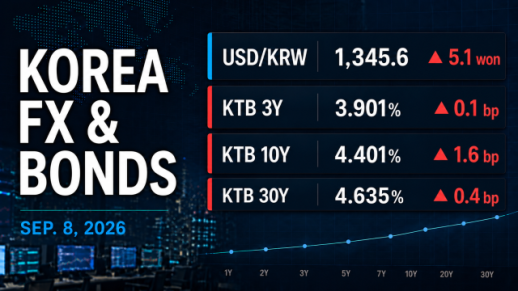 Won weakens for 1st time in five sessions SEOUL, September 8 (AJP) - The South Korean won fell for the first time in five sessions on Tuesday as higher oil prices and strong demand for dollars from importers put pressure on the currency. Korean government bonds ended little changed after an early rise faded. The won closed at 1,345.6 per dollar at 3:30 p.m., weakening 5.1 won from 1,340.5 in the previous session. The currency opened at 1,344.4 and strengthened as far as 1,336.3 in morning trading before reversing course and reaching 1,349.0 during the session. The won weakened despite a softer global dollar and stronger yen, as rising oil prices raised concerns over South Korea's import bill and importers stepped up dollar demand around 1,340 won per dollar. West Texas Intermediate crude rose above US$94 a barrel during Asian trading amid renewed concerns over Middle East supply disruptions. The National Pension Service's halt to currency hedging also limited further won appreciation, while dollar selling by exporters and gains in the yen capped the rise in the dollar-won rate. Government bonds finished broadly steady after an early rally faded, with most benchmark yields moving by less than 1 basis point. The three-year government bond yield edged up 0.1 basis point to 3.901 percent, while the 10-year yield showed the clearest move, rising 1.6 basis points to 4.401 percent. The five-year yield gained 0.7 basis point to 4.127 percent, while the 20-year yield fell 0.7 basis point to 4.560 percent. The 30-year and 50-year yields rose 0.4 and 0.3 basis point to 4.635 percent and 4.543 percent, respectively. The spread between the three-year and 10-year yields widened to 50.0 basis points from 48.5 basis points a day earlier, reflecting a modest steepening of the curve rather than a broad selloff. Bonds had rallied in morning trading, with the three-year yield falling as low as 3.876 percent and the 10-year yield to 4.362 percent. Foreign investors bought three- and 10-year bond futures, while investors sought value around the 3.9 percent level in the three-year sector. The gains faded later in the session as higher oil prices kept inflation risks in focus and overseas bond yields moved higher during Asian trading, leaving the domestic market close to flat by the end of the day. U.S. markets had been closed Monday for the Labor Day holiday, leaving Seoul investors with limited overnight direction. Attention is now shifting to U.S. inflation data after stronger-than-expected employment figures revived expectations of further Federal Reserve tightening. Markets are also watching the Bank of Japan's policy meeting next week, with expectations of another rate increase contributing to the yen's recent strength. AJP Takeaways - South Korea's won weakened 5.1 won to 1,345.6 per dollar Tuesday as higher oil prices and importer dollar demand outweighed support from a softer dollar and stronger yen. - Government bonds surrendered an early rally, with the three-year yield ending nearly flat at 3.901 percent and the 10-year yield rising 1.6 basis points to 4.401 percent. - U.S. markets are turning to U.S. inflation data and upcoming Federal Reserve and Bank of Japan policy meetings for direction after stronger U.S. employment data revived tightening expectations. 2026-09-08 17:18:57
 -
Samsung SDS Executive: RX Involves Designing Entire Factories "Robot transformation (RX) is not just about creating a single robot; it involves designing the entire factory."Bae Soon-min, Executive Vice President and head of the RX business team at Samsung SDS, outlined the company's vision to implement autonomy in manufacturing based on 25 years of experience in manufacturing execution systems (MES) and equipment and logistics automation. The plan focuses on connecting and integrating robots from various manufacturers into production environments.During the 'Real Summit 2026' held on September 8, Bae introduced Samsung SDS's RX strategy under the theme of 'Robot Transformation for Autonomous Manufacturing.' The company will oversee the entire process of robot implementation in manufacturing, from process analysis and feasibility studies to robot selection, deployment, operation, and maintenance.Samsung SDS is expanding its existing manufacturing IT capabilities into RX. The company has conducted automation projects in over 100 Samsung affiliates and more than 430 external clients over the past 25 years, leveraging its MES expertise.Bae described the evolution of manufacturing in three stages: informatization, automation, and autonomy. He explained, "In informatization, humans make decisions and actions while machines record. In automation, humans decide and machines execute. In autonomy, AI makes decisions and robots execute."However, he noted that physical AI and robotic technology have not yet reached completion. Bae stated, "While it is relatively easy to operate a single robot effectively, ensuring that 10 or 100 robots operate seamlessly 24/7 is challenging. What is crucial now is not just purchasing robots but building the system to support them."Samsung SDS is developing a 'robot orchestration platform' that connects and operates robots from different manufacturers alongside existing production equipment. This platform aims to establish a stable operation system for multiple robots based on six elements: autonomy, orchestration, interoperability, resilience, safety, and security. It integrates MES with robots to streamline work instructions, data collection, and operational oversight while utilizing accumulated data for enhancing physical AI.The company is also collaborating with external firms to build an RX ecosystem. This involves partnering with companies specializing in robot hardware, physical AI, data, simulation, system integration, and maintenance to combine necessary technologies for manufacturing environments. Currently, 10 companies, including Rainbow Robotics and Walden Robotics, are participating in this initiative.Bae proposed the 'DRT' methodology for applying RX in manufacturing settings. This four-step approach includes 'Discover,' which involves analyzing processes and tasks on-site; 'Assess,' which evaluates the feasibility of robot application based on current technology; 'Redefine,' which may involve redesigning processes or robots if necessary; and 'Transform,' which encompasses deployment, evaluation, stabilization, and maintenance.He emphasized, "The journey of RX does not start with purchasing robots; it begins with analyzing the site and identifying customer issues to determine which processes are suitable for robot application."Following the session, various robots, including Rainbow Robotics' quadrupedal and humanoid robots, were showcased. Ahn Dae-jung, Vice President in charge of digital factory at Samsung SDS, explained, "Rainbow Robotics' quadrupedal robot and mobile humanoid robot RB-Y1 are being deployed in project units within Samsung affiliates."According to Ahn, Walden Robotics' robots are also being utilized in actual production lines, operating around the clock, while Samsung SDS is validating the on-site applicability of related robots based on use cases from Samsung affiliates.Samsung SDS plans to apply various types of robots based on the manufacturing environment and task characteristics, rather than focusing solely on humanoids. Ahn stated, "Humanoid physical AI is not necessarily the best option; it is essential to analyze the robot's form factor, learning methods, and operational costs comprehensively before making a selection."* This article has been translated by AI. 2026-09-08 17:12:10