


Latest by
-
 Judge Ji Gwi-yeon to Face Trial Over Allegations of Alcohol Entertainment Judge Ji Gwi-yeon of the Seoul Northern District Court will have her trial over allegations of alcohol entertainment presided over by a fellow judge from her judicial training class.According to legal sources on September 8, the Seoul Central District Court has assigned the case involving Judge Ji's violation of the Anti-Corruption Act to Chief Judge Park Gang-kyun of the Criminal Division 4. The date for the first hearing has not yet been determined.Judge Park is a classmate of Judge Ji from the 31st Judicial Research and Training Institute. Being classmates does not automatically disqualify him from presiding over the case, but he may recuse himself if he believes he cannot conduct a fair trial.The Corruption Investigation Office, led by Chief Prosecutor Lee Dae-hwan, indicted Judge Ji without detention on September 4 for violating the Anti-Corruption Act.Judge Ji is accused of receiving 1.36 million won worth of entertainment after having two lawyers cover a bill of 4.09 million won at a reservation-only bar in Cheongdam-dong, Gangnam, in August 2023.The Anti-Corruption Act stipulates that public officials who receive goods or entertainment worth more than 1 million won from the same individual in a single instance are subject to punishment, regardless of the relevance to their duties or any quid pro quo.The two lawyers reportedly split the bill at the time. The Corruption Investigation Office determined that they had shared the intent to entertain Judge Ji and divided the costs among the three attendees, estimating the value of the entertainment received by Judge Ji at 1.36 million won.Considering that the providers of the entertainment were lawyers, the Corruption Investigation Office also investigated the possibility of quid pro quo. However, based on the fact that there were no cases assigned to Judge Ji's court by the lawyers at that time, they concluded that it was difficult to establish a connection to her official duties and did not apply bribery charges.Judge Ji previously served as the presiding judge in the first trial of former President Yoon Suk Yeol's insurrection case, where she sentenced him to life imprisonment. She transferred to the Seoul Northern District Court during the regular personnel reshuffle in February of this year.* This article has been translated by AI. 2026-09-08 16:28:00
 -
 Korea Post Shopping launches Chuseok gift fair Broadcaster Moon Se-yoon and models pose for photos during a promotional event for the 2026 Korea Post Shopping Chuseok Gift Fair at the Seoul Central Post Office in Jung-gu, Seoul, on the morning of Sep. 8, 2026. Korea Post is holding the fair from Sep. 1 to 27, offering discounts on Chuseok gifts and holiday food items. During the event, a special promotion called “Daldal Week” offers 10 popular products at special prices each week. AJP Yoo Na-hyun 2026-09-08 16:26:31
 -
Dongmyeong University Successfully Concludes 'Banyeo Beer Festival' Dongmyeong University's Local Content Focused University Project Team, in collaboration with the Haeundae District Office and Busan Economic Promotion Agency, successfully concluded the '2026 Banyeo Discount Beer Festival' held from September 3 to 5 at the Banyeo 2-dong Market in Haeundae.This event received high praise for integrating the creative ideas of student local creators to revitalize the stagnant alley economy and attract more residents.A key achievement was the successful establishment of a self-sustaining cooperative model, with local governments, public institutions, and universities each playing their roles in a coordinated manner.Notably, Dongmyeong University students planned and operated five specialized pop-up booths that combined the market's unique atmosphere with the latest trends, based on thorough market analysis.These included the Dongmyeong Photo Studio, a retro studio utilizing artificial intelligence; the Banyeo 2-dong Market Painting Board, where merchants and residents communicate through art; the Banyeo 2-dong Re-Market, promoting environmental sustainability and sharing through upcycled products; Fun Jam Gugu, showcasing stylish self-planned goods; and Komujak, offering traditional Korean hanbok experiences for pets. These attractions drew significant visitor engagement, complementing the food stalls prepared by the merchants' association.Analysts suggest that the synergy created by the Haeundae District Office's proactive administrative support, the Busan Economic Promotion Agency's assistance in developing small business markets and branding, and the university's innovative on-site planning provided practical solutions for revitalizing traditional markets.Seo Seong-yeo, head of Dongmyeong University's Local Content Focused University Project Team, stated, "Students gained valuable experience by implementing theories and ideas learned in the classroom directly in the field, fostering deep communication with merchants and residents. We will continue to focus on nurturing professional local creators who can sustainably invigorate local alley economies through close public-private-academic governance with relevant institutions."* This article has been translated by AI. 2026-09-08 16:24:10
-
Government to Assess Economic Supply Chain Crisis Response from September 9-11 The government is set to evaluate its multi-agency response system to global supply chain uncertainties. It plans to verify response procedures and inter-agency cooperation based on a hypothetical supply chain crisis and address any deficiencies.According to the Ministry of Economy and Finance on September 8, the government will conduct a three-day economic supply chain crisis response tabletop exercise (TTX) from September 9 to 11.This exercise is the second to be held under Article 28, Section 5 of the Basic Law on Support for Supply Chain Stabilization for Economic Security, following one conducted in November of last year.The training will progress from identifying supply chain crises to departmental responses and the establishment of follow-up measures. After the exercise, the government will analyze any issues that arise and develop improvement strategies.Lee Seung-wook, Director of Economic Supply Chain Planning at the Ministry of Economy and Finance, stated, "Through this tabletop exercise, we plan to reassess the response systems among relevant departments and agencies and continuously address any shortcomings."The exercise is organized by the Ministry of Economy and Finance and will involve participation from the Ministry of Science and ICT, Ministry of Interior and Safety, Ministry of Agriculture, Food and Rural Affairs, Ministry of Trade, Industry and Energy, Ministry of Environment, Ministry of Land, Infrastructure and Transport, Ministry of Oceans and Fisheries, Ministry of SMEs and Startups, Ministry of Food and Drug Safety, Korea Aerospace Research Institute, Defense Acquisition Program Administration, Korea Forest Service, and Korea Disease Control and Prevention Agency.* This article has been translated by AI. 2026-09-08 16:24:10
-
Retail Stocks Struggle Ahead of Chuseok Amid High Interest Rates and Strong Won Consumer spending typically increases during the Chuseok holiday, but retail stocks are struggling. If the won continues to strengthen and the Bank of Korea implements an interest rate hike, the poor performance of retail stocks is expected to persist.According to the Korea Exchange, from September 7 to today, Shinsegae's stock price has fallen by 5.38%, while Hyundai Department Store has dropped by 5.55%. Major retail representatives, E-Mart and GS Retail, have also seen declines of 6.76% and 4.91%, respectively. This contrasts with the KOSPI, which rose by 10.45% during the same period.By sector, the KRX300 Consumer Staples and Discretionary indices have decreased by 1.41% and 3.76%, respectively, compared to a month ago. This is in stark contrast to the 15.44% and 5.25% increases seen in the KRX300 Information Technology and Industrials sectors. While large tech stocks are gradually trending upward, consumer discretionary and retail stocks are stuck at the lower end of their trading range.The sluggishness in retail stocks is attributed to concerns over weak consumer spending. Although exports, particularly in semiconductors, have increased in the South Korean economy, domestic consumption remains subdued. According to the Korea Development Institute (KDI), the retail sales index in July decreased by 0.8% compared to the same month last year.Profit-taking following a surge in the first half of the year is also cited as a reason for the decline. Retail stocks, including department stores, saw significant gains earlier this year due to heightened market expectations following performance bonuses paid to large corporations. Shinsegae and Hyundai Department Store's stock prices rose by 200% and 118%, respectively, during the first half, while Lotte Shopping increased by 134%. As a result, ongoing sell-offs have led to stagnant stock prices.The outlook for the second half of the year is not promising. While there may be a temporary increase in sales due to the Chuseok holiday, concerns about the strong won persist. The won-dollar exchange rate, which rose to around 1550 won in early July, has recently dropped to the 1330 won range. A stronger won diminishes the purchasing power of foreign tourists, potentially leading to decreased sales at department stores and duty-free shops.The possibility of an interest rate hike by the Bank of Korea adds to the burden. The Bank has indicated that it may raise the benchmark interest rate again within the next six months. An increase in the benchmark rate could lead to a slowdown in consumer spending, hindering growth in the retail sector. If the rate hike materializes, it is expected to further chill an already sluggish domestic economy, with discretionary sectors like department stores likely to be hit harder than essential consumer goods like supermarkets and convenience stores.Concerns about stagnant growth rates have also been raised. Department store sales have seen double-digit growth compared to the same period last year from the fourth quarter of last year through the second quarter of this year, raising fears that growth rates may slow in the second half. There are also analyses suggesting that the performance bonuses from large corporations have not translated into increased sales for department stores and retailers as initially expected.Hana Securities stated, "The recent drop in the exchange rate is a factor heightening anxiety in the department store sector," adding, "If the sales growth rate for department stores falls below 5% compared to the same period last year, skepticism may spread across the market, potentially leading to another decline in related stock prices."* This article has been translated by AI. 2026-09-08 16:24:00
-
Canon Korea to Host 'Still Chubby - Just Like This' Pet Photography Exhibition Canon Korea is set to highlight everyday moments with pets through photography and video. The exhibition aims to capture the natural expressions and movements of pets, sharing the experience of preserving daily life through images.Starting on the 13th and running until October 31, Canon Korea will host the photography exhibition 'Still Chubby - Just Like This' at the Canon Gallery in Gangnam, Seoul. Admission is free.This exhibition is a collaboration with the photo studio 'Texture on Texture.' It will showcase existing works from their 'Olu Olu' project, which documents the lives of pets and their owners, along with newly created photos and videos. The focus is on capturing the natural behaviors of pets as they walk, rest, and engage in their favorite activities, rather than staged scenes.New works were created using the full-frame mirrorless EOS R6 Mark III and RF lenses, as well as the video-focused PowerShot V1. Earlier this year, Canon Korea featured the EOS R6 Mark III and PowerShot V1 in a dedicated experience zone at the KOBA broadcasting equipment exhibition, further expanding the reach of its latest imaging products into everyday photography.During the exhibition, a program will allow the artist to take photos of visitors. These images will be printed on-site using Canon's selfie printer. Specific schedules and participation details will be provided on the official Canon Gallery Instagram account.'Texture on Texture' is a photo studio comprised of artists Shin Hae-soo, Jeong Mel-mel, and Jeong Su-ho. A portion of the sales from 'Olu Olu' related products will be donated to animal rights protection non-profit organizations.* This article has been translated by AI. 2026-09-08 16:24:00
-
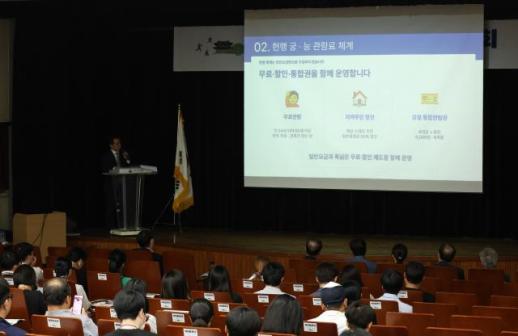 Public forum discusses admission fees for royal palaces and tombs in Seoul A public forum on admission fees for royal palaces and tombs is held at an annex of the National Palace Museum of Korea in Jongno-gu, Seoul, on the afternoon of Sep. 8, 2026. The forum was organized to discuss ways to ensure sustainable visitor services and improve the admission fee system for royal palaces and tombs. AJP Yoo Na-hyun 2026-09-08 16:22:43
 -
Korea's National Health Insurance to Evolve Beyond Treatment to Lifelong Care As South Korea approaches a super-aged society, the National Health Insurance is set to evolve from merely covering treatment costs to encompassing disease prevention and integrated care throughout a person's life. Kang Cheong-hee, the chairperson of the National Health Insurance Service, declared a 'Reboot Health Insurance' initiative, which signifies a fundamental redesign of the health insurance system, during a press conference marking her 50th day in office. On September 8, Kang held the press conference at a restaurant in Jongno, Seoul, where she outlined her vision for the future operation of the service. She announced three main objectives: shifting from a 'system-centered' approach to a 'citizen-centered' one, transforming the service into an 'AI-based health welfare platform,' and establishing a sustainable health insurance system through selective focus. Kang emphasized the need to transition the paradigm of health insurance to focus on 'citizen well-being.' Previously, health insurance, long-term care insurance, and community integrated care operated as separate systems. Moving forward, these will be interconnected around the life of each individual. “The key is to ensure that medical and nursing care are closely integrated in the field, allowing patients to receive continuous services in their own communities,” she explained. “If frailty is neglected, it incurs enormous social costs, including on health insurance finances, so we must shift the system towards prevention and management.” To achieve this, she identified the 'AI-based health welfare platform' as a crucial tool. Kang stated, “We will utilize the big data of the entire population to preemptively block diseases and create a system that provides necessary health management and care services to individuals at the right time.” This reflects her commitment to transforming the service from a mere insurance premium collection and payment agency into a comprehensive health welfare service platform. Kang also announced plans for significant expenditure restructuring to ensure the sustainability of health insurance finances. “We will reassess all projects from scratch, evaluating whether the benefits justify the financial input and whether they lead to tangible results for citizens,” she said. Regarding the legal cap on health insurance premiums (8%), she noted, “At this stage, we are not considering raising the legal limit. Instead of increasing premiums and burdening citizens, we will focus on reducing unnecessary expenditures and directing funds to essential areas.” Kang also addressed the introduction of special judicial police authority to crack down on illegal practices that drain health insurance finances, stating, “We will actively pursue this in collaboration with the Ministry of Health and Welfare, ensuring a safe treatment environment without infringing on human rights.” During the Q&A session, she provided candid responses to pressing issues both within and outside the service. When asked if reduced patient numbers due to conflicts with the medical community had led to decreased spending, Kang firmly stated, “Not at all. We have actually spent more on emergency care and essential medical support projects.” She emphasized, “If we stop investing just because patient numbers have decreased, essential medical services in the community will collapse. It is the role of health insurance to create an environment where hospitals can operate.” Kang expressed concern over the continuous freeze of health insurance premium rates, saying, “If we take a break now, we will have to raise them significantly later. Continuous freezes are not beneficial for the service.” She also commented on the ongoing tobacco lawsuit at the Supreme Court, stating, “Regardless of the outcome, the awareness raised about the harmful effects has been significant. If substances harmful to citizens are clearly proven, the service must actively pursue claims for damages.” Kang concluded the press conference by stating, “The success of policies is determined not by reports but in the field. I promise to listen to the voices of field experts and create tangible changes that citizens can feel, ensuring that 'Reboot Health Insurance' is not just a slogan.”* This article has been translated by AI. 2026-09-08 16:20:00
-
Bank Rates Rise While Savings Banks Cut Rates, Halving Deposit Rate Gap The gap in deposit interest rates between commercial banks and savings banks is rapidly narrowing. While commercial banks have been raising their deposit rates in response to increases in the benchmark and market interest rates, savings banks, which had been focused on securing deposits until last month, are now lowering rates due to a lack of suitable investment opportunities.According to the Korea Federation of Banks, the average interest rate for one-year time deposits at the five major banks (KB Kookmin, Shinhan, Hana, Woori, and NH Nonghyup) was 3.23% as of September 7, up 0.32 percentage points from 2.91% on July 15.In contrast, savings banks are experiencing a decline in deposit rates. The Korea Savings Bank Association reported that the average interest rate for one-year time deposits at 79 savings banks nationwide was 3.72% as of the previous day, down 0.21 percentage points during the same period. Some high-interest products that exceeded 4.5% last month have now dropped to around 4.00% to 4.05%.As a result, the interest rate gap between major commercial banks and savings banks has shrunk from 1.02 percentage points to 0.49 percentage points. Despite the Bank of Korea raising the benchmark interest rate twice, the deposit rates of the two sectors are moving in opposite directions.The differing rate strategies of the two sectors stem from variations in funding conditions. Commercial banks are raising time deposit rates to secure stable funding for lending amid rising market interest rates and increased costs of market-based funding, such as bank bonds. With financial authorities adjusting household loan management goals and promoting inclusive and productive finance, the demand for funds is also growing.On the other hand, savings banks are finding it difficult to engage in aggressive lending due to total loan management and the fallout from real estate project financing (PF) failures. Even if they attract deposits with high interest rates, they cannot effectively utilize these funds for loans, leading to increased interest cost burdens. For savings banks, which urgently need to manage soundness and profitability, there is little reason to maintain high-interest time deposits.Last month, the rapid increase in deposit rates by savings banks was more about securing temporary liquidity than a long-term deposit competition. As savings banks secured the necessary funds, they are now lowering rates to reduce the cost burden associated with additional funding, quickly narrowing the gap with commercial banks.Instead of lowering time deposit rates, savings banks are promoting demand deposit products, such as parking accounts with interest rates up to 7%, to prevent customer attrition. They attract customers with high rates while managing actual funding costs by segmenting the limits and preferential conditions for interest application.However, parking accounts can be withdrawn at any time, limiting their effectiveness as a stable funding source. If the benchmark interest rate rises further and competition for deposits intensifies in the financial sector, savings banks may face the dual challenge of needing to raise deposit rates again while managing funding costs.A savings bank official stated, “There are not many places to invest the secured funds, so the more we raise deposit rates, the greater the cost burden becomes. Balancing liquidity management and profitability defense will be the biggest challenge for the time being.”* This article has been translated by AI. 2026-09-08 16:20:00
-
 Samsung leans on ASML alliance as AI chip race heats up SEOUL, September 08 (AJP) - Samsung Electronics fighting on two fronts — SK hynix in advanced memory and Chinese rivals in legacy chips — is leaning on ASML's near-monopoly in cutting-edge lithography to keep its manufacturing edge in the AI race. The strategy goes beyond buying the industry's most advanced lithography machines. Samsung plans to bring High-NA EUV into advanced DRAM mass production by 2028 while joining an ASML-led effort to develop a new 12-inch photomask platform that could eventually replace the 6-inch format the semiconductor industry has relied on for decades. Together, the initiatives offer a glimpse into how Samsung is preparing its manufacturing technology for the next phase of semiconductor scaling across both memory and foundry operations. Samsung said Tuesday it is expanding its strategic partnership with Dutch chipmaking equipment giant ASML on High-NA extreme ultraviolet lithography and other next-generation semiconductor manufacturing technologies. Taking High-NA into DRAM High-NA EUV is the successor to the EUV lithography systems currently used to manufacture the world's most advanced chips. Lithography is one of the most critical steps in semiconductor manufacturing, using light to transfer microscopic circuit patterns from a photomask onto a silicon wafer. High-NA, short for high numerical aperture, improves EUV resolution, allowing chipmakers to print finer features as transistor and memory-cell dimensions continue to shrink. Samsung plans to introduce High-NA EUV into high-volume manufacturing of advanced DRAM by 2028, which the company says would be the industry's first such application in memory production. The technology could extend the DRAM scaling roadmap by enabling finer patterning while reducing reliance on increasingly complicated multi-patterning processes. Fewer process steps could simplify manufacturing and improve efficiency, although the economics will ultimately depend on yields, equipment productivity and production costs. High-NA carries particular significance for Samsung because it operates both major memory and foundry businesses. Unlike memory-focused manufacturers, Samsung could eventually deploy the technology across advanced DRAM as well as logic chips produced by its foundry division, giving it a broader manufacturing base on which to develop and validate the process. The push comes as competition over next-generation DRAM intensifies. Samsung has moved aggressively to introduce newer manufacturing processes into high-value memory, including sixth-generation 10-nanometer-class, or 1c, DRAM for its HBM4 products. As DRAM scaling becomes increasingly difficult beyond current generations, lithography is becoming another battleground in determining how far chipmakers can shrink memory cells while improving performance and power efficiency. SK hynix is moving on a similar timetable. The Samsung rival has also said it is targeting 2028 to apply High-NA EUV processes to DRAM mass production, underscoring how closely the next stage of the Korean memory race could be fought not only over HBM design and packaging but also over the manufacturing processes behind the chips. Beyond the machine Samsung and ASML are simultaneously looking further ahead at a less visible but potentially consequential component of semiconductor manufacturing: the photomask. Samsung will join ASML's Large Size Mask Consortium, an industry initiative developing a 12-inch photomask platform for High-NA EUV. Photomasks act as highly precise templates containing the circuit patterns that lithography systems transfer onto wafers. The semiconductor industry has relied on the 6-inch photomask format for decades. High-NA EUV, however, introduces a new constraint. While the technology can print finer features than conventional EUV, its current configuration has a smaller exposure field. Large and complex chips can therefore require patterns to be exposed separately and then connected through a process known as stitching. A larger mask platform is designed to ease that limitation. Samsung said moving to 12-inch masks could reduce stitching constraints, improve fab productivity and lower chipmaking costs, allowing manufacturers to capture more of the resolution advantage offered by High-NA EUV. ASML is working with major semiconductor companies including Samsung, TSMC, Intel and Nvidia on the larger-mask initiative as the industry prepares High-NA EUV for broader use in advanced manufacturing. SK hynix has also said it is evaluating participation in the consortium. The project highlights a broader shift in the semiconductor race. As scaling becomes harder and more expensive, simply owning the newest lithography machine may no longer be enough. The surrounding infrastructure — masks, process technology, productivity, yields and the ability to integrate them into mass production — increasingly determines whether an advanced manufacturing technology is economically viable. ASML expects larger masks eventually to allow High-NA systems to manufacture chips comparable in size to those made with today's EUV equipment while improving system productivity. The Dutch company plans to demonstrate a pilot line using the larger masks around 2031, with the technology targeted to be ready for high-volume manufacturing by 2033. The longer timeline separates the 12-inch mask project from Samsung's nearer-term plan to introduce High-NA EUV into DRAM production in 2028. Yet the two efforts point in the same direction: building the manufacturing infrastructure needed to keep semiconductor scaling moving as conventional approaches become increasingly complex and costly. "The AI era is transforming the semiconductor industry and increasing the importance of technological innovation across the entire value chain," Samsung Electronics Vice Chairman and CEO Jun Young-hyun said. "By further strengthening our collaboration with ASML, we are helping lay the foundation for the next generation of AI and semiconductor innovation," he added. ASML CEO Christophe Fouquet described Samsung as one of the Dutch company's most important long-standing innovation partners. "As the industry enters a new era driven by artificial intelligence, close collaboration with our customers becomes even more important," Fouquet said. For Samsung, the High-NA roadmap represents more than the adoption of another expensive piece of equipment. The semiconductor race is increasingly shifting from who can design the fastest chip to who can assemble the manufacturing ecosystem capable of producing ever-smaller and more complex chips economically and at scale. Samsung's bet is that High-NA EUV — first in advanced DRAM and eventually supported by a new generation of larger photomasks — can help anchor that next manufacturing era. Samsung Electronics shares closed 2.96 percent higher at 278,000 won on Tuesday after gaining 5.68 percent in the previous session. AJP Takeaways - Samsung Electronics plans to introduce High-NA EUV into advanced DRAM mass production by 2028, a move it says would mark the industry's first such application in memory manufacturing. - Samsung is also joining an ASML-led initiative to develop 12-inch photomasks, aimed at overcoming stitching constraints and improving productivity as chipmakers push High-NA EUV into more advanced production. - The two initiatives highlight Samsung's broader strategy of using its presence in both memory and foundry to build a manufacturing ecosystem around next-generation lithography, as competition with SK hynix and Chinese chipmakers intensifies. 2026-09-08 16:18:12