SEOUL, November 19 (AJP) - South Korean police launched a search Thursday for Lee Jin-woo, 32, who reportedly achieved a perfect score on the Law Education Eligibility Test (LEET), after concerns were raised over his safety amid allegations of exam cheating, according to police and fire authorities. Lee failed to appear for a scheduled public verification of his academic abilities earlier in the day. Police initially searched Seoul's Gwangjin district before expanding their search to Songpa after tracing his movements by taxi. The case has also been assigned to a specialized police investigation unit following criminal complaints over suspected cheating on national examinations. Tags: South Korea, LEET, Lee Jin-woo, Police, Missing Person, Exam Cheating
SEOUL, November 19 (AJP) - Operating profits at KOSPI-listed companies surged 264.39 percent from a year earlier to 638.28 trillion won (about US$434.2 billion) in the first three quarters of the year, largely driven by strong performances from memory chip giants Samsung Electronics and SK hynix, according to data from the Korea Exchange on Thursday. Earnings also improved among other KOSPI-listed companies, with combined operating profit excluding Samsung Electronics and SK hynix rising 63.94 percent to 202.63 trillion won. Revenue increased 14.35 percent, while net profit climbed 94.86 percent. Despite improved earnings, the number of profitable companies edged down. Of the 635 KOSPI-listed companies analyzed, 492 posted a net profit in the first three quarters, down from 498 a year earlier. Electronics and electrical equipment companies on the junior KOSDAQ also posted strong earnings, with cumulative operating profit jumping 197.31 percent to 2.60 trillion won. The number of profitable companies edged up to 711 from 706 a year earlier. Tags: Korea Exchange, KOSPI, KOSDAQ, Samsung Electronics, SK hynix, stock market
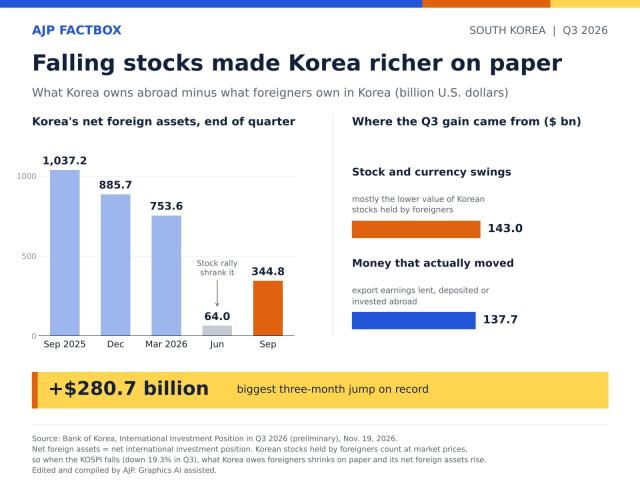
SEOUL, November 19 (AJP) -South Korea's net overseas financial assets rose by a record $280.7 billion in the third quarter, as robust exports boosted holdings abroad while a stock market slump sharply reduced the value of foreign investments in Korea. The country's net international investment position, which measures the value of financial assets owned by Korean residents abroad minus those held by foreigners in Korea, stretched to $344.8 billion at the end of September from $64.0 billion three months earlier, according to the Bank of Korea on Thursday. Overseas financial assets rose $137.9 billion to $3.22 trillion, supported by export earnings and increased purchases of foreign securities. Meanwhile, foreign holdings in Korea shrank $142.9 billion to $2.88 trillion, largely reflecting the KOSPI's 19.3 percent decline. Of the record net gain, $143.0 billion came from market valuation and exchange-rate changes, while $137.7 billion reflected actual transactions. Korea's external financial resilience also improved, with net external debt assets rising to $416.8 billion and the ratio of short-term external debt to foreign reserves falling to 42.9 percent. The headline rebound, however, remains vulnerable to stock market swings, with net overseas assets still well below the $1.04 trillion recorded a year earlier. The value of foreign-held Korean stocks dropped $188.8 billion as the KOSPI fell 19.3 percent during the quarter, with price changes accounting for $180.5 billion of the decline. Foreign investors' net selling of Korean stocks eased to $8.2 billion from $63.9 billion in the second quarter. Price and exchange-rate changes accounted for $143.0 billion of the rise in the net position, according to the BOK. The remaining $137.7 billion came from actual transactions, much of it tied to Korea's export boom. Korea's investment abroad rose $137.9 billion to $3.22 trillion. Loans extended overseas rose $16.9 billion, trade credit $14.8 billion and deposits held abroad $13.9 billion, which the central bank attributed to strong exports. Residents also stepped up purchases of overseas stocks to $32.4 billion from $21.0 billion and turned net buyers of foreign bonds. Korea's exports are on track to top $1 trillion this year for the first time, with January-October shipments up 60.6 percent from a year earlier to $930 billion. Net external assets in debt instruments, which exclude stocks and other equity, rose a record $49.0 billion to $416.8 billion, the highest since the first quarter of 2022. The ratio of short-term external debt to reserve assets fell 3.5 percentage points to 42.9 percent, as short-term borrowing and won deposits at local brokerages declined while reserves grew. Short-term debt's share of total external debt fell 1.7 percentage points to 22.8 percent. The rebound reversed part of a second-quarter plunge, when a stock rally pushed the net position down from $753.6 billion at the end of March. The figure remains about a third of the $1.04 trillion recorded a year earlier. The lower short-term debt ratio, a gauge of Korea's ability to meet near-term foreign obligations, gives the country more room to absorb capital outflows if market turbulence returns.
Oh Se-hoon, the mayor of Seoul, criticized President Lee Jae-myung on November 19 after the enactment of the 'Special Counsel Law' that allows the president to appoint a special counsel to investigate related cases. Mayor Oh estimated the cost of seven special counsels launched or to be launched under the current administration at 110 billion won (KRW) and demanded that President Lee clarify how he will take responsibility if these special counsels fail to deliver results. In a Facebook post on the morning of the enactment, which coincided with the national college entrance exam day, he likened the special counsel law to a test. He stated, "It’s like a student choosing someone to grade their own exam papers." He also pointed out that six out of the twelve investigation items target incidents related to President Lee. Mayor Oh raised concerns about the investigations and prosecutions of existing special counsels. He noted that Daegu Mayor Hong Joon-pyo, who was sentenced to 20 years in prison by the insurrection special counsel, was acquitted in the first trial the previous day, and eight former soldiers indicted on charges related to martial law were also found not guilty in last month’s first trial. He remarked that this could be considered a failing grade in an exam. The special counsel law enacted today aims to clarify whether there was manipulation in the investigation and prosecution processes of national agencies during the Yoon Suk Yeol administration. The Democratic Party, People Power Party, and Rebuilding Korea Party each recommend a candidate, from which the president appoints one. As the investigation and prosecution processes related to incidents involving the president, such as the Daejang-dong development and the remittance to North Korea by Ssangbangwool, are included in the scope of investigation, how to secure the independence of the special counsel from the president, who exercises the final appointment power, is a key issue. Mayor Oh referenced President Lee's self-description as 'the greatest servant of the Republic of Korea' and stated, "If this special counsel ends up empty-handed, how will you take responsibility? Please clarify this to the public first."* This article has been translated by AI.
The first session of the 2027 College Scholastic Ability Test (CSAT) for the Korean language section was analyzed to be somewhat easier than last year's exam and the mock evaluation held in September. With familiar topics and a high perceived connection to EBS, students experienced reduced reading and time pressure, while some high-difficulty questions that required synthesizing information to establish logical connections provided a level of discrimination. On November 19, the CSAT administration stated regarding the Korean language section's direction, "We aimed to measure the Korean language skills necessary for college study based on the 2015 revised Korean curriculum. We did not limit the topics to specific fields but instead included educationally valuable materials, focusing on questions that could be solved using inferential, critical, and creative thinking." In the common subject reading section (17 questions), the topics included: ▲ Digital documents and critical reading (questions 1-3; reading theory) ▲ Various perceptions of Buddhism during the Joseon Dynasty (questions 4-9; integrated humanities topics) ▲ Virtual memory (questions 10-13; science and technology) ▲ Legal responsibilities regarding factual and opinion expressions (questions 14-17; society). In the literature section (17 questions), works included the anonymous classic novel "Changseon Gamuirok" (questions 18-21), Yun Dong-ju's "Confession," Heo Man-ha's "In Front of the Fish Restaurant," and Kim So-yeon's essay "Glass and Mirror" as a mixed genre (questions 22-26), Kim Chae-won's modern novel "Spring's Illusion" (questions 27-30), and classical poetry combining Yeon-an Lee's "Buyeo Nojeonggi" with the works of Song Jong-won and Kim Chung-seon (questions 31-34). The EBS field teacher group provided an overall assessment stating that this year's Korean section was easier than both last year's CSAT and the September mock exam. The amount of information in the passages was appropriate and clearly presented, eliminating advantages or disadvantages based on background knowledge. With 24 out of 45 questions (a connection rate of 53.3%) linked to EBS CSAT preparation materials, it is analyzed that students likely felt a significantly high connection. EBS identified key questions with discrimination, including: ▲ Reading question 12, applying the process of program execution in computer operating systems and TLB number pair replacement to a case study; ▲ Reading question 17, distinguishing between criminal and civil legal responsibilities for defamation and insult; ▲ Modern novel question 30, requiring understanding of character consciousness changes and inner psychology; ▲ Speaking and writing question 40, analyzing dialogue context and ecological exploration reports; ▲ Language and media question 37, precisely analyzing sentence components and embedded clauses. The admissions industry also agreed that the overall perceived difficulty has decreased compared to last year, while noting the relative advantages and disadvantages of each elective subject and the discrimination of high-difficulty questions. Im Seong-ho, head of Jongno Academy, analyzed, "While the overall perceived difficulty has decreased slightly compared to last year's CSAT, the elective subject 'Language and Media' was relatively more difficult than 'Speaking and Writing.' Students tend to solve elective subjects first, so those who chose Language and Media (with a participation rate of 25.3%) likely felt a similar level of pressure as last year from the beginning of the exam." Im identified the highest difficulty questions as reading question 17 (legal passage) and question 8 (integrated humanities topic), as well as language and media question 37. Kim Byeong-jin, head of the Education Assessment Research Institute at Etoos, stated, "Although the reading connection rate is high, students may have struggled with questions utilizing case studies like 12 and 17, as well as critical thinking processes in question 6. In literature, the approach to modern novel question 30, which is not connected to EBS, was challenging, and there were 1-2 discriminative questions placed in each elective subject." Kim Won-jung, head of the Admissions Strategy Office at Daesung Academy, remarked, "It was slightly easier than last year's CSAT and similar in difficulty to the September mock exam. The information density of the reading passages was relatively high, but deriving the correct answers was comparatively clear, so unless students solved literature and reading last, the issue of time shortage would have significantly decreased." However, Kim noted, "The interpretation questions for non-linked works in the mixed genre literature, such as questions 23 and 26, and the grammar set question 36 had a high perceived difficulty, so the gap in perception likely varied greatly depending on the thoroughness of EBS-linked study."* This article has been translated by AI.
The Korea PR Association will hold its fall conference on the 20th under the theme 'Connecting People through PR: Trust, Solidarity, and Community Values.'In celebration of its 30th anniversary, the association plans to discuss the direction and role of PR in the age of digital technology and generative AI, seeking practical solutions from both academia and industry.The conference will feature a total of 18 research presentations and discussions across 9 sessions, including 7 research group sessions and 2 special sessions. The research group sessions will address key issues in PR during the AI era, such as consumer behavior in AI cover song fandoms and communication strategies during crises caused by humans and AI.The special sessions will include a presentation on the achievements of prototype technology development for digital therapeutics (DTX) by the Health Communication Research Institute and Anchor Project Team of Cha University. Discussions will also cover discourse analysis connecting Korea and BTS, as well as models of digital public diplomacy.On the same morning, the finals of the '1st Generation Empathy PR Idea Contest' will take place. This contest, themed 'A Journey Opened by Our Perspectives,' solicited PR videos aimed at fostering empathy and support for barrier-free travel. Seven teams have advanced to the finals, and the final rankings will be determined by combining public votes via the official Instagram of the Korea Tourism Organization and scores from on-site presentations.The convention hall will also host the '2026 Young Community Leaders Insight Camp,' where PR clubs from 20 universities nationwide will share their project outcomes. Participating students will present projects they conducted with mentors from 61 organizations, showcasing cases where PR has addressed community and everyday issues, such as revitalizing local businesses and urban branding.Jang Jeong-heon, President of the Korea PR Association, stated, "As we celebrate our 30th anniversary, we want to re-examine the roles and directions that PR should pursue, centered on trust, solidarity, and community values. I hope this conference will serve as a turning point in opening a new horizon for connecting people through PR."* This article has been translated by AI.
SEOUL, November 19 (AJP) -South Korea's first nationwide emergency alert aimed at preventing exam cheating exposed 22 undeclared smartphones across nine cities and provinces Thursday as students sat the country's high-stakes college entrance exam. The 10.5-second alarm sounded on all powered-on mobile phones at 8:30 a.m. ahead of the College Scholastic Ability Test (CSAT). The unprecedented measure came amid growing fears of AI-assisted cheating using smartphones, miniature cameras and other concealed devices. Education Vice Minister Choi Eun-ok said no use of sophisticated cheating devices beyond smartphones had been reported and the alert caused no delays to the exam. Authorities plan to send additional surprise alerts during the exam to catch phones switched on after the initial warning. The 22 students face further inspections for concealed devices, with criminal complaints possible if sophisticated cheating is established. The government also distributed stickers to cover clothing buttons as part of its expanded anti-cheating safeguards.
In the third quarter of this year, South Korea's external financial assets increased by over $280.7 billion, marking the largest increase on record. This surge was influenced by a significant drop in domestic stock prices, which reduced the value of stocks held by foreign investors.According to the Bank of Korea's 'Third Quarter International Investment Position (Preliminary)' report released on November 19, as of the end of September, external financial assets totaled $344.8 billion, an increase of $280.7 billion from the end of the previous quarter ($64 billion). This quarterly increase is the largest since statistics began being compiled.External financial assets represent the difference between the financial assets held by South Korean individuals and companies abroad and the financial assets held by foreigners in South Korea. In the second quarter, external financial assets saw a record decline due to a surge in the domestic stock market, but in the third quarter, the drop in stock prices contributed to an increase in external financial assets.External financial assets rose to $3.2221 trillion, an increase of $137.9 billion from the previous quarter, marking the fourth-largest increase on record. Residents' overseas securities investments increased by $40.1 billion, and other investments rose by $40.8 billion.The increase in overseas securities investments was influenced by a rise in net stock purchases from $21 billion to $32.4 billion, while bond investments shifted from a net sell of $3 billion to a net buy of $14.4 billion. Thanks to strong exports, loans ($16.9 billion), trade credits ($14.8 billion), and overseas deposits ($13.9 billion) also increased.In contrast, foreign financial liabilities, which correspond to foreign investment in South Korea, decreased by $142.9 billion to $2.8774 trillion from the previous quarter, marking the largest decline on record.Notably, foreign investment in domestic securities fell by $164.3 billion. The KOSPI index dropped by 19.3% in the third quarter, significantly reducing the value of domestic equity securities held by foreigners by $180.5 billion. However, the net selling of domestic stocks by foreigners decreased from $63.9 billion in the second quarter to $8.2 billion in the third quarter.Moon Sang-yoon, head of the Bank of Korea's Overseas Investment Statistics Team, stated, "The decline in foreign financial liabilities was primarily influenced by the drop in domestic stock prices," adding that "the net selling of stocks by foreigners did not have a significant impact."The net external assets, calculated by subtracting external liabilities from external claims, reached $416.8 billion, an increase of $49 billion from the previous quarter. This increase is the largest on record, and the balance is the highest since the first quarter of 2022.External claims rose to $1.2473 trillion, an increase of $66.7 billion from the previous quarter. In contrast, external liabilities increased by $17.7 billion to $830.6 billion. Long-term external debt increased by $27.2 billion, while short-term external debt decreased by $9.5 billion.As a result, the ratio of short-term external debt to reserve assets fell to 42.9%, a decrease of 3.5 percentage points from the previous quarter. The proportion of short-term external debt in total external liabilities also decreased by 1.7 percentage points to 22.8%.Moon noted that the recent fluctuations in domestic stock prices have significantly impacted external financial assets, stating, "While it still holds significance as an indicator of external soundness, it is necessary to evaluate soundness by examining the causes of increases and decreases."Looking ahead to the fourth quarter, he predicted that external financial assets would continue to grow, while there is a slightly higher possibility that external financial liabilities may decrease further, although it is important to monitor potential significant changes in stock prices and exchange rates during the remaining period.* This article has been translated by AI.