


Latest by
-
 Burger King's First Flagship Store Opens in Seongsu with Unique Dining Experience About a 10-minute walk from Seongsu Station, a red-brick building emerges, its purpose not immediately clear due to the lack of signage. However, upon opening the iron door, the atmosphere transforms. Flickering red lights and a light haze fill the long corridor, creating an unfamiliar scene reminiscent of stepping into a giant patty cooker.The space at the end of the corridor resembles a gallery more than a fast-food restaurant. Throughout the area, artworks inspired by fire, heat, and charcoal are displayed, making it the world’s first flagship store, 'Flame Ground by Burger King,' located in Seongsu, Seoul.On August 26, Burger King held a media briefing at Flame Ground, unveiling the store ahead of its official opening next month. Flame Ground expands Burger King's commitment to flame-grilling and the identity of the Whopper into its space, menu, and dining experience. The name combines 'Flame,' representing fire, and 'Ground,' signifying space, to convey a world and stage for experiencing Burger King's signature grilled flavor.Lee Dong-hyung, CEO of BK Korea, stated, “We have pondered how to perfectly convey our 43 years of dedication to burgers to our customers. Flame Ground is our most ambitious declaration and gesture to showcase Burger King's unique worldview.”This year, Burger King expects domestic sales to reach approximately 1.1 trillion won, with the number of locations surpassing 600. With a nationwide network, the company aims to present a new brand image through differentiated menus and content.Lee Seong-ha, Burger King's CMO, explained, “Once sales exceed 1 trillion won and we reach 600 locations, relying solely on common marketing across all stores limits our ability to showcase something new. We believe a two-track strategy is necessary: providing novelty in regular stores while offering unique branding activities and experiences at Flame Ground.”Choosing Seongsu as the location for its first flagship store is also tied to the brand's identity. Once an industrial area, Seongsu was home to factories that worked with iron and fire. Burger King sees the remaining red bricks and factory remnants as aligning with its brand image emphasizing fire and grilling. The area is also known for fostering new trends with various fashion and food and beverage brands.Indeed, Burger King has infused the concept of grilled flavor throughout the space. Collaborating with five emerging domestic artists, the movements of the broiler, a key piece of equipment for grilling patties, and the energy of grilling, charcoal, and heat have been reinterpreted into artworks. Elements like red bricks, metal, lighting, and charred wood are designed to evoke fire and grilling.Exclusive menu items available only at Flame Ground include the 'K-Cube Galbi Burger,' 'Memphis BBQ Burger,' and 'Philly Cheesesteak.' The K-Cube Galbi Burger features a flame-grilled Whopper patty topped with cube galbi, while the Memphis BBQ Burger combines the grilled patty with bacon and grilled onions. The Philly Cheesesteak uses thinly sliced ribeye beef instead of a patty.Inside, a secret dining room with ten seats offers the burger industry’s first course dining experience, 'The Gastro.' Burger King reinterprets its signature Whopper not as a complete burger but as individual components, allowing diners to experience the inherent flavors and roles of ingredients like vegetables, pickles, grilled patties, and buns as the stars of each course. The entire course incorporates Burger King's long-standing flame-grilling method and the heritage of the Whopper, allowing customers to enjoy a familiar burger in a new way.Choi Young-jin, head of Burger King's Product Innovation Center, explained, “Each course showcases different ingredient flavors, but ultimately they connect back to one Whopper. It’s not about creating a completely different Whopper but experiencing the same Whopper from a different perspective.”The Gastro will operate its first season featuring the reinterpreted Whopper course, with plans to explore other brand assets in new ways afterward. The course is priced at 89,000 won per person and operates on a reservation basis. Reservations for the following month will be accepted on the first of each month through Catch Table. Flame Ground is set to officially open on September 10.* This article has been translated by AI. 2026-08-26 17:24:00
 -
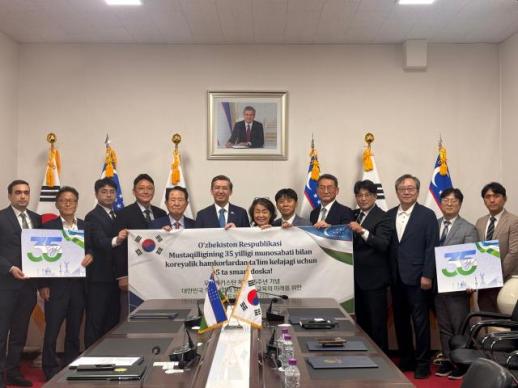 South Korean firms support Uzbek schools with 35 smartboards SEOUL, August 26 (AJP) - Eleven South Korean companies have funded 35 smartboards for schools and vocational institutions across Uzbekistan, as part of an initiative marking the 35th anniversary of the country’s independence. The Embassy of the Republic of Uzbekistan in the Republic of Korea held an appreciation ceremony Wednesday afternoon for 11 Korean companies that helped finance the project, organized ahead of the 35th anniversary of Uzbekistan's independence on Sept. 1. Alisher Abdusalomov, Uzbekistan's ambassador to South Korea, said the interactive smartboards, manufactured by South Korean education technology company AHA, will be distributed to schools and vocational education institutions throughout Uzbekistan. "The advanced interactive smartboards manufactured by AHA will make a significant practical contribution to the digital transformation of education in Uzbekistan," he said. "This equipment will be delivered to schools and vocational education institutions across all regions of the country, giving thousands of young people access to modern technology and new opportunities for learning,” Abdusalomov said. The ambassador said supporting younger generations has long been a top priority for the country. “Education provides a strong foundation for the future, and investment in young people yields the most valuable and lasting results,” he said. The ambassador also pointed to broader changes in Uzbekistan over the past decade, including economic modernization, greater openness to the world and broader social development. The 35 smartboards were funded by 11 Korean companies, including BOMI Engineering & Construction, Shindong Resources, Hansae Mobility, Youngone Corporation, Hyundai Rotem, Edulink Global, DK Consultants, Shield Consulting, Sungshin L&P, Hana Global and UzAuto Korea. AHA, which manufactured the smartboards, supported the project separately by offering the equipment at a 50 percent discount and assisting with logistics and delivery to Uzbekistan. Abdusalomov expressed special appreciation to the company for helping reduce the cost of the equipment and supporting its delivery. He described the support as "a remarkable example of strong corporate social responsibility and genuine partnership." The ambassador said the project also carried broader significance for relations between the two countries. "Your contribution is more than a noble gesture marking the anniversary of Uzbekistan's independence," Abdusalomov told participating companies. "It represents meaningful and practical support for the country's younger generation and makes a valuable contribution to strengthening the bonds of friendship and strategic cooperation between Uzbekistan and the Republic of Korea." The project also reflects the expanding role of Korean companies in Uzbekistan in education and social projects alongside broader economic cooperation between the two countries. AJP Takeaways • Eleven South Korean companies funded 35 smartboards for schools and vocational education institutions across Uzbekistan as part of an education project marking the 35th anniversary of Uzbekistan’s independence on Sept. 1, 2026. • South Korean education technology company AHA manufactured the 35 smartboards and separately supported the project by providing a 50 percent discount and assisting with logistics and delivery to Uzbekistan. • Uzbekistan’s Ambassador to South Korea Alisher Abdusalomov said the smartboard project will support the digital transformation of education, expand learning opportunities for young people and strengthen strategic cooperation between Uzbekistan and South Korea. 2026-08-26 17:22:37
 -
Government Selects Regional Growth Engines for Industrial Development The government has selected regional "growth engines" as part of its initiative to foster industrial development. It plans to identify 3 to 4 growth engines per region, linking local strengths with large-scale corporate investments. This strategy aims to transform local areas into hubs of industrial innovation by combining a seven-part support package with mega-special zones.On August 26, the Ministry of Trade, Industry and Energy announced this plan during the 10th Central-Local Cooperation Meeting, chaired by President Lee Jae-myung at the Blue House.Since September of last year, the ministry has been gathering demand from local governments and has held over 100 consultations to select these growth engines. Feedback was collected from more than 600 companies and regional experts, with selection criteria including corporate investment, regional strengths, growth potential, and alignment with national strategies.In the central region, the growth engines will focus on next-generation displays and semiconductors, high-value-added biopharmaceuticals and materials, advanced batteries, and future defense and transportation systems. The goal is to develop the central region into a "global hub for advanced strategic industries" by leveraging existing high-tech industrial foundations and research and development capabilities.The southwestern region will focus on future power systems, advanced semiconductor manufacturing, AI autonomous driving, next-generation vaccines, and precision medicine. This area aims to create a "renewable energy-based semiconductor and AI cluster" by combining abundant renewable energy resources with significant semiconductor investments.The Daegu-Gyeongbuk region will develop advanced materials and components for semiconductors, key materials for secondary batteries, advanced mobility components, and AI robotics, positioning itself as a "center for advanced materials, components, and AI robotics." The southeastern region will establish a "super-gap manufacturing AI hub belt" centered on advanced shipbuilding and shipping, aerospace and defense, innovative manufacturing for future mobility, and next-generation nuclear power and energy.In Jeonbuk, the growth engines will include a green hydrogen platform, advanced robotics foundry, and agricultural biotechnology. This initiative aims to integrate hydrogen and robotics investments with renewable energy and agricultural biotechnology to create a platform for next-generation life and physical AI manufacturing industries.Gangwon will focus on smart bio and medical devices, specialty semiconductors and ceramics, and clean resources and tourism, while Jeju will concentrate on renewable energy convergence systems, small satellite systems, and clean bio wellness industries. AI will be applied as a common foundational technology across all regions and industries.To connect these growth engines to local industrial ecosystems, the government will implement a seven-part support package consisting of financial, fiscal, regulatory, technological, talent, and infrastructure support. A new "growth engine special subsidy" will be established for large-scale local investments, and sufficient financing will be provided through the National Growth Fund and region-specific funds to support corporate investment and growth.R&D costs and integrated investment and domestic production tax credits will apply regional coefficients, allowing for additional deductions of up to 50%. The government will also significantly ease corporate investment regulations and provide one-on-one support for regional investment challenges. Large-scale R&D projects initiated by local anchor companies and their partners will also be established.To cultivate talent, the government plans to support local national universities, industry-academia convergence districts, and specialized graduate schools to directly train skilled professionals in the regions. Industrial hubs such as corporate advanced cities, RE100 industrial complexes, and manufacturing AI transition clusters will be developed. Timely supply of electricity and water will also be ensured to enhance competitive industrial locations.President Lee Jae-myung stated, "Balanced development is not a choice or a privilege, but a necessary strategy for the survival and sustainable growth of South Korea." He emphasized the commitment to fostering industries and jobs centered around the five poles and three special zones while also improving living conditions related to housing, education, and welfare. 2026-08-26 17:20:20
-
South Korea and Vietnam Strengthen Strategic Cooperation in Trade and Investment South Korea and Vietnam are enhancing their strategic cooperation, focusing on advanced industries, critical mineral supply chains, and energy. The two countries aim to shift the focus of their collaboration, based on the Korea-Vietnam Free Trade Agreement (FTA), towards high-value and future industries, with a goal of achieving $150 billion in trade by 2030.The Ministry of Trade, Industry and Energy announced that Minister Kim Jeong-kwan held the 15th Korea-Vietnam Joint Industrial Committee and the 9th Korea-Vietnam FTA Joint Committee on August 26 at the Lotte Hotel in Seoul, alongside Vietnam's Minister of Industry and Trade, Le Minh Khai.Both nations agreed to translate the cooperation tasks discussed during two summits since the current government took office into concrete outcomes in trade, investment, industrial technology, and energy security. They also reviewed the results discussed in the subcommittees on trade, industrial technology, and energy resources under the Joint Industrial Committee and the implementation body of the FTA Joint Committee.Since the Korea-Vietnam FTA took effect in December 2015, trade between the two countries has increased by an average of about 10% annually. Last year, trade reached $94.6 billion, and in the first half of this year, it recorded $62.4 billion. The Ministry anticipates that if this trend continues, annual trade will exceed $100 billion for the first time this year.Investment cooperation is also expanding. As of June this year, South Korea's cumulative investment in Vietnam reached $102.4 billion, making it the largest investor in the country. Investment in the first half of this year was $8 billion, a 160% increase compared to the same period last year. The investment sectors are broadening to include high-value manufacturing in electronics, semiconductors, advanced materials, and chemicals.In response, both countries agreed to support the recruitment of personnel for South Korean manufacturing companies operating in Vietnam. They will also promote a 'technology sharing model' to transfer technology from local South Korean conglomerates to Vietnamese partner companies. Discussions will also include expanding incentives for South Korean automotive companies operating in Vietnam and standardizing quality.In the critical mineral supply chain sector, administrative procedures are underway to expedite the construction of a critical mineral supply chain technology center. The Vietnamese government will assist in resolving investment challenges faced by South Korean companies, such as permitting for rare earth metal manufacturing plants.In the energy sector, the two countries will pursue long-term resource supply chain cooperation, including joint oil stockpiling and emergency response systems. They will support the smooth implementation of liquefied natural gas (LNG) power projects in Vietnam and strengthen policy cooperation in power grids, nuclear energy, and renewable energy.During the FTA Joint Committee meeting, they discussed improving unnecessary duplicate testing regulations related to lithium-ion batteries and export quarantine cooperation for processed chicken and pork. They also agreed to share information on the current status of import regulations, organizations, laws, and systems to enhance cooperation in trade remedies.Minister Kim stated, "As Vietnam actively promotes attracting investment, introducing advanced technology, localizing industries, and pursuing green and digital transitions, we will expand the scope of trade and investment into future-oriented areas. We will enhance cooperation in cultivating advanced ecosystems and industrial technology talent, as well as strengthen collaboration in critical mineral supply chains and energy security." 2026-08-26 17:20:00
-
 Jeju deaths cast shadow over Korea police power shift SEOUL, August 26 (AJP) - Jeju, long known as South Korea's favorite resort island, has lately been making headlines for grimmer reasons: missing-person cases ending in death, abandoned searches and allegations of police misconduct. The string of cases has turned a local policing scandal into a broader reckoning over whether South Korea's already powerful police force is ready to take on even greater investigative authority. With the country set to abolish its current prosecution service on Oct. 2, repeated cases of botched police investigations and alleged manipulation of official records are sharpening concerns over who will keep police power in check once prosecutors lose their supplementary investigation authority. At the center of the latest controversy is the case of 37-year-old Jang Mi-ran, who disappeared on Jeju in May. A police officer allegedly closed her missing-person case just hours after it was reported, claiming to have contacted Jang and saying she did not want her location disclosed to her boyfriend. Investigators later found no record of such a call. The officer also entered "death in a traffic accident" as the reason for closing the case in a police database, effectively removing Jang from the list of people being actively sought. Jang was later found dead. Authorities are investigating whether the false entry was intended to conceal the mishandling of the case. The officer was arrested Tuesday on charges including dereliction of duty. The case became still more troubling after police failed to preserve a recording of the initial emergency call. The recording was automatically deleted after its three-month retention period expired, even though the officer had already been booked five days earlier, raising questions over why potentially important evidence was not secured. Jeju's missing-person cases have landed at an especially sensitive moment for South Korea's criminal justice system. The current prosecution service is due to disappear on Oct. 2 as part of President Lee Jae Myung's prosecution reform drive. Prosecutors will also lose the power to conduct supplementary investigations themselves, leaving them to request further police investigation when they find shortcomings in cases sent for indictment. The change has revived a long-running debate over whether stripping prosecutors of investigative authority will curb abuses by an institution once criticized for wielding excessive power or simply shift too much authority to the police. President Lee himself acknowledged the danger Tuesday. He said problems involving lax police discipline and irresponsibility in public safety had become "serious" and warned that the police could soon wield the greatest power among state agencies. Lee called for a new government body to oversee police reform, arguing that greater authority must come with greater accountability. The opposition People Power Party (PPP) seized on the Jeju case to renew its attack on the ruling Democratic Party's decision to eliminate prosecutors' supplementary investigation authority. "Even with supplementary investigation authority still in place, police have carried out botched investigations into missing-person cases and filed false reports. I am concerned that such problems will become even more serious once prosecutors lose their supplementary investigation authority and can no longer keep the police in check," said Rep. Yoo Sang-bum, a former chief prosecutor. Rep. Kang Myoung-gu, the PPP secretary on the National Assembly's Public Administration and Security Committee, called the Jeju case "a collapse of Korea's investigative system." "The police have exposed systemic failures and continue to lose public trust. No matter how much the police try to reform themselves internally, such reforms will have little practical effect without an external system of checks and balances," Kang said. He said he would scrutinize the issue during the upcoming parliamentary audit and called for the abolition of prosecutors' supplementary investigation authority to be reconsidered "from the ground up." Rep. Jin Jong-oh, another member of the committee, accused the Democratic Party of trying to repair a problem created by its own prosecution reform. "The Democratic Party, which pushed through the abolition of prosecutors' supplementary investigation authority, is now engaging in a self-defeating farce by setting up a task force to improve police investigations," Jin said. "I condemn the Democratic Party for its hasty policymaking, the consequences of which will ultimately be borne entirely by the public," he added. The ruling party argues that the answer lies not in preserving prosecutors' old powers but in building stronger checks on police. Rep. Kim Young-bae of the Democratic Party, also a member of the committee, said the Jeju case should be treated as a systemic failure rather than the misconduct of a single officer. "The Jeju case is not merely a matter of individual misconduct but a problem with the system for handling missing-person cases, and it must be addressed promptly," Kim said. "We are aware of public concerns that prosecution reform could lead to an excessive concentration of power in the police," he said. "As the president has also called for police reform, we will use the upcoming parliamentary audit to closely examine shortcomings in Korea's criminal justice system and work to address them." The Jeju cases have therefore opened a difficult second front in South Korea's prosecution reform. The government set out to dismantle a prosecution system long accused of concentrating too much investigative and prosecutorial power in one institution. The deaths and alleged failures on Jeju are now forcing policymakers to confront the other side of that reform - how to prevent the concentration of power from simply moving elsewhere. The public-security fallout is adding to worsening sentiment toward the government. Lee's approval rating fell below 40 percent for the first time since he took office in June last year, with a Jowon C&I poll released Wednesday putting support at 38.9 percent and disapproval at 57.9 percent, underscoring the political stakes as concerns grow over police accountability and the government's criminal-justice overhaul. AJP Takeaways Jeju missing-person cases ending in deaths and allegations of falsified police records are intensifying scrutiny of South Korea's police ahead of a major redistribution of investigative power. South Korea will abolish its current prosecution service on Oct. 2, while prosecutors will lose supplementary investigation authority and become more dependent on police to correct shortcomings in criminal investigations. President Lee Jae Myung has warned that police could become the country's most powerful state agency and called for a new police reform body as concerns grow over accountability and oversight. 2026-08-26 17:19:30
 -
Justice Minister Jeong Seong-ho: New Criminal Justice System Must Prioritize Public Safety Jeong Seong-ho, the Minister of Justice, stated that the new criminal justice system, which will include the launch of the Public Prosecution Service and the Serious Crimes Investigation Agency in October, must ensure that public safety is not compromised.During his farewell speech at the Ministry of Justice in the Government Gwacheon Complex on August 26, Jeong said, "We are on the brink of unprecedented change. The Ministry of Justice must transform into an institution solely for the people."He emphasized that the criminal justice system should evolve to protect the daily lives of citizens safely and ensure that no one is wronged through fair procedures.Jeong also acknowledged various concerns surrounding the implementation of the new system. He urged that anticipated issues be addressed with preemptive measures and that any problems arising post-implementation be swiftly rectified.Additionally, he highlighted the importance of crime prevention and recidivism reduction. "Prevention and recidivism prevention are more important than punishment," he said, urging for enhanced capabilities to respond to the increasing rates of juvenile crime. He also encouraged efforts to alleviate overcrowding in correctional facilities through diverse strategies.Since taking office as the first Minister of Justice under the Yoon Suk-yeol administration in July 2022, Jeong has pursued reforms in the criminal justice system. His tenure is marked by achievements such as expanding organization, personnel, and budget, addressing crimes that infringe on public welfare, amending commercial laws, and securing consecutive victories in large-scale international investment disputes (ISDS).As he steps down from his ministerial role, Jeong stated, "I will return to the National Assembly and fulfill my duties while wholeheartedly supporting the Ministry of Justice."He added, "As Confucius said, 'Without trust, nothing stands.' A nation cannot exist without the trust of its people, and if we fail to earn the trust of the public, neither law nor justice can stand firm. Each individual must focus solely on the people in their respective roles, as rebuilding public trust is the path to establishing true justice."* This article has been translated by AI. 2026-08-26 17:16:10
-
MPAG Disrupts Global Music Platform with AI Innovations Startup MPAG is leveraging artificial intelligence (AI) to target the global digital sheet music market. By developing music-specific AI technology based on hundreds of thousands of sheet music and actual performance data, the company is transforming the music creation and performance experience.MPAG is a global music tech company that supports music creators, composers, and musicians in producing and selling sheet music across various genres. Its core business aims to provide new revenue streams for creators while offering users a convenient learning and performance experience.The company emphasizes its competitive edge through music data and AI technology. MPAG has accumulated vast amounts of sheet music data and has been researching music-specific AI technology. One of its key technologies is a sound AI that accurately analyzes the sounds of instruments, including the piano. By learning from thousands of actual performance data, it extracts nuances such as dynamics, tempo, and playing patterns, allowing for precise interpretation of performances against sheet music information.MPAG also possesses its own large language model (LLM) called SheetMusicLLM. This model analyzes performance audio to automatically transcribe sheet music and assists users in interpreting complex scores or visualizing harmonic relationships through interactive Q&A with the AI.The company's flagship service is the music education and sheet music trading platform, MyMusicFive. This open market allows creators to upload and trade their sheet music directly, currently offering over 600,000 pieces. It has enhanced user convenience with AI-based educational features such as real-time note display, black key guides, and automatic page turning.Recently, MPAG introduced new learning features for beginner pianists, providing simplified arrangements of 50 popular songs to help newcomers enjoy playing. The AI offers real-time vocal feedback to create a personalized learning environment akin to one-on-one instruction.MPAG CEO Jeong In-seo stated, "We designed features from the beginner's perspective to ensure that the first experience of learning piano is enjoyable. We will continue to expand a practical AI music education ecosystem that allows anyone to start and grow their musical journey with songs they love."MPAG is expanding MyMusicFive beyond South Korea to North America, Asia, and Europe. With a user base of over 4 million and more than 10,000 artists, international sales account for about 70% of its total revenue, indicating rapid growth in the global market.Recently, the company strengthened its competitiveness in the Japanese market by signing a business agreement with Trax, which operates Japan's largest music platform, Dova Syndrome.MPAG is also focused on enhancing music accessibility through AI technology. It is researching the use of AI for producing braille sheet music, aiming to automate the conversion of musical symbols into braille, thereby reducing the time and costs for transcribers and visually impaired reviewers. Additionally, MPAG is promoting the digital transition of paper sheet music to reduce carbon emissions.An MPAG representative stated, "Our goal is to enable anyone around the world to learn and enjoy music more easily through technology, allowing them to experience the joy of music in their daily lives." 2026-08-26 17:12:10
-
Companies Using AI for Augmentation See Steady Hiring, While Automation Leads to Job Cuts Companies that use AI as a collaborative tool are experiencing steady hiring, while those that fully automate tasks are seeing a decline in entry-level job openings, according to new data. This marks a significant shift from previous discussions that primarily focused on theoretical frameworks regarding automation and augmentation.On August 26, the Stanford Institute for Digital Economy, in collaboration with ADP Research, released the 'Canary Dashboard.' The report indicates that employment among entry-level workers aged 22 to 25 in high AI exposure roles has decreased by 3.8% annually, while those in low AI exposure roles have seen a 2% increase.This gap has widened from 2.8% in April 2024 to approximately 4% currently, with a consistent monthly increase of about 0.5 percentage points over nearly four years. Professor Erik Brynjolfsson noted, "Whatever the cause, this trend shows no signs of abating."One of the most striking findings from the study is the cross-analysis with Anthropic's AI usage data. Researchers found that the decline in entry-level employment is only evident in sectors that utilize AI for automation, while those that employ AI for augmentation do not experience similar reductions.In other words, organizations that use AI as a supportive and collaborative tool are not significantly affected in their hiring practices, whereas those that delegate entire tasks to AI are reducing their entry-level hiring. The researchers emphasized that how AI is utilized is crucial.This empirical evidence aligns with academic frameworks that distinguish between automation and augmentation. The Stanford research team, which includes Professor Brynjolfsson, previously presented a framework assessing the automation and augmentation potential of AI across 844 tasks and 104 occupations using the U.S. Department of Labor's O*NET database.Jobs with high automation potential face significant replacement risks with AI implementation, while those with high augmentation potential allow AI to handle simple, repetitive tasks, leaving room for workers to create added value.In this context, South Korea is rapidly transitioning from automation to augmentation in its AI usage. An analysis released earlier this year by the Korea Institute for International Economic Policy (KIEP) using Anthropic's economic indicators revealed that the proportion of AI automation in South Korea dropped from 44.5% in August of last year to 38.8% this year, a decline of 5.7 percentage points. Conversely, the augmentation rate increased from 55.5% to 61.2%.During the same period, Japan (43.3% to 38.6%), Taiwan (46.6% to 40.9%), and Singapore (45.3% to 39.6%) also saw declines in automation rates, with South Korea experiencing the largest drop among the four countries.International comparisons consistently reflect this trend. According to an economic indicators report released by Anthropic last year, countries with lower income levels and AI adoption rates tend to prefer full task delegation through automation, while those with higher income levels and adoption rates are increasingly favoring augmentation methods focused on learning and repetition. Even after controlling for differences in job composition across countries, a correlation was found indicating that for every 1% increase in AI usage per capita, the proportion of automation decreases by about 3%.* This article has been translated by AI. 2026-08-26 17:12:00
-
SK Telecom and Naver Cloud Form Consortiums for Cybersecurity AI Foundation Model Development The Ministry of Science and ICT has announced that SK Telecom and Naver Cloud have formed consortiums to participate in the project for developing a specialized AI foundation model for cybersecurity. Both consortiums have engaged numerous domestic security companies and university industry-academic cooperation groups, creating a competitive landscape.The ministry reported that it received proposals from two consortiums, SK Telecom and Naver Cloud, during the application period from July 22 to August 26.Led by Deputy Prime Minister and Minister of Science and ICT Lee Kyung-hoon, the ministry is pursuing this initiative as part of national projects aimed at establishing a digital security system for realizing a society that effectively utilizes AI.The SK Telecom consortium has proposed the project titled 'Development of a Comprehensive Cybersecurity Specialized AI Foundation Model Group and Demonstration of Agent-Based Security Services Based on the Domestic Cyber Threat Environment.'The consortium includes 13 organizations: Upstage, SK Shieldus, Secu아이, AhnLab, Igloo Corporation, RaonSecure, Smart M2M, Aim Intelligence, Genieus, Pionlink, the Korea Information Security Industry Association, the Industry-Academic Cooperation Group of Korea University, and the Industry-Academic Cooperation Group of Soongsil University.The Naver Cloud consortium has presented the project titled 'Development of AI Foundation Models for Internalizing National Cybersecurity Capabilities.' This consortium is larger, comprising 32 organizations. Participants include LG CNS, LG Management Development Institute AI Research Center, LG Uplus, Logpresso, MarkAny, Bidraft, Sands Lab, Sparrow, S2W, AI Spera, Winstechnet, East Security, Jiranji Security, Tatum, Trillion Labs, Tiori Korea, PnP Secure, Hyper Excel, Korea Aerospace Industries, and HuneSion, along with public and related institutions such as Korea Hydro & Nuclear Power, KEPCO KDN, and the Financial Security Institute. Additionally, seven university industry-academic cooperation groups are involved, including Korea University (Digital Forensics Research Lab and AI Research Lab), Daegu University, Seoul National University, Chung-Ang University, Pohang University of Science and Technology, Korea Advanced Institute of Science and Technology, and Korea Energy Engineering University.The Ministry of Science and ICT plans to announce the final results in early September after reviewing the submitted documents and conducting evaluations by external experts.* This article has been translated by AI. 2026-08-26 17:12:00
-
Business Sector Welcomes Proposed Reduction of Industrial Electricity Rates The business sector has expressed support for the proposed introduction of a regional pricing system for industrial electricity, which includes a reduction of up to 10% in rates for the southern region.On August 26, the Korea Chamber of Commerce and Industry, along with 21 economic and industrial organizations, released a joint statement welcoming the government's plan to implement a regional pricing system for industrial electricity, aimed at the efficient operation of the national power system and balanced regional development.These organizations pointed out that the rapid growth in electricity demand due to artificial intelligence and advanced industries has exacerbated challenges in the national power supply, particularly with the concentration of demand in the metropolitan area and delays in power grid construction. They noted that the sharp increase in industrial electricity rates has weakened corporate competitiveness.They expressed hope that the introduction of the regional pricing system and the overall trend of rate reductions would alleviate the burden on companies, promote industrial growth, encourage corporate investment, and contribute to balanced regional development.The business sector's support for this rate reduction stems from the significant burden of rising industrial electricity costs. Major manufacturing sectors, particularly steel, petrochemicals, and semiconductors, have faced ongoing cost pressures due to increased electricity rates.They emphasized that since electricity rates are directly linked to production and investment activities, they hope the system will be implemented swiftly to ensure its effects are felt in the industrial sector. They also urged that for the success of mega projects and the nurturing of national strategic industries, policies for regulatory innovation, support for living conditions, and infrastructure expansion for balanced regional development must be established.Furthermore, they stressed their expectation that the regional pricing system for industrial electricity will lay the groundwork for the activation of distributed energy, enhancing industrial competitiveness and driving balanced regional growth.Participating organizations in this statement include the Korea Chamber of Commerce and Industry, the Korea Economic Association, the Korea International Trade Association, the Korea Employers Federation, the Korea Federation of Small and Medium Enterprises, the Korea Federation of Medium Enterprises, the Korea Iron and Steel Association, the Korea Chemical Industry Association, the Korea Petroleum Association, the Korea Machinery Industry Promotion Association, the Korea Display Industry Association, the Korea Semiconductor Industry Association, the Korea Battery Industry Association, the Korea Nonferrous Metals Association, the Korea Textile Industry Association, the Korea Cement Association, the Korea Automobile Mobility Industry Association, the Korea Electric Industry Promotion Association, the Korea Electronics and Telecommunications Industry Promotion Association, the Korea Shipbuilding and Marine Engineering Association, and the Korea Textile Association.* This article has been translated by AI. 2026-08-26 16:52:00