


Latest by
-
 China's Cabbage Controversy: No Formaldehyde Detected in Recent Imports, Says Food Agency Concerns have arisen over the use of formaldehyde, a known carcinogen, in cabbage to maintain freshness in some regions of China. However, recent tests confirmed that no formaldehyde was detected in Chinese cabbage imported into South Korea.The Ministry of Food and Drug Safety announced on August 26 that it conducted tests on eight shipments of Chinese cabbage reported for import on August 24 and found no traces of formaldehyde.In response to the controversy surrounding so-called 'formaldehyde cabbage' in China, the ministry has implemented formaldehyde testing at customs for all incoming shipments of Chinese cabbage since August 24.Additionally, the ministry is conducting tests on domestically produced and distributed cabbage kimchi and pickled cabbage. Inspections are being carried out at various manufacturing facilities, and samples of Chinese cabbage, cabbage kimchi, and pickled cabbage currently in circulation are being collected for testing. Results will be made public as they become available.The ministry is also verifying whether the problematic cabbage was actually imported into South Korea. It is collaborating with the Chinese government to share information and trace the distribution routes of the cabbage.Formaldehyde is classified as a Group 1 carcinogen by the International Agency for Research on Cancer (IARC), a part of the World Health Organization (WHO). While it is used in disinfectants and for preserving biological tissues, its use in food is prohibited.Previously, the use of formaldehyde in cabbage to maintain freshness in some rural areas of China sparked controversy. The Chinese central government has ordered a special investigation to trace the distribution routes of the affected cabbage and is conducting sample tests in various regions.A ministry official stated, "We will continue to gather information regarding the use of formaldehyde in cabbage and strengthen inspections to ensure that the public can consume food with confidence."* This article has been translated by AI. 2026-08-26 16:40:00
 -
Kim Do-kyun Appointed as New CEO of Kangwon Land Kangwon Land has appointed Kim Do-kyun, former commander of the Army Capital Defense Command, as its new CEO.On August 26, Kangwon Land held its 34th extraordinary general meeting at the High1 Palace Hotel, where it approved the appointment of the new CEO, an executive director (vice president), and an audit committee member, along with some amendments to its articles of incorporation.During the meeting, the appointment of Kim as CEO was approved, along with the selection of Yoo Jeong-bae, former president of the Korea Coal Corporation, as executive director, and Jang Kyung-yeol, former head of the Gangwon branch of the National Intelligence Service, as audit committee member.The new CEO candidate will be officially appointed by the president following a recommendation from the Minister of Trade, Industry and Energy. The term is set for three years from the date of appointment.Yoo Jeong-bae has been appointed as the executive director, with a term of two years, following the selection process at the general meeting and final appointment by the head of the organization.Jang Kyung-yeol has been appointed as the audit committee member, with a two-year term, following a recommendation from the Minister of Economy and Finance and final appointment by the president.Kangwon Land also approved amendments to its articles of incorporation to reflect changes in the Commercial Act and enhance shareholder rights protection.Key changes include the introduction of electronic shareholder meetings, modifications to the election process for audit committee members, changes in voting rights for the appointment and dismissal of audit committee members, and specifications regarding the holding and disposal of treasury shares.The introduction of electronic shareholder meetings aims to expand opportunities for shareholder participation and enhance the protection of shareholder rights and the transparency of corporate governance.* This article has been translated by AI. 2026-08-26 16:40:00
-
Yongsan Park Development Remains Uncertain as Officials Seek Alternatives The disagreement between the government and Seoul City over housing supply at Yongsan Park remains unresolved after a second meeting. Minister of Land, Infrastructure and Transport Kim Yoon-deok and Seoul Mayor Oh Se-hoon met again on August 26, but both sides maintained their previous positions regarding the use of Yongsan Park.However, the Seoul City government formally proposed developing the area around the Tancheon Water Recycling Center into a physical AI and youth housing complex, which the Ministry of Land, Infrastructure and Transport agreed to review. Experts advise focusing on viable alternative sites and revitalizing redevelopment and reconstruction efforts rather than engaging in a protracted debate over the historically and ecologically significant Yongsan Park.According to the Ministry of Land, Infrastructure and Transport and Seoul City, Kim and Oh met at the Conference House Dalgaebi in Jung-gu, Seoul, to discuss expanding housing supply in the city. However, the core issue regarding the main body of Yongsan Park remains unchanged.After the meeting, Mayor Oh stated in a background briefing, "We were unable to reach a conclusion today as well," emphasizing that "the main body of Yongsan Park must be preserved at all costs." He added, "The hopeful aspect is that I feel we are narrowing our opinions in various areas, and I expect that we can reach agreements on several issues in about a week."The Ministry of Land, Infrastructure and Transport did not change its stance. Minister Kim remarked, "I believe we are not reaching a consensus on Yongsan Park." The government maintains that it is not looking to develop the entire Yongsan Park but is open to limited use of some damaged areas previously used for accommodations or hospitals for housing targeted at youth and newlyweds.However, Kim noted, "There was never a requirement that it must be Yongsan Park," emphasizing that the search for housing for youth and newlyweds in Seoul includes Yongsan as one of the options, but it is not the goal of the government's supply policy.Nonetheless, there are indications that discussions regarding alternative sites to replace Yongsan Park have progressed. On the same day, Seoul City formally proposed to the Ministry of Land, Infrastructure and Transport the development of a youth housing complex with 10,000 to 13,000 units in the area surrounding the Tancheon Water Recycling Center. The proposed site covers approximately 393,000 square meters.Mayor Oh explained that a master plan for the area adjacent to the Tancheon Water Recycling Center and the Yangjae Stream is being pursued with a target completion by the end of this year. Seoul City aims to secure about 5.5 trillion won in funding by adjusting the functions of the water recycling center and linking it with nearby city-owned land, envisioning a southeastern hub combining physical AI industry and youth housing. The city argues that more housing units can be secured in the Tancheon area than by developing parts of Yongsan Park and is open to proposing additional alternative sites in the future.Oh stated, "If Seoul City creates a catalyst, the private sector can come in, and a new youth housing complex can emerge in the southeastern region. I hope the supply from Yongsan Park is withdrawn and that the southeastern youth complex is adopted, leading to progress in discussions." He further emphasized the efficiency of supply from alternative sites, stating, "Even if we supply from Yongsan Park, we cannot achieve this level of quantity."The Ministry of Land, Infrastructure and Transport also expressed its willingness to review the proposal. Minister Kim said, "We need to receive and analyze the data on the site proposed by Seoul City before we can make any statements. Our basic position is to actively review any sites that can supply housing."Experts believe that as discussions about Yongsan Park are likely to prolong, it is practical to focus on alternative sites with a higher potential for supply and feasibility. Kwon Dae-jung, a professor of real estate economics at Hansung University, stated, "The value of a natural park on the outskirts of the city is significantly different from that of an urban park in the city center. Yongsan Park has great historical significance and value as an urban park, so it should be preserved."Kwon further questioned, "If housing supply is necessary, there are alternative sites proposed by Seoul City, so is there really a need to develop Yongsan Park?" He cautioned that piecemeal development of the park could lead to issues such as haphazard development and additional costs for soil contamination cleanup. He emphasized, "We should preserve the park, but if housing supply is needed, we must find ways to utilize alternative sites."Seo Jin-hyung, a professor of real estate law at Kwangwoon University, also noted, "It is desirable for the central and local governments to each make concessions and adopt a strategy for expanding supply. It is necessary to reflect the opinions of local governments to revitalize redevelopment and reconstruction and to release idle land held by Seoul City."Meanwhile, the Ministry of Land, Infrastructure and Transport has decided to positively review the proposal to relax the legal upper limit of floor area ratio by 1.2 times for private redevelopment, which Seoul City has requested. Excluding the existing housing demolition figures, about 87,000 new units are expected from 253 maintenance projects planned to start construction by 2031. If the 1.2 times floor area ratio is applied, an additional 43,000 units could be added, raising the total to an estimated 130,000 units.Under current law, public redevelopment can allow for a floor area ratio of up to 1.2 times, but expanding this to private redevelopment would require amendments to the Urban Redevelopment Act. The two sides must also negotiate the mandatory ratio of rental housing associated with the additional floor area ratio.* This article has been translated by AI. 2026-08-26 16:32:00
-
 Samsung doubles SSD speed as chipflation bites SEOUL, August 26 (AJP) -Samsung Electronics unveiled its next-generation portable solid-state drives Wednesday with twice the transfer speed of their predecessors, but the higher performance has a steep price amid skyrocketing consumer memory prices. The flagship P9 and mainstream P7 arrive as a broader bout of “chipflation” spreads from memory chips used in AI servers into consumer electronics. NAND flash, the memory technology used in solid-state drives, has remained undersupplied throughout 2026 as manufacturers prioritize fast-growing AI and data-center demand while keeping capacity expansion limited. Market researcher TrendForce expects NAND contract prices to rise another 10 percent to 15 percent in the third quarter. Samsung introduced the P9 and P7 at Gamescom 2026 in Cologne, Germany, with both adopting the high-speed USB4 interface. The products will roll out globally, including in South Korea, starting around the end of August and into September. The flagship P9 delivers sequential read speeds of up to 4,000 megabytes per second and write speeds of up to 3,800 MB/s, roughly twice the performance of Samsung's previous-generation T9. Samsung said the P9 is also the world's first 8-terabyte USB4 portable SSD capable of reaching 4,000 MB/s. It supports direct recording of 12K video and targets professional creators working with large RAW images and ultra-high-resolution footage. The performance gains, however, come as storage costs have moved sharply higher. The 1TB P9 carries a recommended price of 505,000 won ($357) in South Korea, more than three times the 165,000 won launch price of the 1TB T9 in 2023. The comparison is not like-for-like because the new flagship offers substantially higher speeds and a newer interface, but it illustrates how much further up the price ladder Samsung's premium portable storage has moved. The P9 is priced at 966,000 won for 2TB, 2.01 million won for 4TB and 4.01 million won for 8TB. The more mainstream P7 starts at 431,000 won for 1TB and reaches 3.40 million won for the 8TB model. The higher prices come against an unusually favorable market for memory producers. AI infrastructure investment has sharply increased demand for high-capacity storage, while NAND makers are directing more capacity toward higher-margin enterprise SSDs. TrendForce said cloud and server storage remain the main growth engine for NAND, while elevated component costs are already weighing on demand from consumer electronics makers. The industry's pricing power has therefore shifted markedly from the prolonged memory downturn that previously pushed NAND suppliers to cut production. For consumers, the result is an uncomfortable trade-off: faster storage is becoming increasingly useful as AI-generated content, high-resolution video and games swell in size, just as the chips needed to store that data become more expensive. The P7 is aimed at broader everyday use and is compatible with devices ranging from desktops and laptops to smartphones, game consoles and cameras. It has passed two-meter drop tests as well as shock and vibration durability testing. Both the P7 and P9 will be offered in 1TB, 2TB, 4TB and 8TB capacities. The price could prove a hurdle even among consumers already familiar with Samsung's storage products. “Samsung SSDs have a very strong reputation in Korea, and their quality is widely trusted, so I have high expectations for the new products,” said Kim, a Samsung user in his 40s. “But I'm concerned about how much the prices have gone up.” AJP Takeaways Samsung Electronics unveiled its P9 and P7 portable SSDs with USB4, with the flagship P9 delivering read speeds of up to 4,000 MB/s, about twice those of its predecessor. The new SSDs arrive amid “chipflation,” as AI and data-center demand keeps NAND flash supply tight and TrendForce forecasts another 10 percent to 15 percent rise in NAND contract prices in the third quarter of 2026. Samsung's 1TB P9 is priced at 505,000 won in South Korea, while the 8TB model costs 4.01 million won, highlighting the higher cost of premium consumer storage as the global memory market tightens. 2026-08-26 16:25:23
 -
Muan County Promotes Road Name Address System at Yellow Clay Tidal Flat Festival Muan County, part of the integrated metropolitan city of Gwangju, is launching a campaign to promote the practical use of the road name address system during the 12th Muan Yellow Clay Tidal Flat Festival.From August 29 to 30, the county will host a 'Road Name Address Card News Reading Event' at the festival's information center, as announced on the 26th.The event aims to help visitors understand the concept and application of road name addresses in a friendly and accessible manner.Participation is simple. Festival-goers can scan a QR code with their smartphones to access card news related to road name addresses. After reading, they can confirm their participation and receive a gift.The card news will provide various information, from the basic concept of road name addresses to practical usage in daily life. It will also highlight how road name addresses can be crucial for accurately and quickly conveying one's location during emergencies.During the event, the county plans to conduct additional promotional activities centered around the information center to inform festival attendees about the importance and practical applications of road name addresses.Jo Eun-joo, head of the Spatial Information Team, stated, "We hope that visitors to the festival will find the card news event an easy and enjoyable way to learn about road name addresses. We will continue to promote the use of road name addresses in daily life through various events in the future."* This article has been translated by AI. 2026-08-26 16:24:00
-
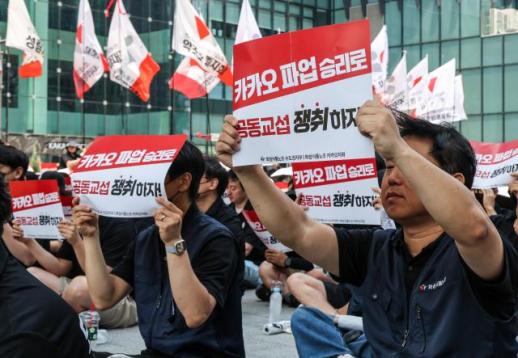 Kakao union vows to block spin-off at December vote SEOUL, August 26 (AJP) - Kakao's labor union will campaign to defeat the technology group's planned split at a December shareholder meeting, arguing the restructuring lacks concrete reform and job-security measures. The union, a chapter of the Korean Chemical, Textile and Food Workers' Union, declared its opposition at a press conference held Wednesday following a rally to authorize a strike at Kakao Bank. Kakao's board resolved on Aug. 21 to divide the company into Kakao AI, a new entity housing its artificial-intelligence platform business, and Kakao X, a surviving holding company overseeing investments and subsidiaries. "A perception is widespread that the company's claim of enhanced corporate value simply will not hold up in practice," said Suh Seung-wook, head of the Kakao union chapter. Suh said a credible reform plan addressing Kakao's existing problems should precede any split, adding that the current blueprint offers no concrete safeguards. He stressed the union was not opposing the division outright but rejecting one pursued without a proper diagnosis of its causes or remedies. The spin-off is subject to a special resolution at the extraordinary general meeting slated for Dec. 17, and the union intends to court major and minority shareholders to vote it down. Suh said that excluding the controlling shareholder's stake of about 24 percent, opposition from more than a third of attending shareholders would sink the motion. The union would first press the National Pension Service to cast its shares against it. The National Pension Service currently holds 5.4 percent of total shares for Kakao, the second largest shareholder. The union also demanded joint bargaining across all affiliates to secure group-wide employment stability, and handed management a common set of demands covering management reform, job security and a revamped compensation system. While a recent tentative wage agreement at Kakao's headquarters narrows the immediate scope for industrial action, the union left the door open to walkouts should the company refuse joint bargaining. Kakao said the spin-off marked a significant change for its workforce and that it would continue to gather employee views and communicate with the union, while dismissing industry speculation that founder Kim Beom-su was involved, casting the move instead as a reckoning with a "post-Kim Beom-su" structure. AJP Takeaways • Kakao's labor union said on Aug. 26, 2026 it will campaign to defeat the company's planned corporate split at an extraordinary shareholder meeting on Dec. 17, citing insufficient reform and job-security measures. • Kakao's board resolved on Aug. 21, 2026 to divide the group into Kakao AI, a new artificial-intelligence platform company, and Kakao X, a surviving investment and subsidiary holding entity, effective Jan. 1, 2027 • The union plans to lobby the National Pension Service and minority shareholders to block the special resolution, and has demanded group-wide joint bargaining while leaving open the possibility of industrial action. 2026-08-26 16:23:10
 -
President Lee: Balanced Development is Essential for South Korea's Survival 이재명 대통령은 26일 “균형발전은 선택이나 시혜가 아니라 대한민국의 생존과 지속 성장을 위한 필수 전략”이라며 강력한 국토 균형발전 정책을 추진하겠다고 밝혔다. 수도권 과밀과 지방소멸이 국가 전체의 효율성과 경쟁력을 떨어뜨리는 핵심 원인이라고 진단하고, 3대 메가 프로젝트로 대표되는 초격차 전략산업을 전국으로 다극화해 지역이 성장을 주도하는 구조를 만들겠다는 구상이다. 이 대통령은 이날 청와대에서 제10회 중앙지방협력회의를 주재하고 “현재 대한민국이 안고 있는 사실상 모든 큰 문제의 출발점은 극심한 국토 불균형”이라며 이같이 말했다. 이번 회의로 지난 6·3 지방선거를 통해 출범한 민선 9기 지방정부와 중앙정부가 처음으로 한자리에 모이게 됐다. 중앙지방협력회의는 대통령이 의장을 맡아 지방자치와 균형성장 관련 주요 정책을 심의하는 중앙·지방 간의 최고협의기구다. 국무총리와 대한민국시도지사협의회장이 공동 부의장을 맡는다. 이 대통령은 “서울을 비롯한 수도권은 지나치게 과밀화돼 폭발 위기를 겪고 있고, 지방은 반대로 소멸 위기를 겪고 있다”며 “이 때문에 국가 전체의 효율성이 저하되고 국가 경쟁력도 잠식되고 있다”고 지적했다. 이 대통령은 “이는 수도권을 위해서도, 국가 전체를 위해서도 결코 바람직하지 않다”며 수도권과 비수도권이 함께 성장할 수 있도록 산업과 일자리, 주거·교육·복지 등 정주 여건을 동시에 재편해야 한다고 역설했다. 지역 성장 전략으로는 3대 메가 프로젝트와 연계한 초격차 전략산업의 다극화를 제시했다. 첨단산업의 생산·연구 기반을 수도권에 집중하지 않고 각 지역의 여건과 경쟁력에 맞게 배치해 권역별 성장엔진을 육성하겠다는 취지다. 이 대통령은 “3대 메가 프로젝트로 상징되는 초격차 전략산업의 다극화는 전국이 더불어 발전하는 ‘모두의 성장 시대’를 여는 열쇠가 될 것”이라고 강조했다. 이어 “중앙정부는 3대 메가 프로젝트와 함께 지방 주도 성장을 뒷받침할 차세대 전략산업 육성에도 총력을 기울이고 있다”며 “5극 3특을 중심으로 산업과 일자리를 키우고 주거와 교육, 복지 등 정주 여건 개선 지원에도 만전을 기하겠다”고 약속했다. 이날 회의에서는 중앙정부가 마련한 정책을 지방정부에 전달하는 데 그치지 않고, 지방정부가 지역별 성장전략을 직접 제시하고 중앙정부와 실행 방안을 논의하는 방식이 채택됐다. 윤호중 행정안전부 장관은 ‘민선 9기 중앙·지방 협력 방안’을 보고했다. 임기근 국무조정실장은 ‘지방 주도 성장 추진 방안’, 김정관 산업통상부 장관은 ‘3대 메가 프로젝트 연계 권역별 성장엔진 육성 방안’, 박홍근 기획예산처 장관은 ‘지방 균형성장을 위한 재정투자 방향’을 각각 설명했다. 16개 시·도지사도 지역별 여건과 강점을 반영한 지방정부 차원의 성장 성공전략을 발표했다. 중앙정부와 지방정부는 이를 바탕으로 산업과 재정 지원을 연결하고 지역별 전략을 실제 사업으로 구체화하는 방안을 자유토론 형식으로 논의했다. 특히 기초지방정부의 대표성을 확대하는 내용의 중앙지방협력회의 운영방안 개정안도 의결했다. 광역단체 중심이었던 협의 구조에 시·군·구의 목소리를 보다 폭넓게 반영해 중앙·광역·기초정부 간 협력체계를 강화하려는 조치다. 이번 회의는 중앙정부가 정책을 결정하고 지방정부가 이를 집행하는 기존 방식에서 벗어나, 지역이 성장전략을 설계하고 중앙정부가 산업·재정·제도로 뒷받침하는 지방 주도 성장 체제로 전환하는 출발점이라는 의미를 갖는다. 이 대통령은 지방자치의 질적 도약을 위해 주민 참여와 지방정부 간 광역 연대, 행정 혁신도 강화해야 한다고 주문했다. 이 대통령은 본격적인 민선 지방자치가 시작된 지 올해로 31년을 맞았다고 언급하며 “그동안 지방정부의 역량과 역할이 꾸준히 강화됐고 지방행정과 입법, 예산 등에 대한 주민 참여도 계속 확대됐다”고 자평했다. 이어 “지난 31년 동안 거둔 성과를 바탕으로 더 많은 주민 참여, 더 굳건한 광역 연대, 더 빠른 행정 혁신이 어우러지는 새로운 지방자치 시대를 준비해야 한다”고 말했다. 이 대통령은 “중앙정부와 지방정부는 국민 삶의 개선과 국가의 지속적인 발전이라는 시대적 소명을 함께 짊어진 동반자이자 운명공동체”라며 “긴밀하게 소통하고 협력하면서 대한민국의 더 나은 미래를 설계해 나가기를 바란다”고 강조했다. 그러면서 “중앙과 지방이 원팀이 돼 대체 불가 대한민국, 국민 모두가 행복한 대한민국을 함께 손잡고 만들어 가자”고 당부했다.* This article has been translated by AI. 2026-08-26 16:20:00
-
Mokpo Natural History Museum and Children's Marine Science Museum Launch Science Education Programs for Fall The Mokpo Natural History Museum and the Mokpo Children's Marine Science Museum are launching fall education programs aimed at enhancing students' scientific curiosity and inquiry skills as the new semester begins.The Mokpo Natural History Museum announced on the 26th that it will operate a hands-on education program titled 'Fall Natural History Class' starting in September, focusing on natural science and dinosaurs.The regular program will run every Saturday from September 12 to December 19. It will feature participatory education for lower elementary students to experience natural science firsthand and a fusion education program combining science and art centered on dinosaurs for preschool and lower elementary students.The museum will also offer educational programs for student groups. From Tuesday to Friday, it will provide experiential education in natural history and career exploration in literature and history tailored to elementary, middle, and high school students.Applications for the regular education program can be submitted through the Mokpo Natural History Museum's website starting September 2, while group education requires prior telephone reservations.The Mokpo Children's Marine Science Museum will also operate the '2026 Fall Saturday Marine Science Class' every Saturday from September 5 to December 12.This Saturday Marine Science Class is designed to help children easily and accessibly understand the principles of marine science through various hands-on experiences.The general marine science course will consist of a total of 13 sessions.Applications for participation will be accepted on a first-come, first-served basis starting from the 26th through the Children's Marine Science Museum's website, with a limit of 20 participants.Kim Areum, an official at the Mokpo Natural History Museum, stated, "We hope that the various exhibition-linked education programs prepared for the new semester will provide students with opportunities to develop an interest in natural science and marine science and to explore them directly."* This article has been translated by AI. 2026-08-26 16:16:00
-
2026 Next-Generation Semiconductor Packaging Industry Exhibition Opens in Suwon The 2026 Next-Generation Semiconductor Packaging Industry Exhibition opened on August 26 at the Suwon Convention Center.This event, co-hosted by Suwon City and Gyeonggi Province, aims to share the latest trends and future visions in advanced packaging technology while promoting technical exchanges among semiconductor companies and experts.Suwon Mayor Lee Jae-jun, during the opening ceremony of the Next-Generation Semiconductor Packaging Industry Exhibition (ASPS) and the International Semiconductor Executive Summit (ISIG), stated, "We are in an era where semiconductor packaging technology determines the competitiveness of artificial intelligence (AI) semiconductors. I hope this exhibition will spark innovation in the packaging industry and serve as a foundation for growth."He added, "Suwon is transitioning into a 'high-tech research city' where research, validation, and startups are organically conducted, focusing on semiconductors, AI, and biotechnology. We will support technological innovation in small and medium-sized enterprises to lay the groundwork for a global high-tech research city."About 180 companies, including Samsung Electronics and SK Hynix, are participating in the exhibition, operating 400 booths. They will showcase advanced technologies related to semiconductor packaging, testing equipment, materials, components, and technical solutions.Packaging is a crucial post-process technology that connects and integrates semiconductor chips at high density, enhancing performance and power efficiency. It is recognized as a key technology that will lead the era of AI semiconductors.The exhibition features an industry showcase, a semiconductor packaging forum, purchasing consultations, a job fair, and company-specific technical seminars.The International Semiconductor Executive Summit (ISIG) will see executives from global semiconductor companies discussing the roadmap for next-generation semiconductor core technologies and global collaboration strategies.A forum on semiconductor packaging trends, themed 'In the Age of AI, a Major Shift from Chips to Systems - The Transformation of Semiconductor Packaging,' was also held. Presenters introduced innovative directions for the AI semiconductor packaging value chain, which connects the stages from product and service creation to delivery to customers.Speakers included Freddy Gavey, a professor at Hebrew University of Jerusalem (geopolitics of AI supremacy and chiplet/advanced packaging), Jo Jin-woo, director at Texas Instruments (TI) Korea (technology convergence of GaN power semiconductors and advanced packaging for AI data center innovation), Im Yong-woo, commercial attaché at the Quebec Government Office in Korea (introduction of the Quebec semiconductor ecosystem and collaboration opportunities), and Lee Hee-seok, a senior official at Samsung Electronics (packaging for AI and AI for packaging).Suwon City is also operating a joint pavilion, featuring three companies: Opts Co., Metasol Co., and MSTech Co., which are showcasing their products and technologies. Suwon City is promoting investment sites and incentives for attracting investment.The Suwon Free Economic Zone is being developed in the western Suwon area (Suwon R&D Science Park, Tapdong Innovation Valley), and the city is pursuing projects to attract investment to become a hub for R&D in advanced industries such as semiconductors and biotechnology.* This article has been translated by AI. 2026-08-26 16:12:20
-
South Korea Passes Carbon Neutrality Law Targeting 53-61% Emission Reduction by 2035 The South Korean government has legally committed to reducing national greenhouse gas emissions by 53% to 61% from 2018 levels by 2035. The law also sets sequential reduction targets for 2040 and 2045, clarifying the carbon neutrality pathway beyond 2030.On August 26, the Ministry of Climate Energy and Environment announced that the National Assembly passed amendments to the "Basic Law on Carbon Neutrality and Green Growth for Responding to the Climate Crisis" and the "Law on Climate Crisis Adaptation and Resilience Enhancement."The amendment to the carbon neutrality law follows a Constitutional Court ruling in August 2024, which found that the existing law lacked emission reduction targets from 2031 to 2049. While the court upheld the goal of reducing emissions by 40% by 2030 compared to 2018 levels, it deemed the absence of a post-2030 reduction pathway insufficient to protect the environmental rights of future generations.The revised law mandates the establishment of long-term reduction targets every five years after 2030. The 2035 target aligns with the Nationally Determined Contribution (NDC) submitted by the government to the international community last year, aiming for a 53% to 61% reduction.For 2040, the law sets a lower limit of 69% and an upper limit of 80%, to be determined by presidential decree by June 2031. The 2045 target will have a lower limit of 84% and an upper limit of 90%, finalized by June 2036.The law also includes principles to prevent excessive burden shifting to future generations. It establishes a legal basis for government support in research, development, investment, and commercialization of greenhouse gas reduction technologies.An independent advisory body, the Climate Science Committee, will be established under the National Climate Crisis Response Committee. This committee will scientifically review long-term reduction targets and implementation progress. The law also introduces definitions for green finance and transition finance, along with provisions for issuing green bonds to fund climate response initiatives.Additionally, a separate climate adaptation law has been enacted to reduce the impacts of climate disasters. Key elements include separating adaptation provisions from the carbon neutrality law and enhancing climate risk assessments and support for vulnerable populations.The government will investigate climate impacts and vulnerabilities by sector and region, visualizing climate risks using spatial information for public access. Central and local governments, along with public institutions, are required to develop climate crisis adaptation measures and risk reduction projects based on this data.Provisions have also been established to conduct tailored support programs for vulnerable groups and areas prone to repeated climate disaster impacts. The law includes plans to build a comprehensive climate insurance information system and foster related industries.A ministry official stated, "We will do our utmost to ensure that the two laws passed today are implemented smoothly in policy practice, including preparing necessary subordinate regulations."* This article has been translated by AI. 2026-08-26 16:12:20