

[TREASURE YouTube channel]
SEOUL -- TREASURE, a new boy band formed by YG Entertainment through an audition survival show, will finally hit the thriving K-pop scene in July. Exact dates would be disclosed later.
YG Entertainment, an entertainment powerhouse in South Korea, uploaded a teaser video titled "TREASURE - DEBUT COMING SOON," onto its official blog. The video briefly introduces all 12 members of the group which will debut in July.
"Along with the comeback schedule for BLACKPINK, the July debut of TREASURE has also been decided," YG said. TREASURE garnered attention from K-pop fans as the first K-pop group act to be unleashed by YG in four years after four-member girl band BLACKPINK that has captured the hearts of global K-pop fans since 2016.
Originally, TREASURE was to be separated into two teams, but YG changed its strategy to unveil an integrated team. The band was reorganized into a 12-member group after Ha Yoon-bin quit. YG said it canceled the contract with Ha as of December 31 last year to respect his musical direction and firm will to go solo.
TREASURE members were to embark on official activities last year but their debut was put off as the agency was embroiled in a drug and sex scandal over "Burning Sun", a music and dance club in Seoul.

Park Sae-jin
Experienced journalist and editor at AJU PRESS specializing in multilingual news. I cover international diplomacy, geolpolitics, and policy, consistently delivering highly accurate, compelling reporting for a worldwide audience.
Copyright ⓒ Aju Press All rights reserved.
Related News
-
 AJP FAQ: Where have all the trash bins gone from Seoul's streets?
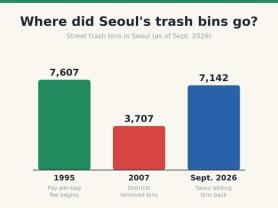
An artificial intelligence (AI)-generated image An artificial intelligence (AI)-generated image Q: Why does finding a public trash bin in Seoul sometimes feel like a treasure hunt? A: There is a historical reason behind Seoul's shortage of public trash bins. The city began removing them after introducing a pay-as-you-throw waste disposal system in 1995. Under the system, residents must buy designated garbage bags and sort their waste before disposal. The problem was that some people tried to get around the rules by dumping household rubbish into public bins. Rather than becoming convenient collection points for pedestrians, the bins were increasingly used as a way to avoid paying for garbage bags. The city responded by cutting their numbers. Q: Just how many bins disappeared? A: Quite a lot. Seoul had 7,607 public trash bins in 1995, but the number had fallen to 3,707 by 2007. The city began putting more bins back on the streets in 2023. As of September this year, Seoul had 7,142, still fewer than it had nearly three decades ago. The gap becomes even more striking when compared with other major cities. Paris has about 24,000 public bins, while Madrid, which has a similar land area to Seoul, has around 90,000. In other words, finding a bin in Seoul can require considerably more effort than finding one in some European capitals. Q: Hasn't Seoul added more bins in recent years? Why is there still a problem? A: More bins have certainly helped, but the city has another problem: tourism is growing faster than the supply of places to throw things away. This is particularly noticeable in busy shopping and tourist districts such as the capital's main shopping district of Myeongdong, where visitors can spend hours walking around with empty coffee cups, food wrappers and shopping bags. Q: Is Myeongdong really that short of trash bins? A: The numbers suggest so. In Jung-gu, the district that includes Myeongdong, an average of about 125 foreign visitors share each public bin every hour. That is roughly six times Seoul's average of 21 visitors per bin. By comparison, Gangnam in southern Seoul, which has considerably more bins, has just 18 visitors per bin. Clearly, not all parts of the city are equally well equipped to deal with the rubbish generated by crowds. Q: Why doesn't the city simply install more bins? A: Because putting a bin on the street is only half the job. Someone has to empty it, clean it and make sure it does not overflow. More bins mean higher maintenance costs and a need for additional workers to collect the rubbish regularly. These expenses fall largely on individual districts, which decide how many bins they can afford to install. Seoul encourages districts to add more bins and provides financial support, but it cannot force them to do so. Q: So, what's the solution? A: Seoul faces a balancing act between keeping its streets clean, making life easier for pedestrians and managing the cost of public services. For now, tourists visiting busy areas such as Myeongdong may still have to walk a little farther to find a bin. After all, enjoying Seoul's shopping streets should not mean carrying an empty coffee cup around for the rest of the afternoon.
-
 Changdeokgung's main gate undergoes major restoration
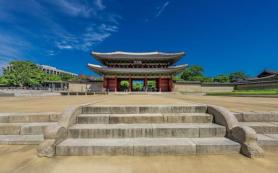
Donhwamun, the main gate of Changdeokgung Palace in Seoul. Courtesy of the Korea Heritage Service SEOUL, November 9 (AJP) - Changdeokgung Palace's historic Donhwamun Gate is undergoing its first major restoration in 29 years, ahead of the royal palace's 30th anniversary as a UNESCO World Heritage site next year. Changdeokgung was inscribed on the UNESCO World Heritage List in 1997. The Royal Palaces and Tombs Center under the Korea Heritage Service said Monday that workers will begin removing roof tiles from Donhwamun this month as part of an extensive restoration project expected to continue through 2028. Donhwamun, the main entrance to Changdeokgung Palace in central Seoul, is believed to be the oldest surviving main gate of the country's royal palaces. Originally built in 1412 during the reign of King Taejong of the Joseon Dynasty, the gate was destroyed during the Japanese invasions of Korea in the late 16th century and rebuilt in 1609. The two-story structure, designated a national treasure in 1963, measures five bays across and two bays deep and is regarded as the largest surviving palace gate in Korea. The restoration comes after repeated safety inspections identified structural problems. A 2014 inspection found structural problems, while follow-up checks between 2020 and 2022 repeatedly showed that the gate was in poor condition and needed repairs. Experts warned in 2022 that damage to the building's interior and exterior could develop into structural deterioration and called for prompt measures, including dismantling and repairing sections of the upper roof. The upcoming work marks the first large-scale restoration of Donhwamun since 1997. Workers will first remove the roof tiles to inspect the condition of the structure and determine the extent to which key components have been deformed. Experts will then decide which parts should be replaced or reinforced. Major wooden components, including rafters and purlins, will subsequently be dismantled in stages. Officials also plan to conduct detailed measurements of individual components, document the gate's traditional decorative coloring and use tree-ring dating to study the age of wooden materials. About 13.5 billion won (US$9.9 million) will be spent on the restoration, which is scheduled to be completed around October 2028. The timetable could be extended if inspections after dismantling reveal that more extensive repairs are required. During construction, visitors will enter Changdeokgung through Geumhomun Gate and a nearby secondary entrance instead of Donhwamun. The restoration site will be opened to the public twice a month starting Nov. 25 through an advance online reservation system. A viewing area has also been installed inside the temporary structure surrounding the construction site. The Royal Palaces and Tombs Center said the project is intended to restore the original form of the aging and deformed gate, improve visitor safety and preserve the historic value of the national heritage site. Changdeokgung served for centuries as one of the principal royal residences of the Joseon Dynasty and is particularly noted for the way its architecture blends with the surrounding natural landscape.
-
 Controversy Over Authenticity of 'Jeungdo Gaja' Resurfaces Amid National Audit
The authenticity controversy surrounding 'Jeungdo Gaja,' believed to be a metal type from the Goryeo Dynasty, has resurfaced during a national audit. There are calls for the National Heritage Agency to conduct a swift and objective re-evaluation, as it could serve as tangible evidence predating the 'Jikji Simche Yojeol.'During the National Assembly's Culture, Sports and Tourism Committee audit on October 23, Democratic Party lawmaker Jo Gye-won criticized the National Heritage Agency for its passive stance, noting that the review process for designating Jeungdo Gaja as a national heritage has been delayed for 16 years.Jo stated, "This is a golden opportunity to enhance the international status of South Korea's cultural heritage," questioning the involvement of committee members who previously voted against the designation in the re-evaluation process.Nam Kwon-hee, a professor at Kyungpook National University who has discovered and researched Jeungdo Gaja, pointed out the lack of expertise in the review process. He mentioned that approximately 40 researchers participated in verifying the typeface, metal composition, carbon dating, and printing issues in 2024. Despite this, he criticized the Cultural Heritage Administration for re-investigating the printing issue without relevant experts and allowing committee members with no research background in typefaces to decide on the designation.The National Heritage Agency's plan to solicit additional types beyond the existing 101 for verification was also scrutinized. Jo questioned whether this was a procedure aimed at rejection, while Nam argued that verifying the existing 101 types took over a year, claiming that the additional solicitation is essentially a delay tactic.Democratic Party lawmaker Lim O-kyung urged that a re-investigation of the existing 101 types should be prioritized based on the results of the Board of Audit and Inspection, and that committee members involved in past reviews should be excluded. In response, Heo Min, the director of the National Heritage Agency, expressed full agreement with forming a new committee. He added, "We will completely reconstitute the review process for the 101 types and ensure thoroughness."Jeungdo Gaja has been embroiled in authenticity disputes since its public unveiling in 2010, leading to the rejection of its designation as a treasure in 2017. The issue of re-evaluation has resurfaced following the audit results from the Board of Audit and Inspection.* This article has been translated by AI.