
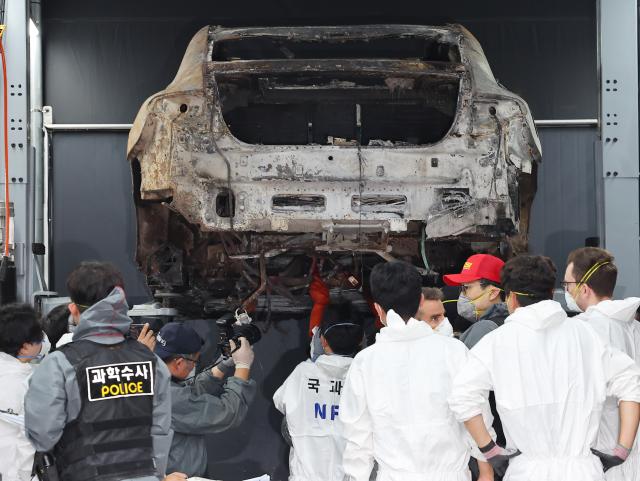
The fire on Aug. 1 originated in an unplugged Mercedes-Benz EV parked in the underground garage of an apartment complex. The blaze resulted in 23 people hospitalized for smoke inhalation, while 87 vehicles were destroyed and an additional 783 were damaged.
According to the Incheon Metropolitan Police Agency, the NFS provided a forensic report Thursday indicating the fire likely began in the sedan's underfloor battery pack.
"We cannot rule out the possibility that an external impact to the vehicle's undercarriage damaged the internal cells of the battery pack, leading to insulation failure and ignition," the forensic service was quoted as saying.
However, the forensics team noted that data extraction from the vehicle's battery management system was impossible due to severe damage from the intense combustion during the fire.
The vehicle had been parked for about 59 hours before the fire broke out. Police are investigating the owner's activities prior to parking, as closed-circuit television footage showed no external impacts during that time.
Authorities are also examining the apartment’s fire safety management, as the sprinkler system malfunctioned during the incident.
Earlier, three people, including a night-shift worker at the apartment management office and the fire safety manager, were booked without detention on charges of professional negligence resulting in injury.

Kim Dong-young
Kim Dong-young is a bilingual journalist at AJU Press (AJP), covering Korean tech, energy, and bio/pharma.
He reports from the field at events like CES and APEC, runs AJP's YouTube channels,
and is pursuing a master's at Sogang's MOT program.
Copyright ⓒ Aju Press All rights reserved.
Related News
-
 Korea's imports of Chinese EVs surpass 1 trillion won
This photo shows an electric vehicle (EV) being charged. Getty Images Bank SEOUL, September 19 (AJP) - Korea’s imports of Chinese electric vehicles (EVs) have exceeded 1 trillion won ($848 million) in the first seven months of 2024, government data showed Wednesday. The Ministry of Trade, Industry and Energy and the Korea International Trade Association reported that Chinese EVs accounted for 65.8 percent of Korea's total EV imports from January to July, reaching 1 trillion won, a staggering 848 percent increase compared to the same period last year. This surge has propelled China to become the largest EV exporter to Korea, overtaking Germany. The influx of Chinese EVs was largely driven by commercial vehicles such as buses and trucks, with Chinese-made electric buses capturing a significant share of the market. According to ministry statistics, buses from Chinese manufacturers like Higer Bus Company and BYD held a 40.7 percent share of Korea’s electric bus market in the first half of 2024. Tesla’s Shanghai-produced vehicles also contributed significantly to the surge in imports. The Model Y, a medium-sized sedan, became the best-selling imported car in Korea during the first half of the year, with sales soaring by 395.4 percent year-on-year to 10,041 units. The Korean auto industry is now facing growing pressure as Chinese brands prepare to enter the passenger car market. BYD, China's largest automaker, is set to launch its electric cars in Korea in the latter half of this year. “Our market and those of other latecomer countries face a significant price disadvantage compared to Chinese EVs,” said an analyst at the Korea Institute for Industrial Economics and Trade. “To improve price competitiveness, we need to innovate production methods and optimize supply chains.”
-
 Korea mandates battery information disclosure for electric vehicles
Government officials announce a comprehensive safety management plan for electric vehicles at the government complex in Seoul on Sept. 6, 2024. Yonhap SEOUL, Sept. 6 (AJP) – The Korean government on Friday announced a comprehensive safety plan for electric vehicles (EVs), which includes the mandatory disclosure of battery information and the early introduction of a battery certification system. The decision was made during a ministerial meeting chaired by Prime Minister Han Duck-soo earlier in the day to address public concerns about EV safety, following a fire involving a Mercedes-Benz sedan in Incheon, west of Seoul, on Aug. 1. The fire, which occurred in the underground parking garage of an apartment complex, injured around 20 people and damaged over 140 cars. "For the electric vehicle industry to grow, thorough safety management must be guaranteed," Prime Minister Han Duck-soo said during the meeting. Under the new rules, EV manufacturers will be required to provide detailed information about their batteries, including the manufacturers, cell types and materials used, according to the Office for Government Policy Coordination under the prime minister. Currently, only battery capacity, rated voltage and maximum output are subject to mandatory disclosure. The government plans to introduce a battery certification program for EVs next month, ahead of its original February 2025 schedule. Additionally, the battery management system (BMS) will be enhanced to detect and warn about battery conditions in real-time. Battery risk standards will also be established by the end of this year, the office said. The government will maintain existing regulations allowing EV chargers to be installed up to three basement levels in parking facilities, despite some calls to restrict installations to ground level. The government plans to deploy 20,000 smart control chargers this year, with an additional 71,000 to follow next year. These chargers are equipped with power line communication modems to prevent overcharging. The new safety measures also mandate the installation of wet sprinkler systems in the underground parking lots of all new buildings and the use of fire-resistant materials on walls, ceilings, and pillars. The government has postponed by one year the requirement for existing buildings to convert 2 percent of their parking spaces into EV charging areas. This regulation, originally set to take effect in January 2025, has been delayed to allow more time for implementation. Additionally, the scope of regular EV inspections will be expanded to include cell voltage, battery temperature, charging and degradation status, and cumulative charge-discharge cycles.
-
 EV fire in Korea sparks safety concerns, prompts industry, government action
Mercedes-Benz employees and fire department officials inspect a burnt Mercedes-Benz EQE sedan in Incheon, south of Seoul, Aug. 8, 2024. Yonhap SEOUL, Sept. 2 (AJP) - A devastating electric vehicle (EV) fire has sparked safety concerns among Korean consumers, prompting the government and industry to strive to minimize the impact on an already sluggish market for green mobility. The incident took place in the underground parking garage of an apartment complex in Incheon, south of Seoul, on Aug. 1. The blaze started in an unplugged Mercedes-Benz electric car and took eight hours to extinguish. More than 20 people were injured due to smoke inhalation, and over 140 cars were destroyed or damaged. The security camera footage of the sedan bursting into flames went viral, sparking widespread panic about EVs. Over 4,200 domestic news articles containing the words "EV" and "battery" have since been published. A Tesla EV fire in Lisbon on Aug. 17 further fueled fears. A secondhand car dealer reported an 184 percent increase in the number of EVs listed for sale in the week following the incident, with prices dropping across the board between 1.1 percent and 3.7 percent. The government and the ruling party frequently convened meetings to discuss measures to alleviate consumer apprehension and prevent a recurrence. In an unprecedented move, companies went so far as to publicly disclose their battery suppliers for the first time. This photo shows burnt cars in an underground parking lot in Incheon, south of Seoul, due to an electric vehicle-induced fire, Aug. 2, 2024. Yonhap Even before the incident, a survey by the Korea Transportation Safety Authority (TS) in late 2023 indicated over 50 percent of EV drivers feared their vehicles could catch fire during collisions or while charging. The incident is feared to further dampen the already shrinking EV market. EV sales in Korea dropped 16.5 percent year-on-year to about 65,000 units in the first half of this year, according to the Korea Automobile and Mobility Association. Korean EV demand has been stuck in the adoption chasm between early adopters and the mainstream market since last year. Experts also attribute the slowdown to the reduction of purchase subsidies early this year, the perennial shortage of charging infrastructure and concerns about battery safety. Despite public perception, data shows EVs are less likely to catch fire than conventional vehicles. Government data indicated that EVs caught fire at a rate of 1.3 per 10,000 cars sold in 2023, compared with 1.9 for gasoline cars. Hyundai Motor recently said the statistics exaggerated EV danger by including all incidents, including those caused by collisions and external factors, and counting other forms of electric mobility including micro-electric vehicles and three-wheelers. This photo shows autonomous vehicle company Waymo's robot taxi moving through an intersection in Chandler Arizona, U.S., Dec. 2, 2017. Reuters - Yonhap Some consumers cautioned against an overly heightened EV phobia. "Aren't there cases of gasoline cars suddenly exploding as well?" said Kim Ji-eun, a 28-year-old Audi Q4 e-tron owner. "I still recommend EVs to my friends, and I plan to purchase a Hyundai or Kia EV model for my next vehicle," she added, citing EVs’ lower fuel expenses, discounts on tolls and parking fees, and government support. However, EV fires are more dangerous than those in gasoline cars due to the thermal runaway effect within batteries, a chain reaction that causes uncontrollable self-heating. EV fires are also harder to control because the batteries are tightly sealed in metal casings. Lithium-ion batteries are particularly vulnerable to external impacts and overcharging, experts say. Even minor damage to the separator within the battery can trigger a dangerous heat cycle. Over time, the formation of dendrites—thorn-like lithium-ion crystals—can puncture these separators, further increasing the risk of thermal runaway. This photo shows the thermal runaway effect demonstrated on cylindrical lithium-ion batteries in Daegu on June 27, 2024. Yonhap The government, EV makers, and academia are swiftly moving to address public concerns and enhance EV safety. The government advised carmakers to disclose their battery suppliers, information previously kept secret by the industry. Starting with Hyundai Motor on Aug. 9, automakers and importers voluntarily made the information public on their websites. Last week, the government and the ruling People Power Party (PPP) agreed to make the disclosure mandatory. During a meeting on Aug. 25, they also agreed to introduce an EV battery certification system on a trial basis in October, earlier than scheduled. Under this program, only government-approved EV batteries will be allowed for sale. Fire departments nationwide will be equipped with specialized EV fire suppression equipment, and the development of unmanned firefighting vehicles for underground spaces is being considered as a long-term project, the PPP said. The installation of wet sprinkler systems will be mandated in all newly constructed underground parking facilities. The Incheon fire was exacerbated because the sprinklers did not work properly. "The Incheon fire was exacerbated by the five-minute delay in activating the sprinklers," Professor Kong Ha-sung from the Department of Fire and Disaster Prevention at Woosuk University said. "Malfunctions can occur in sprinklers and other fire safety equipment, but Korea still struggles to accept this reality," he noted referencing a similar case from 2019. The National Fire Agency is conducting a three-month fire safety inspection of apartment underground parking lots from Aug. 21 to Nov. 20. Seoul City plans to ban EVs charged over 90 percent from entering underground parking lots. These measures are expected to be included in a comprehensive EV safety management plan the government will announce in early September. This photo shows firemen using a portable water tank in a preparation fire drill for EV fires in Seoul on Aug. 28, 2024. Yonhap Meanwhile, the government plans to expand the deployment of battery management systems (BMS) capable of remotely diagnosing battery conditions and alerting consumers and manufacturers to potential issues. Hyundai Motor pledged Thursday to rigorously manage quality in collaboration with battery cell manufacturers and prevent major incidents through proactive diagnostics using their BMS. "We are also strengthening our measures to minimize blind spots in our battery anomaly notification system,” the company said. Korean researchers are also developing the next generation of secondary batteries. Led by the Korea Research Institute of Chemical Technology (KRICT) and six other institutes, the group aims to develop more efficient and safer next-gen batteries by 2028. The scientists are working on four types of batteries: lithium-metal batteries with higher energy storage capacity, lithium-sulfur batteries which are lighter, solid-state batteries which are much less likely to explode, and non-lithium batteries which require fewer imported materials.