
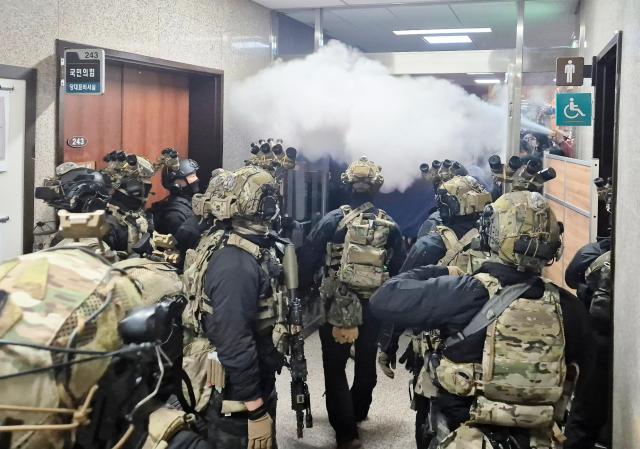
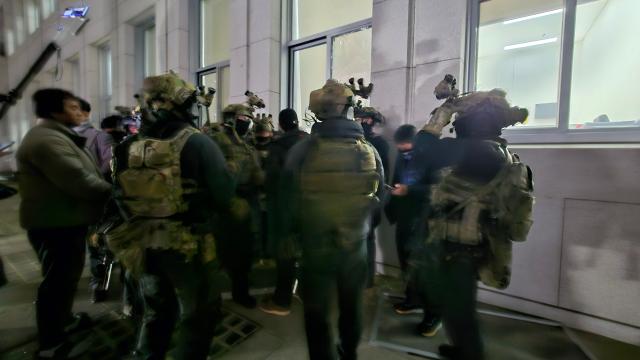
Soldiers equipped with battle dress uniforms (BDUs), night vision goggles, and special warfare gear arrived at the National Assembly via military helicopters around 11:00 p.m. on Dec. 3. Dozens of troops moved toward the main building, where they clashed with citizens and National Assembly officials.
At the building’s entrance, soldiers faced strong resistance from those inside. When their initial attempts to enter were blocked, they smashed windows to gain access. Inside, they encountered another wave of resistance as citizens and parliamentary staff had barricaded doors with desks, chairs, and ropes. Some used fire extinguishers in an effort to impede the soldiers’ advance.
The confrontation intensified until the National Assembly passed a resolution demanding the lifting of martial law. Shortly after, at approximately 1:11 a.m., soldiers carrying riot shields and rifles withdrew from the main building.
Park Sae-jin
Experienced journalist and editor at AJU PRESS specializing in multilingual news. I cover international diplomacy, geolpolitics, and policy, consistently delivering highly accurate, compelling reporting for a worldwide audience.
Copyright ⓒ Aju Press All rights reserved.
Related News
-
 Yoon Suk Yeol and Kim Yong-hyun Deny Charges in Martial Law Appeal
Yoon Suk Yeol and Kim Yong-hyun, along with six others, denied charges of insurrection during the final arguments of their appeal regarding the December 3 martial law incident. Yoon's defense emphasized that their actions were intended to inform the public of a national crisis, while Kim's team rejected allegations of ordering the evacuation of lawmakers and the arrest of politicians, calling for either dismissal of charges or a not guilty verdict.The Seoul High Court's Criminal Division 12-1, presided over by judges Lee Seung-cheol, Jo Jin-goo, and Kim Min-a, held the appeal hearing on November 3. The defense's final arguments for Kim concluded in the afternoon, followed by Yoon's team.Yoon's attorney, Lee Yoon-ho, argued that meetings with military commanders and the issuance of military personnel documents should not be interpreted as evidence of long-term preparations for martial law. He described these meetings as routine morale-boosting gatherings and stated that the personnel documents were part of standard operational procedures. He also refuted claims linking former Defense Intelligence Command chief Noh Sang-won's notebook to Yoon.The credibility of witness statements was also contested. Lee emphasized that the court should rely on objective records, such as CCTV footage and secure phone call logs, rather than witness testimonies that contradict these records.Kim's attorney, Kim Gye-ri, argued that the government sought to inform the public of a crisis due to the opposition's impeachment efforts and budget cuts, framing the martial law as a 'public appeal type' that could not coexist with the intent to disrupt the constitution. She pointed out that the military was deployed minimally after the martial law was declared and that the announcement was made via a live television address, arguing against claims of a 'loyalty coup' aimed at seizing control of the National Assembly.Kim's defense team previously stated that the constitutionality of the martial law and the establishment of insurrection charges are separate issues, asserting that there was no intention to incapacitate the National Assembly for an extended period.The significance of military deployment to the National Assembly and the communication of a list of politicians was also debated. They contended that the order given to former Special Forces commander Kwak Jong-geun was to extract military personnel, not lawmakers, and that Yeo In-hyung, former head of the Counterintelligence Command, was instructed only to assess the situation of politicians, not to arrest them. They emphasized that the military's mission was to secure facilities and maintain vigilance, not to obstruct legislative decisions.The defense explained that the purpose of sending troops to the Election Commission was for security checks and facility protection, not for server removal. They also refuted claims that drone operations were intended to provoke North Korean provocations to create conditions for martial law.Concerns were raised about the legality of the investigation and prosecution process. The defense argued that having the same prosecutor involved from investigation to indictment and trial violated regulations separating these processes. They noted that Kim had coordinated his attendance and voluntarily appeared, suggesting there was ample time to obtain a warrant.The defense appealed to the court to dismiss the charges or, if not accepted, to deliver a not guilty verdict. They concluded by emphasizing that the special prosecutor's call for severe punishment, referencing former Presidents Chun Doo-hwan and Roh Tae-woo, should not set a precedent for punishing one individual based on historical context.In contrast, the special prosecutor's team, led by Jo Eun-seok, sought the death penalty for Yoon and life imprisonment for Kim, asserting that Kim played a leading role in preparing for martial law and drafting the proclamation, while also criticizing claims that the martial law was merely a short-term warning.The first trial concluded that Yoon's actions in sending troops to the National Assembly met the criteria for insurrection charges, resulting in a life sentence for Yoon and a 30-year sentence for Kim.The court plans to hear the remaining final arguments and the defendants' final statements on November 5, after which it will conclude the proceedings and set a date for the verdict.* This article has been translated by AI.
-
 Yoon Denies Existence of Martial Law Master Plan During Special Investigation
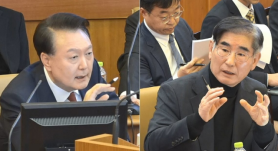
Former President Yoon Suk Yeol (left) and former Defense Minister Kim Yong-hyun Former President Yoon Suk Yeol stated during an investigation by the second special prosecutor team led by Kwon Chang-young that there was no "master plan" for a martial law declaration, asserting that it was merely a declaration without any follow-up actions. Special Prosecutor Kim Jeong-min reported in a press briefing on July 3 that when asked about the purpose and timeline of the martial law, Yoon responded, "It was just a declaration, and therefore, no subsequent actions were taken." Regarding a document containing directives for establishing an emergency legislative body that Yoon handed to then Deputy Prime Minister Choi Sang-mok, he claimed, "I didn’t write it; I didn’t know the contents well, and it was given to me by former Defense Minister Kim Yong-hyun." Yoon also expressed that upon reviewing the document, he found it inappropriate, stating, "The message and purpose of the martial law do not align." When questioned about attempts to arrest lawmakers and politicians for violating the martial law, Yoon firmly stated, "Absolutely not," and described police arrest activities as "a blatant lie." In response, Special Prosecutor Kim expressed disappointment, saying, "It is regrettable from an investigative standpoint. For someone who has served as head of state, it would have been better if he had explained and justified his actions confidently, but it was disappointing." Meanwhile, the special prosecutor team is reportedly leaning toward not prosecuting Yoon and others for charges of rebellion under military law. This decision is believed to be influenced by the potential for double jeopardy, as the insurrection special investigation team has already indicted them on related charges that are currently under trial. * This article has been translated by AI.
-
 Special counsel seeks death penalty for ex-President Yoon over failed martial law bid
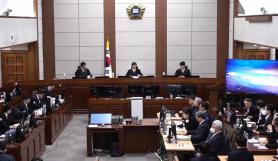
In the final hearing on insurrection trial on Jan. 13, 2026, the special prosecution team argues for a death penalty for ex-president Yoon Suk Yeol, pointing him as the ringleader for the martial-law attempt on Dec. 3, 2024. (Yonhap) SEOUL, January 13 (AJP) -Special Counsel Cho Eun-suk on Wednesday sought the death penalty for former President Yoon Suk Yeol, accusing him of leading an insurrection through his short-lived imposition of martial law on Dec. 3, 2024. Cho’s team asked the Seoul Central District Court’s Criminal Division 25, presided over by Judge Ji Gui-yeon, to impose the maximum sentence during the final sentencing hearing, describing Yoon as the “ringleader” of an anti-constitutional attempt to seize control of the state. The prosecution’s sentencing request had originally been expected on Jan. 9 but was postponed after the review of documentary evidence and final arguments by Yoon and other defendants ran past midnight. The court scheduled an additional hearing, which concluded on Wednesday. Special counsel Park Eok-su said the martial law episode “betrayed the constitutional duty to safeguard citizens’ freedoms” and “essentially infringed upon national security and the survival of the people,” adding that its purpose, methods and execution bore “the character of anti-state activity.” Park said it had become clear whom Yoon had labeled “anti-state forces” to justify the declaration, criticizing what he called an unprecedented “serious destruction of the Constitution.” He cited the storming of the National Assembly and the National Election Commission, as well as attempts to cut off electricity and water supplies to media outlets. According to the prosecution, Yoon declared martial law to seize control of the judiciary and legislature and to remain in power for an extended period, mobilizing state resources meant to serve the national community. Park added that Yoon had shown no reflection on the harm caused to constitutional order and democracy, arguing that “the biggest victims were the people who protected democracy through sacrifice against dictatorship and authoritarianism.” Yoon is accused of conspiring with former Defense Minister Kim Yong-hyun and others to declare unconstitutional and illegal martial law despite the absence of war, armed conflict or a comparable national emergency. Prosecutors allege he incited a riot aimed at undermining the constitutional order. He is also accused of deploying martial law troops and police to block access to the National Assembly in an effort to prevent lawmakers from voting to lift the decree, and of attempting to arrest and detain key political figures. Those allegedly targeted include National Assembly Speaker Woo Won-shik, President Lee Jae Myung, who was then leader of the Democratic Party, former People Power Party leader Han Dong-hoon, and senior officials at the National Election Commission. The trial involves eight defendants regarded as ringleaders of the martial law attempt, including Yoon and Kim. Yoon triggered a major political crisis when he announced the suspension of civilian rule in December 2024 and dispatched troops to parliament. The attempt collapsed within hours after lawmakers scaled fences and broke through a security cordon to convene and vote down the decree. He was detained in January 2025, becoming the first sitting South Korean president to be taken into custody. If convicted, Yoon would become the third South Korean president found guilty of insurrection, following former military leaders Chun Doo-hwan and Roh Tae-woo, who were convicted for their roles in a 1979 coup. In 1997, the Supreme Court upheld life imprisonment for Chun and a 17½-year sentence for Roh, though both were later pardoned. Even if Yoon is sentenced to death, an execution is considered highly unlikely. South Korea has observed an unofficial moratorium on capital punishment since December 1997, following President Kim Dae-jung’s inauguration in 1998. The court is expected to deliver its verdict in February, bringing to a close more than a year of political upheaval following Yoon’s failed martial law declaration. * This article, published by Aju Business Daily, was edited by AJP.