

The South Korean IT services company now holds AI specialist certifications from Microsoft, Amazon Web Services (AWS) and Google Cloud, the company said in a statement.
The Microsoft certification requires partners to pass third-party audits on their technical capabilities in designing, building and operating applications based on its Azure platforms, while meeting standards for employee competency development. LG CNS and Microsoft have been collaborating on AI and cloud services, including jointly operating an "Innovation Journey Workshop" program for enterprise customers.
The company previously became the first Korean firm to obtain AWS's "Generative AI Competency" certification and the first Asian company to receive Google Cloud's "Generative AI Service Specialization" certification. "Based on our globally recognized expertise, we will continue to provide differentiated customer value through AI services optimized for our corporate clients' businesses," said Kim Tae-hoon, senior vice president at LG CNS.

Kim Dong-young
Kim Dong-young is a bilingual journalist at AJU Press (AJP), covering Korean tech, energy, and bio/pharma.
He reports from the field at events like CES and APEC, runs AJP's YouTube channels,
and is pursuing a master's at Sogang's MOT program.
Copyright ⓒ Aju Press All rights reserved.
Related News
-
 From creepy-crawly to culinary contender: Companies bet big on edible insects
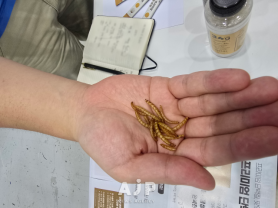
Edible mealworms processed by Grub Lab placed onto a visitor's hand at Agri & Food Tech Start-up Rising Expo 2025, July 18, 2025. AJP Kim Dong-young SEOUL, July 24 (AJP) - The first bite delivered a crispy snap, followed by an unexpectedly savory burst — something between charred prawns and stir-fried anchovies. There was no musty aftertaste, no trace of the gamy aroma one might expect. “These are mealworms,” said Celina Lee, founder and chief executive of Grub Lab, a South Korean food-tech startup focused on edible insects. She watched her guest's reaction with a practiced calm, then offered a second helping — this time, a generous scoop of golden-brown slivers still bearing traces of their original form. “They taste better than they look, don’t they?” Grub Lab is one of South Korean firms betting that insects — once a novelty street snack — could become a cornerstone of future global diets. As the world grapples with the looming threat of food insecurity, the race to develop sustainable protein alternatives has accelerated, and insects are emerging as an unlikely frontrunner. With the global population expected to hit 10 billion by 2050, protein demand is projected to nearly double, putting unprecedented strain on agriculture and livestock production. In response, the food industry is advancing three main alternatives: plant-based meat for vegetarians, lab-grown meat for traditionalists, and edible insects for scalable, low-cost protein. South Korea, which has a long if sporadic tradition of insect consumption — including fried grasshoppers during harvest and silkworm pupae skewered on street corners — is positioning itself as a leader in the insect protein sector. A surge in patents, ranging from insect-based noodles to cheese, illustrates the scope of innovation. “Insects are remarkably efficient,” Lee told AJP. “They consume one-fifth the water and one-fifteenth the feed of traditional livestock, while emitting just a fraction of the carbon dioxide.” Edible insects on a platter/ Getty Images Bank Edible mealworms on a platter/ AJP Kim Dong-young Referred to by industry insiders as “little cattle,” insects also require far less land, needing just one-fourteenth the space per gram of protein compared to cows. With breeding cycles as short as two months, they allow for multiple harvests per year — making them both cost-effective and climate-resilient. Market projections back the optimism. Precedence Research estimates that the global edible insect market, currently valued at $1.77 billion, will grow nearly sixfold to $9.14 billion by 2034. In terms of nutrition, insects outperform many conventional meats. According to South Korea’s Ministry of Food and Drug Safety, mealworms contain 53 grams of protein per 100 grams — about 1.5 times more than pork. Rice grasshoppers contain even more: 64.2 grams of protein per 100 grams and nearly 40 times the iron. Their fat content is significantly lower, and what fat remains consists mostly of healthy unsaturated fatty acids. “Insects are the protein of the future,” said Kim Jae-keun, a professor of smart food resources at Donga University of Health. “They’re a viable alternative, particularly as extreme weather events — like the unusually intense monsoon season we saw this July — drive up feed prices and threaten traditional livestock.” Kim sees smart insect farms as the next frontier: vertically integrated, climate-controlled facilities that can produce reliable yields regardless of external weather conditions. South Korea’s government is beginning to act on that vision. On July 16, officials in Gangwon Province broke ground on a 20 billion won ($14.5 million) industrial complex dedicated to insect smart farming. The 2.8-hectare facility will focus on mass-producing mealworms, grubworms, crickets, and silkworms. “We want zero waste,” said Seok Young-seek, the center’s director. “Insects aren’t just food. Their chitin shells can be used in bioplastics and sensors. Their waste becomes fertilizer. There’s enormous potential.” The first batch — an estimated 200 tons of mealworms — is expected by mid-2026. The complex has already drawn attention from major firms: LG CNS is participating in automation design, while food giants Pulmuone and Hanmi Nutrition have expressed interest in integrating insect protein into their offerings. Despite the momentum, government data shows the number of edible insect businesses in South Korea grew only modestly in recent years — from 2,535 in 2019 to 3,031 in 2023, an 18 percent increase. That growth pales in comparison to the 180 percent surge in the four years leading up to 2015. Total sales in 2023 reached just 47.3 billion won, marking a 5.3 percent increase from the previous year — a sign that consumer acceptance is still lagging. “It’s really the visual aspect that turns people off,” said Lee Joon-ha, an expert in industrial insects at the National Institute of Agricultural Sciences. “People associate bugs with filth or household pests. It’s a deeply ingrained aversion that’s hard to change.” To combat the stigma, officials have organized edible insect festivals and launched public campaigns, including naming contests for farmed bugs. But Lee says a more lasting shift will come only when insects are reimagined in the culinary space. “Right now, we mostly see insects powdered, juiced, or dried. That’s not enough,” he said. “We need genuinely appetizing, original food products — things people want to eat, not just tolerate.” Until then, startups like Grub Lab are pushing forward, hoping that taste, not appearance, will eventually win over the masses. “Once people try it,” Celina Lee said, offering another sample, “they usually come back for more.” Grub Lab's mealworm farm/ Courtesy of Grub Lab
-
 LG CNS partners with Honeywell to jointly develop AI-powered automation systems
LG CNS CEO Hyun Shin-gyoon, left, and Honeywell Process Solutions President Pramesh Maheshwari pose for a photo in Houston, Texas, July 8, 2025. Courtesy of LG CNS SEOUL, July 21 (AJP) - South Korean IT solutions provider LG CNS said Monday it has entered into a partnership with Honeywell of the United States to develop artificial intelligence-based automation technologies tailored for American manufacturing. The collaboration was finalized during a July 8 meeting in Houston between Hyun Shin-gyoon, chief executive of LG CNS, and Pramesh Maheshwari, president of Honeywell Process Solutions. The two companies will jointly develop automation platforms that harness AI to improve production efficiency across a range of industries, including semiconductors, batteries and petrochemicals. The initiative aims to integrate LG CNS’s expertise in automation consulting and service delivery with Honeywell’s global footprint in sensor and control systems. Honeywell’s Process Solutions unit specializes in providing automation tools and software for complex manufacturing environments, particularly in the petrochemical and pharmaceutical sectors. Under the partnership, LG CNS will deploy its AI agents to analyze data captured by Honeywell’s distributed control systems. The real-time data analysis is intended to detect anomalies and trigger immediate corrective actions, helping manufacturers minimize downtime and optimize operations. "This cooperation is the first step for both companies to jointly address business innovation needs of U.S. manufacturing customers and seek technological solutions," Hyun said in a statement. The two companies also plan to develop advanced manufacturing execution systems — platforms that oversee equipment, processes and personnel in real time — to support digital transformation across industrial supply chains. LG CNS and Honeywell said they intend to extend their jointly developed technologies beyond the United States to global markets, including Europe, leveraging Honeywell’s network of more than 100 corporate clients.
-
 LG CNS ventures into insect farming using AI-powered breeding technology
LG CNS's insect farming facility/ Courtesy of LG CNS SEOUL, July 16 (AJP) - South Korean IT solutions provider LG CNS has begun construction on an artificial intelligence-powered insect farming complex in Gangwon Province. The groundbreaking ceremony for the facility — billed as an “insect smart factory” — was held Wednesday in the city of Chuncheon, with Gangwon Province Governor Kim Jin-tae and LG CNS Executive Vice President Kim Hong-keun in attendance. The factory will use advanced automation and AI-driven systems to breed, monitor, and harvest insects such as mealworms at industrial scale. By deploying its proprietary manufacturing automation platform, LG CNS aims to manage the entire production process — from breeding to quality control — through a unified, data-driven control system. At the core of the factory’s operations is an AI system designed to monitor insect growth stages in real time. The technology analyzes movement patterns and color variations to detect abnormalities or disease, identifying substandard or dead specimens before they can contaminate batches. The system is intended to solve a persistent challenge in traditional insect farming, where manual sorting is both labor-intensive and unreliable at scale. “LG CNS will deliver fundamentally differentiated value to customers by combining our automation innovation with the emerging insect industry,” said Kim, the company’s executive vice president. The Chuncheon facility is expected to produce roughly 700 tons of mealworms annually by the end of the year. The insects are widely used in animal feed, protein supplements, and biodegradable materials — key components in efforts to create more sustainable food and resource systems. While insect farming has long been touted as a potential solution to climate and food security issues, scaling production has proven difficult. LG CNS’s entry into the sector reflects a broader push among Korean tech firms to apply AI and automation to ecological and agricultural challenges.