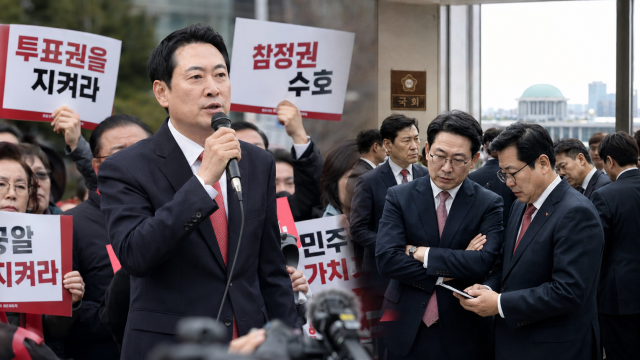
Jang began a nationwide tour on Wednesday to demand a re-run of the June 3 local elections along with an investigation into the ballot shortage controversy.
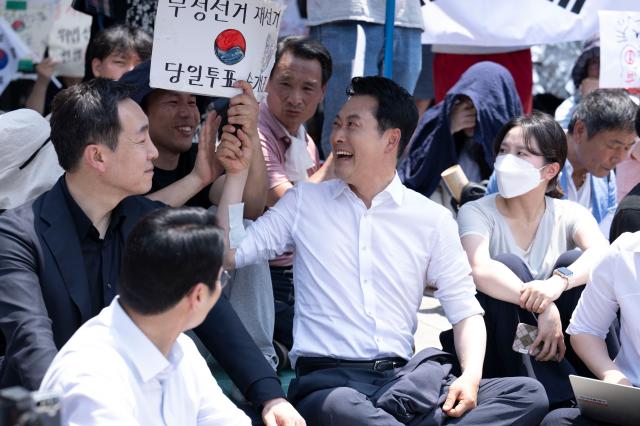
His first stop was Incheon, west of Seoul, where he met young supporters before joining a rally at a busy shopping and nightlife district there.
It was the first time Jang had joined a field rally on the ballot issue outside Seoul's Olympic Park, where protests over the election controversy had already drawn attention from hard-line conservatives.
Party officials said the Incheon event was intended to build momentum for similar gatherings in other cities, including Busan and Gwangju.
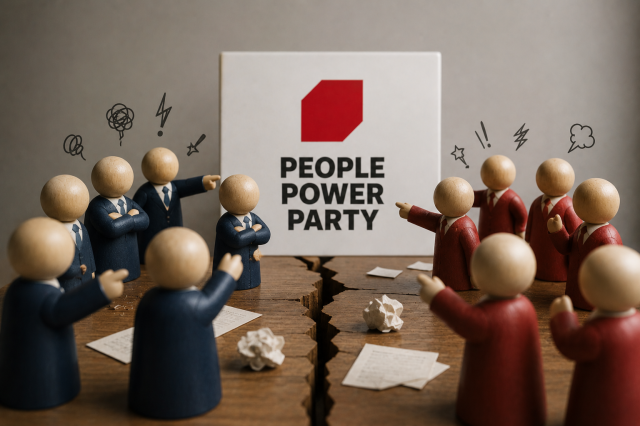
To Jang and his allies, the campaign is a fight for voting rights. To some lawmakers and strategists inside the party, it is something riskier: an attempt to mobilize a restless conservative base at a moment when the party's poll numbers are falling and Jang's leadership is under pressure.
The dispute began with a shortage of ballots during the elections, a logistical failure that opposition lawmakers have seized upon as evidence of serious election mismanagement. Jang has called for a special prosecutor recommended by the opposition, arguing that an inquiry led by the governing side would lack credibility.
Park Sung-hoon, the party's chief spokesman, told reporters at the National Assembly that the special counsel now being discussed "must be led by a person recommended by the opposition." He said the party would "properly reflect voices from outside Parliament" to ensure that a meaningful investigation is carried out.
But the language of election integrity has begun to unsettle some conservatives, who worry that the campaign could blur into the kind of voter-fraud claims long associated with far-right activists.
A Gallup Korea survey conducted from June 30 to July 2 put the PPP at 26 percent, far behind the DP's 41 percent.
The regional numbers have been especially troubling for conservatives. According to Gallup, the party's support in Busan, Ulsan and South Gyeongsang Province — a traditional conservative stronghold — fell from 37 percent in the second week of June to 25 percent in the first week of July.
In Daejeon, Sejong and the Chungcheong region, support dropped from 40 percent in the fourth week of June to 20 percent a week later.
For critics inside the party, Jang's turn to rally politics looks less like a disciplined opposition strategy than an effort to survive a leadership crisis.
Since the elections, he has faced criticism for what some lawmakers describe as "disciplinary politics" aimed at rivals aligned with former party leader Han Dong-hoon. He has also overseen an escalating boycott of parliamentary committees, deepening internal frustration among lawmakers who believe the party should focus on legislative work and rebuilding its image with moderate voters.
Jang's current strategy has reminded some party members of his conduct during the campaign, when calls emerged for him to step back from the front line. At that time, he tried to hold his ground by visiting Chungcheong, his home region, and Daegu and North Gyeongsang Province, the conservative heartland.
Now, critics say, he is again leaning on the party's most loyal supporters rather than broadening its appeal.
Jang had initially planned to travel to Daegu on Friday for a youth meeting and a voting-rights rally. The trip was later postponed. Party officials said the schedule had been adjusted because a weekday event would have limited political impact. But people familiar with the matter said lawmakers from the Daegu area had conveyed concerns about the nature of the rally.
The sensitivities were heightened by the expected appearance of Jeon Han-gil, the far-right YouTuber, at the same rally on Saturday.
"The party chairman represents the entire party. Whatever he intends to do, he should first discuss it with fellow lawmakers at a general meeting of the parliamentary party or through other internal channels," said a three-term lawmaker.
"I didn't even know Jang was considering a nationwide tour," the lawmaker said. "At some point, he stopped consulting other lawmakers and began making decisions on his own."
"His credibility as a leader is finished," said a first-term lawmaker. "The chairman has been pursuing an increasingly unilateral course, and I don't know whether it is for the good of the party or for his own political interests."
"Even PPP lawmakers are not rallying behind Jang," the lawmaker added. "Politics is not something you do alone."
"The best thing Chairman Jang can do for our party is to step down as soon as possible," said another first-term lawmaker.
Rep. Ahn Sang-hoon criticized Jang's nationwide tour, saying it was "nothing more than one of many desperate attempts to preserve power that has already outlived its legitimacy."
"A small stream cannot change the course of the mighty Han River," he added.
Some within the People Power Party, however, argued that Jang's nationwide tour to attend rallies was appropriate.
Yoon Sang-hyun, a five-term lawmaker and chair of the National Assembly's special committee investigating the elections' ballot shortage, said it is only natural for the leader of the main opposition party to travel across the country to listen to the voices of the people and gather public opinion.
"The voices of the people gathering in the public squares today are not the voices of any particular political camp," Yoon said.
"They are the voices of sovereign citizens who, after experiencing the ballot shortage, have begun asking whether their votes are being properly safeguarded."
Yoon also stressed that winning over moderate voters and those in the greater Seoul metropolitan area depends on politicians fulfilling their responsibilities.
"The trust of moderates and metropolitan-area voters is a reward that politicians earn by doing their jobs," he said.
"The party can win their support when the party leader gathers the public's urgent concerns on the ground while the special committee and the parliamentary leadership work in tandem to produce institutional reforms based on evidence and facts."
"The important thing is to build party-wide consensus around that shared task," he added.
Copyright ⓒ Aju Press All rights reserved.