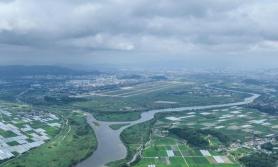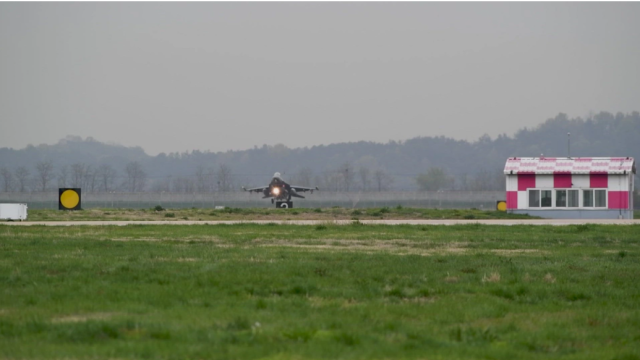
“Consultations have continued throughout the process at various levels, including involving the defense minister, vice minister and chairman of the Joint Chiefs of Staff,” the Defense Ministry spokesperson said during a regular briefing Tuesday, adding that the ministry would actively review and pursue plans to temporarily relocate operations at Gwangju Air Base by mid-2028.
The move follows an order from President Lee Jae Myung on Monday to accelerate preparations for the Honam semiconductor cluster, one of the government's three major regional industrial projects.
"The Defense Ministry plans to actively cooperate with the government's policy to strengthen the competitiveness of the semiconductor industry while minimizing the impact of the temporary relocation of Gwangju Air Base on national security and military readiness," the ministry said in response to a media inquiry.
During a public-private meeting on Monday, Lee instructed the ministry to temporarily transfer Gwangju's military operations to other air bases by mid-2028 so that the site can be put to early use as a semiconductor industrial complex.
Lee stressed that speed would be critical to the government's regional industrial strategy, calling for administrative procedures and infrastructure development to be carried out simultaneously.
"I hope the Honam semiconductor cluster will be implemented as quickly as Kumamoto in Japan," Lee said, referring to the Japanese region that has emerged as a major semiconductor manufacturing hub.
He also called for construction to begin on land near the military airport even before the relocation is completed, while urging authorities to prepare power and water supplies and accelerate necessary legislative changes.
The relocation, however, will require coordination with the United States because Gwangju Air Base is one of the South Korea-U.S. military's Collocated Operating Bases (COBs) where U.S. air assets can deploy during contingencies.
Parts of the base have also been provided to U.S. Forces Korea, meaning the return of those areas will require consultations between the two countries.
The Defense Ministry said it would work closely with relevant agencies and the U.S. side "to ensure the prompt return of land provided to U.S. forces."
Gwangju Air Base is home to the Republic of Korea Air Force's 1st Fighter Wing, which is responsible for advanced flight training for fighter pilots as well as air defense missions over southwestern South Korea.
The base operates aircraft including the T-50 advanced trainer and the domestically developed TA-50 Block 2 light combat aircraft.
The military is reportedly considering dispersing three squadrons under the 1st Fighter Wing to three other Air Force bases - the 16th Fighter Wing in Yecheon, the 20th Fighter Wing in Seosan and the 19th Fighter Wing in Chungju.
The Gwangju project forms part of Lee's broader push to develop three regional "mega-projects" centered on Honam, Yeongnam and Chungcheong as the government seeks to shift more high-tech investment outside the Seoul metropolitan area.

Copyright ⓒ Aju Press All rights reserved.