

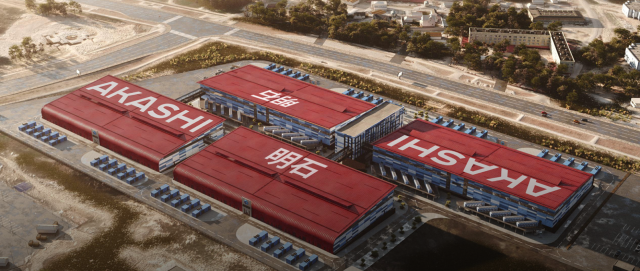
But Seoul is arriving at a market where U.S., Gulf, Chinese and Japanese players are already staking out positions.
Kazakhstan is planning a data-center zone with eventual capacity of 1 gigawatt. Uzbekistan is courting billions of dollars for hyperscale computing. Kyrgyzstan is exploring AI data centers tied to hydropower and battery storage. Tajikistan is linking its AI ambitions with digital infrastructure, hydropower and mineral development, while Turkmenistan has made AI part of a new three-year digital-economy program.
That makes the inaugural Korea-Central Asia Summit in Seoul on Sept. 16-17 more than another exercise in resource diplomacy.
Korea's Ministry of Science and ICT has made becoming a global top-three AI power a national policy goal, with an "AI Highway" of computing infrastructure, homegrown models and nationwide AI adoption at the center of the strategy.
Seoul's newly devised K-AI package is designed to attach Korean AI solutions and data centers to infrastructure financed through the Economic Development Cooperation Fund, with renewable-energy facilities potentially added to the package.
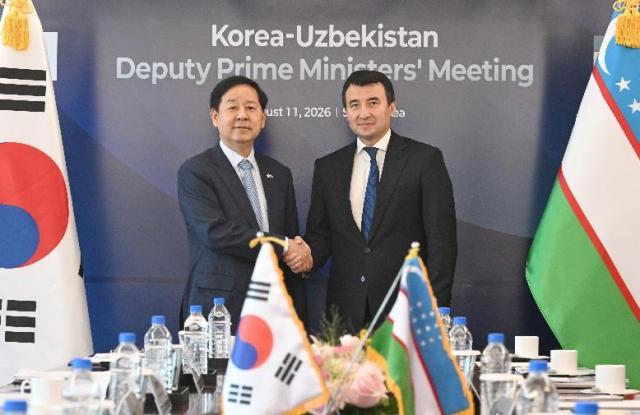
Deputy Prime Minister and Finance Minister Koo Yun Cheol raised the model directly with Uzbek Deputy Prime Minister Jamshid Khodjaev this week, proposing cooperation stretching from critical-mineral exploration and processing to AI data centers and renewable energy.
Seoul describes the K-AI package as linking AI solutions, data centers and power infrastructure to DCF-backed projects.
Khodjaev agreed that AI data centers and critical minerals should become deeper areas of bilateral cooperation, while the two sides identified AI, supply chains, renewable energy, biotechnology and advanced infrastructure as areas to advance before the September summit.
The business is straightforward. Central Asia has much of what Korea's AI expansion increasingly needs, while Korea has much of what Central Asian governments lack.
The five countries offer combinations of electricity, land, critical minerals, hydrocarbons, hydropower and rapidly expanding digital markets. Korea brings semiconductor and memory technology, power equipment, engineering and construction, telecommunications networks, cooling systems, smart-city platforms and development finance.
If those pieces can be assembled together rather than sold one by one, Central Asia could become a test ground for exporting a Korean AI infrastructure stack.
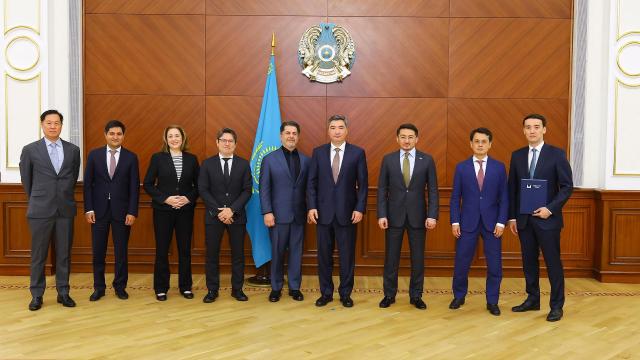
Kazakhstan is moving fastest. Its new Digital Qazaqstan strategy through 2029 explicitly describes an "AI Economy Stack" extending from energy and infrastructure through computing power, data and language models to digital platforms and AI services.
At the center is a sovereign AI hub built around the Data Center Valley in Ekibastuz, the coal-and-power city northeast of Astana. Kazakhstan plans to scale the cluster to 1 GW, bringing computing facilities, research institutions and technology companies onto one platform.
The government estimates the broader Data Center Valley could eventually attract about $30 billion of investment. A first 125-megawatt data center and supporting engineering infrastructure are targeted for completion by the first half of 2027, with later phases taking the cluster toward 1 GW.
Already, Kazakhstan has announced a separate $10 billion package involving U.S.-based Firebird and Nvidia technology that envisages computing capacity using as many as 100,000 advanced GPUs, including GB300 and Vera Rubin chips.
The scale matters for Korea.
Rather than competing only to sell servers or build individual facilities, Korean companies could enter at the level of the entire industrial system - substations and transmission, renewable generation and storage, liquid cooling, data-center construction, networking, AI memory, security and operating platforms. No Korean names have so far appeared in Kazakh projects.

Uzbekistan is following a similar path. President Shavkat Mirziyoyev's AI strategy through 2030 calls for greater AI computing capacity, more AI-based public services and wider deployment in healthcare, agriculture, finance, customs and energy.
The government has already built a $24 million GPU-based AI infrastructure platform and plans additional computing equipment, while Mirziyoyev has repeatedly framed AI and digitalization as strategic tools for economic competitiveness rather than simply an IT-sector policy.
Saudi Arabia's DataVolt has begun implementing a $3 billion, 500-MW data-center project, according to the Uzbek presidency. The country plans to add more than 17 GW of renewable generation by 2030 and expand its high-voltage transmission network as electricity demand rises.
That combination — data centers plus power generation plus grid expansion — closely resembles what Korea's K-AI package is intended to assemble.
Korea already has a beachhead.
KT acquired Uzbek fixed-line operator East Telecom in 2007, and the companies subsequently developed a Tier III-class data center in Tashkent. East Telecom described the project as a 6,000-square-meter facility with more than 300 racks and plans for a broader Central Asian data-center network. But it remains small beside the hundreds-of-megawatts projects now under discussion.
Daewoo E&C and state-backed Korea Overseas Infrastructure & Urban Development Corp., or KIND, have also been asked to examine a data center linked to Tashkent's planned Aerocity development. That remains at the proposal stage rather than a committed hyperscale investment.
The gap illustrates Korea's challenge. It has relevant companies, but not yet a Central Asian project structure that combines them.
Kyrgyz investment authorities this year discussed an AI data center that would draw on the country's hydropower potential, incorporate battery energy storage and reuse heat generated by computing facilities. Its government has also called for regional access to computing capacity through data centers as part of wider AI cooperation.
Tajik President Emomali Rahmon has identified artificial intelligence and digital infrastructure alongside hydropower, mining and mineral processing as prospective areas for foreign investment. Dushanbe has also promoted the idea of a regional AI center and is developing its own AI ecosystem.
Turkmenistan, meanwhile, adopted a digital-economy program running through 2028 that includes development of a national AI strategy and the use of AI technologies across industries.
Those ambitions point toward a possible division of labor across Central Asia rather than five isolated national markets.
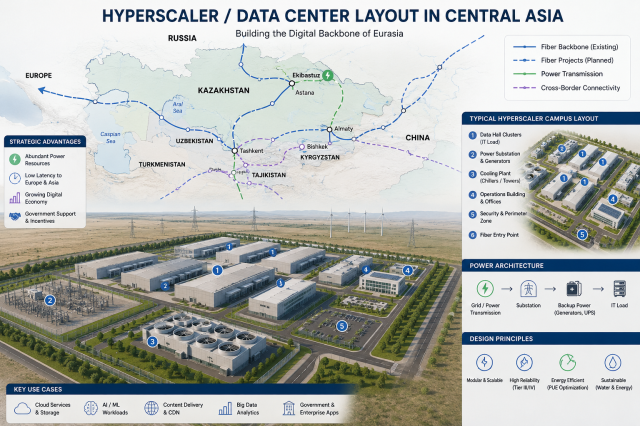
Kazakhstan can offer large-scale power and land for compute. Uzbekistan brings the region's largest population, industrial demand and aggressive investment drive. Kyrgyzstan and Tajikistan offer substantial hydropower potential. Turkmenistan brings energy resources.
For Korea, the more valuable prize may therefore be a regional AI-energy-resource corridor, rather than a single data-center contract.
AI infrastructure requires not only GPUs and high-bandwidth memory but enormous quantities of electricity, electrical equipment, copper, construction materials, cooling equipment and network infrastructure.
Korea is strong in the manufactured end of that chain but remains highly dependent on imported energy and raw materials. A package that combines Korean technology with local resources could therefore give both sides more than a conventional mining agreement.
AI could be used inside the mines, grids and processing plants themselves — for geological analysis, predictive maintenance, power optimization, automated industrial control and logistics — while the same energy and mineral base supports data centers and computing infrastructure.
The upcoming summit's business agenda is therefore likely to be dominated by four overlapping questions: where to build computing capacity, how to power it, how to connect it with critical-mineral supply chains, and who will finance the package.
The last question may be Korea's biggest weakness.
Japan has already demonstrated how a coordinated national package can work in Uzbekistan.
Toyota Tsusho, Internet Initiative Japan, NEC and NTT Communications won a project from state-owned Uzbektelecom covering data centers in Tashkent, Bukhara and Kokand as well as domestic and international telecommunications networks.
Toyota Tsusho acts as prime contractor, IIJ supplies containerized data-center systems and cloud infrastructure, NEC provides network equipment and NTT supports international connectivity. Financing is backed by the Japan Bank for International Cooperation, MUFG Bank and Nippon Export and Investment Insurance.
Japan had begun building that financing-and-technology chain years earlier, including a JBIC-backed Uzbek telecommunications project in 2019.
A Ministry of Finance and Economy official cautioned that the government's push is still at an early stage, admitting no concrete public-private projects that have taken shape yet.
The Sept. 16-17 leaders' gathering will be Korea's first summit with Kazakhstan, Kyrgyzstan, Tajikistan, Turkmenistan and Uzbekistan together.
Officials have placed its economic component under a broader goal of building an “innovative and prosperous future” while institutionalizing the C5 relationship and producing visible cooperation projects.
AJP Takeaways:
- Central Asia is emerging as a potential AI infrastructure partner for Korea, offering power, land, critical minerals and governments seeking sovereign computing and digital industries.
- Kazakhstan and Uzbekistan are moving at hyperscale, with Kazakhstan targeting a 1-GW Data Center Valley and Uzbekistan attracting a $3 billion, 500-MW project from DataVolt.
- Korea's new K-AI package could link AI solutions, data centers, power infrastructure and development finance, turning traditional resource cooperation into a wider AI-energy-minerals partnership.
- The September Korea-Central Asia summit will test Korea's ability to build a coordinated public-private consortium, an area where Japan has already demonstrated a financing-plus-technology model in Uzbekistan.
Copyright ⓒ Aju Press All rights reserved.
