
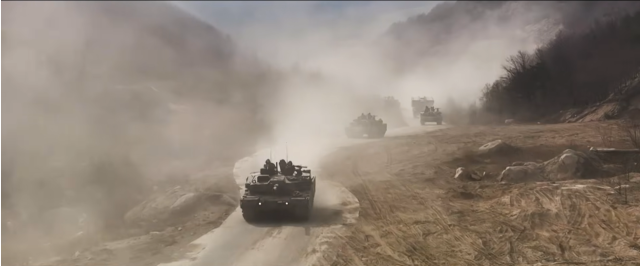
The development follows U.S. President Donald Trump's order to scale back the exercise.
The JCS said the allies agreed to adjust the UFS schedule to run from Aug. 17 through Aug. 21. The exercise had originally been scheduled to continue through Aug. 27.
The decision came after Trump said last Sunday that he had instructed the Pentagon to "substantially" reduce the exercise with South Korea.
The allies will also scale back some of combined field-training drills as part of the UFS exercise, while Seoul and Washington continue to discuss further details.
South Korea and the U.S. had initially planned about 14 such drills at the battalion level or above during this year's UFS.
The annual exercise, which began Monday with about 18,000 South Korean troops participating, is designed to strengthen the allies' combined defense posture and rehearse responses to potential security contingencies on the Korean Peninsula.
Lee Jung-woo
I studied philosophy in college, and sociology and journalism in graduate school. I cover North Korea, South Korean politics, foreign affairs and films. I enjoy Nordic cinema, Indian cuisine and Japanese detective novels. I have a cat and like bright, acidic coffee.
Copyright ⓒ Aju Press All rights reserved.
Related News
-
 Xi Jinping and Vladimir Putin Smile in Shenzhen as Focus Shifts to Trump's Miami G20
The trilateral summit between the United States, China, and Russia, which drew global attention, has concluded. The historical significance of the meeting, where the leaders of these three major powers gathered for the first time, cannot be understated. A joint statement was issued addressing issues such as UN reform, nuclear war prevention, and expanding oil supplies. However, no substantial breakthroughs were achieved on critical issues that are shaking the world, including the Iran-Ukraine war, US-China trade tensions, and semiconductor export controls. This has led to evaluations that, despite the grand diplomatic display, the practical outcomes were limited. Nevertheless, when weighing the diplomatic gains, analyses suggest that Xi Jinping, the Chinese president, and Vladimir Putin, the Russian president, reaped the most benefits. President Xi showcased his influence by leveraging the advantage of hosting the Asia-Pacific Economic Cooperation (APEC) summit to bring the three major powers together. The image of the three leaders seated together, particularly centered around Xi, effectively highlighted China's role as a mediator coordinating major issues at the center of the international order. For President Putin, the summit was also a valuable opportunity. Facing Western sanctions and diplomatic isolation since the invasion of Ukraine, he conveyed the message that Russia remains a major power influencing the global order by standing shoulder to shoulder with the leaders of the US and China. Notably, while the joint statement included warnings against the abuse of the International Criminal Court's (ICC) jurisdiction, the Ukraine war was not mentioned, marking a significant achievement for him. In contrast, President Donald Trump's report card appears relatively weak. Following the Republican Party's defeat in the midterm elections, Trump needed a chance to regain control of domestic affairs, and he partially showcased his presence by facilitating this historic trilateral meeting. However, he did not achieve clear results in finding an exit strategy for the Ukraine and Iran wars or in addressing trade issues with China. In fact, considering that China and Russia are weighing their strategic interests amid the prolonged nature of both wars, there is little incentive for them to readily respond to US demands. Unlike the 1945 Yalta Conference, which discussed post-war order against a 'common enemy' in Nazi Germany, this summit lacked clear shared strategic goals among the three nations. Most importantly, while the US emerged as a superpower leading the international order after World War II, this summit highlighted the reality that the US president must now negotiate interests on an equal footing with the leaders of China and Russia. This symbolizes the relative shift in US influence. As if to reflect this reality, tensions between the US and China resumed immediately after the summit. Following the implementation of new US semiconductor export controls, investigations related to Nvidia have begun. Although China extended its suspension of additional tariffs on the US for two months this month, the potential for renewed tariff conflicts remains. Particularly, if China responds to the US's strengthened semiconductor controls with restrictions on rare earth exports, the fragile trade truce between the two countries could be shaken again. Other international issues also show little sign of resolution. Russia continues its military offensive against Ukraine, and tensions surrounding Iran in the Middle East remain high. Amid a series of attacks on oil tankers in the Strait of Hormuz, Israeli Prime Minister Benjamin Netanyahu has reportedly urged President Trump for additional airstrikes against Iran. Ultimately, despite the historic trilateral summit, major conflicts shaking the international community remain unresolved. In this context, attention now turns to the G20 summit scheduled for December 14-15 in Miami, USA. Xi's attendance is highly anticipated, while Putin's participation remains uncertain. It is unclear whether the three leaders will meet again, but it is evident that this meeting will serve as a stage to gauge the direction of great power diplomacy following the Shenzhen summit. The key question is whether the discussions in Shenzhen can lead to practical agreements and resolutions on international issues. While the Shenzhen summit demonstrated that great powers can engage in dialogue, the dialogue itself does not guarantee peace and stability. There are concerns that, during the process of the three major powers coordinating their interests, the voices of Ukraine and Europe, as well as those of US allies like South Korea and Japan, may be sidelined. Now, less than a month after the Shenzhen summit, President Trump will welcome major world leaders, including Xi Jinping, to his home turf in Miami. If Xi and Putin secured gains in Shenzhen, the focus will be on how much influence Trump can exert in Miami. As the new year approaches with a Democratic-led Congress set to take office, it remains to be seen whether he can lay the groundwork for a counteroffensive to regain control of domestic affairs through diplomatic achievements.* This article has been translated by AI.
-
Trump on Iran, Xi on Great Powers, Putin on Ukraine... Three Leaders' Summit with Diverging Views
The leaders of the United States, China, and Russia held their first trilateral summit on November 19 in Shenzhen, Guangdong Province, China. During the approximately 10 minutes of public remarks, the diplomatic priorities of each country were clearly highlighted. President Donald Trump of the United States prominently addressed the issue of Iran's nuclear weapons, while Chinese President Xi Jinping emphasized cooperation among great powers and underscored China's elevated status in the international community. Russian President Vladimir Putin focused on the issue of the Ukraine war.According to China Central Television (CCTV), the three leaders began their meeting at 4:25 PM at the Qilin Mountain Villa in Shenzhen and engaged in discussions for about 1 hour and 30 minutes. A notable point in Xi's remarks was his message positioning China as one of the world's major powers. He stated, "Positive interactions among great powers are not an option but a task that must be addressed," emphasizing the need for cooperation among the US, China, and Russia. He asserted that since the world is a community with a shared destiny, major powers have a special responsibility for international peace and stability.Xi particularly noted that China is developing a comprehensive strategic partnership with Russia and is also striving to establish a constructive and stable relationship with the United States. He stressed the need to create a framework for great power relations characterized by peaceful coexistence, overall stability, and balanced development. This message is interpreted as highlighting that China, having increased its economic, military, and diplomatic influence, is a key nation responsible for shaping the international order alongside the US and Russia. The summit, which brought together the leaders of the US and Russia, is also seen as a demonstration of China's diplomatic stature.President Trump focused on the issue of Iran's nuclear weapons. He emphasized that the US, China, and Russia are the world's three major nuclear powers and stated that they can cooperate to reduce nuclear weapons and mitigate the risks of nuclear weapon use. He particularly noted the need for a joint response to the nuclear proliferation threats posed by other countries, saying, "This is exactly what we are doing regarding Iran." He further emphasized, "We will not allow Iran to possess nuclear weapons." Trump's remarks are interpreted as underscoring the US's hardline stance toward Iran under the banner of international non-proliferation. By emphasizing that blocking Iran's acquisition of nuclear weapons is a measure for international security, he aims to legitimize the US's policy toward Iran.President Putin highlighted the Ukraine war as a core common interest among the three countries. He claimed that the US, China, and Russia share many overlapping interests in resolving regional conflicts, including the Ukraine dispute. He publicly stated that he discussed the Ukraine issue intensively during his meetings with Xi the previous day and with Trump on the same day. Putin emphasized that the three countries are victorious nations of World War II and bear a joint responsibility for maintaining international peace and security. He suggested that constructive cooperation among the three countries could contribute to global stability and proposed discussing energy security issues.Xi highlighted China's status as a great power and its international role, Trump focused on the US security agenda through the Iran nuclear issue, and Putin emphasized Russia's interests surrounding the Ukraine war. These matters are expected to have been the central topics of discussion at the trilateral summit.* This article has been translated by AI.
-
Xi Jinping Welcomes Trump at Airport, Embraces During Third Meeting This Year
Chinese President Xi Jinping personally welcomed U.S. President Donald Trump at the airport as he arrived in China to attend the Asia-Pacific Economic Cooperation (APEC) summit.President Trump arrived at Shenzhen Bao'an International Airport in Guangdong Province at around 5 p.m. local time on November 18, as reported by China's state-run Xinhua News Agency. President Xi went to the airport to greet Trump, marking their third meeting this year. Having met several times, the two leaders embraced warmly.In May, President Trump visited Beijing for a three-day stay and held talks with President Xi. In September, Xi visited the U.S. for a three-day stay in Washington. The two leaders have engaged in diplomatic exchanges by visiting each other's countries, and this time they met again in Shenzhen, where the APEC summit is being held.At Bao'an Airport, Xi stated, "When I visited the U.S. in September, President Trump and his wife personally came to the airport to greet me and organized a grand welcome ceremony. China values etiquette and has a tradition of reciprocating such gestures." He continued, "I welcome President Trump's return visit and look forward to exchanging in-depth views on significant issues related to China-U.S. relations, Asia-Pacific cooperation, and the global order." He emphasized the desire to develop a "constructive and strategically stable relationship between China and the U.S. based on respect, fairness, and equality."President Trump expressed gratitude for Xi's personal welcome at the airport and thanked the Chinese side for their special hospitality. He said, "I am very pleased to visit great China again, and President Xi is a great leader. I always enjoy meeting with him." He added, "I believe this visit will further develop our bilateral relations and be successful."Attending the airport welcome were Cai Qi, a member of the Standing Committee of the Political Bureau of the Communist Party of China, Wang Yi, the Foreign Minister, and Huang Kunming, the Party Secretary of Guangdong Province.Meanwhile, President Trump will attend the main session of the APEC summit on the morning of November 19. Following that, he will hold a working lunch and a summit with President Xi starting at 12:30 p.m. At 2:30 p.m., he is scheduled to hold a trilateral summit with Russian President Vladimir Putin. During the bilateral talks with Xi, Trump is expected to discuss key issues such as trade conflicts and export controls on advanced technology. The China-U.S. summit is anticipated to focus on economic matters. The trilateral summit, which is being held for the first time, is expected to address major international issues such as the Ukraine war and nuclear disarmament.* This article has been translated by AI.