
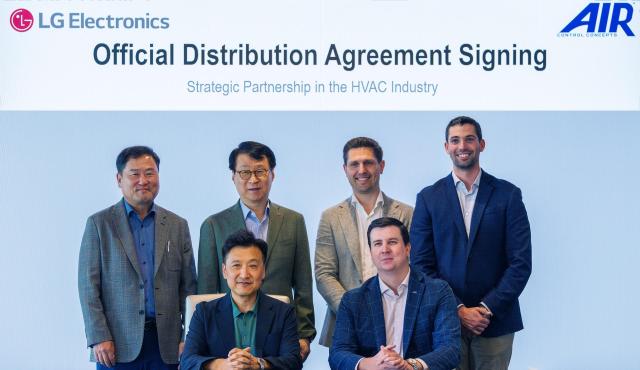
SEOUL, October 06 (AJP) -LG Electronics is expanding its cooling business on the back of the AI data center boom, securing a long-term deal to supply systems for 5 gigawatts of capacity in North America as cooling becomes critical to keeping increasingly powerful AI processors from overheating and sustaining their performance under heavy computing loads.
LG's U.S. unit signed a long-term supply agreement with AIR Control Concept, a North American data center infrastructure company, to provide high-efficiency chillers and other cooling systems in phases, the company said Tuesday. The financial terms and supply period were not disclosed.
The 5-GW capacity represents a sizable order as demand for electricity and cooling infrastructure rises alongside AI computing. Global data center power capacity is expected to increase by 108 GW to 334 GW in 2027 from 226 GW this year, according to Omdia figures cited by LG.
LG and AIR are also discussing expanding the partnership to coolant distribution units, or CDUs, used in liquid-cooling systems as increasingly powerful AI processors generate more heat.
LG said orders for its AI data center cooling solutions exceeded 600 billion won ($447 million) in the first half of this year and are expected to reach several trillion won by year-end. The company has been expanding the business in North America as well as the Middle East and Southeast Asia.

Candice Kim
Candice Kim is a dedicated business and technology reporter specializing in the intersection of high-tech innovation and fast-paced consumer trends. Her core beats span the semiconductor, IT, cosmetics, and retail sectors, where she provides in-depth coverage of industry titans including Samsung Electronics, SK hynix, and LG Electronics, alongside leading consumer brands like Olive Young and Musinsa. Whether analyzing complex silicon supply chains or tracking the latest shifts in beauty and fashion retail, Candice is committed to delivering sharp, accurate reporting that keeps readers informed on the forces shaping today's most dynamic markets.
Copyright ⓒ Aju Press All rights reserved.
Related News
-
 LG CNS Launches Blockchain Platform 'KITL' to Target Digital Asset Infrastructure in Finance
LG CNS is entering the blockchain infrastructure market to support digital asset initiatives for financial institutions. The platform provides essential features for digital asset services, including e-wallets, transaction processing, fee payment, and transaction history collection.On October 6, LG CNS announced the launch of its blockchain infrastructure platform, 'KITL.' This platform offers the necessary infrastructure for banks, securities firms, credit card companies, and payment service providers to build digital asset services such as stablecoins, security token offerings (STOs), and real-world asset (RWA) services.KITL includes four essential functions for digital asset operations: e-wallet, transaction processing, fee payment, and transaction history collection.While financial institutions have traditionally recorded and managed customer transaction histories within their systems, digital assets operate on public blockchains. Therefore, to provide digital asset services, financial institutions require separate infrastructure connected to the blockchain for asset custody, transaction processing, fee payments, and transaction record collection.According to LG CNS, KITL offers these capabilities through its four key functions.The e-wallet functions like a bank account, storing digital assets and performing electronic signatures during transfers. Typically, the private keys required for electronic signatures are stored in hardware security modules (HSMs), which have limited storage capacity. LG CNS has developed a method that generates private keys only when needed for signatures and discards them afterward, allowing the issuance of wallets to millions of customers without the need for additional equipment. The company has completed the patent registration for this technology.The e-wallet technology has been applied in the Bank of Korea's digital currency pilot project, 'Project Han River,' and has been expanded to work with both private and public blockchains. The technology was validated in a real transaction environment involving seven participating banks and approximately 80,000 customers who conducted actual payments at convenience stores and supermarkets.Transaction processing tracks the status of transactions requested by financial institutions until they are successfully processed on the blockchain and communicates the results. Fee payment manages the distribution of blockchain usage fees, known as 'gas fees,' according to the agreements made by service providers such as banks and credit card companies.Transaction history collection retrieves only the relevant transaction records from public blockchains worldwide. For instance, issuers can use this to compare the total issuance of stablecoins with dollar and won deposits, while stablecoin distributors can utilize it for settlement, accounting, and auditing purposes.LG CNS highlighted the scalability of KITL as one of its strengths. Building separate infrastructure for each type of digital asset, such as deposit tokens, tokenized securities, and stablecoins, could lead to redundant investments as businesses expand. KITL is designed to allow the four core functions to be used collectively across various digital assets and blockchain networks. This means financial institutions can leverage existing infrastructure when adding new digital assets or integrating other blockchain networks like Solana alongside Ethereum.LG CNS has also established a global partner ecosystem centered around KITL. The company has signed memorandums of understanding (MOUs) with five leading global blockchain firms to address various areas necessary for digital asset businesses.Collaborations include working with Circle, the issuer of the stablecoin USDC, and Securitize, a platform for issuing and managing tokenized securities. They are also partnering with the Canton Foundation, a global financial transaction blockchain foundation, Chainalysis, a blockchain intelligence platform, and Chainlink.With Circle, LG CNS will develop digital asset infrastructure and solutions tailored to the domestic technology and regulatory environment. Together with Securitize, they will co-develop solutions for tokenizing funds and bonds in compliance with domestic regulations. The partnership with the Canton Foundation aims to establish infrastructure that enables domestic financial institutions to participate in the Canton network.In collaboration with Chainalysis, LG CNS will integrate transaction monitoring capabilities into KITL to help financial institutions detect and block the inflow of funds related to criminal activities. The partnership with Chainlink will focus on integrating KITL with Chainlink services.Kim Hong-geun, Vice President of LG CNS's Digital Business Division, stated, "We will provide the necessary infrastructure and global partnerships for digital asset businesses through KITL, enabling financial institutions to start services as soon as regulations are implemented."* This article has been translated by AI.
-
LG Electronics Supplies Integrated Cockpit Solution for Renault's First SDV
LG Electronics will supply an integrated cockpit solution that controls the dashboard and infotainment system for Renault Group's new electric van. This system is designed to integrate the driver's electronic systems in line with the software-defined vehicle (SDV) concept, which focuses on software-based vehicle functionality.On October 6, LG Electronics announced it will provide its next-generation integrated cockpit solution for Renault's 'New Trafic E-Tech Electric.' This vehicle has been recognized as the first commercial SDV in Europe and was recently named '2027 World Van of the Year.'The solution combines a dashboard that displays driving information with an infotainment system that supports navigation and media playback. By providing a consistent screen layout and operation method for both systems, it allows drivers to easily access information. According to LG Electronics, this integration enables automakers to simplify parts and design, thereby reducing production costs.This integration responds to changes in the vehicle's electronic control structure. Traditional vehicles operated dozens of electronic control units (ECUs) for various functions. In contrast, SDVs utilize high-performance computers and a centralized software structure to control multiple functions. Renault plans to implement a control structure centered around two high-performance computers and an Android-based vehicle operating system, 'CAR OS,' developed in collaboration with Google.SDVs can improve functionality through wireless software updates even after delivery. LG's integrated cockpit is designed to continuously upgrade advanced features based on AI to align with this structure.The collaboration between LG Electronics and Renault has expanded from traditional infotainment systems to integrated cockpits. LG was recognized as an excellent supplier by Renault in 2014, 2017, and 2020. In 2021, the two companies jointly developed an Android-based vehicle infotainment system. This solution leverages technologies accumulated in both the vehicle dashboard and infotainment sectors.LG Electronics plans to expand its collaborations with major automakers in North America and Asia, including Renault.Lee Seok-hyun, President of LG Electronics' Vehicle Solutions Company, stated, 'We will continue to develop the key technologies and solutions necessary for the mobility industry to transition to SDVs through close collaboration with global automakers, including Renault Group.'* This article has been translated by AI.
-
LG Tests Space Components on Nuri Rocket, Including Camera and Battery
LG is testing its camera, battery, and power control technologies in space, utilizing existing commercial technologies to verify reliability in orbit rather than developing new components from scratch. This marks the first time LG affiliates have jointly launched various components on a single satellite for space validation.On October 6, LG Science Park announced that it will equip the CubeSat aboard the fifth launch of the Nuri rocket, scheduled for October 7, with five components from LG Electronics, LG Energy Solution, and LG Innotek. The validation is being prepared in collaboration with the unmanned exploration research institute, a startup focused on lunar rover development.The components include a camera module from LG Innotek and a battery pack from LG Energy Solution. LG Electronics is supplying a power module, attitude control actuator, and satellite communication antenna. The camera module will capture images of the Korean Peninsula and transmit data back to Earth. The power module and attitude control actuator will manage the satellite's power and orientation, while the battery pack will provide power and collect status information.If the Nuri rocket launch and satellite separation proceed as planned, these components will undergo operational testing for about 60 days at an altitude of approximately 570 kilometers. A key verification target is whether the commercially available components can function normally in the actual space environment, which includes exposure to vacuum, extreme temperature changes, and radiation.This test will employ a Commercial Off-The-Shelf (COTS) approach, which involves adapting existing commercial components for space use. This method can reduce development time and costs compared to creating dedicated space components from the ground up. However, since ground-based components are not designed for space radiation and temperature variations, separate reliability verification is necessary before actual operation.LG aims to gather data on how each component performs in orbit and plans to use the results to enhance its technology. This represents an initial step in determining whether the technologies acquired from its existing electronics and battery businesses can be expanded into the space sector.Notably, LG Electronics, LG Innotek, and LG Energy Solution each possess expertise in power control, camera, and battery technologies. The satellite must generate and store power, control its orientation, and capture information to send back to Earth. For LG, the critical question is whether it can extend its core components from existing businesses into the space environment rather than building a separate space venture from scratch.LG plans to gradually expand the scope of its verification efforts. By 2028, it aims to launch its own CubeSat. While this test involves components mounted on a satellite developed by the unmanned exploration research institute, future plans include validating independent satellite mounting technology.LG is also broadening its collaborations in the space sector. LG Science Park discussed cooperation with the Korea Aerospace Administration on two occasions last year regarding the space industry. Additionally, LG Energy Solution has begun developing aerospace battery cells in partnership with South8 Technologies in the United States. As LG expands from supplying technology among its affiliates to joint validation efforts, it is solidifying its movement to explore the space industry as a new application market for its existing electronics and battery technologies.Jung Soo-hun, CEO of LG Science Park, stated, "This launch is the first step in confirming how LG's technology operates in the space environment. We will continue to validate the technologies we have accumulated on the ground and contribute to the domestic space industry ecosystem."* This article has been translated by AI.