
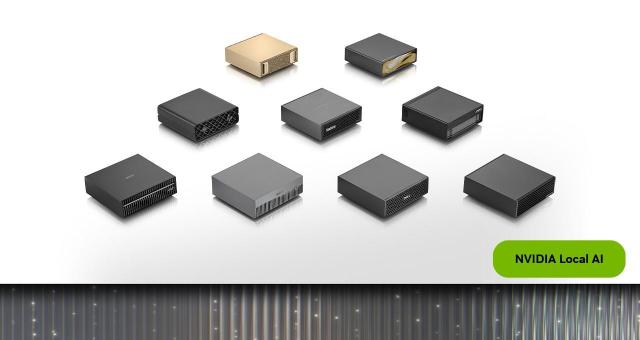
SEOUL, October 06 (AJP) - Nvidia has introduced a 64GB version of its DGX Spark personal AI supercomputer, expanding its push to let developers run large AI models and agents locally without relying on cloud computing.
The new model will be available starting Oct. 23 through Acer, ASUS, Dell, Gigabyte, HP and MSI, with prices starting at $4,999, Nvidia said Tuesday. It uses the same GB10 Grace Blackwell Superchip and Nvidia AI software stack as the existing 128GB version.
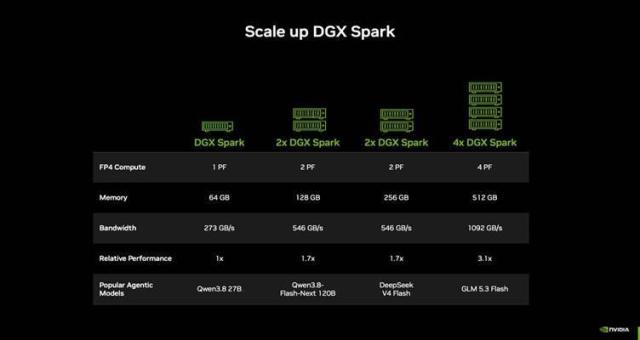
Two 64GB DGX Spark systems can also be connected into a cluster, combining 128GB of memory and supporting models with up to 200 billion parameters. Nvidia said its internal testing using Qwen 3.8 27B showed performance gains of up to 1.7 times compared with a single system.

Candice Kim is a dedicated business and technology reporter specializing in the intersection of high-tech innovation and fast-paced consumer trends. Her core beats span the semiconductor, IT, cosmetics, and retail sectors, where she provides in-depth coverage of industry titans including Samsung Electronics, SK hynix, and LG Electronics, alongside leading consumer brands like Olive Young and Musinsa. Whether analyzing complex silicon supply chains or tracking the latest shifts in beauty and fashion retail, Candice is committed to delivering sharp, accurate reporting that keeps readers informed on the forces shaping today's most dynamic markets.
Copyright ⓒ Aju Press All rights reserved.
Related News
-
 Nvidia Hits Record High, But SK Hynix Shares Decline
Nvidia reached a record high on the New York Stock Exchange, yet SK Hynix saw a decline of over 2% in early trading. Following a rapid increase in stock prices, there has been a notable selling pressure from foreign investors, leading to profit-taking. Additionally, the large-scale stock buybacks by Samsung Electronics and SK Hynix are nearing completion, raising interest in future supply and demand changes. As of 10:46 a.m., SK Hynix shares were trading at 1,796,000 won, down 2.44% from the previous trading day. Meanwhile, Samsung Electronics fell 0.36% to 275,000 won. This contrasts sharply with the previous day's performance in the U.S. markets. On October 5, Nvidia closed at $238.90, up 2.1%, marking a new all-time high. During the day, it peaked at $240.10, with its market capitalization swelling to $5.76 trillion, bringing it close to the milestone of $6 trillion. The decline in SK Hynix shares can be attributed primarily to profit-taking following a sharp rise in stock prices. SK Hynix surged approximately 11.6% from 1,683,000 won on September 14 to 1,879,000 won on September 21. After a correction to 1,761,000 won on September 28, the stock rebounded for four consecutive days from September 29 to October 2, gaining about 4.6%. Samsung Electronics also experienced a significant rise, increasing about 15.3% from 248,500 won to 286,500 won between September 15 and 23. Although it dropped 5.43% to 270,000 won on September 28, it quickly rebounded with gains of 1.85% on September 29 and 2.23% on October 1. There is also a notable difference in foreign trading activity. According to estimates from Kiwoom Securities, foreign and foreign institutional investors have net sold approximately 348.1 billion won worth of SK Hynix shares, compared to about 139.5 billion won for Samsung Electronics, indicating that SK Hynix's net selling is about 2.5 times larger. However, these figures are estimates and may differ from final trading trends. Both companies are nearing the end of their large-scale stock buyback programs, which could impact future supply and demand. Samsung Electronics announced a plan to buy back approximately 15 trillion won worth of its own shares on August 21, with the buyback period set from August 24 to November 21. The initial planned quantity was 53,285,968 shares. As of now, the cumulative buyback has reached 55.8 million shares, or 104.72% of the planned quantity, with an execution amount of 14.7 trillion won, approximately 98.1% of the announced amount. Due to fluctuations in stock prices, the actual number of shares purchased has exceeded the initial planned quantity, but in terms of monetary value, the buyback is nearing completion. SK Hynix also announced a plan to buy back approximately 40 trillion won worth of its own shares on August 19, with the buyback period from August 20 to November 19. Of the planned 24.07 million shares, 18.85 million shares have been purchased, representing 78.31% of the planned quantity. In monetary terms, about 32.97 trillion won has been executed, which is approximately 82.4% of the total announced amount of 40 trillion won. While SK Hynix has more remaining shares to buy back compared to Samsung Electronics, it has already completed a significant portion of its planned buyback. The stock buybacks have consistently provided buying demand for both stocks, and once the buybacks conclude, the supply and demand environment may change. Given the characteristics of large semiconductor stocks, where foreign trading has a significant impact, the reduction in fixed buying demand from stock buybacks could amplify the influence of foreign trading.* This article has been translated by AI.
-
U.S. Treasury Yields Surge, Yet Nasdaq Hits Record High; Will Semiconductor Stocks Benefit?
Despite U.S. long-term Treasury yields reaching their highest level in over 22 years, the New York stock market rose on October 6, driven by technology stocks focused on artificial intelligence (AI). This raises questions about whether the positive momentum will carry over to the domestic market. In the NXT premarket, domestic semiconductor stocks like Samsung Electronics and SK Hynix are also seeing gains.On October 5, the Dow Jones Industrial Average closed up 90.94 points (0.18%) at 51,267.90. The S&P 500 index rose 51.23 points (0.66%) to finish at 7,773.95, while the tech-heavy Nasdaq Composite Index gained 286.45 points (1.05%) to close at 27,477.31, setting a new record high.AI-related stocks and major tech companies led the market rally. SpaceX surged 7.63%, while Tesla (2.20%), Nvidia (2.12%), Meta Platforms (1.90%), and Microsoft (1.48%) all posted gains. Nvidia also reached an all-time high closing price.In contrast, the bond market continued to experience selling pressure. The yield on the U.S. 10-year Treasury note climbed to 5.347% during trading, the highest level since April 2002. The 30-year yield also soared to 5.702%. This spike in yields was influenced by the U.S. Institute for Supply Management's (ISM) September Services Purchasing Managers' Index (PMI), which showed the price index rising to its highest level since 2022, reigniting inflation concerns.Despite the high yields, expectations for earnings growth among AI companies are believed to be supporting investor sentiment. Analysts suggest that the ongoing demand for computing driven by increased AI infrastructure investment is making tech stocks less sensitive to rising interest rates.In the domestic market, attention is expected to focus on large-cap semiconductor stocks, buoyed by the strength of U.S. tech shares. As of 8:07 a.m. on October 6, Samsung Electronics was up 0.72%, and SK Hynix rose 0.22%. SK Square and Hyundai Motor also showed increases of 0.26% and 0.72%, respectively.Seo Sang-young, a researcher at Mirae Asset Securities, noted that while the surge in U.S. Treasury yields poses a burden for the domestic market, the strong performance of Asian markets and the resilience of the semiconductor sector are positive indicators. The MSCI Korea ETF rose 3.10% last Friday but fell 0.22% on October 6, while the Philadelphia Semiconductor Index increased by 0.28%.Seo emphasized the importance of monitoring the rise in long-term Treasury yields, particularly as the 10-year yield exceeds 5.3%. However, he pointed out that the dollar-won exchange rate in the offshore non-deliverable forward (NDF) market was recorded at 1,340.20 won, below the previous Friday's closing price of 1,350.60 won, along with falling international oil prices, which could alleviate some pressure on the domestic market.Market attention is also focused on the release of the Federal Reserve's minutes from the September Federal Open Market Committee (FOMC) meeting on October 7. Following weaker-than-expected U.S. employment data, concerns about further rate hikes have somewhat eased, leading to speculation about the Fed officials' views on future interest rate paths.* This article has been translated by AI.
-
 Seoul stocks stall at 7,000 as Nasdaq rally skips memory
Graphics by AJP Song Ji-yoon SEOUL, October 06 (AJP) - An all-time closing high on the Nasdaq failed to lift South Korea's benchmark Korea Composite Stock Price Index (KOSPI) as Seoul reopened after a long holiday weekend. Foreign investors sold, and SK hynix tracked weak US memory peers rather than Nvidia. The KOSPI stood at 7,000.99 as of 9:27 a.m. after opening higher, down 2.75 points or less than 0.1 percent. Wall Street's rally came alongside U.S. 10-year Treasury yields at their highest since 2002, and the money moved into small caps instead. The tech-heavy secondary KOSDAQ jumped 2.4 percent, while Japan's Nikkei 225 edged up 0.3 percent and mainland China's markets stay shut for the National Day holiday until Thursday. Foreign investors net sold 298.8 billion won ($222.5 million) of KOSPI shares, while institutions bought 154.0 billion won ($114.7 million). The flat headline masked broad gains underneath, with 479 KOSPI stocks advancing against 362 decliners. SK hynix was the heaviest drag on the index as it fell 1.5 percent to 1,813,000 won ($1,350.0). Overnight, Micron Technology lost 1.0 percent and SK hynix's American depositary receipts slipped, even as Nvidia closed at an all-time high. Samsung Electronics rose 0.5 percent to 277,250 won ($206.4) ahead of its third-quarter preliminary earnings, due this week. Samsung Electro-Mechanics was the standout large cap. The maker of multilayer ceramic capacitors and chip-package substrates climbed 5.1 percent to 1,662,000 won ($1,237.5). In New York on Monday, the Nasdaq Composite rose 1.1 percent to an all-time closing high of 27,477.31 and the Standard & Poor's 500 (S&P 500) added 0.7 percent, as weak September US payrolls data cooled bets on a Federal Reserve rate hike this month. The bond market told a different story. The 10-year Treasury yield touched 5.347 percent intraday, its highest since April 2002, as a services-sector price gauge hit its strongest reading since mid-2022. The KOSDAQ stood at 914.30, up 21.01 points from Friday's close. The won traded at 1,343.0 per dollar, weakening 0.5 won. Korean markets were closed Monday for a substitute holiday for National Foundation Day and will close again Friday for Hangul Day, leaving just three sessions this week. Those sessions carry two tests, the Fed's September meeting minutes due Wednesday and Samsung's earnings. Kiwoom Securities expects the KOSPI to trade between 6,800 and 7,300 this week. With yields still climbing, the 7,000 line looks more like a floor under test than a level the market has reclaimed. AJP Takeaways - The KOSPI hovered near 7,000 in early trade after the holiday despite an all-time closing high on the Nasdaq, as foreign investors net sold 298.8 billion won ($222.5 million). - SK hynix fell 1.5 percent while Samsung Electronics rose 0.5 percent ahead of its third-quarter preliminary earnings, and the KOSDAQ jumped 2.4 percent. - With US 10-year Treasury yields at their highest since 2002, the Fed minutes and Samsung's earnings will test the 7,000 level over a three-session week. Entity tags: KOSPI, KOSDAQ, SK hynix, Samsung Electronics, Samsung Electro-Mechanics, Nvidia, Micron Technology, Nasdaq Composite, S&P 500, Nikkei 225, Federal Reserve, US 10-year Treasury yield, Kiwoom Securities