
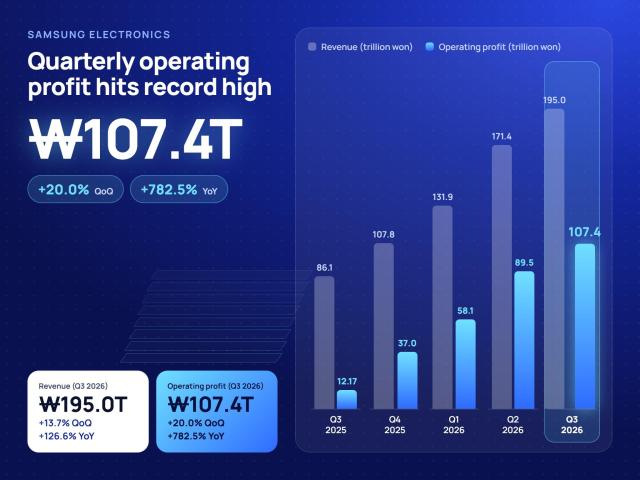
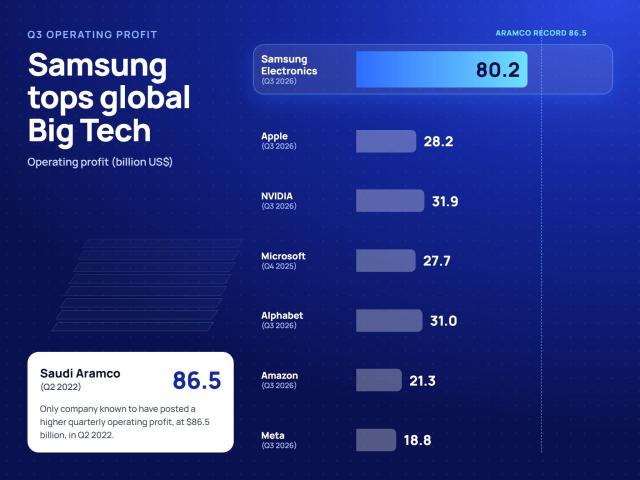
Samsung Electronics on Oct. 9 posted in its earnings guidance its largest-yet three-month operating profit of 107.4 trillion won ($80.2 billion) for quarter ended September, up 782.5 percent from a year earlier, driven by soaring memory chip prices and AI-related demand. Revenue rose 126.6 percent to 195 trillion won.
The result marked Samsung's fourth consecutive quarter of record earnings, surpassing the quarterly operating profits of major global tech companies, including Apple and Nvidia. Saudi Aramco recorded a higher quarterly operating profit of $86.5 billion in the second quarter of 2022.

Candice Kim
Candice Kim is a dedicated business and technology reporter specializing in the intersection of high-tech innovation and fast-paced consumer trends. Her core beats span the semiconductor, IT, cosmetics, and retail sectors, where she provides in-depth coverage of industry titans including Samsung Electronics, SK hynix, and LG Electronics, alongside leading consumer brands like Olive Young and Musinsa. Whether analyzing complex silicon supply chains or tracking the latest shifts in beauty and fashion retail, Candice is committed to delivering sharp, accurate reporting that keeps readers informed on the forces shaping today's most dynamic markets.
Copyright ⓒ Aju Press All rights reserved.
Related News
-
 KOSPI Falls Despite Samsung Electronics' Strong Earnings Report
Samsung Electronics reported earnings that exceeded market expectations, but its stock fell after an initial rise. Following a decline in all three major U.S. stock indices overnight, most of the KOSPI's top market capitalization stocks also showed weakness.As of 9:23 a.m. on October 8, the KOSPI was down 22.90 points (0.44%) at 6,774.26 compared to the previous trading day.In the securities market, foreign and institutional investors sold a net 545 billion won and 234.8 billion won, respectively, while individual investors bought a net 756.9 billion won.Before the market opened, Samsung Electronics announced its preliminary earnings for the third quarter of 2026, reporting sales of 195 trillion won, a 126.6% increase from the same period last year. Operating profit reached 107.4 trillion won, up 782.5% year-on-year.These figures surpassed the previous quarter's record earnings of 171.5 trillion won in sales and 89.5 trillion won in operating profit. Compared to the previous quarter, sales and operating profit increased by 13.7% and 20%, respectively. The operating profit slightly exceeded the consensus estimate of 106 trillion won compiled by financial information provider FnGuide. However, Samsung's stock, which initially rose by over 1% before the opening, was down 0.37%.Most of the top market capitalization stocks were also weak, with SK Square down 1.4%, Samsung Electro-Mechanics down 0.4%, and Hyundai Motor down 2.98%. In contrast, LG Energy Solution rose 5.12%, and SK Hynix increased by 1.2%.At the same time, the KOSDAQ index recorded a drop of 9.56 points (1.06%) to 888.58 compared to the previous trading day.In the KOSDAQ market, individual investors bought a net 170.9 billion won, while foreign and institutional investors sold a net 149.9 billion won and 23.4 billion won, respectively.Among the top market capitalization stocks, EcoPro rose 0.98%, EcoPro BM increased by 2.65%, and JUSUNG Engineering was up 1.01%, while Alteogen fell 6.03% and Rainbow Robotics dropped 2.01%.Overnight, U.S. stock markets closed lower. The Dow Jones Industrial Average finished down 341.41 points (0.66%) at 51,179.87.The S&P 500 index fell 17.16 points (0.22%) to close at 7,801.77, while the Nasdaq Composite dropped 61.20 points (0.22%) to finish at 27,538.69.Long-term U.S. Treasury yields surged to their highest levels in over 20 years, putting pressure on the stock market. The yield on the 10-year Treasury note exceeded 5.36%, marking the highest level since 2002. The 30-year Treasury yield also rose to around 5.73%, the highest in 24 years.Han Ji-young, a researcher at Kiwoom Securities, stated, "Today, despite the easing of the surge in U.S. 10-year Treasury yields and a reduction in the decline of U.S. stocks, the market is expected to show volatility as it digests the preliminary earnings announcement from Samsung Electronics, along with supply and demand issues related to the holiday and options expiration dates."He added, "The focus should be on the changes in stock prices and foreign investor demand immediately after Samsung's preliminary earnings announcement, as well as the changes in profit estimates for 2027, rather than whether the results exceeded consensus expectations."Han emphasized that since this announcement is preliminary, the lack of detailed figures may lead to temporary discrepancies in market interpretations regarding exchange rate impacts and performance by business segment. He also noted that short-term supply and demand issues could arise due to the market closure on Friday and ETF rebalancing on October 8 and 12, as well as options expiration on October 8.* This article has been translated by AI.
-
 Samsung Elec shatters earnings record, OP at $80 billion
Samsung Electronics Seocho headquarters/ AJP Yoo Na-hyun SEOUL, October 08 (AJP) - An unprecedentedly long crop year for memory makers under the AI windfall has fueled the red-hot earnings streak to new heights, pushing Samsung Electronics’ three-month operating profit above the 100 trillion won ($80.2 billion) milestone in the quarter ended September, according to the chipmaker’s earnings guidance Thursday. The world’s largest memory chipmaker estimated operating profit at 107.4 trillion won, up 20.01 percent on quarter and nearly nine times the 12.17 trillion won recorded a year earlier. Preliminary revenue came to 195 trillion won, up 13.70 percent on quarter and 126.59 percent on year. The result extended Samsung's record earnings streak to four consecutive quarters. Shares opened nearly flat on a tug of war between institutional selling and retail buying. At 9:20 a.m. in Seoul, the stock was at 268,000 won (down 0.19 percent.) The figure slightly beat market expectations, although revenue fell short. Financial data provider FnGuide’s latest consensus had put third-quarter revenue at 200.64 trillion won and operating profit at 106.64 trillion won. An LSEG SmartEstimate based on 21 analysts stood at 106.1 trillion won for operating profit. Samsung, whose operations span from chips and display components to smartphones and home appliances, will provide a full business breakdown when it releases finalized results later this month. Samsung’s semiconductor business, known as the Device Solutions, or DS, division, is broadly expected to have led the surge, benefiting from higher DRAM and NAND prices as strong AI infrastructure investment continued to strain global memory supply. The DS division accounted for nearly all - or 99.7 percent - of Samsung's total operating profit in the second quarter, underscoring how heavily the company's earnings have swung back toward semiconductors. AI data centers have boosted demand beyond high-bandwidth memory, or HBM, to conventional server DRAM and enterprise solid-state drives. At the same time, memory makers have shifted more production capacity toward advanced AI products, further tightening supplies of conventional chips. Samsung’s expanding HBM business is also expected to have played a greater role. The company said during its second-quarter earnings call that HBM4 revenue was expected to more than triple sequentially in the third quarter as volume shipments expanded. The gains came despite headwinds from a stronger Korean won and rising component costs in Samsung’s consumer businesses. The won strengthened sharply during the quarter, reducing the value of overseas earnings, while soaring memory prices that benefited its semiconductor division also raised costs for its smartphone and home appliance businesses. Those pressures prompted analysts to lower their forecasts ahead of the results. Citi cut its third-quarter operating profit estimate to 104.1 trillion won from 115.5 trillion won, citing an estimated 5 trillion won impact from currency movements and another 5 trillion won from additional employee incentive provisions. Kiwoom Securities projected operating profit of 107 trillion won, down from an earlier 122 trillion won estimate. Still, memory remained overwhelmingly the biggest earnings driver. Conventional DRAM prices were expected to rise 10 percent to 15 percent quarter-on-quarter in the third quarter, supported by persistent supply constraints, although the pace slowed sharply from the previous quarter.
-
 Korean stocks slip despite spectacular Samsung Q3
Graphics by AJP Song Ji-yoon SEOUL, October 08 (AJP) -South Korean stocks edged lower Thursday morning as foreign and institutional selling continued to retreat despite stellar third-quarter earnings guidance from Samsung Electronics and LG Energy Solution. The benchmark KOSPI fell 0.2 percent to 6,793.26 as of 10:30 a.m. (0130 GMT) after trading between 6,731.75 and 6,810.83. Foreign investors sold 635.7 billion won ($475.2 million) worth of shares, while institutions unloaded 300.7 billion won. Retail investors bought 704.6 billion won, helping limit the decline. Samsung Electronics slipped 0.2 percent to 268,000 won despite reporting its highest quarterly operating profit on record on still-robust demand for memory chips powering artificial intelligence. The company estimated third-quarter operating profit at 107.4 trillion won, up 782.5 percent from a year earlier. Revenue jumped 126.6 percent to 195 trillion won, according to its preliminary earnings guidance released Thursday. Samsung's shares nevertheless declined, suggesting that much of the earnings optimism had already been reflected in its recent gains. Rival SK hynix moved in the opposite direction, rising 1.7 percent to 1,752,000 won. Battery makers outperformed the broader market after LG Energy Solution reported stronger-than-expected third-quarter earnings. LG Energy Solution climbed 5.5 percent to 412,500 won after estimating operating profit at 756 billion won, up 25.7 percent from a year earlier. Revenue rose 59 percent to about 9.6 trillion won, marking a quarterly record. The earnings improvement was supported by growing demand for energy storage systems (ESS), particularly in North America, as the company sought to offset slower growth in the electric vehicle market. The operating profit included 416.9 billion won in U.S. manufacturing tax credits. Excluding those incentives, the company posted an operating profit of 339.1 billion won. The results also benefited from compensation related to an automaker's unmet purchase commitments. Samsung SDI gained 5 percent to 589,000 won, extending the rally across battery-related stocks. Elsewhere on the KOSPI, Hyundai Motor fell 2.9 percent to 326,250 won, while Doosan Enerbility declined 4.5 percent to 76,900 won. LG Electronics slipped 3.13 percent to 201,500 won after reporting preliminary third-quarter operating profit of 781.8 billion won on revenue of 23.83 trillion won. Both figures increased from a year earlier but fell short of market expectations. Naver lost 2.2 percent to 184,700 won. Attention also turned to Hanmi Pharmaceutical after its obesity treatment Eppe received regulatory approval Wednesday, becoming the first domestically developed GLP-1 obesity drug approved in South Korea. The once-weekly injection, known chemically as efpeglenatide, will compete with Novo Nordisk's Wegovy and Eli Lilly's Mounjaro. Hanmi said the drug achieved an average weight reduction of 9.75 percent over 40 weeks in a phase 3 clinical trial involving 448 Korean patients. The company plans to launch the treatment as early as this month. Electric products led sector gains, rising 4.5 percent, while battery production and sodium-ion battery themes advanced 4.5 percent and 4.7 percent, respectively. The tech-heavy KOSDAQ edged down 0.1 percent to 897.62, after trading between 883.85 and 903.12. Foreign investors sold 56.1 billion won as institutions unloaded 17.5 billion won, while retail investors bought 74.6 billion won. Biotechnology shares were among the biggest decliners on the KOSDAQ. Peptron plunged 29.9 percent to 91,700 won, while Alteogen fell 6.4 percent to 240,500 won. Samchundang Pharm dropped 3.7 percent to 232,000 won, while HLB slipped 0.8 percent to 45,500 won. By contrast, Jusung Engineering jumped 10.4 percent to 273,250 won, while EcoPro gained 1.9 percent to 93,600 won. Elsewhere on the index, Taihan Fiberoptics fell 4.1 percent to 17,210 won and OE Solutions dropped 4.8 percent to 4,960 won. LED equipment stocks led thematic gains, rising 5.7 percent, while display equipment and components advanced 2.5 percent. Throughout Asia, Japan's Nikkei 225 fell 0.7 percent to 69,563.75, while Hong Kong's Hang Seng Index slipped 0.2 percent to 24,079.81. China's Shanghai Composite bucked the regional decline, rising 0.3 percent to 3,851.67. The Korean won strengthened 0.3 percent to 1,337.7 won per dollar. Oil prices rose amid renewed concerns over Middle Eastern supply disruptions. West Texas Intermediate crude gained 1.4 percent to $89.50 a barrel, while Brent crude advanced 1.6 percent to $101.80.