
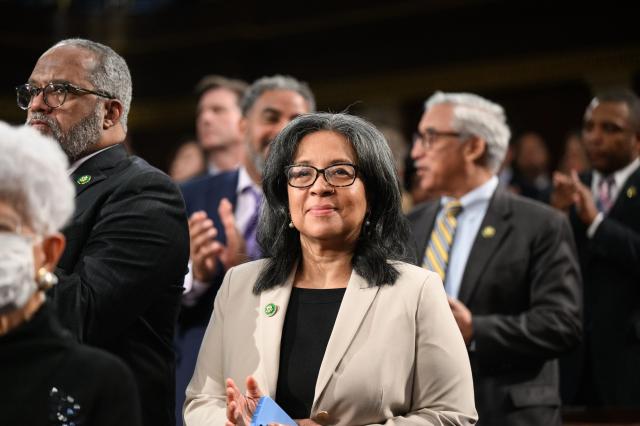
SEOUL, November 16 (AJP) - Revisiting President Donald Trump's signature tariff policy will be a top priority when Democrats take control of the House and Senate in January, said a veteran Democratic lawmaker recently elected to a fourth term representing Washington state.
"One of the things we can do, because the Democrats will now control the House and the Senate, is to look at our tariff policy to ensure that it's fair and that we are not doing anything that will harm our allies," Rep. Marilyn Strickland said in a recent video interview with AJP.
"I am very excited to share with you that Hakeem Jeffries, the incoming Speaker of the House, has said that dealing with tariffs will be one of the first things that we do in the next Congress," said the lawmaker, who is one of the first Korean American women elected to Congress.
Strickland was born in Seoul in 1962 to a Korean mother and an African American father who served in the U.S. Army.
Poorly designed tariffs raise costs for American consumers and businesses, she argued, placing the treatment of trading partners at the heart of the affordability debate that helped shape the midterm elections.
For South Korea, that debate bears directly on a trading relationship built on lowering barriers.
The South Korea-U.S. free trade agreement, which took effect in March 2012, reduced or eliminated tariffs across much of bilateral trade. Trade in goods and services between the two countries totaled $241.6 billion in 2025, according to the Congressional Research Service.
The November 2025 bilateral trade and investment deal established a 15 percent tariff framework for many Korean goods and lowered automobile tariffs from 25 percent to 15 percent in exchange for Korean investment commitments totaling $350 billion.
The agreement followed Trump's April 2025 "Liberation Day tariff" announcement in the opening months of his second presidency, part of the most sweeping tariff increases since the Smoot-Hawley Tariff Act of 1930.
Strickland's ties to South Korea are personal as well as political.
"I tell folks that I am a proud Korean American, African American woman. I was born in Seoul and was raised by a Korean woman. I will always be a daughter of Korea."
When she took her first congressional oath on Jan. 3, 2021, Strickland wore a hanbok, becoming the first member to wear the traditional Korean attire at a congressional swearing-in, according to her office.
She wanted her mother, watching on television during the pandemic, to be able to distinguish her among hundreds of lawmakers.
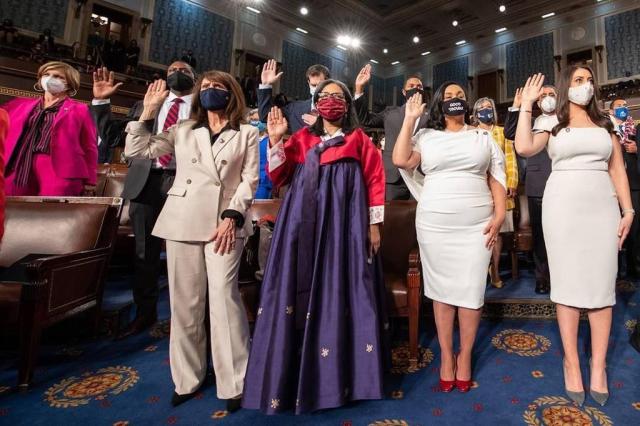
The choice also carried a broader message. Against a backdrop of anti-Asian hostility and rhetoric she described as racist, Strickland wanted to affirm that her Korean and Black heritage had a place in American public life.
"It was important to demonstrate that, as a woman who is Korean and Black, I am proud of my heritage and that I am as American as anyone else is," she said.
"I wanted to send a message about what being American means, and my life experience is part of the American experience."
That connection informs a policy agenda spanning trade, industrial cooperation and the South Korea-U.S. alliance. Shipbuilding offers a point of agreement with the Trump administration.
"Korea is so dominant when it comes to shipbuilding. I had the opportunity to visit Hyundai Heavy Industries and Samsung when I was in Korea recently," she said.
She was impressed by the scale of Korean shipyards, their workforce and the speed and quality of construction. The challenge for the United States, she said, is to draw on that expertise while training American workers and attracting investment in domestic shipbuilding.
The November 2025 agreement earmarked $150 billion of South Korea's $350 billion investment commitment for shipbuilding cooperation under the MASGA initiative, short for Make American Shipbuilding Great Again.
The accompanying joint fact sheet called for cooperation on workforce development, shipyard modernization, maintenance and repair, and supply chains.
In Washington state, the industry encompasses ferry construction and commercial vessel repair around Seattle and Tacoma, alongside naval maintenance at the Puget Sound Naval Shipyard in Bremerton.
On the East Coast, Hanwha Systems and Hanwha Ocean completed their $100 million acquisition of Philly Shipyard in December 2024, giving the Korean group a U.S. production base.
Strickland pointed to partnerships in the Philadelphia area as examples of cooperation that should bring together Korean investment and expertise with American manufacturing and jobs.
She also linked shipbuilding capacity to security in the Indo-Pacific, noting that her district includes Joint Base Lewis-McChord, a major military installation supporting operations in the region.
Her recent visit to South Korea included an Oct. 14 meeting with Foreign Minister Cho Hyun, who sought her support for implementing commitments made by the two countries' leaders. Strickland reaffirmed bipartisan congressional support for the alliance.

"I want to reiterate that the alliance between the Republic of Korea and the United States remains strong. You are one of our best allies, and we know that it is important for us to continue to work together on deterrence against North Korea, but also in the Indo-Pacific. We want to keep it free and open," she said.
Asked about the transition of wartime operational control, she left detailed military judgments to commanders while emphasizing readiness and shared responsibility.
The 2025 joint fact sheet reaffirmed cooperation toward that transition and South Korea's commitment to develop the capabilities needed to lead the allies' combined conventional defense against North Korea.
"In order for the operations to work, both parties have to step up and pull their weight and do their part and be prepared. I am confident that can happen," she said.
Strickland brings those priorities to a Congress whose balance of power has shifted decisively toward Democrats.
The former Tacoma mayor defeated Republican Chris Chung in Washington's 10th Congressional District to secure a fourth term. Democrats won majorities in both the House and Senate in the Nov. 3 elections, setting up divided government for the final two years of Trump's presidency.
She serves on the House Armed Services Committee and the Transportation and Infrastructure Committee, with assignments covering military personnel, readiness, the Coast Guard and maritime transportation. Her office announced Nov. 10 that she had been elected vice chair for communications of the New Democrat Coalition for the next Congress.
Jeffries announced his candidacy for speaker after the election and outlined a first-100-days agenda that includes reversing Trump's tariffs and Medicaid cuts. His election as speaker would require a formal House vote when the new Congress convenes in January.
Congressional control, however, would not automatically translate into tariff relief or allow Democrats to enact their agenda without negotiation. Legislation generally requires approval from both chambers and the president's signature, unless Congress overrides a veto. Most contested legislation in the Senate faces a 60-vote threshold to end debate, although final passage generally requires a simple majority.
For Strickland, the central domestic test is whether Democrats can convert their electoral gains into tangible relief from the cost of daily life.
"The affordability crisis is the most important issue for the American people right now across the country in every district," she said.
She singled out healthcare alongside gasoline, groceries and childcare, accusing the administration and congressional Republicans of eroding families' economic security.
"The administration and the Republican majority have kicked millions of people off of healthcare," she said.
"Healthcare and the affordability crisis are top priorities for the American people."
In her assessment, Republican losses reflected the electoral consequences of policies that disproportionately hurt the party's own constituents.
"I am hopeful that my Republican colleagues learned their lesson. They got wiped out in the elections in the House, and a lot of that is simply because the votes that they took to take healthcare and food away and to drive up the cost of living affect their districts more than they affect Democratic districts," she said.
"So hopefully people have learned from experience. They saw what happened in '26; they want to avoid it in '28. I am hopeful that they will come out from under the knee of Donald Trump and put the people they represent first. That's how we have bipartisan support."
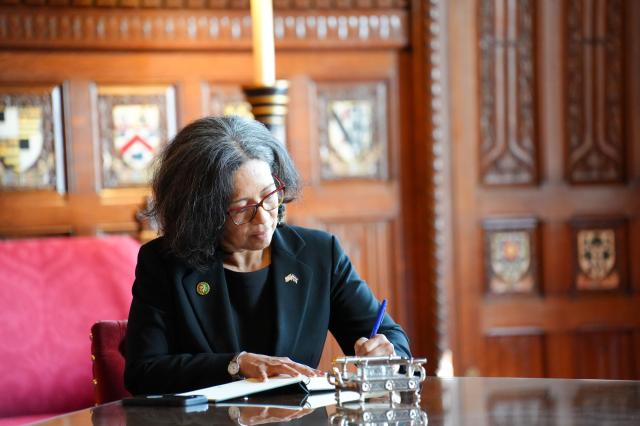
Defense remains one avenue for cooperation, she said.
"There's what I call a governing center that understands the importance of defense that will get it over the finish line," she said.
"Anytime we work on a defense bill out of our House Armed Services Committee, it typically comes out of the committee in a bipartisan way. When it comes out of the House Armed Services Committee, the Senate will do some things with it as well."
She distinguished between agreement on military priorities and the inclusion of unrelated political provisions. In July, she voted against the House version of the fiscal 2027 National Defense Authorization Act, saying restrictions on voting had been attached to a measure containing worthwhile bipartisan defense policies.
She made clear that securing a defense bill could not come at the expense of voting rights.
The incoming majority faces a further balancing act in investigating the Trump administration. Strickland supported accountability but cautioned against allowing investigations to overshadow the commitments on which Democrats had campaigned.
"We have to be strategic about where we go after this administration," she said.
"We cannot let coming after the Trump administration turn this into a circus that takes away from the fact that we promised to improve the quality of life for the American people," she said.
Lee Jung-woo
I studied philosophy in college, and sociology and journalism in graduate school. I cover North Korea, South Korean politics, foreign affairs and films. I enjoy Nordic cinema, Indian cuisine and Japanese detective novels. I have a cat and like bright, acidic coffee.
Copyright ⓒ Aju Press All rights reserved.
Related News
-
 China Begins Preparations for 21st Communist Party Congress Amid Xi Jinping's Expected Fourth Term
China has commenced preparations for the 21st National Congress of the Communist Party, where Xi Jinping is expected to secure a fourth term. The number of delegates attending the congress has been set at 2,360, and the election process has begun.According to a report by the state-run Xinhua News Agency on November 7, the Central Committee of the Communist Party recently issued a notice regarding the delegate election process, confirming the total number of delegates.The Central Committee emphasized that the 21st Congress is a significant political event for the party and the nation, occurring at a crucial time for the realization of socialist modernization and the pursuit of the second centenary goal.The election process will involve a strengthened review of political qualifications. The aim is to select individuals who faithfully adhere to the party constitution and exemplify the values of party membership.Candidates will be evaluated based on their political stance, awareness, judgment, and execution capabilities. The principle of 'single vote disqualification' will be applied, meaning politically unqualified candidates will be eliminated regardless of other evaluation results.The delegate elections began today and are expected to conclude by the end of June next year. The 21st Congress, scheduled for next year, is anticipated to confirm Xi's fourth term.* This article has been translated by AI.
-
NBC Predicts Democratic Wins in Both Houses of Congress
As the counting of votes in the U.S. midterm elections progresses, NBC has predicted victories for the Democratic Party in both the House and Senate.On November 3, NBC stated, "The Democrats will take both the House and Senate in the midterm elections, allowing them to control Congress starting in January." This suggests that the Democratic Party is expected to emerge as the majority party in Congress when the new term begins next January.As of 2:08 PM KST on November 4, in the Senate elections, Democrats have secured 52 of the 100 seats (with a majority at 51), while Republicans hold 40 seats. Notably, Democrats are solidifying their lead by winning key battleground states, including Texas and North Carolina.In the House elections, Democrats have claimed 189 of the 435 seats (with a majority at 218), while Republicans have secured 110 seats.Therefore, if the current trends continue, Democrats are expected to win in both chambers of Congress.NBC noted, "The Democrats are likely to use their newly acquired power to initiate investigations into President Donald Trump, his family, and his administration, while also seeking to check the president through legislation." The network added, "However, President Trump still has the power to veto legislation, and he has indicated that he would exercise this power if the election results favor the Democrats."* This article has been translated by AI.
-
Chinese Communist Party's 5th Plenary Session Begins Today, Prepares for Next Party Congress
The 5th Plenary Session of the 20th Central Committee of the Chinese Communist Party opened on October 26 in Beijing. The four-day meeting will focus on establishing party discipline and strengthening anti-corruption measures. It is expected to serve as a platform for Xi Jinping's leadership to reorganize the party's structure and management system ahead of the 21st Party Congress in 2027.According to China's state-run Xinhua News Agency, the main agenda of this meeting is to study major issues for the continuous promotion of comprehensive and strict party governance. During the session, the Central Committee will hear reports from the Politburo of the Chinese Communist Party and review related decision documents. The leadership decided to submit these documents for review at the 5th Plenary Session during a Politburo meeting in September.Comprehensive and strict party governance has been a key governance principle emphasized by President Xi Jinping since he took office. This approach encompasses not only the eradication of corruption but also the supervision of officials' exercise of power, the strengthening of political discipline, and accountability in policy implementation. The meeting is expected to discuss ways to institutionalize this principle and enhance the party's centralized leadership.The timing of this meeting, held about a year before the 21st National Congress scheduled for next fall, is noteworthy. The National Congress, held every five years, determines the party's future policy direction and major leadership structure. Therefore, the 5th Plenary Session carries political significance in reaffirming party discipline and management principles in preparation for the upcoming congress.Next year, Xi's fourth term is expected to be confirmed at the congress. Consequently, there is keen interest in whether discussions regarding the future leadership structure will take place during this session. However, it remains uncertain whether specific outlines of the next leadership will emerge from this meeting. Reuters has analyzed that this session could serve to strengthen party discipline and solidify Xi's authority ahead of the 2027 leadership reshuffle.Issues concerning high-ranking officials are also a point of observation. The Central Committee is composed of full and alternate members elected at the 20th Party Congress in 2022. The Asia Society Policy Institute estimates that 291 members will attend this meeting, accounting for approximately 77% of the total 376 members.Meanwhile, President Xi stated during a speech at the 90th anniversary of the Long March on October 22, "To navigate the new Long March well, we must uphold the party's leadership and strengthen party building," emphasizing the need to continuously promote comprehensive and strict party governance.* This article has been translated by AI.