
ADEL licensed its Alzheimer's drug candidate ADEL-Y01, jointly developed with Oscotec, to French pharmaceutical giant Sanofi in a deal worth up to $1.04 billion last December, including an upfront payment of $80 million. The company plans to use its IPO proceeds to fund clinical trials, develop drug delivery technology and expand its drug pipeline.
Tags: South Korea, ADEL, KOSDAQ, IPO, Biotechnology, Alzheimer's Disease, Sanofi, Oscotec, Pharmaceuticals, Drug Development, Clinical Trials, Healthcare, Technology Licensing, Stock Market

Kim Hee-su
Kim Hee-su is a bilingual reporter at AJU Press, covering defense and foreign affairs. Before joining AJP in 2025, she worked at The Korea Times, where she wrote interview stories, including a profile of North Korean defector Kim Gum-hyok, and produced digital content. She also previously worked as a researcher for KBS News 9’s International News Department, supporting correspondents in 10 countries around the world. She graduated from the University of Toronto in Canada with a double major in Book and Media Studies and East Asian Studies.
Copyright ⓒ Aju Press All rights reserved.
Related News
-
 Aribio Lab Shares Surge After Alzheimer’s Drug Delays Symptoms by 31%
Aribio's oral Alzheimer’s treatment candidate has reportedly delayed the clinical deterioration rate by 31% in a patient group that did not take existing symptom-relief medications, leading to a surge in the stock price of related listed company Aribio Lab, which reached its price limit.According to the Korea Exchange on November 18, as of 1:36 PM, Aribio Lab's shares were trading at 5,290 won (KRW), up 1,220 won (29.98%) from the previous trading day. The stock opened at 4,785 won (KRW) and expanded its gains throughout the day to hit the upper limit.The rise in stock price was driven by the announcement related to the global Phase 3 clinical trial of the oral Alzheimer’s treatment candidate. Aribio confirmed the results the previous day, stating that the candidate delayed clinical deterioration by 31% in a patient group that did not take existing symptom-relief medications. Aribio, the drug developer, is a non-listed company traded on K-OTC and is a separate entity from Aribio Lab.The clinical trial was designed to analyze 604 participants who did not take existing symptom-relief medications such as acetylcholinesterase inhibitors or memantine, comparing the 'monotherapy group' with all clinical participants. This design followed consultations with major regulatory agencies such as the U.S. Food and Drug Administration (FDA) and the European Medicines Agency (EMA).Jae-jun Jeong, CEO of Aribio, stated, "The 31% delay in clinical deterioration confirmed at the one-year mark in the monotherapy group supports our hypothesis," adding, "We aim to quickly enter the FDA approval application process based on these global clinical trial results." Aribio plans to apply for FDA approval next year and aims for commercialization in 2028.* This article has been translated by AI.
-
Aribio's Oral Alzheimer's Drug AR1001 Set for Key Phase 3 Results
Aribio is set to unveil the global Phase 3 results of its oral Alzheimer's treatment this month. The once-daily pill could mark a significant step toward commercialization, especially as it is tied to a potential technology export deal worth up to 7 trillion won. Industry attention is focused on the outcome.According to industry sources, Aribio will present the topline results of its oral Alzheimer's drug candidate, AR1001, at the Clinical Trials on Alzheimer's Disease (CTAD 2026) conference in Boston on November 16. This presentation has been selected as the first key oral presentation on the opening day of the conference.Currently, approved early Alzheimer's treatments in the U.S., such as Eisai's Leqembi and Eli Lilly's Donanemab, require regular injections and management of side effects. In contrast, AR1001 is administered as a 30mg daily dose for early-stage Alzheimer's patients, offering a distinct advantage.The Phase 3 trial involved 1,535 early Alzheimer's patients across 13 countries, with 1,348 completing the 52-week treatment. The primary evaluation metric is the Clinical Dementia Rating Scale Sum of Boxes (CDR-SB), which assesses cognitive function and daily living abilities.The critical question is whether AR1001 can effectively slow cognitive decline and deterioration in daily living skills compared to a placebo. In the Phase 2 trial, it failed to meet primary endpoints after 26 weeks, prompting a longer 52-week treatment period and revised evaluation design for this trial.The results of this trial are expected to influence the direction of a major technology export deal. In May, Aribio signed an option and licensing agreement with China's Fusheng Pharmaceutical for the global development, approval, manufacturing, and commercialization rights to AR1001, potentially worth up to $4.7 billion (approximately 7 trillion won).Aribio received $60 million (about 90 billion won) as an upfront payment in July. If Fusheng exercises its option following the Phase 3 topline results, Aribio will receive an additional $80 million (approximately 120 billion won). Subsequent payments will follow based on regulatory approvals and sales milestones.Fusheng's decision to exercise its option hinges on the Phase 3 results. If AR1001 fails to demonstrate efficacy on the primary endpoints, it could jeopardize the execution of the large licensing agreement and impact Aribio's funding and corporate valuation. The company has previously raised research and development funds through convertible bond issuance during its clinical trials.Industry experts believe that if AR1001 succeeds in commercialization, it could quickly penetrate the early Alzheimer's treatment market as a differentiated oral medication compared to existing injectable therapies. The company aims to achieve sales of 1 trillion won by 2030 through the commercialization of AR1001 and expansion of indications. However, given the high rate of clinical trial failures in Alzheimer's drug development, the upcoming CDR-SB results and safety data will be crucial in determining the drug's commercialization potential.If efficacy and safety are confirmed in the Phase 3 trial, Aribio plans to initiate discussions with the U.S. Food and Drug Administration (FDA) for a New Drug Application (NDA).* This article has been translated by AI.
-
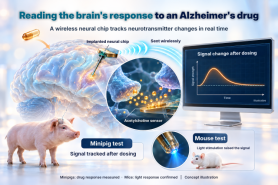 Wireless brain chip tracks Alzheimer's drug in real time
Courtesy of KAIST SEOUL, October 27 (AJP) - A wireless chip implanted in the brain has tracked, second by second, how a widely used Alzheimer's drug changes the level of a brain chemical tied to memory. It gives researchers a direct view of a brain drug at work instead of an inference drawn from behavior. KAIST said Tuesday that a team led by Jang Kyung-in, a professor in its Department of Mechanical Engineering, developed the chip with researchers from the Daegu Gyeongbuk Institute of Science and Technology, the Korea Brain Research Institute and the Korea Research Institute of Bioscience and Biotechnology. Implanted in a minipig, the chip tracked acetylcholine as it rose after a dose of the drug donepezil and then slowly returned to its normal level. Brain drugs are mostly judged indirectly, through memory and behavior tests or imaging scans. The main direct method, which draws fluid from the brain for analysis, takes several minutes or more per sample, too slow to follow chemical signals that shift within seconds. Acetylcholine carries messages between nerve cells and plays a central role in memory and learning. Its level falls in Alzheimer's disease, and donepezil works by blocking an enzyme that breaks it down. The team placed the chip in the minipig's prefrontal cortex, the region behind the forehead that handles judgment and attention. Minipigs have brains closer in size and structure to human brains than rodents do, and readings traveled by Bluetooth, so the animal was not tethered by wires. Acetylcholine produces no electrical signal of its own, so the chip uses two enzymes to convert it into hydrogen peroxide, which an electrode turns into a measurable current. A sensing layer of porous chitosan, a material from crab and shrimp shells, woven with platinum-coated silver nanowires, speeds up that reaction. To filter out other brain chemicals that give off similar signals, the probe carries one electrode coated with the enzymes and one left bare. Subtracting one reading from the other isolates acetylcholine. The probe also holds a tiny light-emitting diode that can switch on nerve cells engineered to respond to light. In a separate experiment on mice, turning on the light raised the acetylcholine signal, showing the same probe can both stimulate brain cells and read their chemical response. Jang said the work points toward brain interfaces that read the brain's state and adjust stimulation in response, adding chemical signals to the electrical ones such devices read today. "This study has laid the foundation for moving toward technology that reads changes in the brain and adjusts stimulation according to that response," he said. The study did not show that the chip treats Alzheimer's disease or improves memory, and the drug tracking and light stimulation were tested in different animals. Before any use in people, researchers must confirm that the chip is safe to leave in the brain long term and that its readings stay reliable, KAIST said. Enside, a startup Jang founded and leads as chief executive, will pursue commercialization. Son Ji-eun, Oh Se-hyeok and Ha Jeong-dae of the Daegu Gyeongbuk Institute of Science and Technology (DGIST) were co-first authors, and Jang was the corresponding author. The study was published Oct. 14 in Device, an applied technology journal from Cell Press. Journal/Source: Device Title: Implantable Neural Chip with Electrochemical Sensing and Optogenetic Stimulation for Monitoring of Cholinergic Pharmacological Responses Link/DOI: 10.1016/j.device.2026.101329